
In the evolving landscape of manufacturing, powder metallurgy has emerged as a pivotal technique for producing bevel gears, especially in applications like power tools where high-volume production and cost-effectiveness are paramount. However, the inherent density limitations of powder metallurgy compared to wrought steel often result in compromised strength, posing challenges for demanding applications. As market competition intensifies, particularly in mid-to-low-end segments, enhancing the strength of powder metallurgy bevel gears while maintaining cost efficiency has become a critical pursuit. In this article, I will delve into the methodologies for manufacturing high-strength powder metallurgy bevel gears, focusing on material selection, structural design optimizations, and advanced processing techniques. Through a first-person perspective, I aim to provide a comprehensive guide that integrates theoretical insights with practical applications, leveraging formulas and tables to summarize key concepts. The goal is to empower engineers and manufacturers to produce bevel gears that meet rigorous performance standards, thereby expanding their utility in industries such as automotive, aerospace, and consumer electronics. Throughout this discussion, the term ‘bevel gears’ will be emphasized repeatedly to underscore its centrality, and I will incorporate visual aids and technical details to ensure clarity and depth.
The performance of powder metallurgy bevel gears is fundamentally influenced by the choice of raw materials. Iron-based powder systems often incorporate alloying elements to enhance mechanical properties, and the selection process requires a nuanced understanding of compositional effects. For instance, nickel (Ni) is commonly added to improve toughness and strength, with its impact quantifiable through empirical relationships. The strength increment ΔS due to nickel addition can be modeled as: $$ \Delta S = k_N \cdot [Ni] $$ where ( k_N ) is a material-specific constant and ( [Ni] ) denotes the weight percentage of nickel. Typically, increasing nickel content from 2% to 5% can boost tensile strength by 20-30%, but beyond this range, diminishing returns may occur due to microstructural inhomogeneities. Carbon content, on the other hand, plays a crucial role in hardness and wear resistance, yet excessive carbon can embrittle bevel gears under impact loads. For high-stress applications involving sudden torque or shock, a low-carbon formulation (e.g., 0.3-0.6% C) is preferred to balance ductility and surface durability. This is particularly vital for bevel gears operating in dynamic environments like electric drills or gearboxes, where fatigue failure must be mitigated.
To illustrate the interplay of alloying elements, consider the following table summarizing typical powder compositions for high-strength bevel gears:
| Element | Weight Percentage Range | Primary Effect on Bevel Gears | Recommended for High-Strength Applications |
|---|---|---|---|
| Iron (Fe) | Balance (90-95%) | Base matrix, provides structural integrity | Yes |
| Nickel (Ni) | 2-5% | Enhances toughness and hardenability | Yes, with controlled diffusion |
| Copper (Cu) | 1-3% | Improves strength and corrosion resistance | Optional, depending on cost constraints |
| Carbon (C) | 0.3-0.8% | Increases hardness; higher levels risk brittleness | Yes, but optimized for low impact scenarios |
| Molybdenum (Mo) | 0.5-1.5% | Refines grain structure, boosts fatigue strength | Yes, especially for high-cycle fatigue |
Beyond composition, the powder manufacturing process significantly affects homogeneity and, consequently, the performance of bevel gears. Simple blending of elemental powders can lead to segregation during handling and compaction, resulting in inconsistent properties across gear teeth. In contrast, pre-alloyed or diffusion-bonded powders ensure uniform distribution of alloying elements, which is critical for achieving high strength in bevel gears. The homogeneity index ( H ) can be expressed as: $$ H = 1 – \frac{\sigma_c}{\bar{c}} $$ where ( \sigma_c ) is the standard deviation of composition measurements and ( \bar{c} ) is the mean concentration. For high-strength bevel gears, H should exceed 0.95, necessitating advanced powder production techniques like water atomization or gas diffusion. This emphasis on material uniformity underscores the importance of selecting appropriate raw materials for powder metallurgy bevel gears, as even minor inconsistencies can precipitate premature failure in service.
Structural design is another cornerstone for enhancing the strength of powder metallurgy bevel gears. The unique geometry of bevel gears, with tapered teeth and significant height variations between the tooth tip and root, poses challenges during powder compaction. Since powder particles exhibit minimal lateral flow under pressure, density gradients often arise, leading to weaker regions at the tooth tips where stress concentrations are highest. To address this, I propose design modifications that minimize height differentials, thereby promoting uniform densification. For a standard straight bevel gear, the tooth profile can be optimized by adjusting the pressure angle and addendum modification coefficient. The density ratio ( \rho_r ) between tooth tip and root can be approximated as: $$ \rho_r = \frac{\rho_{tip}}{\rho_{root}} \approx 1 – \alpha \cdot \Delta h $$ where ( \alpha ) is a compaction-dependent constant and ( \Delta h ) is the height difference. By reducing ( \Delta h ) through design changes—such as employing a constant-depth tooth form or incorporating relief features—( \rho_r ) approaches unity, resulting in more consistent mechanical properties. This optimization is crucial for bevel gears subjected to high torque, as it ensures that the entire tooth contributes effectively to load-bearing capacity.
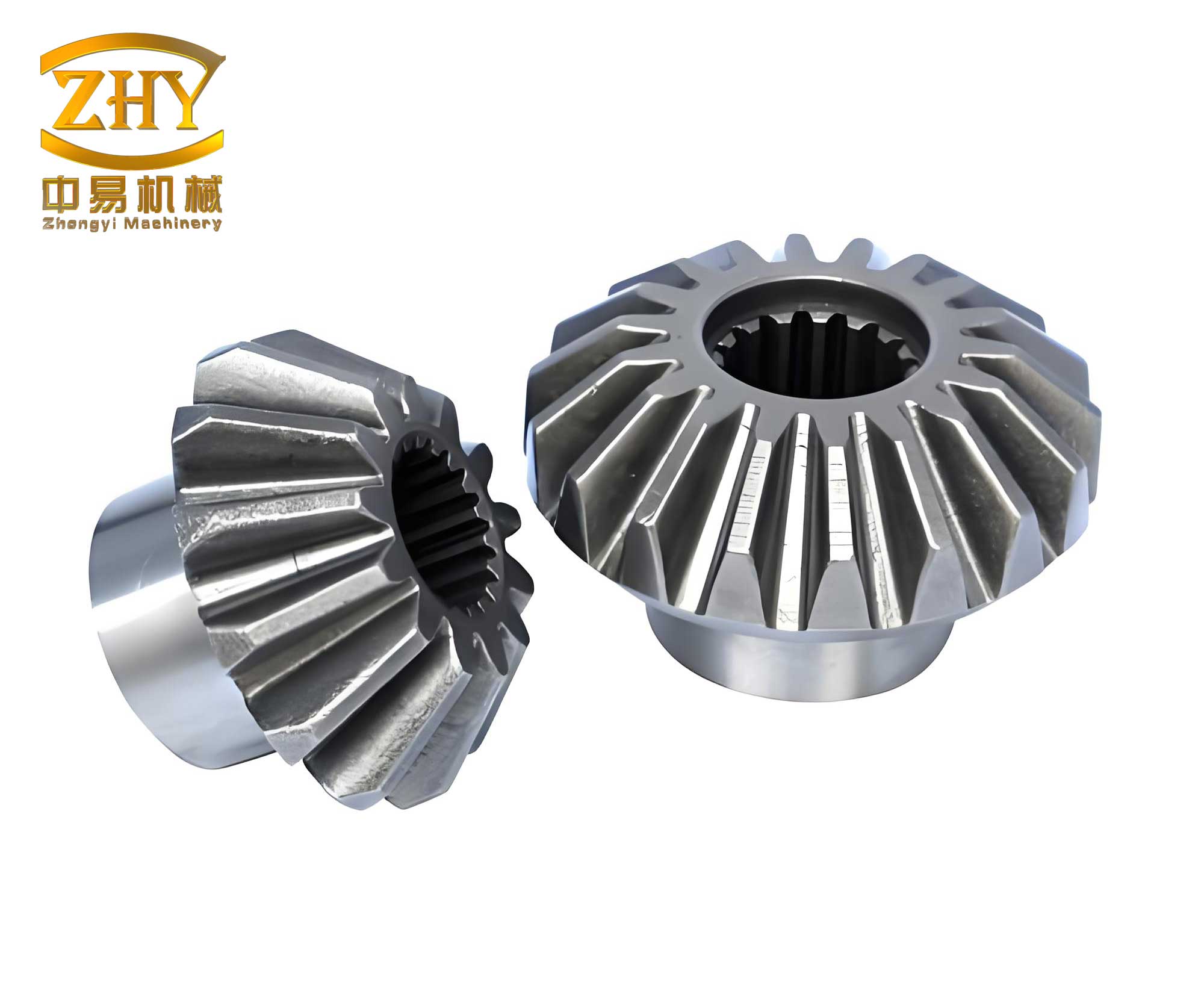
The image above illustrates typical bevel gear geometries, highlighting the importance of structural symmetry for density uniformity. In practice, finite element analysis (FEA) can be employed to simulate compaction and identify potential weak spots. For example, by modeling the stress distribution during pressing, engineers can iteratively refine the gear design to achieve a more homogeneous density field. This proactive approach not only enhances the strength of powder metallurgy bevel gears but also reduces post-processing defects like cracking or distortion. Furthermore, incorporating fillets at tooth roots and optimizing the gear backcone distance can mitigate stress risers, thereby improving fatigue life. These design principles are essential for manufacturing high-performance bevel gears that meet the rigorous demands of modern applications.
Processing techniques play a pivotal role in realizing the full potential of powder metallurgy bevel gears. Among these, warm compaction stands out as a method to achieve higher densities beyond conventional pressing. Warm compaction involves heating the powder mix to temperatures around 130-150°C before compaction, which reduces friction and enhances particle deformation, leading to improved green density. The density increase ( \Delta \rho ) from warm compaction can be quantified as: $$ \Delta \rho = \rho_w – \rho_c = \beta \cdot T $$ where ( \rho_w ) is the warm-compacted density, ( \rho_c ) is the conventional density, ( \beta ) is a material constant (typically 0.01-0.02 g/cm³ per °C), and T is the temperature in °C. For bevel gears, this translates to densities exceeding 7.2 g/cm³, significantly boosting strength and wear resistance. The following table compares key properties of bevel gears produced via different compaction methods:
| Compaction Method | Typical Density (g/cm³) | Tensile Strength (MPa) | Impact Energy (J) | Suitability for High-Strength Bevel Gears |
|---|---|---|---|---|
| Conventional Pressing | 6.8-7.1 | 400-500 | 10-15 | Moderate, for light-duty applications |
| Warm Compaction | 7.2-7.4 | 550-650 | 20-25 | High, ideal for demanding environments |
| Double Press/Double Sinter | 7.3-7.5 | 600-700 | 25-30 | Very high, but cost-intensive |
Sintering parameters further influence the microstructure and strength of bevel gears. Standard sintering at 1120°C for 30 minutes in a 90% N₂ + 10% H₂ atmosphere may suffice for general-purpose gears, but high-strength variants require optimized cycles. Increasing the sintering temperature or time enhances diffusion bonding, leading to better interparticle bonding and pore rounding. The sintering neck growth radius ( x ) can be described by the classical equation: $$ x^n = K \cdot t \cdot \exp\left(-\frac{Q}{RT}\right) $$ where ( n ) is a time exponent (often 2-5 for powder systems), ( K ) is a pre-exponential factor, ( t ) is time, ( Q ) is activation energy, ( R ) is the gas constant, and ( T ) is absolute temperature. For bevel gears, extending sintering to 1150°C for 45 minutes can improve tensile strength by 15-20%, albeit with a risk of increased distortion due to thermal gradients. Therefore, a balanced approach is necessary, perhaps incorporating stepped sintering profiles or controlled cooling rates to minimize dimensional changes while maximizing strength.
Heat treatment is the final step in augmenting the performance of powder metallurgy bevel gears. Case carburizing is particularly effective for imparting a hard, wear-resistant surface while retaining a tough, ductile core—a combination essential for gears facing cyclic impacts and frictional loads. The effective case depth ( d ) is often specified as a function of gear module ( m ), with: $$ d = \gamma \cdot m $$ where ( \gamma ) ranges from 0.25 to 0.4, depending on the required core properties. Surface hardness targets for bevel gears typically lie between 650 HV0.1 and 820 HV0.1, ensuring resistance to pitting and abrasion. To match the service life of mating gears, it is advisable to set the hardness of the larger bevel gear about 50 HV0.1 lower than that of the smaller pinion, compensating for differences in stress cycles and sliding velocities. Additionally, post-heat-treatment processes like shot peening can introduce compressive residual stresses, further enhancing fatigue strength. The overall improvement in gear durability can be estimated using the modified Goodman relation: $$ \sigma_a = \sigma_{fat} \left(1 – \frac{\sigma_m}{\sigma_{uts}}\right) $$ where ( \sigma_a ) is the allowable alternating stress, ( \sigma_{fat} ) is the fatigue limit, ( \sigma_m ) is the mean stress, and ( \sigma_{uts} ) is the ultimate tensile strength. By optimizing heat treatment parameters, manufacturers can produce bevel gears that withstand extreme operational conditions, thereby expanding their applicability in high-power tools and machinery.
Beyond these core techniques, secondary operations such as sizing, coining, or surface densification can be employed to refine the geometry and density of bevel gears. For instance, selective surface densification via rolling or machining can increase the density of tooth flanks to nearly 7.6 g/cm³, dramatically improving contact fatigue resistance. Moreover, advanced sintering methods like sinter-hardening—where the cooling rate from sintering temperatures is controlled to induce martensitic transformation—eliminate the need for separate heat treatment, reducing costs and distortion. The hardness after sinter-hardening ( H_{SH} ) can be correlated with cooling rate ( CR ) via: $$ H_{SH} = H_0 + \lambda \cdot \ln(CR) $$ where ( H_0 ) is the base hardness and ( \lambda ) is a material constant. These integrated approaches underscore the synergy between material science and processing innovation in producing high-strength powder metallurgy bevel gears.
In summary, the journey to manufacturing high-strength powder metallurgy bevel gears involves a holistic optimization of materials, design, and processes. From selecting pre-alloyed powders with tailored nickel and carbon contents to redesigning gear geometry for uniform compaction, each step contributes to enhanced performance. Warm compaction and optimized sintering push density boundaries, while case carburizing and surface treatments fortify the gears against wear and fatigue. As I reflect on these methodologies, it becomes clear that the future of powder metallurgy bevel gears lies in continuous improvement through research and collaboration. By embracing advanced simulation tools, real-time process monitoring, and sustainable practices, the industry can overcome current limitations and unlock new potentials. Ultimately, the insights shared here aim to serve as a practical guide for engineers seeking to elevate the strength and reliability of bevel gears, ensuring they meet the ever-growing demands of modern technology. Whether in electric vehicles, renewable energy systems, or precision instruments, high-strength powder metallurgy bevel gears will play a pivotal role in driving innovation forward.
To further illustrate the interplay of factors affecting bevel gear strength, consider the following comprehensive table that encapsulates key parameters and their optimal ranges:
| Aspect | Parameter | Optimal Range for High-Strength Bevel Gears | Impact on Strength (Quantitative Estimate) |
|---|---|---|---|
| Material | Nickel Content | 3-4% | +25% tensile strength |
| Carbon Content | 0.4-0.6% | Balances hardness and toughness | |
| Powder Type | Diffusion pre-alloyed | Homogeneity index >0.95 | |
| Design | Tooth Height Difference (Δh) | Minimized (< 10% of module) | Density uniformity >98% |
| Pressure Angle | 20-22° | Improves load distribution | |
| Processing | Warm Compaction Temperature | 140°C | Density increase to 7.3 g/cm³ |
| Sintering Temperature/Time | 1150°C for 40 min | +18% tensile strength | |
| Case Depth (γ factor) | 0.3 | Surface hardness 750 HV0.1 |
Additionally, the economic viability of these methods cannot be overlooked. While advanced techniques like warm compaction or sinter-hardening may entail higher initial costs, the resultant improvement in gear lifespan and reliability often justifies the investment through reduced warranty claims and downtime. For bevel gears used in mass-produced consumer tools, even a marginal strength enhancement can translate to significant competitive advantages. Therefore, manufacturers should adopt a total-cost-of-ownership perspective when selecting manufacturing routes for powder metallurgy bevel gears.
In closing, I reiterate that the pursuit of high-strength powder metallurgy bevel gears is a multidisciplinary endeavor, blending metallurgy, mechanical design, and process engineering. By systematically addressing each facet—from raw material homogeneity to post-sintering treatments—engineers can produce gears that rival their wrought steel counterparts in performance while retaining the cost benefits of powder metallurgy. As technology advances, emerging trends such as additive manufacturing or nano-structured powders may further revolutionize this field, offering new avenues for strength optimization. For now, the methods discussed herein provide a robust foundation for producing durable, high-performance bevel gears that meet the challenges of today’s industrial landscape. Through continued experimentation and knowledge sharing, the potential of powder metallurgy bevel gears will only continue to grow, powering innovations across countless applications.