
In the coal mining industry, transfer reducers play a critical role in the continuous operation of armored face conveyors and related machinery. As an engineer specializing in the research and management of mining equipment, I have observed that spiral bevel gears, often referred to simply as bevel gears, are among the most vulnerable components in these reducers. Positioned at the high-speed end of the gearbox, these bevel gears are subjected to extreme conditions, including heavy shock loads, high humidity, and significant dust contamination. Their failure rate surpasses that of other gear pairs within the same reducer, leading to frequent downtime and substantial replacement costs. Historically, the average service life of a bevel gear pair in such applications has been around 2.6 million tons of coal throughput, with each pair costing approximately $16,000. For large mining operations, this translates to annual expenses exceeding hundreds of thousands of dollars solely on bevel gear replacements. Therefore, understanding the root causes of bevel gear damage and implementing effective preventive measures are paramount for enhancing operational efficiency and reducing costs in coal mining.
The design of transfer reducers in mining necessitates a compact configuration where the motor axis is perpendicular to the chain wheel axis of the transfer machine head, aligning with the layout of mine roadways to minimize space occupancy. This design inherently requires the use of bevel gears to achieve a 90-degree power transmission angle. A typical reducer, such as the JOY 500EX model used in many mining operations, features a spiral bevel gear pair at the input stage, operating at speeds up to 1,450 rpm with a power rating of 400 kW. The bevel gears in these reducers are precision components that demand careful assembly and maintenance. However, the harsh mining environment often accelerates their wear and failure, making them a focal point for reliability improvements.
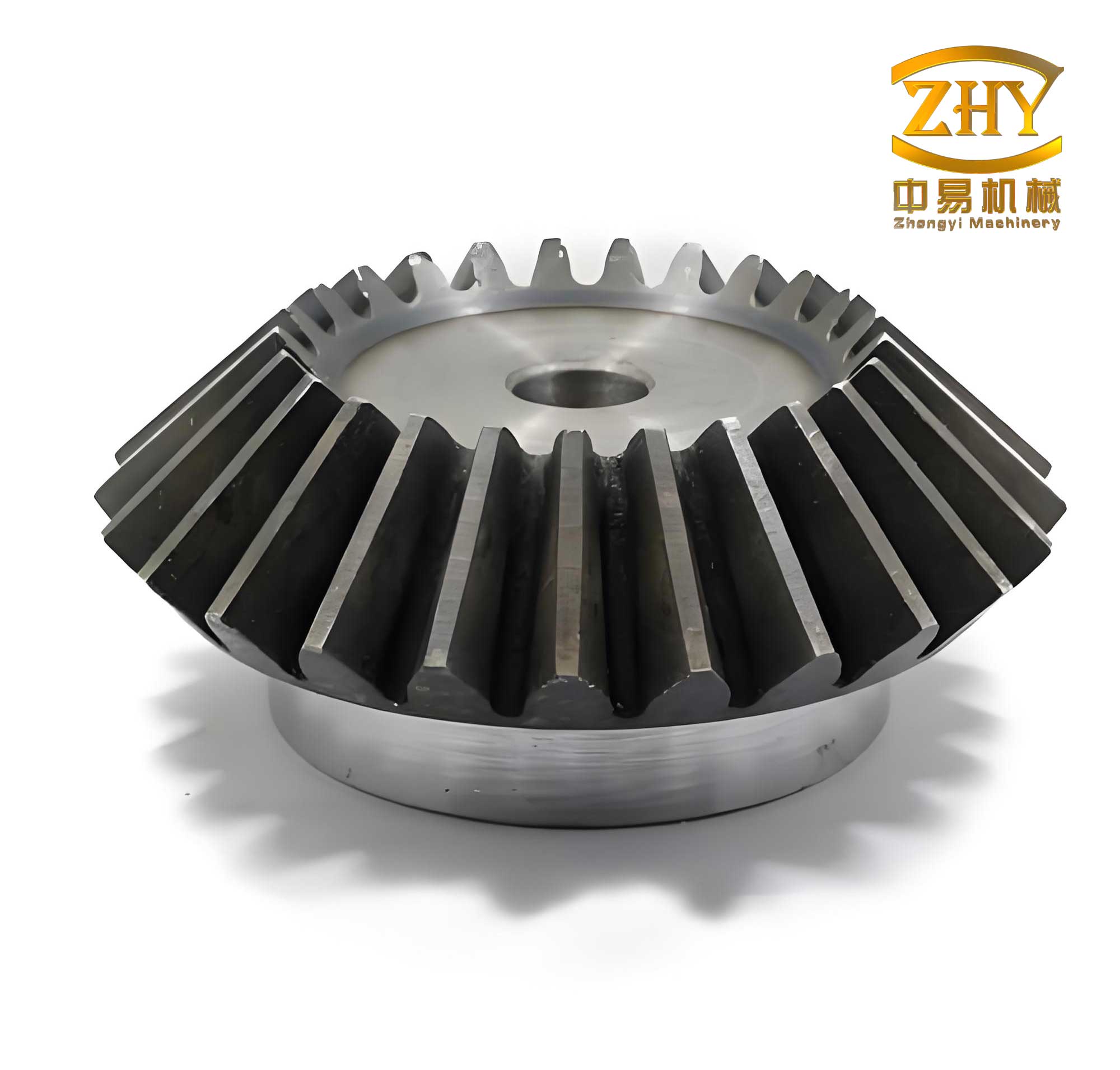
The primary causes of bevel gear damage can be categorized into environmental factors, inadequate maintenance, and improper adjustments. Each of these aspects contributes to various failure modes, including pitting, scuffing, cracking, and ultimately, tooth breakage. In this article, I will delve into these causes, supported by engineering analyses, tables, and formulas, and propose comprehensive preventive strategies to extend the lifespan of bevel gears in mining reducers.
Environmental and Operational Challenges
Mining environments pose unique challenges for bevel gears. The continuous exposure to shock loads from coal transportation, combined with high humidity and airborne dust, creates a perfect storm for accelerated wear. Shock loads induce dynamic stresses that can exceed the design limits of bevel gears, leading to fatigue failures. Humidity promotes corrosion, while dust particles can infiltrate the gear mesh, acting as abrasives that degrade tooth surfaces. These factors are exacerbated by the high-speed operation of bevel gears, which generates significant heat and friction. The thermal expansion associated with elevated temperatures can alter gear clearances and contact patterns, further increasing the risk of failure. To quantify the impact, consider the following table summarizing key environmental stressors and their effects on bevel gears:
| Environmental Stressor | Effect on Bevel Gears | Potential Failure Mode |
|---|---|---|
| Shock Loads | Induces dynamic bending and contact stresses | Tooth bending fatigue, cracking |
| High Humidity | Promotes corrosion and oxidation | Surface pitting, reduced lubrication efficiency |
| Dust Contamination | Abrasive wear on tooth surfaces | Loss of profile accuracy, increased backlash |
| Temperature Fluctuations | Thermal expansion alters clearances | Misalignment, uneven load distribution |
Moreover, the lubricant in the reducer can become contaminated with metal particles from wear, further accelerating the degradation of bevel gears. Regular monitoring of these environmental factors is essential, but often overlooked in busy mining operations.
Maintenance Deficiencies and Their Consequences
One of the most common reasons for premature bevel gear failure is inadequate maintenance. This encompasses lax inspection routines, improper lubrication practices, and neglecting minor adjustments that can snowball into major issues. Bevel gears rely on precise alignment and optimal lubrication to function correctly. When maintenance is sidelined, several problems arise:
- Loose Fasteners and Bearing Wear: The constant vibration in mining equipment can cause lock nuts on bevel gear shafts to loosen, leading to axial play. Additionally, angular contact ball bearings supporting the bevel gears may wear out or fail due to overloading or contamination. This results in shaft misalignment, which disrupts the proper meshing of bevel gears. The misalignment increases localized contact stresses, as described by the Hertzian contact stress formula for bevel gears:
$$ \sigma_H = Z_E \sqrt{ \frac{F_t}{b d_{m1}} \cdot \frac{u+1}{u} \cdot \frac{1}{\cos \beta} } $$
where \( \sigma_H \) is the contact stress, \( Z_E \) is the elasticity factor, \( F_t \) is the tangential force, \( b \) is the face width, \( d_{m1} \) is the mean pitch diameter of the pinion, \( u \) is the gear ratio, and \( \beta \) is the spiral angle. Misalignment increases \( F_t \) unevenly, raising \( \sigma_H \) beyond safe limits and causing pitting or spalling.
- Improper Lubrication: Lubrication is the lifeblood of bevel gears. Overfilling the reducer reduces air space, leading to overheating, while underfilling causes insufficient oil film thickness between meshing teeth. The minimum film thickness \( h_{min} \) can be estimated using the Dowson-Higginson equation:
$$ h_{min} = 2.65 \frac{(G U)^{0.7}}{W^{0.13}} R_x $$
where \( G \) is the material parameter, \( U \) is the speed parameter, \( W \) is the load parameter, and \( R_x \) is the effective radius. Inadequate lubrication reduces \( h_{min} \), resulting in boundary lubrication conditions that promote wear and scuffing. Furthermore, infrequent oil changes allow metal debris to accumulate, acting as abrasives that score the bevel gear surfaces. The table below outlines recommended lubrication practices for bevel gears in mining reducers:
| Maintenance Activity | Frequency | Key Parameters |
|---|---|---|
| Oil Level Check | Daily | Maintain at midpoint of sight glass |
| Oil Change (New Reducer) | After 200 hours | Use ISO VG 320 or equivalent |
| Oil Change (Regular Operation) | Every 6 months or 2,500 hours | Monitor temperature; shorten interval if >70°C |
| Oil Analysis | Quarterly | Check for metal content >100 ppm |
Implementing these practices ensures that bevel gears operate with a protective oil film, reducing friction and wear.
Adjustment Errors: Backlash and Contact Pattern
Even with perfect maintenance, bevel gears can fail if their meshing parameters are not correctly adjusted. Two critical adjustments are backlash (the clearance between mating teeth) and the contact pattern (the area where teeth make contact under load). Incorrect adjustments lead to concentrated loads and premature failure.
Backlash Adjustment: Backlash is essential to accommodate thermal expansion, lubricant film, and manufacturing tolerances. For the bevel gears in mining reducers, the recommended backlash typically ranges from 0.20 mm to 0.30 mm, depending on the gear size and load. Insufficient backlash causes the bevel gears to jam, eliminating the oil film and leading to scuffing or welding of teeth. Excessive backlash results in impact loading during startup and reversals, causing tooth chipping or breakage. The backlash \( j \) can be measured using the “wire method” or a dial indicator, and it should be adjusted by shimming the gear axially. The relationship between axial adjustment \( \Delta a \) and backlash change \( \Delta j \) for spiral bevel gears is approximated by:
$$ \Delta j \approx 2 \Delta a \tan \alpha \sin \delta $$
where \( \alpha \) is the pressure angle and \( \delta \) is the pitch cone angle. This formula helps technicians make precise adjustments to achieve optimal backlash.
Contact Pattern Adjustment: The contact pattern indicates how well the bevel gears share the load. An ideal pattern is elliptical or rectangular, located centrally on the tooth flank, slightly toward the toe (small end), covering 32-50% of the tooth length and 40-60% of the tooth height. Poor contact patterns, such as those concentrated at the heel (large end) or tip, cause stress concentrations. The contact stress \( \sigma_c \) at any point can be modeled using:
$$ \sigma_c = \sqrt{ \frac{F_n}{2 \pi b} \cdot \frac{1}{\rho} \cdot \frac{E}{1-\nu^2} } $$
where \( F_n \) is the normal force, \( \rho \) is the relative radius of curvature, \( E \) is Young’s modulus, and \( \nu \) is Poisson’s ratio. A misaligned contact pattern reduces \( \rho \), increasing \( \sigma_c \) and leading to pitting or spalling. To adjust the pattern, technicians use marking compounds (e.g., Prussian blue) and shift the pinion axially or radially. The table below summarizes adjustment guidelines based on pattern deviations:
| Contact Pattern Issue | Adjustment Action | Effect on Bevel Gears |
|---|---|---|
| Pattern too close to heel | Move pinion away from gear | Distributes load toward toe |
| Pattern too close to toe | Move pinion toward gear | Shifts load toward heel |
| Pattern too narrow | Increase pinion offset | Widens contact area |
| Pattern too high on tooth | Decrease gear mounting distance | Lowers contact to mid-flank |
Regular verification of backlash and contact pattern, especially after maintenance events, is crucial for prolonging the life of bevel gears.
Proactive Prevention Strategies
Based on my experience, a holistic approach to preventing bevel gear damage involves engineering controls, rigorous maintenance protocols, and continuous training. Here are key strategies:
- Enhanced Monitoring Systems: Install vibration sensors and oil debris monitors on reducers to detect early signs of bevel gear wear. An increase in vibration amplitude at the mesh frequency \( f_m = \frac{N \times rpm}{60} \), where \( N \) is the number of teeth, can indicate misalignment or tooth damage. Oil analysis can reveal ferrous particle counts, alerting to abnormal wear before failure.
- Precision Alignment During Assembly: Use laser alignment tools to ensure the bevel gear shafts are perpendicular within tolerances (e.g., ±0.05 mm). Proper alignment minimizes edge loading and ensures even stress distribution across the bevel gears.
- Customized Lubrication Schemes: For extreme conditions, consider synthetic lubricants with extreme pressure (EP) additives. The film thickness can be enhanced by selecting oils with higher viscosity index. The specific film thickness \( \lambda \) is given by:
$$ \lambda = \frac{h_{min}}{\sqrt{R_{q1}^2 + R_{q2}^2}} $$
where \( R_{q1} \) and \( R_{q2} \) are the root-mean-square roughness of the gear surfaces. Maintaining \( \lambda > 3 \) ensures full-film lubrication, protecting the bevel gears from direct metal-to-metal contact.
- Training and Documentation: Train maintenance personnel on the specifics of bevel gear adjustment and inspection. Develop checklists that include torque values for lock nuts, backlash measurements, and contact pattern records. This standardizes procedures and reduces human error.
- Redesign Considerations: Where possible, upgrade to carburized and ground bevel gears with higher hardness (e.g., 58-62 HRC) to resist abrasion and pitting. The bending stress \( \sigma_b \) at the tooth root can be reduced by optimizing the fillet radius \( r_f \):
$$ \sigma_b = \frac{F_t}{b m_n} Y_F Y_S Y_\beta $$
where \( m_n \) is the normal module, \( Y_F \) is the form factor, \( Y_S \) is the stress correction factor, and \( Y_\beta \) is the helix angle factor. A larger \( r_f \) increases \( Y_S \), lowering \( \sigma_b \) and improving fatigue resistance.
Implementing these strategies requires an investment in time and resources, but the payoff is substantial. In case studies, mines that adopted such measures saw bevel gear lifespan increase by over 30%, reducing downtime and replacement costs significantly.
Conclusion
Bevel gears are indispensable yet vulnerable components in coal mine transfer reducers. Their high failure rate stems from a combination of harsh operating environments, maintenance shortcomings, and improper adjustments. Through detailed analysis using engineering principles, formulas, and best practices, I have highlighted that proactive prevention is key. Regular inspections, precise lubrication management, accurate backlash and contact pattern adjustments, and the adoption of advanced monitoring technologies can collectively enhance the durability and reliability of bevel gears. As mining operations push for higher productivity and lower costs, focusing on these aspects will ensure that bevel gears perform optimally, supporting continuous and efficient coal extraction. By prioritizing the health of bevel gears, we not only save on direct expenses but also contribute to the overall safety and sustainability of mining activities.