
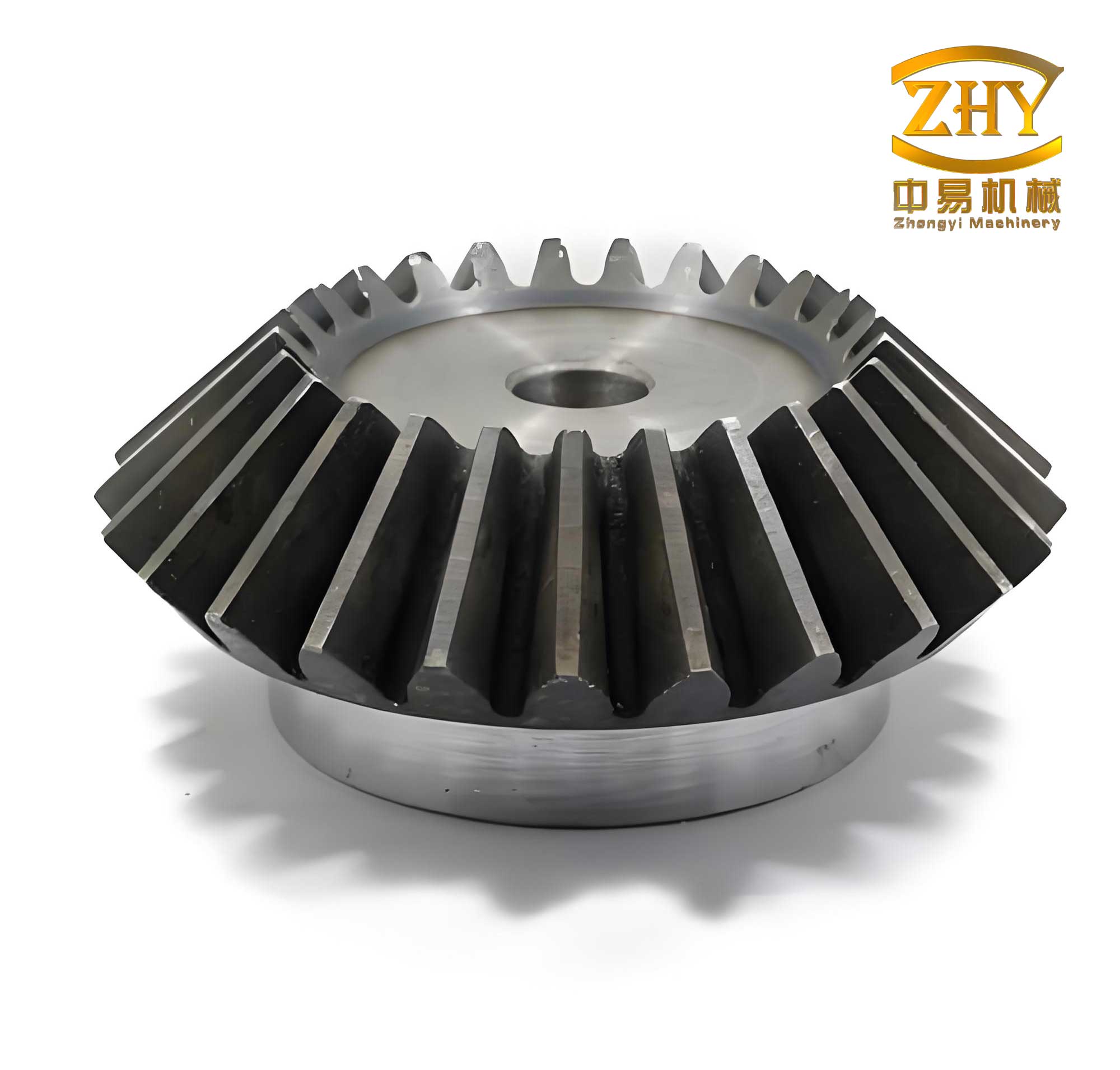
In mechanical engineering, the design of bevel gear transmissions is critical for transmitting power between intersecting shafts, particularly in applications such as automotive differentials, industrial machinery, and aerospace systems. Traditional design methods for bevel gears often rely on empirical formulas and safety factors, which ensure strength requirements but may lead to over-design, resulting in excessive material usage, larger dimensions, and higher costs. As a result, these designs are not optimal in terms of efficiency and resource utilization. To address this, I explore the application of genetic algorithms (GAs) for optimizing bevel gear transmission parameters, aiming to minimize the gear pair volume while satisfying all performance constraints. This approach leverages the global search capabilities of GAs, which are well-suited for nonlinear, multi-modal optimization problems. In this article, I present a comprehensive methodology, including mathematical modeling, GA implementation, and a case study, to demonstrate the effectiveness of this optimization technique for bevel gears. Throughout, I emphasize the importance of bevel gears in various industries and how optimization can enhance their design.
Genetic algorithms are a class of evolutionary algorithms inspired by natural selection and genetics. They are particularly effective for solving complex optimization problems where traditional gradient-based methods may fail due to discontinuities, multiple optima, or lack of derivative information. The basic steps of a GA involve encoding potential solutions as chromosomes, initializing a population, evaluating fitness, and applying genetic operators such as selection, crossover, and mutation over multiple generations. The process iteratively improves the population, converging toward an optimal or near-optimal solution. For bevel gear optimization, GAs offer advantages such as robustness, global search ability, and ease of integration with other computational tools. The flowchart of a typical GA includes initialization, fitness evaluation, selection based on fitness, crossover to combine parent solutions, mutation to introduce diversity, and termination when a stopping criterion is met. This iterative nature allows GAs to explore a wide design space, making them ideal for parameter optimization in bevel gear transmissions where multiple variables interact nonlinearly.
To apply genetic algorithms to bevel gear optimization, I first establish a mathematical model that defines the objective function, design variables, and constraints. The goal is to minimize the total volume of the bevel gear pair, which correlates with material usage and weight, while ensuring that the gears meet all mechanical strength requirements. The volume of a straight bevel gear can be approximated as the sum of the volumes of two truncated cones representing the gear bodies. For a bevel gear pair with shaft angle Σ = 90°, the total volume V is given by:
$$ V = V_1 + V_2 = \frac{\pi}{3} b \cos \delta_1 \left[ \left( \frac{m z_1}{2} \right)^2 + \frac{m z_1}{2} \cdot \frac{R – b}{R} \cdot \frac{m z_1}{2} + \left( \frac{R – b}{R} \cdot \frac{m z_1}{2} \right)^2 \right] + \frac{\pi}{3} b \cos \delta_2 \left[ \left( \frac{m z_2}{2} \right)^2 + \frac{m z_2}{2} \cdot \frac{R – b}{R} \cdot \frac{m z_2}{2} + \left( \frac{R – b}{R} \cdot \frac{m z_2}{2} \right)^2 \right] $$
where:
– \( z_1 \) and \( z_2 \) are the numbers of teeth for the pinion and gear, respectively.
– \( m \) is the module at the large end of the bevel gears (a standardized value).
– \( R \) is the cone distance, calculated as \( R = \frac{m}{2} \sqrt{z_1^2 + z_2^2} = \frac{m z_1}{2} \sqrt{1 + u^2} \), with \( u = z_2 / z_1 \) being the gear ratio.
– \( b \) is the face width, given by \( b = \phi_R R \), where \( \phi_R \) is the face width coefficient, typically ranging from 0.25 to 0.35.
– \( \delta_1 \) and \( \delta_2 \) are the pitch angles, with \( \delta_2 = \arctan(u) \) and \( \delta_1 = 90^\circ – \delta_2 \) for a shaft angle of 90°.
The design variables are selected as the independent parameters that significantly influence the volume and performance of the bevel gears. I choose three key variables:
$$ \mathbf{X} = [z_1, m, \phi_R]^T = [x_1, x_2, x_3]^T $$
These variables are optimized within specified constraints to ensure the bevel gears operate reliably under given loads. The constraints include both performance and boundary limits. First, the contact fatigue strength condition must be satisfied to prevent surface pitting, which is critical for bevel gears in heavy-duty applications. The constraint is expressed as:
$$ g_1(\mathbf{X}) = [\sigma_H] – 949 \sqrt{\frac{K T_1}{\phi_R (1 – 0.5 \phi_R)^2 d_1^3 u}} \geq 0 $$
where:
– \( [\sigma_H] \) is the allowable contact stress for the gear material.
– \( K \) is the load factor, accounting for dynamic effects and load distribution.
– \( T_1 \) is the torque transmitted by the pinion, computed as \( T_1 = 9.55 \times 10^6 \frac{P_1}{n_1} \), with \( P_1 \) as power and \( n_1 \) as speed.
– \( d_1 \) is the pitch diameter of the pinion, \( d_1 = m z_1 \).
Second, the bending fatigue strength condition must be met to avoid tooth breakage, especially at the root. This constraint is given by:
$$ g_2(\mathbf{X}) = [\sigma_F] – \frac{4 K T_1 Y_{FS}}{\phi_R (1 – 0.5 \phi_R)^2 z_1^2 m^3 \sqrt{1 + u^2}} \geq 0 $$
where:
– \( [\sigma_F] \) is the allowable bending stress.
– \( Y_{FS} \) is the composite tooth form factor, which depends on the virtual number of teeth \( z_v = z / \cos \delta \). For bevel gears, it can be approximated using empirical formulas, such as \( Y_{FS} = \frac{z_v}{0.269118 z_v – 0.840687} \).
Additionally, boundary constraints are applied to ensure practical design limits:
– The pinion tooth number must avoid undercutting: \( z_1 \geq 17 \cos \delta_1 \).
– The module must be within a standard range: \( m_{\text{min}} \leq m \leq m_{\text{max}} \), typically \( m \geq 2 \) mm.
– The face width coefficient is limited: \( 0.25 \leq \phi_R \leq 0.35 \).
These constraints form a nonlinear optimization problem. To handle potential fuzziness in real-world conditions, such as material property variations, I incorporate a fuzzy optimization approach by converting fuzzy constraints into crisp ones using the optimal level-cut method. However, for simplicity in GA implementation, I treat them as deterministic constraints. The fitness function for the GA combines the objective function and penalty terms for constraint violations. For a chromosome \( \mathbf{X} \), the fitness \( \text{Val}(\mathbf{X}) \) is defined as:
$$ \text{Val}(\mathbf{X}) = f(\mathbf{X}) + p(\mathbf{X}) $$
where \( f(\mathbf{X}) = V \) is the volume to minimize, and \( p(\mathbf{X}) \) is a penalty function. Since bevel gear transmissions are typically closed systems, contact fatigue strength is prioritized over bending strength. Thus, I assign penalty factors \( r_1 = 1 \) for contact strength violations and \( r_2 = 0.5 \) for bending strength violations. The penalty function is:
$$ p(\mathbf{X}) = \begin{cases}
0 & \text{if } \mathbf{X} \text{ is feasible} \\
r_1 [\min(0, g_1(\mathbf{X}))]^2 + r_2 [\min(0, g_2(\mathbf{X}))]^2 & \text{if } \mathbf{X} \text{ is infeasible}
\end{cases} $$
This formulation guides the GA toward feasible solutions while minimizing volume. To illustrate the optimization process, I present a case study involving the design of a bevel gear transmission for an industrial application. The specifications are as follows: shaft angle Σ = 90°, input power \( P_1 = 9.2 \) kW, pinion speed \( n_1 = 970 \) rpm, gear ratio \( i = 3 \), service life of 10,000 hours, and 7-grade accuracy. The pinion is made of 40Cr steel with tempered hardness of 260 HB, and the gear is made of 45 steel with tempered hardness of 230 HB. The loads are steady, and the mounting conditions involve an overhung pinion and a straddle-mounted gear. Using these inputs, I compute the allowable stresses: \( [\sigma_H] = 640 \) MPa and \( [\sigma_F] = 250 \) MPa, based on material properties and reliability requirements. The load factor K is taken as 2.0, considering moderate shock and accuracy.
The GA is implemented using MATLAB and its Genetic Algorithm Toolbox (GA Toolbox). I code the fitness function as an M-file, incorporating the volume calculation and constraints. The design variables are encoded as real-valued numbers within bounds: \( z_1 \in [17, 35] \), \( m \in [2, 10] \) mm, and \( \phi_R \in [0.25, 0.35] \). The GA parameters include a population size of 30, maximum generations of 100, selection via tournament, crossover probability of 0.8, and mutation probability of 0.1. These settings balance exploration and exploitation for bevel gear optimization. The optimization converges after approximately 72 generations, with the best solution yielding \( \mathbf{X}^* = [18.87, 5.00, 0.25]^T \). After rounding \( z_1 \) to 19 for practicality, the optimal parameters are: pinion teeth \( z_1 = 19 \), gear teeth \( z_2 = 57 \), module \( m = 5 \) mm, and face width coefficient \( \phi_R = 0.25 \). The corresponding volume is \( V^* = 7.6992 \times 10^5 \) mm³. For comparison, a traditional design using standard procedures gives \( z_1 = 24 \), \( z_2 = 72 \), \( m = 4 \) mm, \( \phi_R = 0.3 \), and volume \( V = 9.1969 \times 10^5 \) mm³. The optimization results in a volume reduction of 16.3%, demonstrating significant material savings while meeting all strength criteria. The table below summarizes the comparison:
| Design Method | Pinion Teeth \( z_1 \) | Gear Teeth \( z_2 \) | Module \( m \) (mm) | Face Width Coefficient \( \phi_R \) | Gear Pair Volume \( V \) (mm³) |
|---|---|---|---|---|---|
| Traditional Design | 24 | 72 | 4 | 0.3 | 9.1969 × 10⁵ |
| Optimized Design (GA) | 19 | 57 | 5 | 0.25 | 7.6992 × 10⁵ |
This case study highlights the efficacy of genetic algorithms in optimizing bevel gear transmissions. The GA efficiently navigates the design space, considering multiple constraints and objectives. The reduction in volume not only lowers material costs but also contributes to compact and lightweight designs, which are advantageous in applications like automotive and aerospace where space and weight are critical. Furthermore, the optimization process can be extended to other types of bevel gears, such as spiral or hypoid bevel gears, by adjusting the mathematical model to account for additional factors like spiral angle or offset. The flexibility of GAs makes them suitable for such variations, enabling tailored designs for specific bevel gear applications.
In conclusion, the integration of genetic algorithms into bevel gear design offers a powerful tool for achieving optimal parameters that minimize volume while ensuring reliability. This approach addresses the limitations of traditional methods, which often rely on conservative assumptions and iterative tuning. By formulating the problem with an objective function and constraints, and leveraging GA’s global search capabilities, designers can obtain superior solutions that enhance performance and efficiency. The case study validates the methodology, showing a tangible improvement in design outcomes. Future work could incorporate multi-objective optimization to balance volume, efficiency, noise, and cost, or integrate finite element analysis for more precise stress evaluation. Ultimately, the adoption of advanced optimization techniques like genetic algorithms will drive innovation in bevel gear technology, supporting the development of more sustainable and high-performance mechanical systems. As bevel gears continue to be vital components in countless industries, optimizing their design through methods such as GAs will remain a key area of research and application.