
The evolution of power transmission systems, particularly in demanding applications like heavy-duty automotive drive axles, has continuously pushed the boundaries of material performance. For decades, gear manufacturing, especially for critical components like the bevel gears in differentials, relied heavily on standard steels. However, the relentless pursuit of higher efficiency, durability, and reliability has exposed the limitations of traditional materials. Modern bevel gears are subjected to extreme cyclical loading, requiring exceptional fatigue resistance, high core strength, and, crucially, minimal and predictable deformation during the essential carburizing heat treatment process. This paper details the first-person development journey of a specialized steel, 22CrMoH2, engineered specifically to meet these stringent demands for high-performance bevel gears.
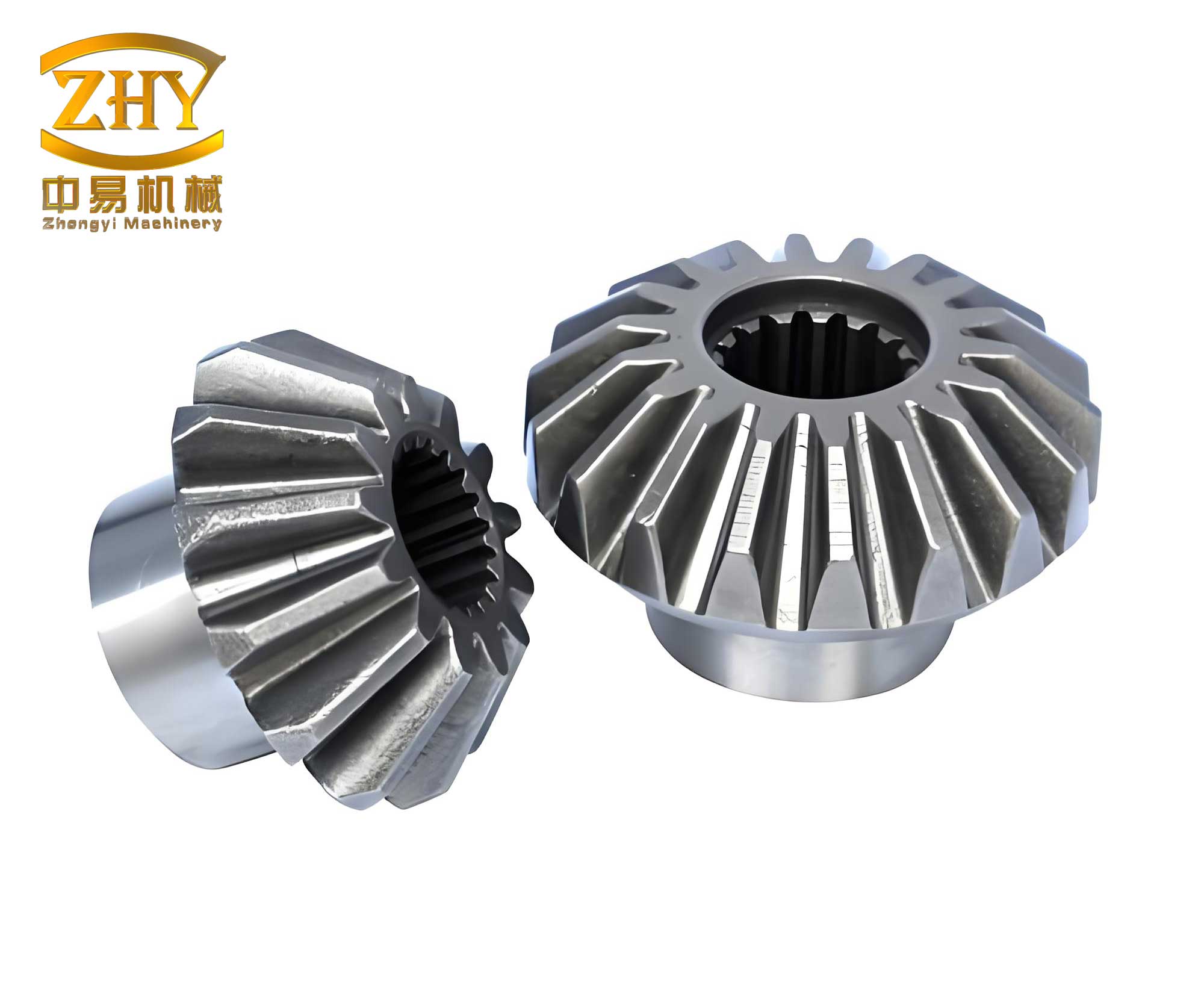
The primary challenge was two-fold: achieving ultra-low distortion post-carburizing and guaranteeing a superior, consistent fatigue life. Our development strategy was rooted in a holistic approach, integrating targeted microalloying, advanced melt cleanliness practices, and precise thermomechanical processing to control microstructure at every stage.
1. Material Design Philosophy for Bevel Gear Performance
The core properties of bevel gears—resistance to contact fatigue, bending fatigue, and dimensional stability—are dictated by the steel’s chemical composition and resulting microstructure. Our design focused on three interconnected pillars: grain refinement for stability, enhanced hardenability for core strength, and supreme cleanliness for fatigue initiation resistance.
1.1. Grain Refinement and Distortion Control
Heat treatment distortion in bevel gears arises from non-uniform phase transformations and stress relief. A fine, homogeneous austenitic grain structure prior to quenching is paramount for uniform transformation and reduced distortion. While aluminum nitride (AlN) provides grain boundary pinning, its effectiveness diminishes during prolonged high-temperature carburizing (typically at 930°C). We introduced niobium (Nb) as a key microalloying element. Nb forms stable carbonitrides, Nb(C,N), which exert a powerful pinning force on austenite grain boundaries, effectively preventing coarsening even at elevated temperatures.
The efficacy of Nb is highly concentration-dependent. An optimal level is required to maximize the number density of fine precipitates. Our target was set at approximately 0.04% Nb, based on the principle that the pinning force ($F_{pin}$) is proportional to the volume fraction ($f$) and inversely proportional to the particle radius ($r$):
$$ F_{pin} \propto \frac{f}{r} $$
At lower Nb contents, the volume fraction is insufficient. Conversely, excess Nb leads to coarse, sparse precipitates, reducing the total pinning boundary area and effectiveness. This precise control was critical for the bevel gears to maintain dimensional tolerances after heat treatment.
Furthermore, macrosegregation patterns (often termed “ghost lines” or “sulfide patterns”) in the rolled product can induce asymmetrical stresses and uneven transformation, leading to unpredictable distortion in the final bevel gear. Our strategy employed a large-diameter continuous cast round bloom. The axisymmetric solidification of a round bloom promotes a more uniform and symmetrical segregation pattern compared to square sections. Combined with a high reduction ratio during rolling, this practice helps to diffuse and homogenize segregation, contributing to uniform deformation behavior.
1.2. Hardenability and Microstructure Design
The core strength and the gradient properties of the carburized case in a bevel gear depend on hardenability. Our composition leverages chromium (Cr) and molybdenum (Mo) synergistically. Mo, controlled at the mid-to-upper specification limit, plays a multifaceted role: it significantly enhances hardenability of both the case and core, suppresses the formation of intergranular oxides during carburizing, and refines carbide morphology. Unlike chromium carbides which can form deleterious networks, molybdenum promotes the formation of fine, globular carbides, improving bending fatigue strength and wear resistance. Chromium was maintained at the mid-to-lower limit to provide necessary hardenability and solid solution strengthening while balancing cost and the risk of excessive residual austenite. Titanium (Ti) was strictly minimized due to its tendency to form large, brittle TiN inclusions that act as potent fatigue crack nuclei.
The final optimized chemical composition ranges, showcasing our internal control philosophy, are presented in Table 1.
| Element | Standard Range | Internal Control Target | Rationale |
|---|---|---|---|
| C | 0.19 – 0.25 | 0.20 – 0.24 | Core strength / Case carbon potential |
| Si | 0.17 – 0.37 | 0.23 – 0.27 | Deoxidation, solid solution strengthening |
| Mn | 0.60 – 1.00 | 0.80 – 0.98 | Hardenability, sulfide shape control |
| P | ≤ 0.020 | ≤ 0.018 | Minimize segregation and embrittlement |
| S | ≤ 0.025 | ≤ 0.008 | Improve fatigue life, reduce MnS inclusions |
| Cr | 0.90 – 1.25 | 0.92 – 1.00 | Hardenability (Mid-Lower Limit) |
| Mo | 0.35 – 0.45 | 0.40 – 0.42 | Hardenability, grain refinement, carbide control (Mid-Upper Limit) |
| Als | 0.012 – 0.020 | 0.015 – 0.020 | Grain refinement via AlN |
| Nb | – | ~0.04 | Austenite grain pinning for distortion control |
| O [ppm] | ≤ 12 | ≤ 10 | Ultra-clean steel objective |
| Ti [ppm] | ≤ 60 | ≤ 40 | Avoid large TiN inclusions |
1.3. Fatigue Life and the Imperative of Cleanliness
The fatigue performance of bevel gears is dominantly controlled by the presence of stress concentrators. Non-metallic inclusions, particularly large oxides, are the most common initiation sites for subsurface-originated fatigue failures. The relationship between fatigue limit ($\sigma_{f}$) and inclusion size ($\sqrt{area}$) is often described by models such as the Murakami equation:
$$ \sigma_{f} = \frac{C (HV + 120)}{(\sqrt{area})^{1/6}} $$
where $C$ is a constant and $HV$ is the Vickers hardness. This highlights the detrimental exponential effect of inclusion size. Therefore, our process design prioritized the minimization of total oxygen (T.O) and the elimination of macro-inclusions. A low sulfur content further reduces the population of plastic MnS inclusions which can also be detrimental. The goal was to create a material with an extremely homogeneous and clean matrix, ensuring that the high contact stresses in the bevel gear tooth flank are not locally amplified by microstructural defects.
2. Integrated Manufacturing Process for Bevel Gear Steel
The realization of the designed material properties requires meticulous control across the entire production chain. The following process route and key control points were established.
2.1. Steelmaking and Refining for Cleanliness
The process begins with hot metal charging into a basic oxygen furnace. Key steps include:
- Desulfurization Pressure Reduction: Using low-sulfur hot metal to minimize the burden on secondary metallurgy.
- High Tap Carbon Practice: Tapping with higher carbon reduces the oxidization of alloying elements like Cr and Mo, decreasing deoxidation product formation later.
- Ladle Furnace (LF) & Vacuum Degassing (VD): Precise temperature control and alloy trimming. The VD process, with vacuum held below 100 Pa for over 15 minutes, is critical for hydrogen and nitrogen removal, and for promoting the agglomeration and flotation of oxide inclusions.
- Soft Stirring: Controlled inert gas stirring after VD is essential for final inclusion floatation without slag re-entrainment.
- Tundish and Mold Flow Control: Stable levels in tundish and mold are maintained to prevent slag entrapment. Mold Electromagnetic Stirring (M-EMS) parameters are optimized (e.g., 150 A, 2 Hz) to ensure adequate homogenization without pushing negative segregation bands (“white bands”) too far outward, which would enlarge the segregation zone in the final bevel gear stock.
Continuous casting is performed using a round bloom caster. The round geometry and selected secondary cooling strategy promote a deep, symmetrical equiaxed crystal zone, central to achieving the desired low and symmetrical macrosegregation pattern essential for bevel gear stability.
2.2. Rolling and Thermal Processing
The as-cast structure must be transformed into a dense, homogeneous product. The key stages are:
- Reheating: Sufficient soaking time is allowed to ensure temperature uniformity and partial dissolution of Nb carbonitrides for later reprecipitation.
- High Reduction Breakdown Rolling: A large initial reduction pass is applied at high temperature. This heavy deformation is critical for physically breaking down and dispersing the as-cast segregation pattern, effectively reducing its severity and visibility in the final product. The high total reduction ratio (from 600mm bloom to final round) also heals central porosity.
- Controlled Cooling and Annealing: After rolling, the bars are slow-cooled or isothermally annealed to produce a uniform, soft pearlitic-ferritic microstructure ideal for machining the complex tooth forms of bevel gears prior to carburizing.
3. Quality Validation of the Developed Bevel Gear Steel
Comprehensive testing was conducted on multiple heats of the produced 22CrMoH2 steel to verify it met all design objectives for bevel gear applications.
3.1. Chemical Homogeneity and Cleanliness
Multi-point sampling across the diameter of bars confirmed excellent homogeneity. The maximum range of carbon content within a single heat was only 0.02-0.04%, indicating minimal microsegregation. Cleanliness targets were consistently achieved, as shown in Table 2.
| Parameter | Internal Target | Achieved Range |
|---|---|---|
| Total Oxygen [ppm] | ≤ 10 | 6.1 – 8.6 |
| Nitrogen [ppm] | ≤ 60 | 52 – 63 |
| Sulfur [%] | ≤ 0.008 | 0.013 – 0.015 |
| Titanium [ppm] | ≤ 40 | 35 – 43 |
3.2. Hardenability Response
The hardenability, measured by the Jominy end-quench test, is the cornerstone of core property prediction. All tested heats met the required hardenability band, ensuring consistent through-hardening in the massive sections of truck bevel gears. Results from sample heats are summarized in Table 3.
| Heat Identification | J9 (9 mm from quenched end) | J15 (15 mm from quenched end) | Specification |
|---|---|---|---|
| Heat A | 45, 46 | 40, 39 | J9: 43-48 HRC J15: 36-41 HRC |
| Heat B | 46, 46 | 39, 39 | |
| Heat C | 45, 46 | 39, 40 | |
| Heat D | 45, 46 | 41, 40 | |
| Heat E | 45, 44 | 41, 39 | |
| Heat F | 46, 45 | 41, 40 |
3.3. Microstructural and Macroscopic Evaluation
Metallographic examination revealed the success of the grain refinement strategy. The prior austenite grain size was consistently between ASTM 7.5 and 8.5, confirming the effective pinning action of Nb(C,N) and AlN precipitates during simulated carburizing conditions. Macro-etch testing showed a sound internal structure with minimal centerline segregation and a very faint, symmetrical ghost line pattern, rated between 0 and 1.0 according to relevant standards. This is a direct result of the round bloom casting and high-reduction rolling practice, crucial for the dimensional stability of the final bevel gear.
Non-metallic inclusion ratings were exceptionally low, as quantified in Table 4. The stringent control of oxide (A-type) and silicate (C-type) inclusions is particularly noteworthy for fatigue performance.
| Inclusion Type | Thick/Coarse | Thin/Fine |
|---|---|---|
| A (Sulfides) | 0.5 – 1.0 | 1.0 – 1.5 |
| B (Alumina) | 0 – 0.5 | 0 – 1.0 |
| C (Silicates) | 0 – 0.5 | 0 – 1.0 |
| D (Globular Oxides) | 0 – 0.5 | 0.5 – 1.0 |
4. Application Performance in Bevel Gears
The ultimate validation of the developed 22CrMoH2 steel was its performance in real-world bevel gear manufacturing. Approximately 500 tonnes of material were supplied for the production of drive pinion and ring gear sets for heavy-duty trucks. The key performance metrics were:
Heat Treatment Distortion: After the standard gas carburizing and high-pressure gas quenching process, the circumferential deformation (runout) of the bevel gears was meticulously measured. The composite qualified rate, meaning gears conforming to the stringent deformation limit of ≤ 0.1 mm, reached 92.55%. This high level of consistency and low distortion significantly reduces the need for post-heat-treatment grinding, lowering cost and improving gear geometry integrity.
Fatigue Life: Finished bevel gears underwent rigorous bench testing to simulate extreme service loads. The fatigue life consistently met and exceeded the customer’s specification requirements. The combination of fine grain size, high core strength from optimized hardenability, and exceptional steel cleanliness directly translated into a robust and reliable fatigue performance, a critical attribute for the demanding duty cycle of heavy vehicle bevel gears.
5. Conclusion
The successful development and production of 22CrMoH2 steel demonstrate a systematic, metallurgically-grounded approach to solving the concurrent challenges of distortion control and fatigue life enhancement in high-performance bevel gears. By integrating:
- Precision microalloying with ~0.04% Nb for austenite grain pinning,
- A “Mo-high, Cr-mid” hardenability design for core strength and good carbide morphology,
- An ultra-clean steelmaking process focused on low T.O and Ti, and
- A thermomechanical processing route utilizing round blooms and high reduction to mitigate segregation,
a material was engineered that delivers predictable, minimal heat treatment deformation and outstanding durability. The application results confirm that this steel is a high-reliability solution for the most demanding bevel gear applications, providing a solid foundation for advancing powertrain technology in heavy-duty and other critical mechanical systems. The principles established here—of targeting specific microstructural features to solve application-defined problems—provide a valuable framework for the future development of advanced engineering steels.