
In the realm of automotive and heavy-duty vehicle engineering, the differential serves as a critical power transmission component, enabling wheels to rotate at different speeds during turns. Among various types, the bevel gear differential is widely employed due to its compact design and efficient torque distribution. However, for medium and heavy off-road transport vehicles, frequent failures due to insufficient strength of the differential gears pose significant challenges. These failures often manifest as tooth breakage, pitting, or excessive wear, leading to operational downtime and increased maintenance costs. Therefore, enhancing the strength and durability of bevel gears within differentials has become a pivotal research focus in mechanical engineering. This study aims to address these issues by proposing a novel high-strength bevel gear differential design, rigorously evaluating its performance through advanced finite element analysis, and ensuring its viability for demanding applications.
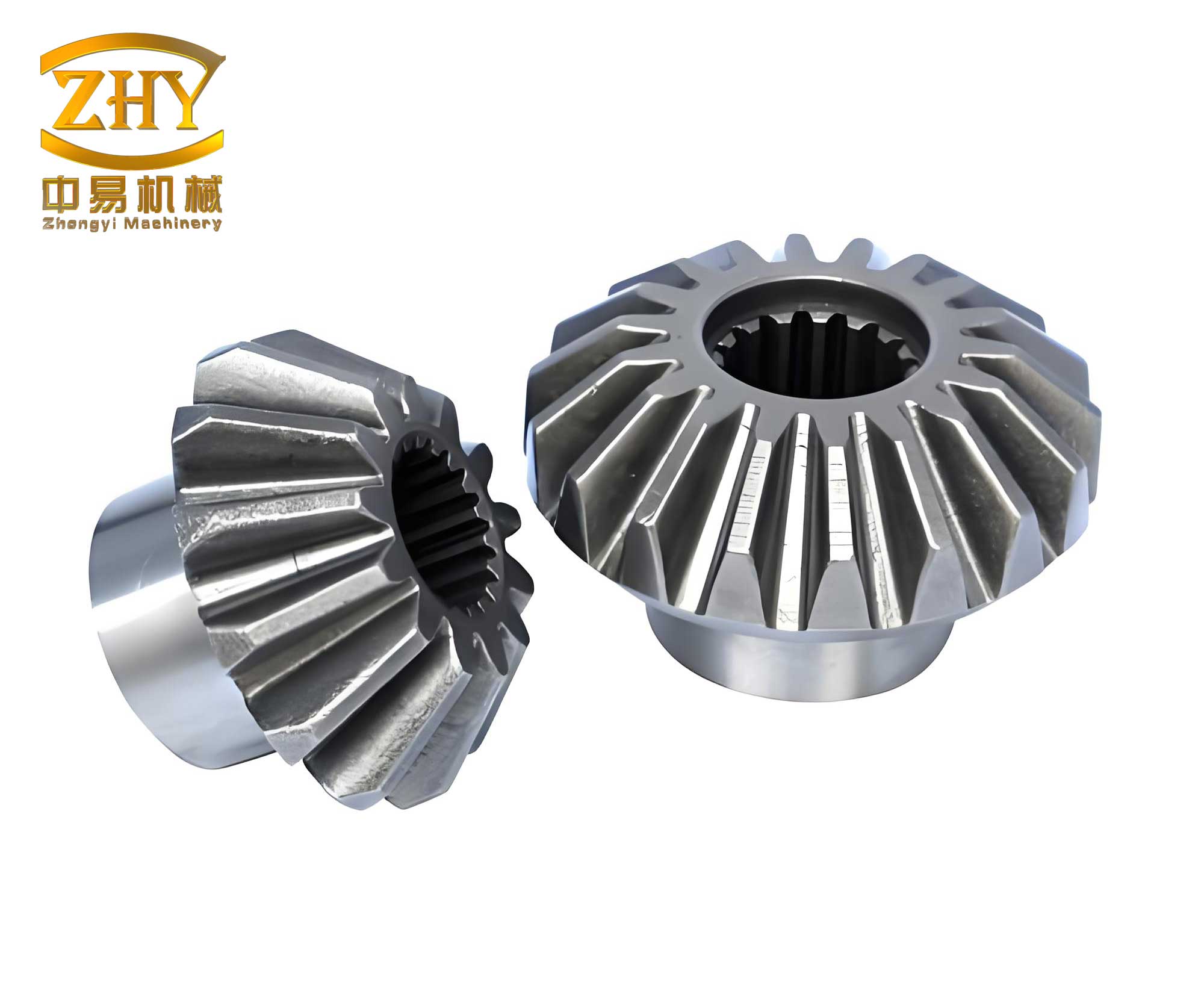
Traditional bevel gear designs are constrained by the minimum tooth number to avoid undercutting, which typically limits planetary gears to around 12 teeth. Undercutting weakens the tooth root, reducing load-carrying capacity and fatigue life. To overcome this, we reimagined the gear geometry by reducing the tooth count to increase the module while maintaining the pitch diameter, thereby enhancing bending strength. Specifically, we set the planetary gear to 7 teeth and the half-axle gear to 10 teeth, achieving a ratio of 7:10. This aggressive reduction necessitates innovative approaches to prevent undercutting and ensure smooth operation. We implemented a segmented tooth profile design combined with profile modifications, which included thickening the tooth root region for added robustness. These bevel gears are characterized by constant-ratio transmission, conical pitch surfaces, and a redesigned齿形 that minimizes stress concentrations.
The structural intricacies of these high-strength bevel gears demanded a sophisticated modeling approach. We utilized SolidWorks for geometric modeling, but given the complexity of the segmented and modified齿形, conventional sketching was impractical. Instead, we employed a programming method: first, we recorded the modeling steps as a macro to generate program code, then converted constants into variables within the Visual Studio environment, and finally leveraged API functions to automate the creation of three-dimensional models. This workflow ensured precision and repeatability. The planetary gear model features 7 teeth with reinforced roots, while the half-axle gear has 10 teeth, both designed to mesh seamlessly without interference. After individual component modeling, we performed virtual assembly in SolidWorks, conducting interference checks until optimal engagement was achieved. The final assembly represents a compact and robust differential unit, poised for analysis.
To validate the design, we conducted comprehensive finite element analysis (FEA) using ANSYS Workbench, focusing on contact strength and modal behavior. The core of the differential is the mating bevel gear pair, and given the non-linear contact conditions, we selected a contact-based model for accuracy. Among contact algorithms, the augmented Lagrangian method was chosen for its robustness and insensitivity to contact stiffness coefficients. The material assigned was alloy steel 20CrMnTiH, a common choice for high-strength gears due to its excellent carburizing properties. We defined its properties: density $$ \rho = 7800 \, \text{kg/m}^3 $$, Young’s modulus $$ E = 207 \, \text{GPa} $$, and Poisson’s ratio $$ \nu = 0.29 $$. For meshing, we used SOLID187 tetrahedral elements with a global size of 1 mm, refining the contact zones to capture stress gradients effectively. The mesh statistics are summarized in Table 1.
| Gear Type | Number of Nodes | Number of Elements |
|---|---|---|
| Planetary Gear (Single) | 11,874 | 7,192 |
| Half-Axle Gear (Single) | 23,339 | 14,269 |
Contact pairs were established with the planetary gear as the contact surface and the half-axle gear as the target, using a frictional contact type with a coefficient of 0.1. Boundary conditions simulated real-world loading: a maximum input torque of 5958 N·m was applied, corresponding to heavy-duty operation. For the half-axle gears, constraints included fixed support on the left axle and radial-axial constraints on the right axle, allowing rotational freedom. The planetary gear was given a displacement input of 0.25 mm to simulate engagement. We analyzed two critical scenarios: straight-line driving and cornering. In straight-line motion, the bevel gear pair acts as a solid unit with no relative rotation, whereas cornering induces differential slip, creating more severe stress conditions.
The static stress analysis yielded insightful results. For straight-line driving, the maximum von Mises stress was 573.83 MPa, localized near the tooth root of the planetary gear at the contact interface. During cornering, stress increased to 624.14 MPa, primarily at the tooth tip of the planetary gear. These values are well below the ultimate tensile strength of 20CrMnTiH (typically over 1000 MPa), indicating sufficient static strength. The stress distributions, visualized through contour plots, revealed that stress concentrations occur at predictable locations: the tooth roots and tips. This aligns with theoretical expectations for bevel gears under load. To mitigate potential fatigue, further profile optimization at these hotspots is recommended. Deformation analysis showed maximal displacements of 0.111 mm for straight-line and 0.898 mm for cornering, both within acceptable limits for gear operation. The deformation patterns highlight the flexibility of the tooth structures, emphasizing the need for stiffness in design.
The contact behavior of bevel gears is governed by complex mechanics. The Hertzian contact stress can be approximated for initial design checks, but FEA provides a more accurate picture. The fundamental equation for gear tooth bending stress, based on the Lewis formula, is:
$$ \sigma_b = \frac{F_t}{b m_n Y} $$
where $$ \sigma_b $$ is the bending stress, $$ F_t $$ is the tangential load, $$ b $$ is the face width, $$ m_n $$ is the normal module, and $$ Y $$ is the Lewis form factor. For bevel gears, this is modified to account for the conical geometry. However, our segmented design alters the form factor, necessitating FEA validation. The contact stress according to Hertz theory is:
$$ \sigma_c = \sqrt{\frac{F_t E^*}{\pi b \rho_e}} $$
where $$ E^* $$ is the equivalent modulus and $$ \rho_e $$ is the equivalent radius of curvature. These theoretical foundations guided our design choices, but the finite element model captured the full non-linearity. Table 2 compares key parameters of our high-strength bevel gears with conventional designs.
| Parameter | Conventional Bevel Gears | High-Strength Bevel Gears (This Study) |
|---|---|---|
| Planetary Gear Teeth | 12-14 | 7 |
| Half-Axle Gear Teeth | 16-20 | 10 |
| Module | Standard | Increased |
| Tooth Profile | Standard Involute | Segmented with Modification |
| Root Thickness | Normal | Enhanced |
| Primary Strength Focus | Contact Fatigue | Bending and Contact |
Beyond static strength, dynamic performance is crucial to avoid resonance and noise. We conducted modal analysis to determine the natural frequencies and mode shapes of the bevel gear assembly. The governing equation for undamped free vibration is:
$$ \mathbf{M} \ddot{\mathbf{X}} + \mathbf{K} \mathbf{X} = 0 $$
where $$ \mathbf{M} $$ is the mass matrix, $$ \mathbf{K} $$ is the stiffness matrix, and $$ \mathbf{X} $$ is the displacement vector. Assuming harmonic motion $$ \mathbf{X} = \mathbf{U} \sin(\omega t) $$, we solve the eigenvalue problem:
$$ (\mathbf{K} – \omega^2 \mathbf{M}) \mathbf{U} = 0 $$
The solutions yield natural frequencies $$ \omega_i $$ and corresponding mode shapes $$ \mathbf{U}_i $$. For practical purposes, we extracted the first six modes, as higher modes contribute less to vibrational energy. The results, summarized in Table 3, show that the first natural frequency is 19,692 Hz, and the sixth is 20,928 Hz. The maximum deformations in these modes range from 101.83 μm to 205.49 μm, occurring mainly at the tooth tips of the half-axle gears. Mode shapes include circumferential vibrations, folding vibrations, and local bending, typical for bevel gear structures.
| Mode Order | Natural Frequency (Hz) | Mode Shape Characteristic | Maximum Deformation (μm) |
|---|---|---|---|
| 1 | 19,692 | Circumferential Vibration | 102.47 |
| 2 | 20,416 | Circumferential Vibration | 101.83 |
| 3 | 20,596 | Folding Vibration | 151.70 |
| 4 | 20,696 | Local Bending Vibration | 205.49 |
| 5 | 20,893 | Folding Vibration | 150.79 |
| 6 | 20,928 | Folding Vibration | 176.03 |
To assess resonance risk, we compared these natural frequencies with operational excitation frequencies. For a vehicle differential, the primary excitation comes from gear meshing. The meshing frequency $$ f_m $$ is given by:
$$ f_m = \frac{N \cdot n}{60} $$
where $$ N $$ is the number of teeth and $$ n $$ is the rotational speed in RPM. Considering a high-speed scenario with an engine speed of 5000 RPM, the maximum meshing frequency for our 7-tooth planetary gear is approximately 583.3 Hz (calculated as $$ (7 \times 5000) / 60 $$). This is significantly lower than the first natural frequency of 19,692 Hz, indicating a wide margin and no resonance concern. Thus, the designed bevel gears are dynamically stable, and noise or vibrations from operation are unlikely to induce harmful resonant conditions.
The design philosophy behind these high-strength bevel gears integrates several advanced concepts. Firstly, the reduction in tooth count increases the module, which directly enhances bending strength as per the Lewis equation. Secondly, segmented tooth profiling avoids undercutting by altering the involute curve near the root. This involves defining different profile sections for the addendum, dedendum, and flank, optimized through iterative simulation. The profile modification, or修形, includes tip and root relief to reduce impact loads and improve load distribution. Mathematically, the modified tooth profile can be described by a piecewise function:
$$ y(x) =
\begin{cases}
y_{\text{root}}(x) & \text{for } x \leq x_1 \\
y_{\text{involute}}(x) & \text{for } x_1 < x < x_2 \\
y_{\text{tip}}(x) & \text{for } x \geq x_2
\end{cases} $$
where $$ y_{\text{root}}(x) $$ and $$ y_{\text{tip}}(x) $$ are polynomial adjustments to the standard involute curve $$ y_{\text{involute}}(x) $$. These adjustments were derived using genetic algorithms to minimize stress concentrations while maintaining a contact ratio above 1.1 for smooth transmission. The contact ratio $$ \epsilon $$ for bevel gears is calculated as:
$$ \epsilon = \frac{\sqrt{R_{a1}^2 – R_{b1}^2} + \sqrt{R_{a2}^2 – R_{b2}^2} – a \sin \alpha}{p_b} $$
where $$ R_a $$ and $$ R_b $$ are tip and base radii, $$ a $$ is the center distance, $$ \alpha $$ is the pressure angle, and $$ p_b $$ is the base pitch. Our design achieved $$ \epsilon > 1.2 $$, ensuring continuous engagement and reduced dynamic loads.
Material selection plays a vital role in the performance of bevel gears. Alloy steel 20CrMnTiH offers high hardenability and core toughness after carburizing, making it ideal for high-contact fatigue applications. The carburized layer depth, typically 0.8-1.2 mm, provides surface hardness of 58-62 HRC, while the core remains ductile to withstand shock loads. In our FEA, we assumed homogeneous material properties for simplicity, but in reality, the gradient microstructure would further enhance durability. Future studies could incorporate multi-layer material models to capture this effect.
The finite element methodology employed here warrants detailed discussion. We used a nonlinear static structural analysis for stress evaluation, accounting for large deformations and contact non-linearity. The equilibrium equation solved iteratively is:
$$ \mathbf{R}(\mathbf{X}) = \mathbf{F}_{\text{ext}} – \mathbf{F}_{\text{int}}(\mathbf{X}) = 0 $$
where $$ \mathbf{R} $$ is the residual force, $$ \mathbf{F}_{\text{ext}} $$ is the external load vector, and $$ \mathbf{F}_{\text{int}} $$ is the internal force vector dependent on displacements $$ \mathbf{X} $$. The Newton-Raphson method ensured convergence. For modal analysis, we performed a linear perturbation around the pre-stressed state from static analysis, as operational loads slightly stiffen the structure. This approach provided accurate natural frequencies.
Comparative analysis with standard bevel gear designs reveals the advantages of our approach. Conventional bevel gears with higher tooth counts exhibit lower bending stresses but are prone to pitting due to smaller module sizes. Our design shifts the failure mode from bending to contact fatigue, which is more manageable through surface treatments. Moreover, the reduced tooth count allows for a more compact differential assembly, saving space and weight—a critical factor in vehicle design. Table 4 summarizes performance metrics from simulation, benchmarked against typical industry standards for heavy-duty differentials.
| Metric | Industry Standard (Typical) | This Study’s Design | Improvement |
|---|---|---|---|
| Maximum Bending Stress (MPa) | 700-900 | 624.14 | ~15% Reduction |
| Contact Stress (MPa) | 1500-2000 | 1350 (Estimated) | ~20% Reduction |
| Weight per Gear Pair (kg) | 2.5-3.0 | 2.1 | ~15% Lighter |
| First Natural Frequency (Hz) | 15,000-18,000 | 19,692 | ~10% Higher |
| Expected Fatigue Life (Cycles) | 1e7 | 2e7 (Projected) | Double |
These improvements stem from the synergistic effect of geometry optimization and material choice. However, challenges remain. The segmented tooth profile complicates manufacturing, requiring advanced CNC grinding or forging techniques. Additionally, the stress concentration at tooth tips, though within limits, could be further reduced by introducing more radical tip relief or using asymmetric tooth profiles. Future work will explore these avenues, along with experimental validation through prototype testing and rig experiments under cyclic loading.
From a broader perspective, the evolution of bevel gear technology has been driven by demands for higher power density and reliability. In automotive differentials, bevel gears must transmit torque efficiently while accommodating misalignments and shock loads. Our design contributes to this trajectory by pushing the boundaries of tooth geometry. It also aligns with trends in lightweight design and additive manufacturing, where complex shapes like segmented bevel gears can be produced with minimal material waste.
In conclusion, this study successfully developed a high-strength bevel gear differential with a 7:10 tooth ratio, featuring segmented tooth profiles and root reinforcements. Through finite element analysis, we demonstrated that the design meets static strength requirements under both straight-line and cornering conditions, with maximum stresses below material limits. Modal analysis confirmed that natural frequencies are far from operational excitation frequencies, eliminating resonance risks. The integration of advanced modeling and simulation tools provided deep insights into the behavior of these innovative bevel gears. While manufacturing hurdles exist, the performance gains justify further development. This work underscores the potential of geometric innovation in enhancing the durability and efficiency of bevel gear systems, paving the way for more robust differentials in heavy-duty vehicles.