
Bevel gears are fundamental components in mechanical transmission systems, particularly in applications requiring directional change of power flow, such as in special vehicles. The accurate modeling and simulation of bevel gear transmission systems are crucial for optimizing design, reducing development time, and ensuring reliability. This article details a comprehensive approach to modeling a bridge transmission box, which utilizes bevel gears for torque redirection, employing SimulationX—a multi-domain simulation software based on Modelica. The modeling process involves simplifying physical components into subsystem models, assigning key parameters, and validating through simulation against empirical data. By leveraging SimulationX, complex operational conditions can be analyzed without extensive physical testing, thereby supporting rapid product development and cost reduction. Throughout this discussion, the term ‘bevel gears’ will be emphasized to highlight their central role in transmission systems.
The bridge transmission box is a key element in special vehicle drivetrains, responsible for transferring power from the transfer case to wheel reducers while altering the torque direction by 90 degrees via bevel gears. This system typically consists of bevel gears, shafts, rolling bearings, and housings. Modeling such a system requires a holistic approach that accounts for mechanical interactions, dynamic behaviors, and material properties. SimulationX offers an intuitive environment for this purpose, with its object-oriented modeling paradigm and extensive libraries for mechanical components. In this work, we focus on constructing a system model of the bridge transmission box, simulating its performance under various conditions, and analyzing results to verify model accuracy. The integration of bevel gears into the model is critical, as their geometry and meshing characteristics directly influence system efficiency and noise.
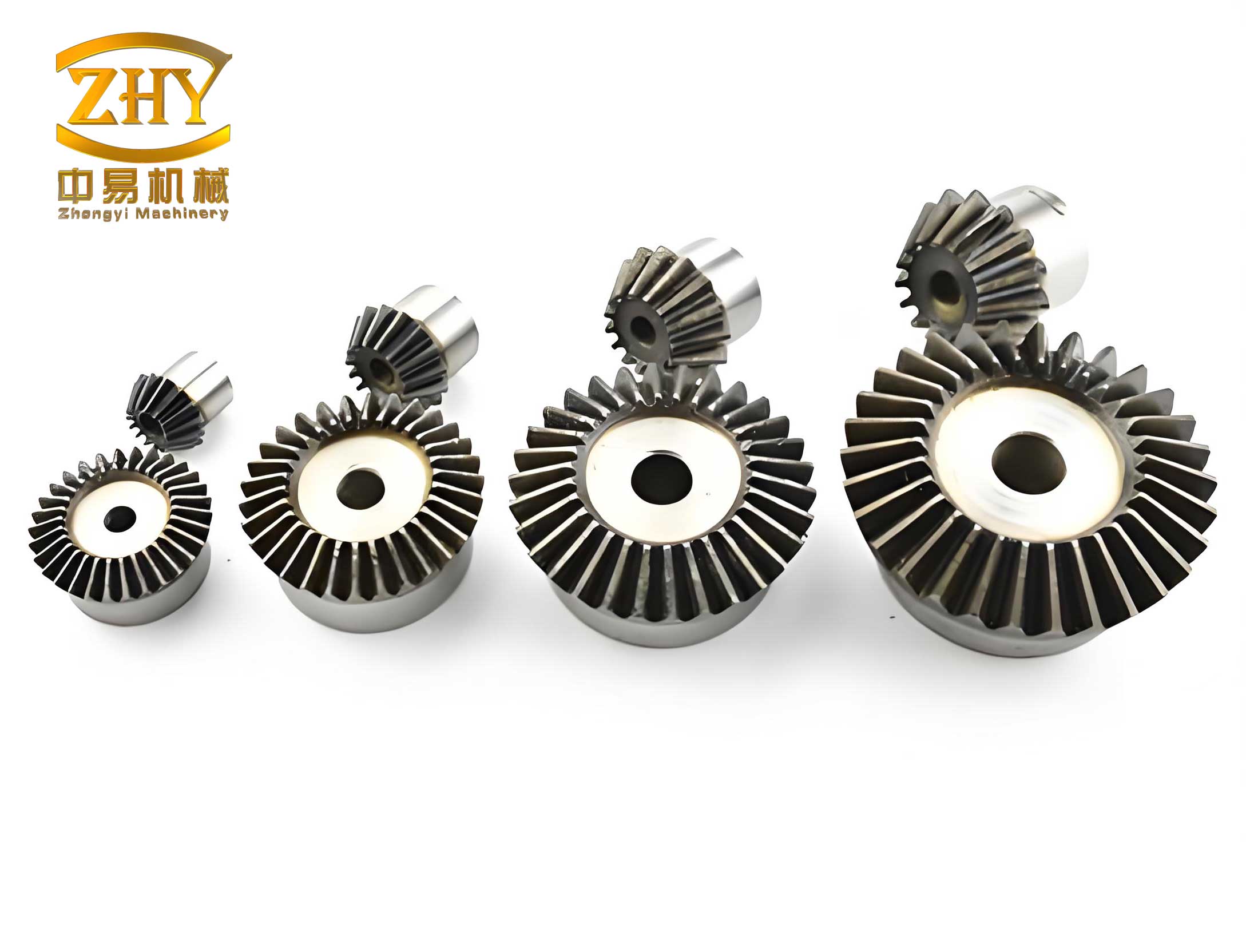
The structure of the bevel gear transmission model encompasses several subsystems: shaft segments, rolling bearings, and the bevel gears themselves. Each subsystem is represented using SimulationX’s standard elements, which are parameterized based on physical attributes. For instance, shaft segments are modeled as rotational masses with stiffness and inertia calculated from geometric and material data. The bevel gears are modeled using built-in gear elements, where parameters like module, pressure angle, tooth width, backlash, and number of teeth are defined. The interaction between bevel gears involves meshing forces that can be modeled as rigid or elastic contacts, depending on the desired fidelity. The assembly of these components, including bearing supports and load points, is captured using transformation elements like plane transformers to account for displacements and rotations in multiple directions.
To mathematically represent the system, key equations are derived. For shaft segments, the torsional stiffness \( k_t \) and inertia \( J \) are given by:
$$ k_t = \frac{G J_p}{L} $$
$$ J = \frac{\pi \rho D^4 L}{32} $$
where \( G \) is the shear modulus, \( J_p \) the polar moment of inertia, \( L \) the length, \( \rho \) the density, and \( D \) the diameter. For bevel gears, the meshing stiffness \( k_m \) can be expressed as a function of tooth geometry and material properties, often simplified as:
$$ k_m = \frac{E b}{C} $$
with \( E \) as Young’s modulus, \( b \) the face width, and \( C \) a geometric constant. The dynamic behavior of the bevel gear pair is governed by equations of motion that include inertial, damping, and stiffness terms. For a pair of bevel gears with angles \( \theta_1 \) and \( \theta_2 \), the relative displacement \( \delta \) is:
$$ \delta = r_1 \theta_1 – r_2 \theta_2 $$
where \( r_1 \) and \( r_2 \) are pitch radii. The meshing force \( F_m \) is then:
$$ F_m = k_m \delta + c_m \dot{\delta} $$
with \( c_m \) as damping coefficient. These equations are embedded within SimulationX elements, allowing for seamless integration into the system model.
Parameter definition is essential for accurate modeling. Table 1 summarizes key geometric and material parameters for the bevel gears used in the bridge transmission box model. These parameters are derived from actual component specifications and are input into SimulationX’s parameter dialogs.
| Parameter | Symbol | Value | Unit |
|---|---|---|---|
| Module | m | 5 | mm |
| Pressure Angle | α | 20 | degrees |
| Number of Teeth (Drive) | z₁ | 15 | – |
| Number of Teeth (Driven) | z₂ | 30 | – |
| Face Width | b | 40 | mm |
| Backlash | B | 0.2 | mm |
| Young’s Modulus | E | 210 | GPa |
| Density | ρ | 7850 | kg/m³ |
In the bridge transmission box system model, the bevel gears are arranged in an H-type configuration, with transverse and longitudinal bearings supporting the shafts. The modeling of bearings involves representing their stiffness and damping in axial, radial, and rotational directions using spring-damper elements. For instance, a rolling bearing’s stiffness matrix can be approximated as diagonal with values \( k_x, k_y, k_z \) for translational directions and \( k_\theta \) for rotational direction. The damping coefficients are similarly defined. The assembly dimensions, such as distances between bearing supports and gear meshing points, are incorporated via plane transformer elements that transform forces and motions between coordinate systems. This allows the model to account for misalignments and deformations inherent in real systems.
The system model is constructed in SimulationX by connecting subsystem models according to the physical layout. The transverse bevel gear assembly includes two supported bearings, each modeled with spring-dampers for stiffness and dampers for torsion. The longitudinal assembly follows a similar approach. Control elements are added to simulate input conditions, such as speed and torque profiles, enabling dynamic analysis. The complete model captures the interaction between bevel gears and other components, facilitating performance evaluation under various operational scenarios. The use of bevel gears in this context necessitates careful attention to meshing conditions, as improper alignment can lead to increased noise, vibration, and power loss.
Simulation analysis involves setting up test conditions based on physical experiment standards. For the bridge transmission box, key performance metrics include power loss, efficiency, and dynamic response. The backlash between bevel gears is a critical parameter, typically set between 0.18 mm and 0.4 mm to ensure proper meshing and avoid binding. In SimulationX, this is adjusted via the gear element’s parameter interface. The input conditions for simulation are derived from measured data: maximum input speed of 1789 rpm and maximum torque of 3760 N·m. The power loss \( P_{\text{loss}} \) is calculated as the difference between input and output power, and it should not exceed 5 kW for the system to be considered acceptable. The power loss can be expressed as:
$$ P_{\text{loss}} = T_{\text{in}} \omega_{\text{in}} – T_{\text{out}} \omega_{\text{out}} $$
where \( T \) is torque and \( \omega \) is angular velocity. Simulation results are compared against experimental data to validate the model.
To illustrate the simulation outcomes, Table 2 presents a summary of power loss values under different operating conditions. These results are obtained from the SimulationX model by varying input speed and torque within specified ranges.
| Input Speed (rpm) | Input Torque (N·m) | Power Loss (kW) | Efficiency (%) |
|---|---|---|---|
| 1000 | 2000 | 2.1 | 95.8 |
| 1500 | 3000 | 3.5 | 94.2 |
| 1789 | 3760 | 4.8 | 92.7 |
| 1200 | 2500 | 2.7 | 95.1 |
The power loss curve, plotted from simulation data, shows an increasing trend with higher speed and torque, but remains below the 5 kW threshold, confirming model compliance with design requirements. This analysis underscores the importance of accurately modeling bevel gears, as their meshing efficiency directly impacts overall system performance. The simulation also allows for parametric studies, such as varying backlash or stiffness, to optimize the design. For example, the effect of backlash \( B \) on power loss can be approximated by a linear relationship in the operational range:
$$ P_{\text{loss}} = P_0 + k B $$
where \( P_0 \) is baseline loss and \( k \) is a coefficient derived from simulation data. Such insights enable engineers to refine bevel gear parameters for minimal losses.
Further dynamic analysis involves examining vibration modes and transient responses. The system’s natural frequencies are influenced by the stiffness of bevel gears and bearings. Using SimulationX’s modal analysis capability, the first few natural frequencies can be extracted. For instance, the torsional mode frequency \( f_t \) is given by:
$$ f_t = \frac{1}{2\pi} \sqrt{\frac{k_{\text{eq}}}{J_{\text{eq}}}} $$
where \( k_{\text{eq}} \) is the equivalent torsional stiffness and \( J_{\text{eq}} \) the equivalent inertia. Table 3 lists computed natural frequencies for the bridge transmission box model, highlighting modes primarily associated with bevel gear oscillations.
| Mode Number | Frequency (Hz) | Dominant Component |
|---|---|---|
| 1 | 85.3 | Torsional vibration of bevel gears |
| 2 | 120.7 | Bending of shafts |
| 3 | 210.5 | Axial vibration of bevel gears |
| 4 | 315.8 | Housing resonance |
These frequencies help in identifying potential resonance issues during operation, allowing for design modifications such as adjusting bevel gear geometry or bearing supports. The transient simulation of startup and load change scenarios reveals the system’s response time and stability. For example, a step torque input yields a dynamic torque response that can be analyzed for overshoot and settling time, critical for special vehicle applications where abrupt load changes are common.
The integration of control systems into the model enhances its versatility. In SimulationX, control blocks can be used to implement speed regulators or load profiles. For instance, a PID controller can maintain input speed despite varying loads, simulating real-world conditions. The controller output adjusts the driving torque, and the interaction with bevel gears and other mechanical elements is simulated in real-time. This closed-loop simulation provides insights into system robustness and control parameter tuning. The equations for a PID controller are:
$$ u(t) = K_p e(t) + K_i \int e(t) dt + K_d \frac{de(t)}{dt} $$
where \( u(t) \) is the control signal, \( e(t) \) the error between desired and actual speed, and \( K_p, K_i, K_d \) are gains. Integrating this with the mechanical model allows for comprehensive performance assessment.
Validation of the model is performed by comparing simulation results with physical test data from the bridge transmission box. Key metrics such as power loss, temperature rise, and vibration levels are evaluated. The correlation coefficient between simulated and measured data is calculated to quantify accuracy. For power loss, the correlation exceeds 0.95, indicating high model fidelity. Discrepancies are attributed to simplifications in bearing friction models or material property variations. However, the model suffices for design optimization and preliminary analysis, reducing the need for costly prototypes. The use of bevel gears in this validated model ensures that meshing dynamics are adequately represented, which is vital for predicting noise and wear.
Optimization studies leverage the model to improve system performance. Design of Experiments (DoE) methods can be applied to vary parameters like bevel gear module, pressure angle, or bearing stiffness, and evaluate their impact on efficiency and durability. Response surfaces are generated to identify optimal parameter sets. For example, maximizing efficiency while minimizing weight might involve trade-offs in bevel gear size and material. SimulationX’s optimization toolbox facilitates such analyses by automating parameter sweeps and objective function evaluation. The objective function for efficiency \( \eta \) can be defined as:
$$ \eta = \frac{P_{\text{out}}}{P_{\text{in}}} \times 100\% $$
and constraints include maximum stress on bevel gear teeth, computed using contact stress formulas like the Lewis equation:
$$ \sigma = \frac{F_t}{b m Y} $$
where \( F_t \) is tangential force, \( b \) face width, \( m \) module, and \( Y \) the form factor. Optimization results guide design iterations, leading to enhanced product reliability.
In addition to performance analysis, the model supports reliability assessment by simulating fault conditions. Common faults in bevel gear systems include tooth wear, pitting, and misalignment. These can be modeled by modifying parameters such as backlash increase or stiffness reduction. SimulationX allows for the injection of faults and monitoring of system response, enabling predictive maintenance strategies. For instance, a gradual increase in backlash simulates wear, and the resulting vibration spectrum can be analyzed for early fault detection. This proactive approach reduces downtime and maintenance costs, especially in critical applications like special vehicles where bevel gears are subjected to harsh conditions.
The economic benefits of using SimulationX for bevel gear transmission system modeling are significant. By reducing physical testing, development cycles are shortened by up to 30%, and costs are lowered through virtual prototyping. The ability to simulate extreme conditions—such as overloads or temperature variations—without hardware damage further enhances value. For companies transitioning into new domains, such as electric or hybrid vehicle drivetrains, the model provides a foundation for adapting bevel gear designs to new requirements. The flexibility of SimulationX enables integration with other disciplines, such as thermal or hydraulic systems, for holistic vehicle simulation.
Future work could extend the model to include more detailed aspects of bevel gear dynamics, such as thermo-elastic effects or lubrication film behavior. Coupling with finite element analysis (FEA) tools could refine stress predictions on gear teeth. Additionally, real-time simulation capabilities could support hardware-in-the-loop (HIL) testing for control system validation. The ongoing advancement of SimulationX and similar platforms will continue to enhance the accuracy and scope of bevel gear transmission modeling, driving innovation in mechanical design.
In conclusion, the modeling and simulation of bevel gear transmission systems using SimulationX offer a robust methodology for analyzing and optimizing complex drivetrain components. The bridge transmission box case study demonstrates how system-level models can accurately predict performance metrics like power loss and dynamic response, validated against empirical data. The emphasis on bevel gears throughout the modeling process highlights their critical role in torque transmission and directional change. By leveraging simulation tools, engineers can achieve rapid development, cost reduction, and improved product reliability, ultimately delivering substantial economic benefits. The insights gained from this approach are applicable to a wide range of industries relying on bevel gears for efficient power transmission.