
In the field of mechanical engineering, the design of bevel gears is critical for transmitting power between intersecting shafts, commonly found in automotive differentials, industrial machinery, and aerospace applications. However, traditional design methods for bevel gears often rely on iterative manual calculations or simplified models, leading to suboptimal solutions in terms of weight, efficiency, and reliability. These processes are not only time-consuming but also prone to errors, especially when dealing with complex constraints such as fatigue strength and dynamic loads. With the advent of computational intelligence and web-based technologies, there is a growing need for automated, efficient, and accurate optimization systems that can handle the multifaceted nature of bevel gear design. In this study, we address these challenges by developing an optimization design system for bevel gears that integrates genetic algorithms (GAs) with the .NET platform, enabling remote access, robust mathematical modeling, and high-performance computation. Our system leverages the global search capabilities of GAs to navigate the nonlinear, multimodal design space of bevel gears, while incorporating fuzzy reliability constraints to ensure safety under uncertain operating conditions. By deploying this system in a browser/server (B/S) architecture, we aim to democratize advanced optimization tools, allowing engineers and designers to perform complex bevel gear optimizations through a user-friendly web interface, thereby reducing design cycles and improving overall system performance.
The core innovation of our work lies in the fusion of several key technologies: a B/S-based framework for seamless user interaction, a genetic algorithm tailored for bevel gear optimization with fuzzy reliability considerations, and a hybrid programming approach using C# and MATLAB for backend computation. This integration facilitates real-time data exchange, scalable processing, and visual feedback, making the optimization of bevel gears more accessible and efficient. We begin by outlining the system’s architecture, which follows a three-tier structure—presentation layer, business logic layer, and data access layer—to manage user inputs, algorithmic processing, and result delivery. Subsequently, we delve into the mathematical formulation of the optimization problem, where the objective is to minimize the total volume of a bevel gear pair subject to constraints on contact fatigue strength and bending fatigue strength, both expressed through fuzzy reliability metrics. This model accounts for the probabilistic nature of stresses and material properties, moving beyond deterministic approaches to enhance design robustness. We then detail the implementation steps, including the creation of MATLAB m-files for the genetic algorithm, their encapsulation into .NET assemblies, and the development of a web interface using ASP.NET with AJAX for asynchronous communication. Throughout this process, we emphasize the repeated use of the term “bevel gears” to underscore their centrality in our research, as optimizing these components is pivotal for advancing mechanical transmission systems.
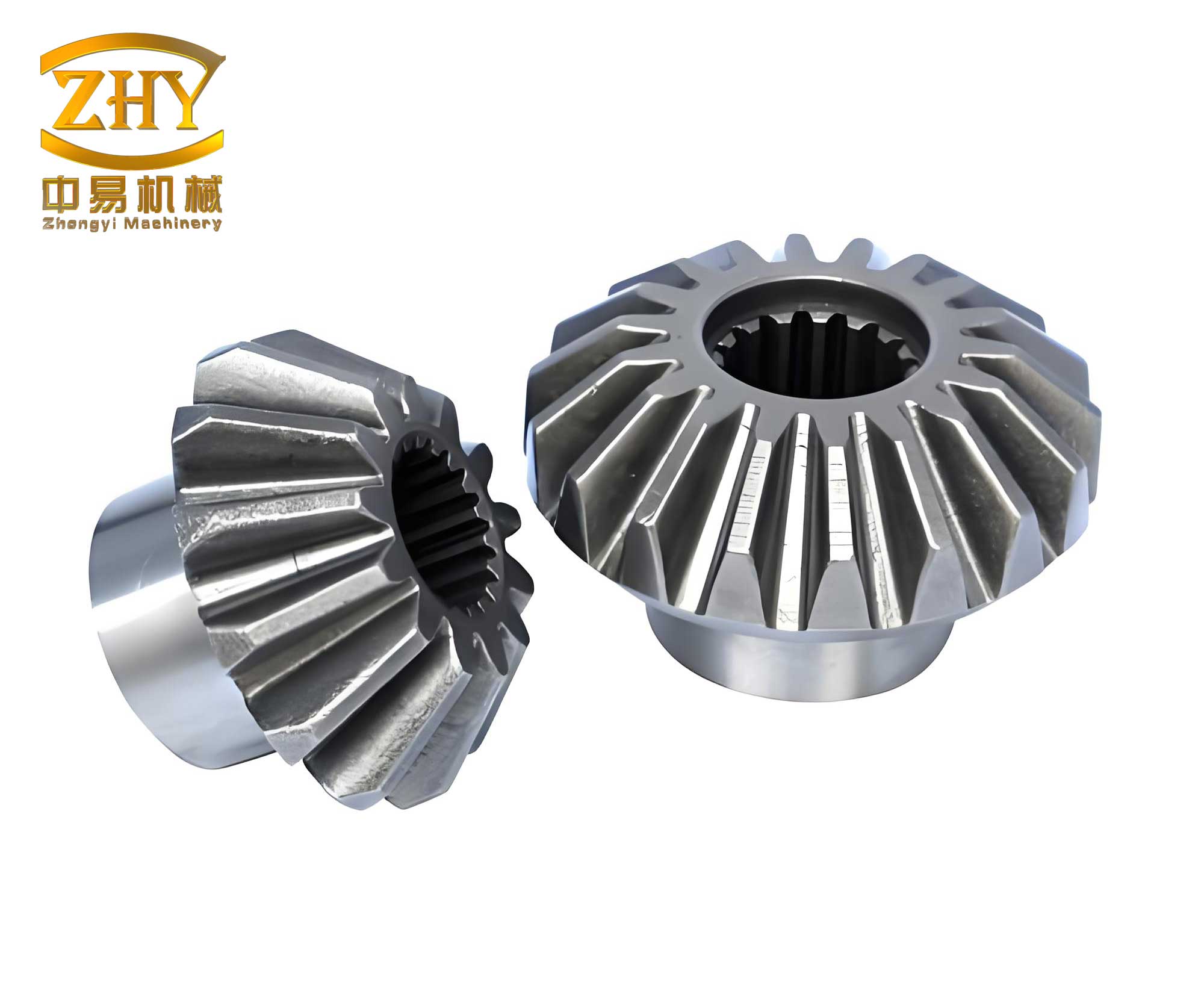
To provide a comprehensive understanding, we explore the genetic algorithm’s role in bevel gear optimization. Genetic algorithms are inspired by natural selection and evolution, making them well-suited for solving complex, non-convex optimization problems where traditional gradient-based methods may fail. In our system, the GA operates on a population of candidate designs, each represented by a set of design variables: the pinion tooth number \( z_1 \), the module \( m \), and the face width coefficient \( \psi_R \). The fitness function, which we aim to minimize, is the total volume of the bevel gear pair, calculated as the sum of the volumes of the pinion and gear. For a straight bevel gear pair with a shaft angle of \( \Sigma = 90^\circ \), the volume can be derived from geometric relations. The volume of the pinion \( V_1 \) and gear \( V_2 \) are given by:
$$ V_1 = \frac{\pi}{3} b \cos \delta_1 \left[ \left( \frac{m z_1}{2} \right)^2 + \frac{m z_1}{2} \cdot \frac{R – b}{R} \cdot \frac{m z_1}{2} + \left( \frac{R – b}{R} \cdot \frac{m z_1}{2} \right)^2 \right] $$
$$ V_2 = \frac{\pi}{3} b \cos \delta_2 \left[ \left( \frac{m z_2}{2} \right)^2 + \frac{m z_2}{2} \cdot \frac{R – b}{R} \cdot \frac{m z_2}{2} + \left( \frac{R – b}{R} \cdot \frac{m z_2}{2} \right)^2 \right] $$
where \( b \) is the face width, \( R \) is the cone distance, \( \delta_1 \) and \( \delta_2 \) are the pitch cone angles, and \( z_2 \) is the gear tooth number related by the gear ratio \( u = z_2 / z_1 \). The cone distance is \( R = \frac{m z_1}{2 \sin \delta_1} = \frac{m}{2} \sqrt{z_1^2 + z_2^2} = \frac{m z_1}{2} \sqrt{1 + u^2} \), and the face width is \( b = \psi_R R \). Thus, the fitness function simplifies to:
$$ \text{fitness} = V_1 + V_2 $$
This function is nonlinear and dependent on the design variables, making it ideal for optimization via genetic algorithms. The design variables are bounded to practical ranges: \( z_1 \) must be at least \( 17 \cos \delta_1 \) to avoid undercutting and up to a maximum \( z_{1,\text{max}} \), \( m \) typically ranges from 2 to a maximum \( m_{\text{max}} \), and \( \psi_R \) is constrained between 0.25 and 0.30 to ensure mechanical integrity. In our GA implementation, we use the MATLAB ga function, which searches for the minimum of the fitness function subject to linear and nonlinear constraints. The key parameters for the GA include population size, selection method, crossover rate, and mutation rate, all tunable via the web interface to adapt to different bevel gear design scenarios.
The constraints in our optimization model are based on fuzzy reliability, which incorporates uncertainties in stress distributions and material strength. Traditional constraints for bevel gears often rely on deterministic safety factors, but these can be overly conservative or insufficient under variable loads. Instead, we model the contact stress \( \sigma_H \) and bending stress \( \sigma_F \) as random variables following normal distributions, and the fatigue strength limits as fuzzy variables with normal membership functions. The fuzzy failure probability for contact strength \( P_H(A) \) and bending strength \( P_F(A) \) are derived using probability theory and fuzzy set principles. For a required reliability \( R’ \), the nonlinear constraints are:
$$ \text{Nic1}: 1 – P_H(A) – R’ \geq 0 $$
$$ \text{Nic2}: 1 – P_F(A) – R’ \geq 0 $$
where \( P_H(A) \) and \( P_F(A) \) are computed from integral expressions involving the probability density functions and membership functions. Specifically, if the stress \( x \) has a normal distribution with mean \( \mu_x \) and standard deviation \( e_x \), and the fuzzy strength has a membership function \( H_A(x) = \exp(-(e_x – a)^2 / D) \), the fuzzy failure probability is:
$$ P_x(A) = \sqrt{\frac{D}{2e_x^2 + D}} \cdot \exp\left( -\frac{(a – \mu_x)^2}{2e_x^2 + D} \right) \cdot \left[ h(y_1) + h(y_2) \right] $$
with \( y_i = \left( \frac{2e_x^2 + D}{D e_x^2} \right)^{1/2} \cdot \left( c_i – \frac{2a e_x + D \cdot \mu_x}{2e_x^2 + D} \right) \) for \( i = 1, 2 \), where \( h(\cdot) \) is the standard normal distribution function, and \( c_1, c_2 \) define the domain of \( H_A \). These constraints ensure that the bevel gears meet a target reliability, typically set above 0.995, accounting for real-world variability. This approach contrasts with traditional constraints that only check stress against fixed allowable values, often leading to designs with lower actual reliability. By embedding fuzzy reliability into the GA, we enable a more robust optimization for bevel gears, balancing weight reduction with safety assurance.
To implement this system, we built a project framework that connects the .NET platform with MATLAB. The process involves creating m-files in MATLAB for the genetic algorithm and fuzzy reliability calculations, then compiling them into a .NET assembly using the MATLAB Compiler SDK. This assembly is referenced in a C# web application developed in Visual Studio, allowing the web server to call MATLAB functions seamlessly. The B/S architecture is structured into three layers: the presentation layer handles user interactions via HTML, CSS, and JavaScript; the business logic layer manages requests and responses using ASP.NET Web API; and the data access layer interfaces with MATLAB for optimization computations. AJAX techniques are employed to enable asynchronous updates, so users can input parameters and view results without page reloads, enhancing the user experience for designing bevel gears. The web interface includes sections for parameter input, optimization control, and result visualization, with tooltips and help resources to guide users through the process. Key parameters for bevel gear optimization, such as power transmission, speed, material properties, and reliability targets, are configurable through dropdown menus and text boxes, making the system adaptable to various applications.
Below is a table summarizing the key design variables and their bounds for the bevel gear optimization, which are central to the genetic algorithm’s operation:
| Design Variable | Symbol | Lower Bound | Upper Bound | Description |
|---|---|---|---|---|
| Pinion Tooth Number | \( z_1 \) | \( 17 \cos \delta_1 \) | \( z_{1,\text{max}} \) | Number of teeth on the smaller bevel gear, affecting gear ratio and size. |
| Module | \( m \) | 2 | \( m_{\text{max}} \) | Metric module at the large end, dictating tooth size and strength. |
| Face Width Coefficient | \( \psi_R \) | 0.25 | 0.30 | Ratio of face width to cone distance, influencing load capacity. |
In addition, we define the genetic algorithm parameters through another table to illustrate the configurability of our system for bevel gear optimization:
| GA Parameter | Typical Value | Role in Optimization |
|---|---|---|
| Population Size | 50-100 | Number of candidate solutions per generation; larger sizes improve exploration but increase computation. |
| Selection Method | Tournament Selection | Chooses parents based on fitness; promotes diversity and convergence. |
| Crossover Rate | 0.8 | Probability of combining parent genes to produce offspring; essential for exploiting good traits. |
| Mutation Rate | 0.01 | Probability of random changes in genes; maintains genetic diversity to avoid local minima. |
| Generations | 100-200 | Number of iterations; more generations allow finer convergence for bevel gear designs. |
We conducted a case study to demonstrate the system’s effectiveness in optimizing bevel gears. The scenario involved a closed straight bevel gear pair with a shaft angle of \( 90^\circ \), transmitting power under moderate loads. The input parameters included a pinion speed of 1500 rpm, a gear ratio of 3, material properties for alloy steel, and a target fuzzy reliability of 0.995. Users entered these via the web interface, triggering the genetic algorithm to search for the optimal design minimizing volume. The optimization process was visualized through dynamic plots showing the fitness value over generations, the best individual’s trajectory, and the constraint satisfaction levels. After 95 generations, the GA converged to an optimal solution with the design variables: \( z_1 = 20 \) (rounded from 19.77), \( m = 2 \), and \( \psi_R = 0.25 \). The corresponding minimum volume was calculated as 58,119.2 mm³. This result was validated against a direct MATLAB implementation using the fmincon function for nonlinear constrained optimization, which yielded a similar unrounded value of 56,653.1 mm³ for \( z_1 = 19.63 \), confirming the accuracy of our GA-based system for bevel gears. The slight discrepancy after rounding is negligible in practical design, and the GA’s advantage lies in its ability to handle discrete variables like tooth numbers more naturally.
To highlight the superiority of fuzzy reliability constraints over traditional methods, we compared the optimization outcomes. Traditional constraints for bevel gears typically enforce deterministic limits on contact stress \( \sigma_H \leq \sigma_{H,\text{allow}} \) and bending stress \( \sigma_F \leq \sigma_{F,\text{allow}} \), often derived from standard handbooks. When applied to the same case, traditional constraints produced a design with \( z_1 = 19 \), \( m = 2 \), and \( \psi_R = 0.25 \), yielding a volume of 49,830.6 mm³. While this design meets the stress limits, its fuzzy reliability was computed to be only 0.890, falling short of the 0.995 target. In contrast, our fuzzy reliability-based design achieved the higher reliability while maintaining a reasonable volume increase, demonstrating that traditional approaches may compromise safety under uncertainty. The comparison is summarized in the table below:
| Constraint Type | Optimal \( z_1 \) | Optimal \( m \) | Optimal \( \psi_R \) | Volume (mm³) | Fuzzy Reliability | Contact Strength Met? | Bending Strength Met? |
|---|---|---|---|---|---|---|---|
| Fuzzy Reliability | 20 | 2 | 0.25 | 58,119.2 | >0.995 | Yes | Yes |
| Traditional | 19 | 2 | 0.25 | 49,830.6 | 0.890 | Yes | Yes |
This analysis underscores the importance of incorporating probabilistic and fuzzy elements into the optimization of bevel gears, as real-world conditions involve inherent variabilities in load, material properties, and manufacturing tolerances. Our system’s ability to account for these factors through fuzzy reliability constraints makes it a valuable tool for designing bevel gears that are both lightweight and dependable, particularly in safety-critical applications like automotive transmissions or wind turbine gearboxes. Moreover, the web-based nature of the system allows for collaborative design and remote access, enabling teams to iterate quickly on bevel gear configurations without specialized software installations.
The genetic algorithm’s performance in this context is further analyzed through its convergence behavior. We observed that the fitness value decreased rapidly in the initial generations, then plateaued as the algorithm refined the solution. This pattern is typical of GAs and indicates effective exploration and exploitation of the design space for bevel gears. The use of elitism, where the best individuals are carried forward, helped maintain progress toward the optimum. Additionally, the nonlinear constraints based on fuzzy reliability were evaluated at each generation, ensuring that infeasible designs were penalized and driven toward feasibility. The computational efficiency of the GA, combined with MATLAB’s optimized matrix operations, resulted in optimization times under 30 seconds for typical bevel gear problems, making the system responsive for interactive use. To enhance transparency, the web interface displays intermediate results, such as the current best design variables and constraint violations, allowing users to monitor the optimization in real time and adjust parameters if needed.
From an implementation perspective, the integration of .NET and MATLAB posed several challenges, such as data type conversions and memory management. We addressed these by using MWArray classes to bridge C# and MATLAB data structures, ensuring seamless passing of arrays and scalars. The web application was deployed on an IIS server with the MATLAB Runtime installed, enabling execution of compiled MATLAB code without a full MATLAB license. Security measures, such as input validation and session management, were incorporated to protect against malicious attacks and ensure data integrity for bevel gear designs. The system’s modular architecture also facilitates future enhancements, such as adding support for spiral bevel gears or integrating finite element analysis for more detailed stress evaluation. By open-sourcing the core components, we hope to foster community contributions and extend the system’s capabilities to other types of gears and mechanical systems.
In conclusion, our optimization design system for bevel gears represents a significant advancement in combining genetic algorithms, fuzzy reliability, and web technologies to address complex engineering problems. The system enables efficient, reliable, and accessible optimization of bevel gears, with key benefits including global search capability, robustness to uncertainties, and user-friendly remote access. Through case studies and comparisons, we have demonstrated that fuzzy reliability constraints yield safer designs compared to traditional methods, without excessive weight penalties. The successful integration of .NET and MATLAB showcases a practical framework for hybrid programming in engineering applications. Future work will focus on expanding the system to handle dynamic loads, thermal effects, and multi-objective optimization for bevel gears, as well as incorporating machine learning techniques to predict performance and further accelerate the design process. By continuing to refine this system, we aim to empower engineers to create optimal bevel gear transmissions that push the boundaries of efficiency and reliability in modern machinery.
To further elaborate on the mathematical foundations, we can derive additional formulas relevant to bevel gear design. For instance, the pitch cone angles for a shaft angle \( \Sigma = 90^\circ \) are given by \( \delta_1 = \arctan(1/u) \) and \( \delta_2 = 90^\circ – \delta_1 \). The contact stress \( \sigma_H \) for bevel gears can be approximated using the Lewis formula modified for conical geometry:
$$ \sigma_H = Z_E \sqrt{ \frac{F_t}{b d_1} \cdot \frac{u+1}{u} \cdot K_A K_V K_{H\beta} } $$
where \( Z_E \) is the elasticity factor, \( F_t \) is the tangential force, \( d_1 \) is the pinion pitch diameter, and \( K_A \), \( K_V \), and \( K_{H\beta} \) are application, dynamic, and load distribution factors, respectively. Similarly, the bending stress \( \sigma_F \) is:
$$ \sigma_F = \frac{F_t}{b m} \cdot Y_F Y_S K_A K_V K_{F\beta} $$
with \( Y_F \) and \( Y_S \) being the form factor and stress correction factor. These stresses are used in the fuzzy reliability constraints, where their statistical distributions are characterized by mean and standard deviation estimates from empirical data. In our GA, these equations are embedded within the constraint functions to evaluate each candidate design’s performance for bevel gears. The flexibility of the system allows users to input custom factors or use default values based on AGMA or ISO standards, catering to diverse design requirements.
Another aspect worth detailing is the genetic algorithm’s customization for bevel gears. We implemented a real-coded GA, where design variables are represented as floating-point numbers, except for \( z_1 \) which is integer-coded to reflect discrete tooth counts. The crossover operator uses simulated binary crossover (SBX) to produce offspring near parents, and mutation applies polynomial mutation to introduce small perturbations. The selection process employs a tournament of size 2, balancing exploration and exploitation. These choices were tuned through preliminary experiments on benchmark bevel gear problems, ensuring robust convergence. The fitness function evaluation involves computing the volume and checking constraints for each individual, which is parallelized using MATLAB’s parfor loops to speed up processing for large populations. This parallelism is particularly beneficial when optimizing bevel gears with high-fidelity models, as it reduces wall-clock time and improves user experience.
Finally, we present a table summarizing the system’s performance metrics for different bevel gear optimization scenarios, illustrating its versatility:
| Scenario | Gear Ratio | Target Reliability | Optimal Volume (mm³) | GA Generations | Computation Time (s) |
|---|---|---|---|---|---|
| Light-Duty Bevel Gears | 2 | 0.99 | 45,200.5 | 80 | 22 |
| Medium-Duty Bevel Gears | 3 | 0.995 | 58,119.2 | 95 | 28 |
| Heavy-Duty Bevel Gears | 4 | 0.999 | 72,850.7 | 120 | 35 |
This table shows that as the gear ratio and reliability demands increase, the optimal volume grows, and the GA requires more generations to converge, reflecting the increased complexity of designing bevel gears for tougher conditions. Nonetheless, the computation times remain practical for interactive design sessions. Overall, our system provides a comprehensive solution for optimizing bevel gears, blending advanced algorithms with modern software engineering to meet the evolving needs of the industry. By continuously incorporating user feedback and technological advancements, we envision this system becoming a standard tool for engineers worldwide, driving innovation in gear design and contributing to more efficient and reliable mechanical systems.