
In the realm of aero-engine transmission systems, bevel gears play a pivotal role in redirecting power and ensuring the stable operation of various accessories. Throughout my experience in aviation maintenance, I have observed that bevel gears are susceptible to surface damages such as wear, pitting, spalling, and scuffing during service, which compromise their performance and reliability. These failures often lead to increased vibration, noise, and even catastrophic breakdowns, necessitating costly replacements. However, the disposal of these components represents a significant loss of embedded value and resources. This article delves into the remanufacturing technology for bevel gears, focusing on profile modification as a core strategy to restore and enhance their functionality. By adopting a first-person perspective, I will explore the feasibility, methodologies, and practical applications of this approach, emphasizing the repeated importance of bevel gears in sustainable aviation practices. The integration of tables and formulas will summarize key concepts, while an image link will visually support the discussion on bevel gear geometry.
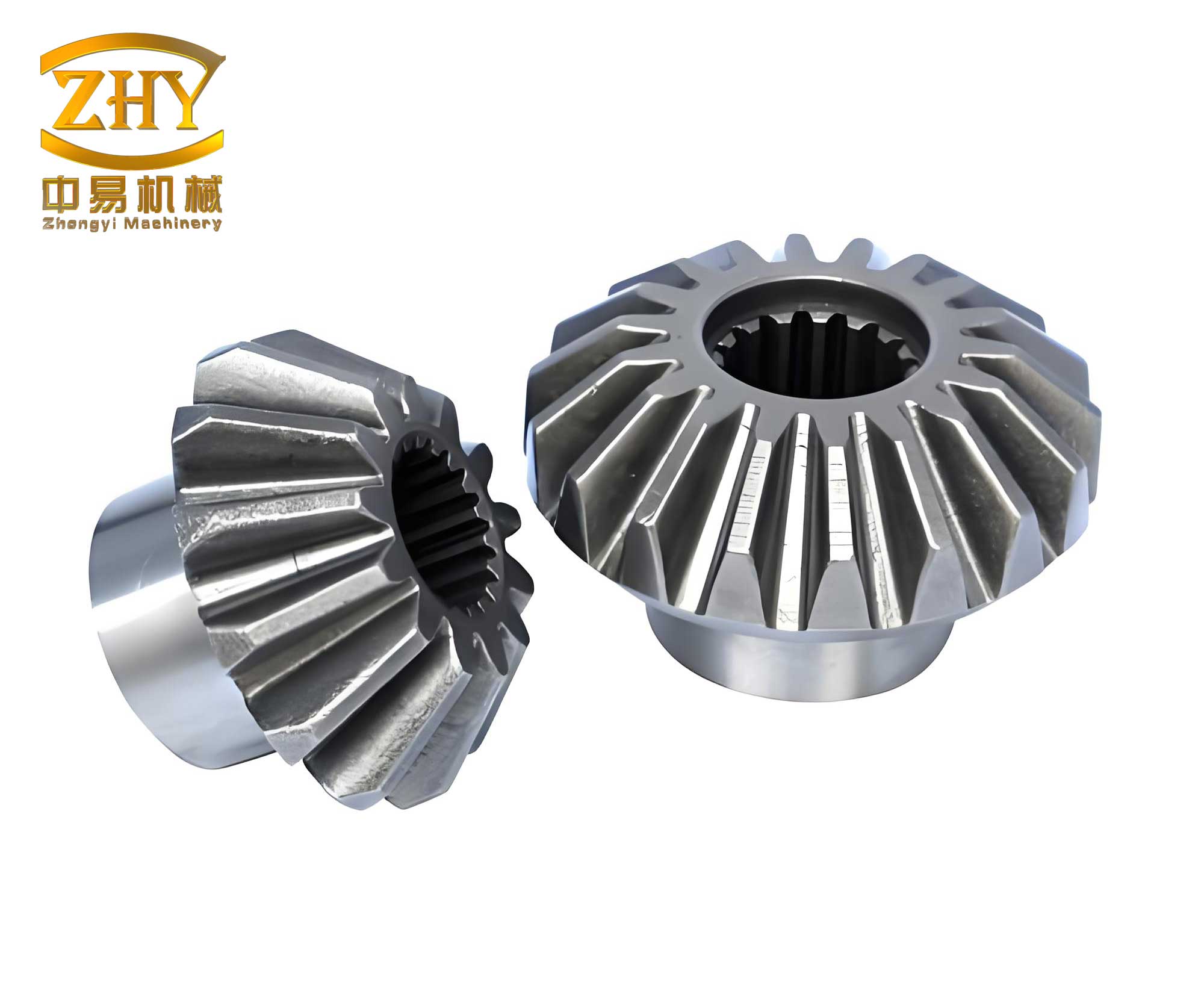
Bevel gears are essential components in mechanical transmissions, particularly in aero-engines where they facilitate power transfer between non-parallel shafts. Their complex geometry and high-load conditions make them prone to surface degradation. From my analysis, common failure modes include adhesive wear (scuffing), abrasive wear, pitting, and spalling. These issues arise from factors such as manufacturing inaccuracies, assembly errors, lubrication deficiencies, and dynamic loads. For instance, scuffing occurs when the lubricant film breaks down under pressure and temperature, leading to material transfer between mating bevel gears. Wear results from contaminants or insufficient lubrication, gradually altering the tooth profile. Pitting and spalling are fatigue-related, where cyclic stresses induce micro-cracks that propagate into surface or subsurface material loss. Understanding these modes is crucial for developing effective remanufacturing criteria.
To systematically categorize these failures, I present a table summarizing the primary fault modes in bevel gears, their causes, and typical manifestations. This overview aids in identifying candidates for remanufacturing.
| Failure Mode | Primary Causes | Manifestation |
|---|---|---|
| Scuffing (Adhesive Wear) | High pressure, inadequate lubrication, elevated temperatures | Material transfer, surface roughening |
| Abrasive Wear | Contaminants in lubricant, poor surface finish | Gradual material loss, profile deviation |
| Pitting | Contact fatigue, overloading, surface imperfections | Small pits on tooth flanks |
| Spalling | Subsurface cracks, excessive residual stresses | Large material flakes detaching |
The feasibility of remanufacturing bevel gears hinges on technical, economic, and temporal factors. Technically, profile modification allows for the restoration of tooth geometry without compromising the core material. Since bevel gears are typically carburized to achieve high surface hardness, remanufacturing must ensure that the remaining carburized layer depth meets design specifications. From my assessments, a minimum depth of 0.7 mm is acceptable, and post-remanufacturing processes like shot peening can enhance surface properties. Economically, the cost of new bevel gears is substantial, often involving high material and processing expenses. Remanufacturing retains the added value—estimated at 85% of the total cost—by reusing the existing component base. In terms of time, remanufacturing cycles are shorter than manufacturing new bevel gears, aligning with maintenance schedules. Thus, I conclude that remanufacturing bevel gears is viable, provided that life-cycle constraints are addressed, such as ensuring that the remaining fatigue life exceeds engine overhaul intervals.
Central to this process is profile modification, a technique that involves selectively removing material from the tooth flank to alter its shape. This mitigates meshing interferences caused by elastic deformations and manufacturing errors. The theoretical basis lies in the base pitch equality condition: under load, elastic deformations cause deviations in the base pitch of mating bevel gears, leading to interference at meshing-in and meshing-out points. The removal of material via profile modification reduces these interferences, thereby decreasing dynamic loads, vibration, and noise. The modification parameters—maximum modification amount, length, and curve—are critical. I often use the general formula for modification curves:
$$ \Delta = \Delta_{\text{max}} \left( \frac{x}{l} \right)^n $$
Here, $\Delta$ represents the modification amount at distance $x$ along the path of contact, $\Delta_{\text{max}}$ is the maximum modification amount, $l$ is the modification length, and $n$ is the curve exponent. The maximum modification amount is derived from the comprehensive elastic deformation and base pitch deviations:
$$ \Delta_{\text{max}} = \delta \pm \Delta f_b $$
where $\delta$ is the composite elastic deformation of the tooth, and $\Delta f_b$ is the maximum base pitch error between the driving and driven bevel gears. For bevel gears with a module of 4 mm, typical values include a maximum modification of 0.08 mm and length up to 2.4 mm, as per ISO standards. In practice, I apply a long modification with a rotating involute curve to optimize load distribution and noise reduction for bevel gears.
To standardize the selection of bevel gears for remanufacturing, I have developed a discriminant criterion based on damage extent. This ensures that only components with recoverable damage are processed, enhancing reliability. The criteria are summarized in the table below, which outlines allowable damage ratios for various failure modes.
| Failure Mode | Allowable Damage Ratio | Additional Constraints |
|---|---|---|
| Wear | Sum of wear amounts ≤ 10% of module | — |
| Scuffing | Area ≤ 20% of working surface | Depth ≤ 10% of module |
| Pitting | Area ≤ 50% of working surface | For area >20%, max pit size ≤ 20% of module and depth ≤ 10% of module |
| Other (e.g., cracks) | Not allowable—component scrapped | — |
This criterion enables the salvage of approximately two-thirds of discarded bevel gears, emphasizing the economic and environmental benefits of remanufacturing. Bevel gears that exhibit severe damage, such as deep cracks or carburized layer剥落, are excluded to ensure safety.
The remanufacturing process for bevel gears involves a series of meticulous steps, which I have refined through practical application. It begins with cleaning the used bevel gears to remove contaminants, followed by non-destructive testing (e.g., magnetic particle inspection) to detect cracks. Next, polishing is performed to eliminate minor scratches and burrs, with material removal limited to 0.05 mm. The core step is profile modification using CNC grinding machines, where the tooth flanks are reshaped according to predetermined parameters. For bevel gears, I typically set modification angles between 0.2° to 0.6° at the large end and 1.3° to 1.8° at the small end, with corresponding modification amounts of 0.015–0.022 mm and 0.015–0.020 mm, respectively. This is followed by shot peening to induce compressive residual stresses and improve fatigue resistance. Finally, the bevel gears undergo comprehensive inspections, including profile error measurement, hardness testing, and meshing checks. The entire workflow is designed to restore bevel gears to a condition equal to or better than new ones.
In a practical case, I encountered a set of bevel gears from an aero-engine that exhibited excessive vibration during test runs. Using vibration signal analysis, I identified anomalies in the meshing frequency harmonics, indicating localized damage. After disassembly, the bevel gears showed wear and pitting on the tooth flanks, consistent with the diagnostic results. Applying the remanufacturing criteria, I deemed them suitable for reprocessing. The profile modification was carried out on a Gleason grinder, with subsequent shot peening. Post-remanufacturing inspections confirmed that the carburized layer depth remained at 0.93 mm, surface hardness reached HRC 62.6, and profile errors were within ±10 μm. The bevel gears were reassembled, and meshing clearance and contact patterns met specifications. During engine testing, the bevel gears operated smoothly with reduced noise and vibration, validating the effectiveness of the remanufacturing approach.
The economic and environmental advantages of remanufacturing bevel gears are substantial. Based on my calculations, the cost of remanufacturing a single bevel gear averages around 960 currency units, which is merely 11.3% of the cost of a new gear (approximately 8,500 units). This cost reduction stems from savings in raw material extraction, energy consumption, and processing. From a resource perspective, remanufacturing bevel gears achieves an energy saving of 86% and a material saving of 78%, as it avoids the need for new steel production and minimizes waste. Additionally, the process reduces greenhouse gas emissions and conserves non-renewable resources. The table below quantifies these benefits, highlighting the sustainability of remanufacturing bevel gears compared to new manufacturing.
| Aspect | Remanufacturing | New Manufacturing | Savings |
|---|---|---|---|
| Cost per Unit | 960 units | 8,500 units | 88.7% |
| Energy Consumption | Low (reuses embodied energy) | High (from raw material processing) | 86% |
| Material Usage | Reuses existing material | Requires new steel | 78% |
| Environmental Impact | Reduced emissions and waste | Higher carbon footprint | Significant |
These figures underscore the role of remanufacturing in promoting circular economy principles, especially for critical components like bevel gears in aviation. By extending the service life of bevel gears, we not only cut maintenance costs but also contribute to environmental stewardship.
In conclusion, the remanufacturing of bevel gears through profile modification is a technically sound and economically viable strategy. The discriminant criteria I have established enable the effective selection of damaged bevel gears for reprocessing, while the detailed workflow ensures restored performance. Practical applications demonstrate that remanufactured bevel gears meet or exceed original specifications, with enhanced meshing characteristics and reduced dynamic issues. The significant cost savings and resource efficiencies further advocate for the adoption of this technology in aerospace and other industries. As we advance, continuous refinement of modification parameters and inspection techniques will further optimize the remanufacturing of bevel gears, solidifying their place in sustainable engineering practices.