
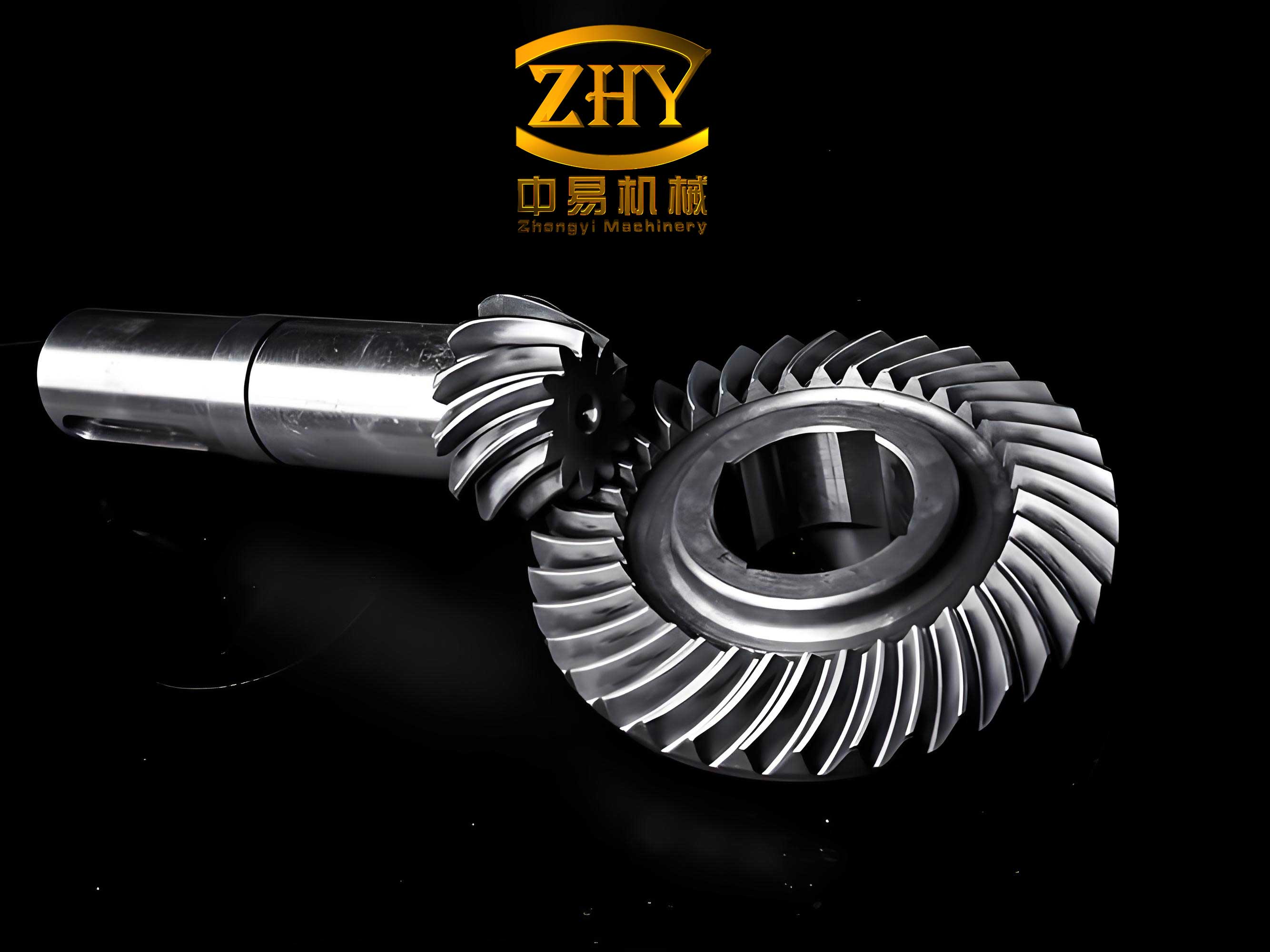
In the realm of mechanical power transmission, spiral bevel gears serve as indispensable components for transmitting motion and force between intersecting or skew axes. Their advantages, including compact structure, smooth and quiet operation, and high load-bearing capacity, make them the preferred choice in demanding applications such as aerospace, wind turbines, marine propulsion, and high-speed rail. The precision of a spiral bevel gear is paramount, and one critical yet often challenging finishing operation is the machining of the tip fillet or chamfer. This process, typically performed after gear grinding, is not merely cosmetic; it is functionally essential for reducing stress concentration at the tooth root and enhancing meshing stability and fatigue life. Inaccuracies in fillet machining—such as uneven profiles, steps, or incomplete rounds—can lead to premature failure under cyclic loading. Therefore, achieving high precision in spiral bevel gear tip fillet machining is a significant industrial challenge.
Conventional automated methods for fillet machining, whether using dedicated tools on gear cutting machines, industrial robots, or multi-axis CNC machining centers, often face two fundamental limitations that cap their achievable accuracy. First, the establishment of the on-machine measurement coordinate system for the workpiece is frequently imprecise. Due to inherent manufacturing tolerances, the actual gear deviates from its perfect theoretical model. Accurately aligning the machine’s coordinate system, especially in angular orientation, to the gear’s design datum becomes non-trivial. Second, even with a reasonably established frame, the programmed tool path derived from the theoretical tooth surface geometry does not perfectly coincide with the actual machined tooth surface of the specific spiral bevel gear. Directly applying this theoretical path can result in machining errors, overcuts, or undercuts on the fillet. This paper addresses these core issues by presenting a comprehensive methodology that integrates iterative coordinate system establishment, measurement model correction, and optimal tooth surface matching to enable the precise machining of spiral bevel gear tip fillets.
Precision Establishment of the On-Machine Measurement Coordinate System
The foundation of any in-situ inspection and compensation machining process is an accurately defined workpiece coordinate system. For a complex component like a spiral bevel gear, establishing a measurement frame (denoted as $S_{om}$: $o_{om}$-$x_{om}y_{om}z_{om}$) that closely aligns with its theoretical design frame ($S_g$: $o_g$-$x_gy_gz_g$) is critical. The conventional approach of probing a few datum features can be insufficient due to part errors. We propose an iterative method that refines the angular orientation of the $x_{om}$-axis by leveraging the geometry of a reference point on the tooth flank.
The process begins with a preliminary setup. First, the gear’s back face (Plane A) is probed at multiple ($m \geq 3$) points $P_{Ak}=[x_{Ak}, y_{Ak}, z_{Ak}, 1]^T$ in the machine coordinate system $S_m$. A plane is fitted using the least-squares method. The plane equation $z = a_0 x + a_1 y + a_2$ is found by minimizing:
$$F(a_0, a_1, a_2) = \frac{1}{2}\sum_{k=1}^{m} (a_0 x_{Ak} + a_1 y_{Ak} + a_2 – z_{Ak})^2$$
Solving $\partial F / \partial a_i = 0$ yields the coefficients. This plane is then offset by the theoretical distance $h$ (from $o_g$ to the back face) to define the $x_{om}o_{om}y_{om}$ plane. Second, the gear’s pilot bore or outer cylindrical surface (Cylinder B) is probed at $n$ points $P_{Bl}$. A cylindrical surface is fitted, and its axis direction $(a, b, c)$ and a point $(x_0, y_0, z_0)$ on the axis are determined by minimizing the distance errors subject to $a^2+b^2+c^2=1$. This axis defines the $z_{om}$ direction, and its intersection with the previously defined plane sets the origin $o_{om}$. Third, an initial $x_{om}$-axis is coarsely set by probing near a theoretical reference point (e.g., the midpoint $P_{53}$ on the tooth flank) and using the line through this measured point parallel to the plane and normal to $z_{om}$.
The crucial refinement step is the iterative alignment of the $x_{om}$-axis. From the theoretical model, we have the exact position $P_{53}$ and its unit normal vector $\mathbf{n}_{53}$ in $S_g$. In the preliminary $S_{om}$, the machine is commanded to probe along this theoretical normal direction at the estimated location of $P_{53}$. The actual contacted point is $P_{a53}=[x_{a53}, y_{a53}, z_{a53}, 1]^T$. If the radial distances $R_{53}=||P_{53}||$ and $R_{a53}=\sqrt{x_{a53}^2+y_{a53}^2}$ are equal within a tolerance $\epsilon$ (e.g., 1 µm), the alignment is perfect. Otherwise, a rotational misalignment $\beta = \arctan(y_{a53}/x_{a53})$ exists. The entire $S_{om}$ frame is rotated around $z_{om}$ by $-\beta$, and the probing of $P_{53}$ is repeated. This loop continues until $|R_{a53} – R_{53}| < \epsilon$, resulting in a highly accurate measurement frame where the $x_{om}$-axis is precisely aligned relative to the actual gear tooth.
Tooth Surface Matching for Accurate Tool Path Generation
With an accurate measurement frame established, the next step is to capture the actual geometry of the spiral bevel gear tooth flanks and align it optimally with the theoretical model. This alignment is necessary to generate a compensated tool path for the fillet operation that faithfully follows the real part, not just the CAD model.
Measurement Point Acquisition and Model Correction
A grid of points is planned on the theoretical tooth surface, typically following standards (e.g., 5 rows along the profile and 9 columns along the length). For a point $P_{ij}$ on the theoretical surface with its normal $\mathbf{n}_{ij}$, the machine probes along $\mathbf{n}_{ij}$ in $S_{om}$. However, due to surface form errors, the probe sphere might contact a point $Q_t$ different from the intended $Q_{ij}$, leading to measurement interference and incorrect error evaluation. To obtain the true corresponding point $Q’_{ij}$ on the actual surface for each theoretical point $P_{ij}$, we first construct a Non-Uniform Rational B-Spline (NURBS) surface $Q(u,v)$ to represent the measured point cloud.
A NURBS surface of degree 3 is defined as:
$$Q(u,v) = \frac{\sum_{i’=0}^{s} \sum_{j’=0}^{t} N_{i’,3}(u) N_{j’,3}(v) \omega_{i’,j’} d_{i’,j’}}{\sum_{i’=0}^{s} \sum_{j’=0}^{t} N_{i’,3}(u) N_{j’,3}(v) \omega_{i’,j’}}$$
where $d_{i’,j’}$ are control points, $\omega_{i’,j’}$ are weights, and $N_{i’,3}(u), N_{j’,3}(v)$ are the B-spline basis functions. The measured points are used to fit this surface. For a given theoretical point $P_{ij}$, we find the parameters $(u_{ij}, v_{ij})$ on the NURBS surface such that the surface normal at $Q(u_{ij}, v_{ij})$ is parallel to $\mathbf{n}_{ij}$. This is done by solving an optimization problem:
$$\min_{u,v} || (P_{ij} – Q(u,v)) \times \mathbf{n}_{ij} || \rightarrow 0$$
The solution $Q’_{ij} = Q(u_{ij}, v_{ij})$ is the true corresponding point on the actual surface, correcting for any probe interference.
Optimal Positional Matching via Six-DOF Adjustment
The set of points $Q’_{ij}$ represents the actual tooth surface in the measurement frame $S_{om}$. To match it with the theoretical surface (defined in $S_g$), we seek a rigid-body transformation that minimizes their deviations. The transformation is defined by three translational ($\Delta x, \Delta y, \Delta z$) and three rotational ($\Delta a, \Delta b, \Delta c$) adjustments. A transformed actual point $Q^b_{ij}$ is calculated as:
$$Q^b_{ij} = \mathbf{M}_c(\Delta c) \cdot \mathbf{M}_b(\Delta b) \cdot \mathbf{M}_a(\Delta a) \cdot \mathbf{M}_{xyz}(\Delta x, \Delta y, \Delta z) \cdot Q’_{ij}$$
where $\mathbf{M}_{xyz}, \mathbf{M}_a, \mathbf{M}_b, \mathbf{M}_c$ are the standard 4×4 homogeneous transformation matrices for translation and rotations about X, Y, Z axes, respectively.
The deviation at a point is the projected distance along the theoretical normal: $E_{ij} = (P_{ij} – Q^b_{ij}) \cdot \mathbf{n}_{ij}$. The goal is to find the optimal adjustment vector $\mathbf{\Delta}^* = [\Delta x, \Delta y, \Delta z, \Delta a, \Delta b, \Delta c]^T$ that minimizes the overall deviation. We formulate this as a constrained nonlinear least-squares problem:
$$\min_{\mathbf{\Delta}} Q(\mathbf{\Delta}) = \frac{1}{2}\sum_{i=1}^{9}\sum_{j=1}^{5} E_{ij}^2(\mathbf{\Delta})$$
$$\text{subject to: } E_{53}(\mathbf{\Delta}) = 0 \text{ (reference point constraint)}$$
$$\text{and } \frac{\partial Q}{\partial \Delta c} \approx 0, \frac{\partial Q}{\partial \Delta a} \approx 0, \frac{\partial Q}{\partial \Delta b} \approx 0$$
The constraint $E_{53}=0$ fixes the positional freedom by defining the deviation at the midpoint reference point as zero. The sensitivity analysis reveals that rotational errors, particularly around the gear axis ($\Delta c$), have the most significant impact on the objective function $Q$. Therefore, gradient constraints related to these rotations are relaxed into inequalities $|\partial Q / \partial \Delta c| \le \xi$, etc., to guide the solver and improve robustness. This optimization problem is solved efficiently using a trust-region method (e.g., Dog-leg algorithm), which approximates $Q(\mathbf{\Delta})$ with a quadratic model within a trusted region and iteratively finds the optimal step $\mathbf{d}_k$.
Once $\mathbf{\Delta}^*$ is obtained, the transformation defines the precise spatial relationship between the actual and theoretical spiral bevel gear tooth surfaces. The tool path for the tip fillet, initially generated from the theoretical model, is then transformed by the inverse of $\mathbf{\Delta}^*$. This compensated path guides the cutting tool relative to the actual gear position, ensuring the fillet is machined accurately at the intersection of the real tooth flank and the tip cone.
Case Study: Implementation and Validation
To validate the proposed methodology, a machining experiment was conducted on a five-axis CNC machining center (Jingdiao GDGR200T). The test specimen was a spiral bevel gear with an outer diameter of 200 mm. The target was to machine a consistent 0.5 mm radius fillet along all tooth tips.
Process Workflow
1. Path Planning: A 0.5 mm radius fillet was modeled on the theoretical spiral bevel gear CAD model in UG NX. A toolpath for a ball-nose end mill was generated and post-processed into NC code.
2. On-Machine Measurement & Matching: The gear was mounted on the CNC machine. The iterative coordinate system establishment was performed. For the test gear, the iterative process converged after adjusting $\beta = 0.015^\circ$. Subsequently, the tooth flank was measured, a NURBS surface was fitted, and the optimal matching transformation was calculated. The result was $\mathbf{\Delta}^* = (-0.00094, -0.00099, 0.00100, 0.00080, -0.00015, -0.00010)$ in mm and radians.
3. Machining: Two methods were compared:
* Conventional Method: The machine’s workpiece zero was set using standard probing (without iterative refinement), and the original theoretical NC code was run.
* Proposed Method: The machine’s workpiece zero was set using the iteratively refined frame. The theoretical NC code was transformed using the inverse of $\mathbf{\Delta}^*$ before execution.
Results and Discussion
After machining, the fillet profiles were measured using a high-precision contour measuring instrument. The results clearly demonstrate the effectiveness of the proposed approach.
| Machining Method | Measured Fillet Radius (mm) | Deviation from 0.5 mm Target (mm) |
|---|---|---|
| Conventional Method | 0.609 | +0.109 |
| Proposed Method | 0.513 | +0.013 |
The conventional method produced a fillet that was over 100 µm larger than specified, indicating a significant misalignment between the tool path and the actual gear. In contrast, the proposed method, which incorporated iterative coordinate alignment and optimal tooth surface matching, achieved a fillet radius within 13 µm of the target. This represents a precision improvement of 96 µm, conclusively validating that the methodology effectively addresses the core challenges of coordinate system inaccuracy and theoretical-actual surface mismatch in spiral bevel gear fillet machining.
Conclusion
This paper presents a systematic and effective methodology for the precision machining of spiral bevel gear tip fillets. By directly confronting the two major sources of inaccuracy—imprecise workpiece coordinate establishment and misalignment between theoretical and actual tooth surfaces—the method enables a significant leap in achievable fillet quality. The iterative technique for refining the on-machine measurement coordinate system ensures that the gear is located in the CNC machine’s frame with high angular accuracy. The subsequent process of capturing the actual tooth surface via corrected probing, modeling it with a NURBS surface, and optimally matching it to the theoretical model through a six-degree-of-freedom transformation allows for the generation of a compensated, highly accurate tool path. The experimental results on a 200 mm diameter spiral bevel gear demonstrate a 96 µm improvement in fillet radius accuracy compared to conventional methods, confirming the practical viability and substantial benefit of this approach. This methodology provides a robust framework for high-precision finishing of critical gear components, ultimately contributing to enhanced performance and reliability in advanced power transmission systems.