
The analysis of dynamic behavior in gear transmissions is fundamentally dependent on an accurate understanding of the time-varying excitations present within the gear mesh. Among these, stiffness excitation, arising from the periodic change in the total effective mesh stiffness as teeth engage and disengage, is a primary source of vibration and noise. Therefore, the precise calculation of gear tooth elastic deformation and the resultant meshing stiffness is a cornerstone of reliable gear dynamics research. While substantial work has been dedicated to developing analytical and numerical methods for determining the meshing stiffness of parallel axis gears like spur and helical gears, the case for spiral bevel gears presents significantly greater challenges.
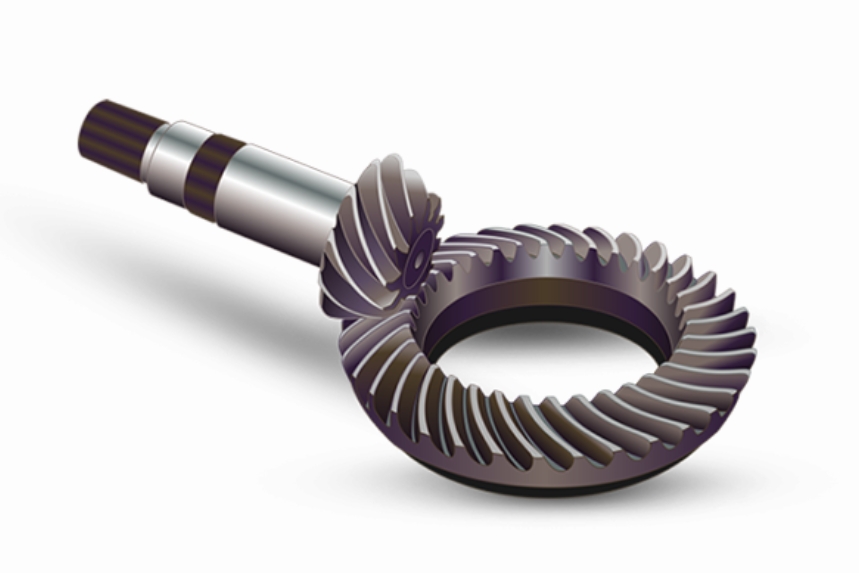
The complex, spatially curved tooth surfaces of a spiral bevel gear make closed-form analytical solutions for load distribution and deflection exceptionally difficult. In many dynamic studies of spiral bevel gears, simplified representations of the mesh stiffness—often modeled as a sinusoidal or cosine series—are employed. These approximations, while computationally efficient, can compromise the accuracy of the dynamic response predictions. This work focuses on establishing a robust, finite element method (FEM)-based procedure for calculating the true time-varying meshing stiffness of spiral bevel gears under loaded conditions. This approach, rooted in the principles of Loaded Tooth Contact Analysis (LTCA) via FEM, provides a high-fidelity foundation for subsequent nonlinear dynamic simulations.
The core objective is to compute the mesh stiffness throughout the complete engagement cycle of a spiral bevel gear pair. The instantaneous mesh stiffness \( k \) is defined as the ratio of the total normal contact force \( F_n \) transmitted across the gear mesh to the total composite elastic deflection \( u_n \) experienced by the contacting teeth along the line of action. For a single tooth pair in contact, the stiffness \( k_n \) is given by:
$$k_n = \frac{F_n}{u_n}$$
The total composite elastic deflection \( u_n \) is a sum of contributions from all elastic deformations in the load path that influence the relative displacement of the contact points. For a comprehensive model, this includes: the localized Hertzian contact deformation \( u_H \), the bending and shear deflections of the gear teeth \( u_b \), and the deformations of the supporting structure (shafts, bearings, housing) \( u_f \). To maintain a focus on the gear mesh itself and limit model complexity, this analysis concentrates on the contributions from the tooth bodies and the contact zone, effectively considering \( u_H \) and \( u_b \). For a contact involving multiple points on a single tooth flank, the total deflection is the sum of contributions from each contact region \( i \):
$$u_n = \sum_{i=1}^{2} u_{Hi} + \sum_{i=1}^{2} u_{bi}$$
During operation, a spiral bevel gear pair typically has multiple tooth pairs in contact simultaneously due to its overlap ratio. The load is shared among these pairs. From a stiffness perspective, these parallel load paths act like springs in parallel. Therefore, the overall mesh stiffness \( k_m \) at any instant is the sum of the individual stiffness values \( k_{ni} \) of all \( p \) tooth pairs that are actively transmitting load:
$$k_m = \sum_{i=1}^{p} k_{ni}$$
The primary challenge in applying these formulas to spiral bevel gears lies in accurately determining \( F_n \) and \( u_n \) for the complex, loaded contact scenario. The contact force is not a simple concentrated load but a distributed pressure over a potentially elliptical contact patch that moves and changes shape across the curved tooth flank. The deflection is not uniform across this patch. Analytical methods struggle with this geometry. Consequently, the Finite Element Method (FEM) is the most viable tool for obtaining accurate numerical solutions for the mechanical response, including contact pressures, forces, and deformations.
Constructing an effective FEM model for spiral bevel gear LTCA requires careful attention to several key steps: geometric model generation, meshing strategy, material definition, contact formulation, and boundary condition application. The process begins with an accurate 3D solid model. Modern techniques often involve generating the conjugate tooth surfaces through numerical simulation of the gear generation process (e.g., face-milling or face-hobbing), resulting in a point cloud. This point cloud is then interpolated using Non-Uniform Rational B-Spline (NURBS) surfaces to create a watertight, CAD-compatible solid model suitable for finite element analysis. A model of a hypoid spiral bevel gear pair is representative of this process.
The finite element discretization is critical for solution accuracy and efficiency. Due to the curved nature of spiral bevel gear teeth, structured hexahedral meshing often leads to element distortion. A robust choice is the use of 8-node linear hexahedral elements with reduced integration (C3D8R in Abaqus notation). Reduced integration elements are less sensitive to mesh distortion compared to fully integrated elements and generally offer better performance in terms of displacement solution accuracy and computational cost for problems dominated by bending, such as gear tooth deflection.
A significant aspect of modeling gears in standard 3D solid element codes is applying rotational boundary conditions and torques, as solid elements have only translational degrees of freedom at their nodes. This is achieved through the use of kinematic coupling constraints. A reference point (RP) is created along the axis of each gear. This RP is then kinematically coupled to the nodes on the inner bore surface of the corresponding gear. This constraint effectively creates a rigid connection between the RP and the gear body. Torques and rotational boundary conditions (fixities) are then applied directly to these reference points, and the constraints transmit these conditions to the gear body, simulating the real mounting and loading scenario.
Before applying the methodology to spiral bevel gears, it is prudent to validate the core FEM approach for stiffness calculation against a well-established benchmark. Spur gear mesh stiffness has been extensively studied, and reliable empirical formulas exist. The validation involves modeling a spur gear pair with the same FEM techniques intended for the spiral bevel gear (element type, contact algorithm, boundary condition application) and comparing the resulting stiffness curve to that from a trusted empirical formula. One such formula, derived from planar strain finite element analysis and regression, calculates single tooth stiffness \( k_i \) at a contact point located a distance \( r_i \) from the gear center \( O_1 \):
$$k_i(r_i) = (A_0 + A_1 X_i) + (A_2 + A_3 X_i)\frac{r_i – R}{X_i m(1 + X_i)}$$
where \( X_i = r_i / R – 1 \), \( m \) is the module, \( R \) is the pitch radius, and the coefficients \( A_0 \) to \( A_3 \) are polynomial functions of the number of teeth \( z_i \).
We select a spur gear pair for validation with the parameters listed in the table below.
| Parameter | Pinion | Gear |
|---|---|---|
| Number of Teeth, \( z \) | 94 | 94 |
| Module, \( m \) (mm) | 1 | 1 |
| Pressure Angle, \( \alpha \) (deg) | 14.5 | 14.5 |
| Face Width, \( b \) (mm) | 12 | 12 |
| Young’s Modulus, \( E \) (GPa) | 210 | 210 |
| Poisson’s Ratio, \( \nu \) | 0.3 | 0.3 |
| Applied Torque, \( T \) (N·m) | 98 | — |
A five-tooth segment model is created and analyzed under load. The FEM-calculated mesh stiffness over one engagement cycle is plotted against the stiffness obtained from the empirical formula. The results show excellent agreement, with only minor discrepancies attributable to the different modeling foundations (3D vs. 2D plane strain). This successful validation confirms that the chosen FEM modeling techniques—C3D8R elements, kinematic coupling, and the contact-solving algorithm—are capable of producing accurate gear mesh stiffness results, thereby justifying their application to the more complex geometry of spiral bevel gears.
The primary case study involves a spiral bevel gear pair manufactured using the Formate (gear) and Generate (pinion) method. The geometric design parameters are as follows:
| Parameter | Pinion | Gear |
|---|---|---|
| Number of Teeth, \( z \) | 17 | 28 |
| Module, \( m \) (mm) | 10.3572 | 10.3572 |
| Face Width, \( b \) (mm) | 50 | 50 |
| Outer Cone Distance, \( R_e \) (mm) | 169.63 | 169.63 |
| Spiral Angle at Heel, \( \beta_e \) (deg) | 35 | 35 |
| Hand of Spiral | Left | Right |
A five-tooth sector model is constructed to balance computational cost with the need to minimize boundary effects from the coupling constraints on the central tooth’s deformation. The model is meshed with C3D8R elements. The material is defined as steel with \( E = 209 \) GPa and \( \nu = 0.3 \). The tooth flanks of the pinion and gear are defined as a surface-to-surface contact pair with a friction coefficient of 0.15. The boundary conditions are applied via kinematic coupling: the gear’s reference point is fixed in all directions except for rotation about its axis, where a torque is applied. The pinion’s reference point is initially fixed, then prescribed a rotational displacement to drive the mesh through a full engagement cycle.
The analysis is performed in three steps to ensure convergence: (1) a small rotational adjustment to eliminate initial backlash and establish stable contact, (2) application of the full torque load to the gear, and (3) driving the pinion through its rotational increment to simulate meshing. The analysis is performed for 30 distinct angular positions of the gear to capture the stiffness variation.
From the FEM results, the key outputs are extracted. The contact force distribution on the central tooth flank is visualized, showing the characteristic elliptical contact patch. The resultant total normal contact force \( F_n \) on this tooth is output as a history variable. Simultaneously, the elastic deformation field \( u_n \) in the contact region is obtained. Since deformation varies across the contact patch, the nodal displacements for nodes in contact (contact force > 0) are averaged to obtain a single composite deflection value for that load state. For each of the 30 angular positions, a pair of values \( (F_n, u_n) \) is obtained.
Using the formula \( k_n = F_n / u_n \), the single-tooth stiffness \( k_n \) is calculated for each position. A sample of the calculated stiffness values for the central tooth pair over the gear rotation is shown in the table below.
| Gear Rotation, \( \theta_g \) (deg) | Stiffness, \( k_n \) (MN/m) | Gear Rotation, \( \theta_g \) (deg) | Stiffness, \( k_n \) (MN/m) |
|---|---|---|---|
| 1 | 105.001 | 16 | 860.490 |
| 5 | 310.046 | 20 | 743.818 |
| 10 | 625.853 | 25 | 420.353 |
| 15 | 849.583 | 30 | 55.611 |
Plotting and interpolating these values yields the single-tooth-pair meshing stiffness curve. The curve exhibits the expected trend: stiffness is lowest at the initial contact point where tooth engagement begins with tip or root contact, rises to a maximum near the pitch point where the tooth is stoutest, and then decreases as engagement progresses towards the opposite flank.
To compute the total mesh stiffness \( k_m \), the contact overlap (contact ratio) must be determined. In the FEM model, this is observed directly from the contact force history of adjacent teeth. The contact ratio \( \varepsilon \) is calculated as the ratio of the single-tooth contact duration \( \Delta T \) to the time delay \( \Delta t \) between the start of engagement of successive tooth pairs:
$$\varepsilon = \frac{\Delta T}{\Delta t}$$
From the force histories of the central three teeth in the five-tooth model, \( \Delta T \) and \( \Delta t \) are measured, yielding a contact ratio \( \varepsilon \approx 2.524 \) for the nominal load case. The single-tooth stiffness curve is then phase-shifted by an angle \( \Delta\alpha = \varphi / \varepsilon \), where \( \varphi \) is the total rotation analyzed, to generate the stiffness curves for the preceding and following tooth pairs. The total mesh stiffness \( k_m \) at any instant is finally obtained by summing the stiffness contributions from all tooth pairs that are in contact at that instant, according to the formula \( k_m = \sum k_{ni} \). The resulting total mesh stiffness curve is periodic and exhibits smaller fluctuations compared to the large variation seen in the single-tooth curve, due to the load-sharing effect.
A crucial aspect of spiral bevel gear behavior is the load-dependent nature of the contact. Different applied torque loads change the contact ellipse size, the load distribution across the face width, and critically, the effective contact ratio. Heavier loads cause greater tooth deflection, which can engage portions of the tooth flank earlier and prolong contact, effectively increasing the instantaneous contact ratio. To investigate this, the analysis is repeated for three different torque loads applied to the gear: 15 MN·m (nominal), 6.5 MN·m, and 0.8 MN·m. The contact force histories are analyzed for each case to determine the load-dependent contact ratio. The results show a clear trend: \( \varepsilon_{15} = 2.524 \), \( \varepsilon_{6.5} = 2.238 \), \( \varepsilon_{0.8} = 1.650 \). The corresponding total mesh stiffness curves are calculated and plotted together.
The comparison reveals significant load-dependence. First, the amplitude of the stiffness variation increases with load. Under higher torque, the teeth deflect more, but the load-sharing among a greater number of teeth (higher \( \varepsilon \)) mitigates the per-tooth load. The summation of stiffer individual tooth paths (due to contact moving to more favorable regions under load) and more paths in parallel leads to a higher mean mesh stiffness. Second, the period of the stiffness fluctuation is also affected because the contact ratio changes. A lower load results in a lower contact ratio, meaning the transition between double and single tooth contact zones is more pronounced, and the periodic pattern of \( k_m \) changes accordingly. This demonstrates that assuming a constant, load-independent stiffness curve for dynamic analysis of spiral bevel gears can lead to inaccuracies, especially under varying load conditions.
In conclusion, this work has detailed a comprehensive finite element methodology for calculating the time-varying meshing stiffness of spiral bevel gears, a critical input for high-fidelity dynamic analysis. The procedure encompasses accurate geometric modeling, appropriate finite element discretization and contact formulation, and careful extraction of force and deflection data. The method was validated against established spur gear results. Applied to a spiral bevel gear pair, it successfully generated single-tooth-pair and total mesh stiffness curves. The investigation into load effects underscored a critical finding: the mesh stiffness of a spiral bevel gear is not a fixed property of its geometry but is strongly dependent on the applied torque. Load influences both the amplitude and the periodic character of the stiffness curve by altering the effective contact ratio and the load distribution on the complex tooth flanks. Therefore, accurate dynamic modeling of spiral bevel gear systems, particularly for applications with significant load fluctuations, must account for this load-dependent stiffness characteristic. The finite element-based approach presented here provides a reliable foundation for obtaining such accurate stiffness data.