
In the field of precision manufacturing, the spiral bevel gear stands as a critical component in transmission systems, where its dimensional accuracy and mechanical performance directly influence operational reliability and efficiency. The die quenching process is widely adopted to enhance the wear resistance and strength of spiral bevel gears while controlling distortion during heat treatment. However, due to the complex geometry of spiral bevel gears, the distortion mechanisms during die quenching cooling are not fully understood, leading to reliance on empirical tuning of process parameters in production. This often results in inconsistent product quality and reduced stability. To address these challenges, we have developed a digital design platform based on a mechanism-data fusion model. This platform enables rapid prediction of quenching distortion under various process conditions and facilitates automated optimization of process parameters, thereby providing a robust tool for improving the manufacturing precision of spiral bevel gears.
The core of our platform lies in integrating high-fidelity numerical simulation results with data-driven modeling techniques. Traditional finite element simulation of the die quenching process for spiral bevel gears is computationally expensive due to the complex structure and large size of the gear, involving multiphysics coupling such as thermal, phase transformation, and mechanical fields. To overcome this limitation, we constructed a surrogate model using radial basis functions (RBF) trained on a dataset generated from high-throughput finite element simulations. This approach allows for fast prediction of distortion responses without the need for repeated costly simulations. The platform also incorporates an optimization module based on the particle swarm optimization (PSO) algorithm to search for optimal process parameters within a defined design space. An interactive graphical user interface (GUI) built with Qt and VTK libraries provides user-friendly access to parameter design, prediction visualization, and optimization results. Throughout this article, we will delve into the architecture, mathematical foundations, implementation details, and practical applications of this digital design platform, emphasizing its role in advancing the heat treatment of spiral bevel gears.
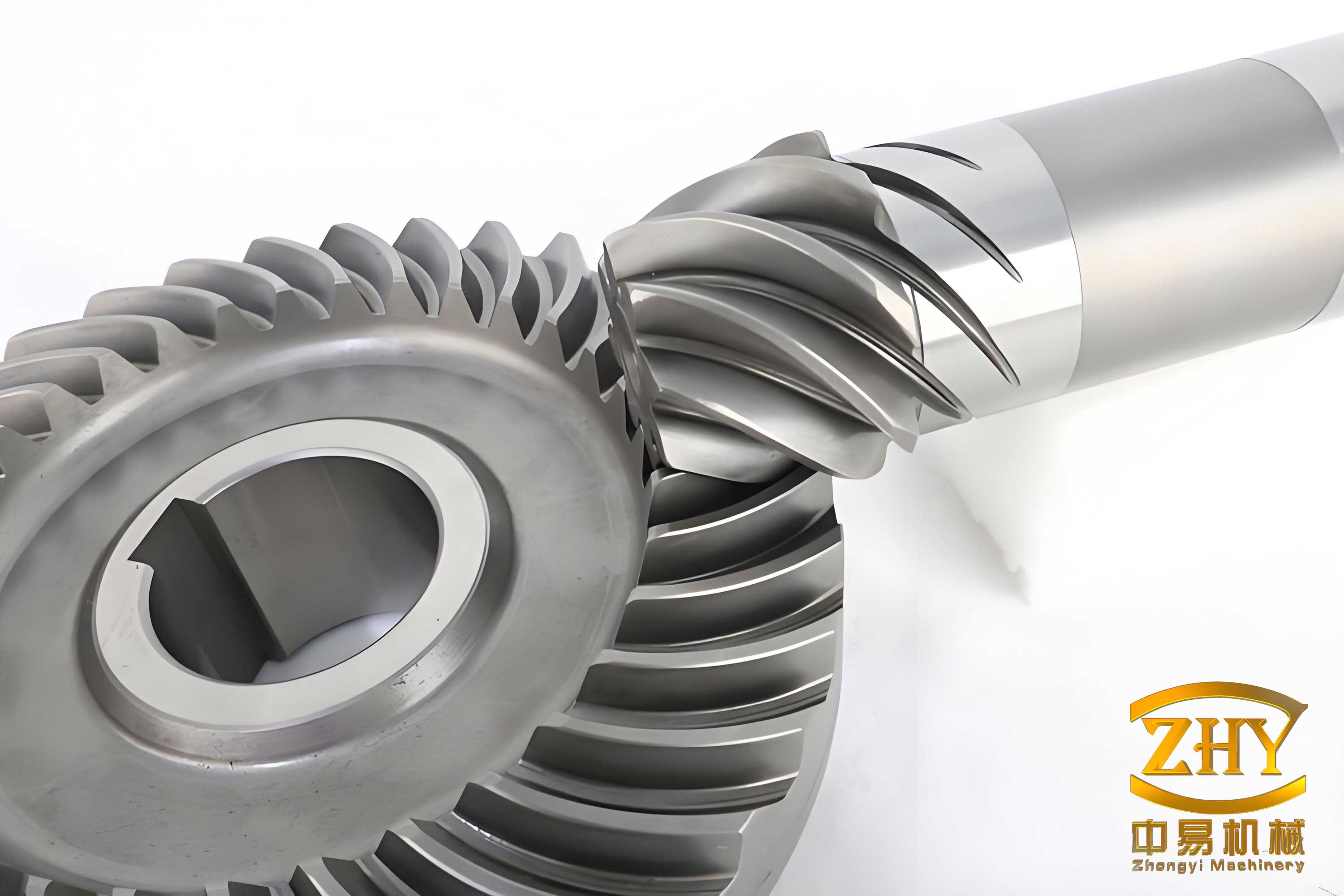
The spiral bevel gear, with its curved teeth and conical shape, is subjected to significant thermal and mechanical stresses during die quenching. The process involves heating the gear to austenitizing temperatures followed by rapid cooling in a die under pressure to control distortion. Key process parameters include die pressure, ring pressure, pressure angle, and die dimensions, all of which interact in complex ways to influence final gear geometry. Without a systematic design approach, manufacturers often face trial-and-error adjustments, leading to increased scrap rates and prolonged development cycles. Our platform aims to streamline this by providing a digital twin of the die quenching process, enabling virtual testing and optimization before physical implementation. By leveraging a mechanism-data fusion model, we combine the physical insights from finite element analysis with the adaptability of data-driven methods, creating a powerful tool for the heat treatment industry.
The architecture of our digital design platform is structured into three layers: the user input interface, the solver layer, and the result post-processing layer. The user input interface, developed using Qt, allows engineers to set process parameters, define optimization objectives, and visualize results. The solver layer encapsulates the RBF-based surrogate model and the PSO algorithm, which form the computational engine. The post-processing layer handles the visualization of distortion contours, stress distributions, and optimization histories using VTK. This modular design ensures scalability and ease of maintenance. The platform operates by first accepting user inputs through the GUI, then invoking the surrogate model to predict distortion responses, and finally rendering the results in an interactive 3D viewer. For optimization tasks, the PSO algorithm iteratively searches the design space, calling the surrogate model to evaluate candidate solutions until convergence criteria are met.
At the heart of the solver layer is the RBF surrogate model, which approximates the input-output relationship between process parameters and distortion responses. We generated a comprehensive dataset of 700 samples using Latin hypercube sampling to ensure uniform coverage of the design space. Each sample corresponds to a set of process parameters, and the resulting distortion data were obtained from finite element simulations performed with MSC.Marc. The RBF model is trained on this dataset to learn the mapping function. Mathematically, the RBF model is expressed as:
$$f(\mathbf{x}) = \sum_{j=1}^{n_c} \omega_j \phi(\|\mathbf{x} – \mathbf{c}^{(j)}\|)$$
where \(\mathbf{x}\) is the input vector of process parameters, \(\mathbf{c}^{(j)}\) are the centers of the radial basis functions, \(n_c\) is the number of centers, \(\phi\) is the basis function, and \(\omega_j\) are the weight coefficients. We employed the multiquadric function as the basis function, given by:
$$\phi(r) = (r^2 + \sigma^2)^{\frac{1}{2}}$$
Here, \(r = \|\mathbf{x} – \mathbf{c}^{(j)}\|\) is the Euclidean distance, and \(\sigma\) is a width parameter controlling the smoothness of the function. The weights \(\omega_j\) are determined by solving a linear system derived from the training data, ensuring that the model interpolates or approximates the known responses accurately. The accuracy of the RBF model was validated against additional simulation data, achieving a prediction accuracy of over 95%. This high fidelity allows the platform to provide reliable distortion predictions in near real-time, with computational responses taking as little as 0.06 seconds per evaluation.
The optimization module utilizes the particle swarm optimization algorithm to find optimal process parameters that minimize distortion objectives. PSO is a population-based stochastic optimization technique inspired by social behavior, such as bird flocking. In our implementation, each particle represents a candidate solution (i.e., a set of process parameters), and the swarm iteratively updates particle positions based on personal and global best solutions. The velocity and position update equations are:
$$\mathbf{v}_i^{(t+1)} = w \mathbf{v}_i^{(t)} + c_1 r_1 (\mathbf{p}_{\text{best},i} – \mathbf{x}_i^{(t)}) + c_2 r_2 (\mathbf{g}_{\text{best}} – \mathbf{x}_i^{(t)})$$
$$\mathbf{x}_i^{(t+1)} = \mathbf{x}_i^{(t)} + \mathbf{v}_i^{(t+1)}$$
where \(\mathbf{v}_i\) and \(\mathbf{x}_i\) are the velocity and position of particle \(i\), \(w\) is the inertia weight, \(c_1\) and \(c_2\) are acceleration coefficients, \(r_1\) and \(r_2\) are random numbers, \(\mathbf{p}_{\text{best},i}\) is the personal best position of particle \(i\), and \(\mathbf{g}_{\text{best}}\) is the global best position found by the swarm. The platform allows users to customize PSO parameters, such as swarm size, iteration count, and learning factors, to tailor the optimization process to specific needs. Additionally, constraints can be imposed on the design variables to ensure practical feasibility. For example, pressures may be limited to safe operational ranges, and die dimensions may be constrained by manufacturing tolerances.
The graphical user interface is designed for intuitive interaction, featuring a main window with toolbars, side panels, and a central 3D viewer. Key functionalities include parameter input, model visualization, node selection for detailed analysis, and optimization setup. The VTK-based viewer supports operations like rotation, zooming, slicing, and contour plotting, enabling users to inspect distortion patterns from various angles. Distortion magnitudes can be scaled for better visualization, and multiple scalar and vector fields (e.g., displacement, stress) can be displayed simultaneously. The interface also includes panels for showing numerical results at selected nodes and plotting optimization history curves. This comprehensive GUI reduces the learning curve for engineers and enhances productivity in process design.
To demonstrate the platform’s capabilities, we present a case study involving the die quenching of a spiral bevel gear from a prototype transmission system. The initial process parameters led to dimensional deviations beyond acceptable limits, affecting gear meshing and performance. The critical process variables identified were: punch pressure (\(p_1\)), ring pressure (\(p_2\)), pressure angle (\(p_3\)), and die size (\(p_4\)). Their design spaces are summarized in the table below:
| Process Variable | Symbol | Design Range |
|---|---|---|
| Punch Pressure | \(p_1\) | [720, 1080] psi |
| Ring Pressure | \(p_2\) | [480, 720] psi |
| Pressure Angle | \(p_3\) | [68.22, 70.12] degrees |
| Die Size | \(p_4\) | [83.22, 85.62] mm |
The primary distortion metrics of concern were the face cone angle deviation and the backplane height change of the spiral bevel gear. Using the platform, we first performed a distortion prediction for a baseline set of parameters: \(p_1 = 850\) psi, \(p_2 = 700\) psi, \(p_3 = 69.05^\circ\), and \(p_4 = 84\) mm. The RBF surrogate model predicted the displacement field, showing significant radial expansion of the gear teeth and downward warping of the backplane. The calculated distortions were: face cone angle change of \(-0.172^\circ\) and backplane height reduction of \(-0.247\) mm. These values indicated the need for process optimization.
We then configured the PSO module to minimize a composite objective function \(J\) that accounts for multiple distortion criteria. The objective function is defined as:
$$\min_{p_1, p_2, p_3, p_4} J(p_1, p_2, p_3, p_4) = \sum_{i=1}^{4} \text{opt}_i$$
where each term \(\text{opt}_i\) represents a weighted distortion component:
$$\text{opt}_1 = w_1 \times |d_1 – d_2|, \quad \text{opt}_2 = w_2 \times |a_1|, \quad \text{opt}_3 = w_3 \times |a_2|, \quad \text{opt}_4 = w_4 \times |d_1 – d_3|$$
Here, \(d_1\) is the axial distortion of the backplane, \(d_2\) is the axial distortion at the barrel bottom, \(d_3\) is the axial distortion at the barrel shoulder, \(a_1\) and \(a_2\) are face cone angle changes, and \(w_i\) are weighting coefficients set based on engineering priorities. The constraints are as given in the table above. After running the PSO algorithm with a swarm size of 200 particles for 30 iterations, the platform converged to an optimal solution. The optimal parameters and the resulting distortion improvements are shown in the following table:
| Parameter | Optimal Value | Baseline Value |
|---|---|---|
| Punch Pressure (\(p_1\)) | 1016.64 psi | 850 psi |
| Ring Pressure (\(p_2\)) | 588.54 psi | 700 psi |
| Pressure Angle (\(p_3\)) | 69.997° | 69.05° |
| Die Size (\(p_4\)) | 85.324 mm | 84 mm |
| Face Cone Angle Change | 0° | -0.172° |
| Backplane Height Change | +0.024 mm | -0.247 mm |
The optimization results demonstrate a remarkable reduction in distortion. The face cone angle deviation was eliminated, and the backplane height change was reduced to a negligible +0.024 mm, well within tolerance limits. This outcome highlights the platform’s effectiveness in identifying process parameters that enhance the dimensional stability of spiral bevel gears after die quenching. The visualization module further allows engineers to examine the predicted distortion patterns under the optimal parameters, confirming uniform contraction and minimal warping compared to the baseline.
Beyond this case study, the platform supports broader applications in heat treatment process design. For instance, it can be adapted to different gear geometries or materials by retraining the RBF model with new simulation data. The modular architecture facilitates integration with other finite element software or experimental databases. Additionally, the platform can be extended to include other quenching media or cooling strategies, making it a versatile tool for the manufacturing industry. The use of surrogate modeling significantly reduces computational costs, enabling rapid exploration of large design spaces that would be prohibitive with direct simulation alone. This is particularly beneficial for spiral bevel gears, where each simulation can take hours or even days on high-performance computing clusters.
In terms of mathematical robustness, the RBF model’s performance depends on the choice of basis function and training data density. We conducted sensitivity analyses to determine the optimal width parameter \(\sigma\) and found that the multiquadric function provided stable interpolations across the design space. The model’s accuracy was quantified using the coefficient of determination \(R^2\) and root mean square error (RMSE) metrics. For our dataset, \(R^2\) values exceeded 0.95 for all key distortion outputs, indicating excellent predictive capability. The PSO algorithm’s convergence behavior was also monitored; typical runs showed rapid improvement in the first 10-15 iterations, followed by refinement towards the global optimum. The algorithm’s stochastic nature helps avoid local minima, which is crucial for nonlinear problems like die quenching distortion.
The digital design platform also incorporates features for result validation and uncertainty quantification. Users can compare surrogate model predictions against new finite element simulations or experimental measurements to assess model drift over time. If discrepancies arise, the model can be updated incrementally with additional data points, ensuring long-term reliability. Furthermore, the platform can generate probabilistic forecasts by incorporating noise models or Monte Carlo sampling, providing confidence intervals for distortion predictions. This is essential for risk assessment in high-stakes applications such as aerospace or automotive transmissions, where spiral bevel gears are subjected to stringent quality standards.
Looking ahead, we plan to enhance the platform with advanced machine learning techniques, such as deep neural networks or Gaussian processes, to handle even more complex input-output relationships. Real-time data integration from sensors during actual quenching processes could enable adaptive control and digital twin applications. Additionally, cloud-based deployment could facilitate collaboration among geographically dispersed teams, accelerating the adoption of digital design in heat treatment workshops. The ultimate goal is to establish a comprehensive ecosystem for spiral bevel gear manufacturing, from design to production, with minimized distortion and maximized performance.
In conclusion, our digital design platform based on mechanism-data fusion represents a significant advancement in the heat treatment of spiral bevel gears. By combining high-throughput simulation, radial basis function modeling, and particle swarm optimization, we have created a tool that enables fast, accurate prediction and optimization of die quenching distortion. The user-friendly interface and robust computational backend empower engineers to design processes efficiently, reducing reliance on trial-and-error and improving product quality. The case study confirms that optimized parameters can effectively control critical dimensions like face cone angle and backplane height, leading to more reliable spiral bevel gears in transmission systems. As manufacturing continues to evolve towards Industry 4.0, such digital platforms will play a pivotal role in achieving precision, consistency, and sustainability in gear production.