
In my extensive involvement with automotive remanufacturing and production engineering, I have consistently faced the persistent challenge of efficiently cleaning spiral bevel gears. These components are not merely parts; they are the linchpins of a vehicle’s final drive system, transmitting tremendous torque and enduring significant shock loads. The shift towards mass production has made traditional cleaning methods a bottleneck, compelling me to explore and develop a specialized solution. This article details my first-hand journey in conceiving, designing, and implementing a through-type turbulent flow cleaning machine tailored explicitly for the high-volume washing of spiral bevel gears. The core innovation lies in harnessing chaotic fluid dynamics to overcome the cleaning dead zones inherent in conventional systems, thereby ensuring the stringent cleanliness required for subsequent pairing, heat treatment, and final assembly processes.
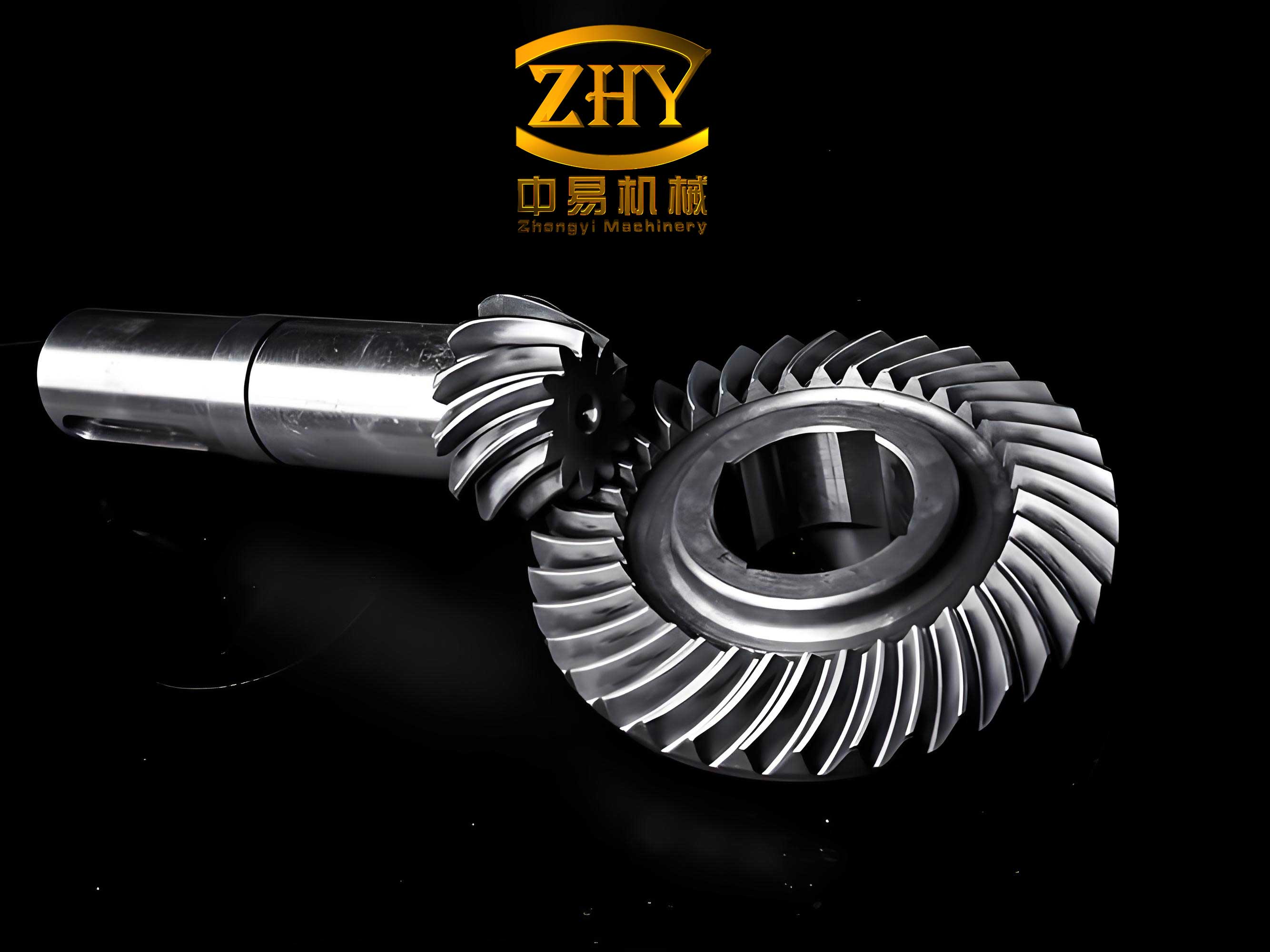
The paramount importance of the spiral bevel gear in automotive drivetrains cannot be overstated. Whether in a single-reduction axle for heavy trucks or as a component within a multi-stage reduction system, the spiral bevel gear is subjected to extreme operational stresses. Its complex, curved tooth geometry is engineered for smooth engagement and high load capacity, but this very complexity complicates post-machining cleaning. In a typical high-volume production line, spiral bevel gears undergo a sequence of operations: rough and finish turning, drilling, tapping, rough and finish milling (or lapping) of the teeth, followed by cleaning, pairing, carburizing, grinding, and final lapping. Each machining stage introduces contaminants—cutting oils, metallic swarf, and grinding particulates—that must be thoroughly removed before critical stages like heat treatment and precision pairing. Any residual contaminant can lead to premature wear, noise, and catastrophic failure. Therefore, the cleaning process is not a mere ancillary step but a vital quality gate.
My initial assessments revolved around evaluating off-the-shelf cleaning equipment. Predominantly, the market offers two types: overhead monorail systems and through-type conveyor belt systems. The overhead system involves manually loading gears onto fixtures, which are then conveyed into a chamber for rotation under spray nozzles. The through-type system involves placing gears individually on a moving belt that passes through a spray tunnel. While versatile for general parts, these systems proved inadequate for the mass production of spiral bevel gears, particularly the large-diameter driven gears (often called the ring gear). The driven spiral bevel gear can weigh between 20 to 50 kg, making manual handling for loading/unloading not only labor-intensive but also a significant source of potential handling damage (nicks and dents). Furthermore, the geometry of the spiral bevel gear is problematic. The back face of the driven gear typically contains 8 to 12 threaded mounting holes. In a static spray setup, whether hanging or on a belt, the directed, laminar flow of cleaning fluid creates shadows and dead zones, leaving the back face and, most critically, the internal threads of these holes inadequately cleaned. The production rate, or cycle time, of these generic machines also struggled to match the fast pace of a dedicated spiral bevel gear machining line, which could process a batch every few minutes.
The epiphany came from analyzing fluid mechanics. Traditional cleaning relies on orderly, directed flow with a predictable velocity vector field. The cleaning efficacy for a given pressure and flow rate is governed by the impact force and shear stress on the part surface. For a complex shape like a spiral bevel gear, a stable flow field will inevitably leave areas with near-zero fluid velocity. The key was to disrupt this order. I hypothesized that by creating a controlled turbulent flow regime within a submerged bath, we could subject the entire surface area of the spiral bevel gear, including hidden recesses and threaded holes, to random, high-velocity fluid eddies. Turbulence is characterized by chaotic, stochastic motion with high mixing and momentum transfer. The governing parameter is the Reynolds number (Re), which predicts the transition from laminar to turbulent flow:
$$Re = \frac{\rho \cdot v \cdot L}{\mu}$$
where $\rho$ is the fluid density, $v$ is the characteristic velocity, $L$ is the characteristic length (e.g., hydraulic diameter of the tank), and $\mu$ is the dynamic viscosity. For water at elevated temperatures (50-70°C), the viscosity decreases, aiding in achieving higher Reynolds numbers. My design goal was to ensure Re > 4000 within the cleaning tank to guarantee fully developed turbulence.
The fundamental design principle was to use the existing production line fixtures directly. These fixtures, or racks, hold multiple spiral bevel gears (typically 4-6 pieces) at a specific angle (15°-20°) for easy transport between machines. My machine would accept the entire rack without requiring any unloading, eliminating handling damage and saving time. The challenge was to clean every spiral bevel gear on this rack thoroughly while it remained in this fixed orientation. The solution was the Through-Type Turbulent Flow Cleaning Machine, whose major components and their functions are summarized in the table below.
| Component | Primary Function | Key Design Parameters |
|---|---|---|
| Turbulent Vibration Wash Tank | Primary cleaning via submerged, chaotic fluid flow and mechanical agitation. | Two opposed 7.5 kW pumps; Flow rate: 120 m³/h each; Tank volume: 3 m³; Vibration frequency: 20-30 Hz; Stroke: 50 mm. |
| Spray Rinse Chamber | Removal of residual cleaning solution and dislodged contaminants. | Multi-directional nozzle array (40 nozzles); Pressure: 0.6 MPa; Rinse time: >90 s. |
| Air Knife Drying Chamber | Removal of bulk water via high-velocity compressed air. | Compressed air pressure: 0.7 MPa; Nozzle configuration: top, left, right. |
| Infrared Drying Chamber | Complete evaporation of residual moisture. | Infrared heater power: 15 kW; Temperature control: 80-100°C. |
| Automated Transfer System | Movement of gear rack between stations without manual intervention. | Soft-push/pull rods; Servo-driven; Positioning accuracy: ±2 mm. |
The heart of the system is the turbulent vibration wash tank. The design incorporates two high-capacity centrifugal pumps mounted on opposite sides of the tank. Each pump draws heated cleaning solution (a water-based detergent at 60-70°C) from a central reservoir and discharges it into the tank through strategically angled inlet ports fitted with flow deflectors. These deflectors are crucial; they are angled to create opposing rotational vortices within the tank. The return flow outlet is positioned centrally at the tank bottom. When both pumps operate simultaneously, the two high-velocity, opposed jets collide in the center of the tank, breaking down into intense, random eddies—the desired turbulent state. The energy dissipation rate per unit mass (ε), a key measure of turbulence intensity, can be approximated for this impinging jet setup:
$$ \epsilon \approx \frac{C \cdot (U^3)}{D} $$
where $U$ is the mean jet velocity, $D$ is the tank diameter, and $C$ is an empirical constant. A high ε value correlates with strong turbulent mixing and scouring action on the spiral bevel gear surfaces.
To further enhance cleaning, I integrated a vertical vibration mechanism for the rack platform. After the rack is lowered into the turbulent bath, the platform oscillates with a short stroke (20-50 mm) at a frequency of 20-30 cycles per minute. This vertical movement constantly alters the relative position of each spiral bevel gear within the chaotic flow field, ensuring that every nook, cranny, and threaded hole is exposed to the high-energy fluid. The dwell time in this primary wash stage is configurable but typically set between 180 to 300 seconds, which has proven sufficient for even heavily soiled spiral bevel gears.
Following the turbulent wash, the rack is elevated and transferred via a soft-pull rod into the spray rinse chamber. Here, a comprehensive network of nozzles delivers a clean water rinse from all directions—top, bottom, left, and right. This step is vital to eliminate any detergent film and remaining particulate matter. The rinse water is typically deionized to prevent spotting. The effectiveness of spray rinsing can be modeled by considering the impingement force and the cleaning factor. The impact pressure (P_imp) of a water jet on a surface is given by:
$$ P_{imp} = \frac{1}{2} \rho v_j^2 $$
where $v_j$ is the jet velocity at the nozzle exit. By ensuring a dense nozzle pattern and adequate pressure, we achieve complete coverage of the complex spiral bevel gear topography.
Subsequent stages address drying. The air knife chamber uses strategically placed nozzles to blow off the majority of the water film. The final infrared drying chamber gently heats the gears to evaporate all residual moisture, preventing flash rusting. The entire process is fully automated and synchronized. The rack, loaded with spiral bevel gears, is pushed onto the machine’s entry roller conveyor. A soft-push rod indexes it into position above the turbulent wash tank. The tank’s elevator lowers the rack into the bath. After the wash cycle, it lifts the rack for transfer to the rinse, air-knife, and drying chambers sequentially, before being pushed out onto the exit conveyor. All chambers are equipped with vapor extraction hoods connected to an exhaust system to maintain a safe and clear working environment.
The performance of this turbulent flow cleaning system was rigorously validated. The most critical quality metric is the cleanliness level of the spiral bevel gear, particularly in the threaded holes. We adopted a gravimetric analysis method: washing a sample gear, then ultrasonically cleaning the threaded holes in a solvent and weighing the extracted contaminant. The results, compared against the older through-type spray washer, were dramatic. The data is best presented in a comparative table.
| Cleaning Method | Avg. Contaminant Weight from Threaded Holes (mg) | Visual Cleanliness (Tooth Face) | Cycle Time per Rack (s) | Labor Required (Loading/Unloading) |
|---|---|---|---|---|
| Traditional Through-Type Spray | 45 – 120 | Acceptable, but oil streaks on back face | ~150 | Manual handling of each gear |
| Turbulent Flow Vibration Wash | 2 – 8 | Excellent on all surfaces | ~240 (including dry) | Only handling of full rack (4-6 gears) |
The improvement is quantitatively clear. The turbulent flow machine reduced particulate contamination in the most critical area by an order of magnitude. While the cycle time per rack is longer, the total labor time and physical strain are drastically reduced because the entire rack is processed as a unit. Furthermore, the elimination of manual handling significantly lowered the defect rate due to磕碰伤 (handling damage). The machine’s adaptability is another strength. By adjusting the rack design, the same core system can clean different sizes of spiral bevel gears, from small pinions to large ring gears. The key parameters—turbulence intensity (controlled via pump speed), vibration frequency, temperature, and chemical concentration—can all be fine-tuned for different soil types or gear materials.
From a theoretical fluid dynamics perspective, the success of this design validates the application of turbulent transport mechanisms for industrial cleaning. The random velocity fluctuations in turbulence ($u’$) enhance the scalar (contaminant) flux. The turbulent diffusivity ($D_t$) is much larger than molecular diffusivity, governed by relations like:
$$ D_t \sim u’ \cdot l $$
where $l$ is the turbulent integral length scale. In our tank, the impinging jets and deflectors create a wide range of eddy scales, from large energy-containing eddies down to small dissipative eddies (Kolmogorov scale), ensuring efficient mixing and contaminant removal from all surface geometries of the spiral bevel gear.
In conclusion, the development of this through-type turbulent flow cleaning machine represents a significant advancement in manufacturing technology for high-volume spiral bevel gear production. By moving away from ordered, laminar-based cleaning to a controlled chaotic fluid environment, we have solved a longstanding bottleneck. The machine addresses the triad of challenges: cleaning effectiveness for complex geometries (like the spiral bevel gear’s back face and threads), high production throughput, and the elimination of manual handling damage. The design principles—utilizing existing fixtures, creating opposing jet-induced turbulence, and incorporating auxiliary vibration—are broadly applicable to the cleaning of other complex, high-value components in automotive and aerospace manufacturing. The spiral bevel gear, a critical and demanding component, now has a cleaning solution that matches its importance to the vehicle’s drivetrain. Future work may involve integrating real-time water quality monitoring and adaptive control of turbulence parameters based on sensor feedback, pushing the boundaries of smart, efficient manufacturing cleaning systems even further.