
In the field of mechanical transmission, spiral bevel gears play a crucial role due to their ability to transmit power between intersecting shafts with high efficiency and smooth operation. Among various types, the Klingelnberg spiral bevel gear, produced using specialized machining processes, represents an advanced design with unique meshing properties. However, comprehensive theoretical and practical studies on its meshing characteristics remain limited. This paper aims to address this gap by conducting an in-depth analysis of the meshing traits of spiral bevel gears, focusing on the derivation of tooth surface equations, investigation of conjugate meshing conditions, and simulation of meshing trajectories. I will employ principles from gear meshing theory and differential geometry to establish mathematical models, followed by computer simulations to visualize and analyze the effects of key parameters. The goal is to enhance the understanding and application of spiral bevel gears in industrial settings, such as automotive and machinery systems, where precise motion transmission is essential.
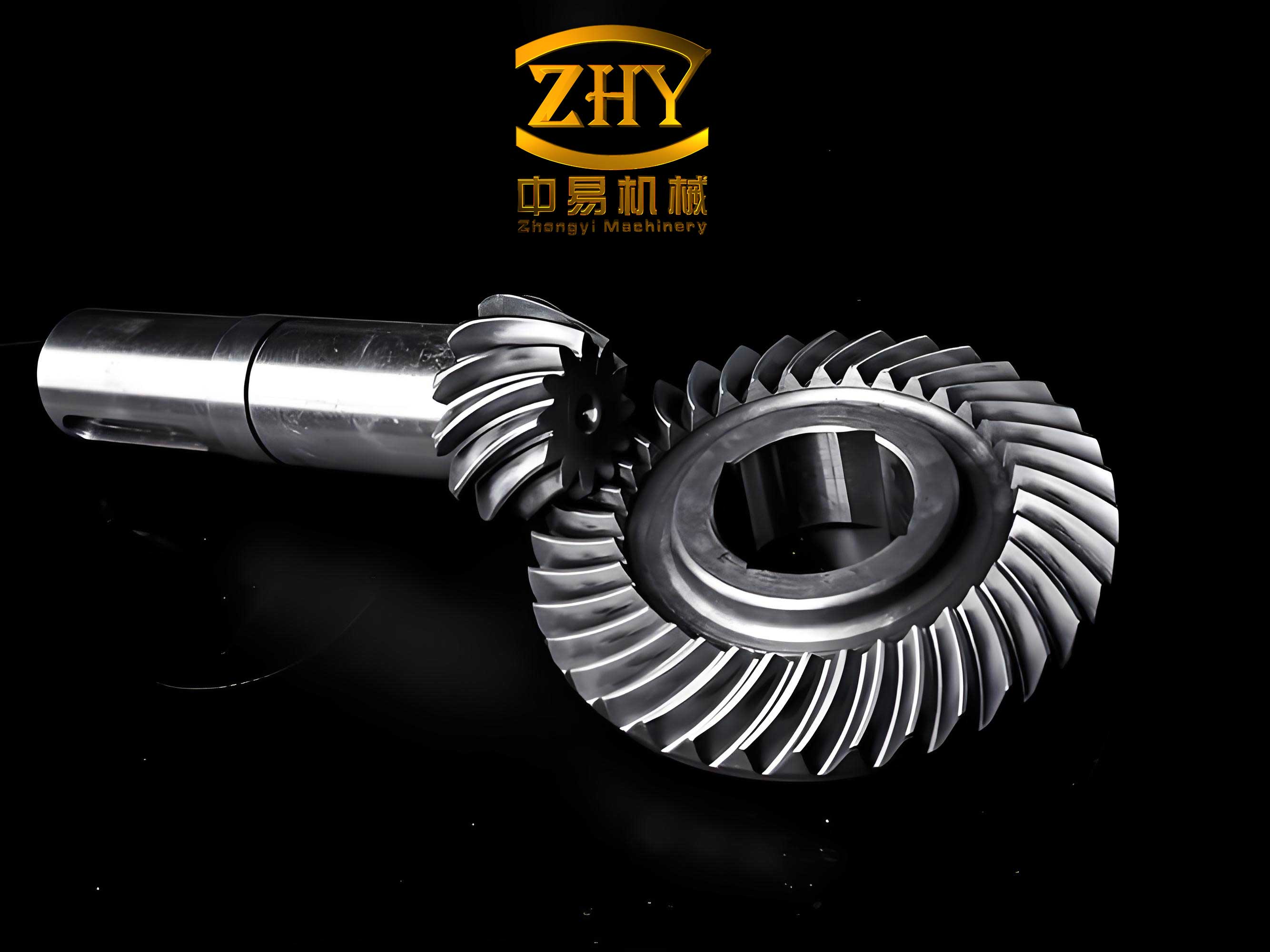
Spiral bevel gears are characterized by their curved teeth, which provide gradual engagement and reduced noise compared to straight bevel gears. The Klingelnberg variant, in particular, is manufactured using a face-milling process with a generating gear, leading to complex tooth geometries that require detailed analysis. In this study, I will first set up coordinate systems to describe the relative motions between the generating gear and the workpiece. Then, I will derive the tooth surface equations for the spiral bevel gear, considering both convex and concave sides. Based on these equations, I will analyze the meshing conditions, including relative velocity vectors, common normal vectors, and contact line equations. Finally, I will use simulation tools to examine the meshing trajectory and identify influential parameters. Throughout this paper, the term “spiral bevel gear” will be emphasized to highlight its significance in transmission systems.
Theoretical Foundation
The analysis of spiral bevel gears relies on fundamental theories from gear meshing principles and differential geometry. Gear meshing theory involves the study of conjugate surfaces that maintain continuous contact during motion transmission, while differential geometry provides tools for describing curved surfaces and their properties. For spiral bevel gears, the tooth surface is generated by the motion of a cutting tool relative to a generating gear, resulting in a ruled surface. The mathematical representation of this surface is essential for predicting meshing behavior. In this section, I will outline key concepts, such as coordinate transformations, surface parametrization, and meshing conditions. The general meshing condition for two surfaces in contact can be expressed as:
$$ \mathbf{N} \cdot \mathbf{V}_{12} = 0 $$
where \(\mathbf{N}\) is the common normal vector at the contact point, and \(\mathbf{V}_{12}\) is the relative velocity vector between the two surfaces. This equation ensures that the surfaces do not penetrate or separate during motion. For spiral bevel gears, this condition must be satisfied along the entire contact path, which is influenced by parameters like pressure angle, spiral angle, and gear geometry.
Coordinate System Setup
To derive the tooth surface equations for spiral bevel gears, I establish multiple coordinate systems that describe the relative positions and orientations of the generating gear, pinion, and gear. This approach simplifies the analysis of meshing dynamics. I define fixed and moving coordinate systems as follows:
- A fixed coordinate system \(O_p – x y z\) attached to the center of the generating gear, with \(O_p – xy\) representing the generating gear’s pitch plane.
- Moving coordinate systems \(O_1 – x_1 y_1 z_1\) and \(O_2 – x_2 y_2 z_2\) attached to the pinion and gear, respectively, which rotate with their respective axes.
The transformations between these systems involve rotation matrices that depend on angles such as \(\theta_p\), \(\theta_1\), and \(\theta_2\), which correspond to the rotational positions of the generating gear, pinion, and gear. For a spiral bevel gear pair with shaft angle \(\delta_1 + \delta_2 = 90^\circ\), the relationships are given by:
$$ \frac{\theta_1}{\theta_p} = \frac{\omega_1}{\omega_p} = \frac{z_1}{z_p} = m, \quad \frac{\theta_2}{\theta_p} = \frac{\omega_2}{\omega_p} = \frac{z_2}{z_p} = n, \quad \frac{\theta_1}{\theta_2} = \frac{\omega_1}{\omega_2} = \frac{z_1}{z_2} = i $$
where \(\omega\) denotes angular velocity, \(z\) denotes tooth number, and \(m\), \(n\), \(i\) are constants. The transformation matrices can be written as:
$$ \mathbf{M}_{p0} = \begin{bmatrix} \cos\theta_p & \sin\theta_p & 0 \\ -\sin\theta_p & \cos\theta_p & 0 \\ 0 & 0 & 1 \end{bmatrix}, \quad \mathbf{M}_{10} = \begin{bmatrix} \cos\theta_1 & \cos\beta_1 \sin\theta_1 & -\sin\beta_1 \sin\theta_1 & 0 \\ -\sin\theta_1 & \cos\beta_1 \cos\theta_1 & -\sin\beta_1 \cos\theta_1 & 0 \\ 0 & \sin\beta_1 & \cos\beta_1 & -R_m \sin\beta_1 \\ 0 & 0 & 0 & 1 \end{bmatrix} $$
and similarly for \(\mathbf{M}_{20}\). Here, \(\beta_1\) and \(\beta_2\) are spiral angles related to the shaft angles. These coordinate systems are crucial for expressing the tooth surface equations in a unified framework.
Derivation of Tooth Surface Equations
The tooth surface of a spiral bevel gear is generated by the cutting edge of a tool during the machining process. For the Klingelnberg spiral bevel gear, a face-milling cutter with straight blades is used, and the generating gear’s tooth surface is a ruled surface formed by the tool’s motion. I consider the generation of a concave tooth surface on the generating gear, which conjugates with the convex surface of the pinion. The derivation begins by defining the position vector of a point on the cutting edge in the fixed coordinate system.
Let \(\mathbf{r}_u\) be the position vector of a point on the cutting edge, expressed as:
$$ \mathbf{r}_u = \mathbf{M}_{dv} + \mathbf{r}_v + \mathbf{u} $$
where \(\mathbf{M}_{dv}\) is the vector from the generating gear center to the cutter center, \(\mathbf{r}_v\) is the vector from the cutter center to a reference point on the cutting edge, and \(\mathbf{u}\) is a vector along the cutting edge. Using parameters such as tool pressure angle \(\alpha_0\), spiral angle \(\beta_m\), and distances \(M_{dv}\) and \(r_v\), the components can be detailed as:
$$ \mathbf{r}_u = (M_{dv} \sin\phi_v – r_v \sin\eta_v – u \sin\alpha_0 \cos\beta_m) \mathbf{i} + (M_{dv} \cos\phi_v + r_v \cos\eta_v + u \sin\alpha_0 \sin\beta_m) \mathbf{j} + u \cos\alpha_0 \mathbf{k} $$
As the cutter rotates relative to the generating gear, the point on the tooth surface is obtained by applying rotation transformations. The resulting position vector \(\mathbf{r}_{pu}\) for a point on the generating gear’s concave surface is:
$$ \mathbf{r}_{pu} = [M_{dv} \sin(\phi_v – \theta) – r_v \sin(\eta_v + l\theta) – u \sin\alpha_0 \cos(\beta_m – l\theta)] \mathbf{i} + [M_{dv} \cos(\phi_v – \theta) + r_v \cos(\eta_v + l\theta) + u \sin\alpha_0 \sin(\beta_m – l\theta)] \mathbf{j} + u \cos\alpha_0 \mathbf{k} $$
where \(\theta\) is the rotation angle of the generating gear, and \(l = \omega_0 / \omega_p\) is the ratio between cutter and generating gear angular velocities. Thus, the parametric equations for the tooth surface are:
$$ x_v = M_{dv} \sin(\phi_v – \theta) – r_v \sin(\eta_v + l\theta) – u \sin\alpha_0 \cos(\beta_m – l\theta) $$
$$ y_v = M_{dv} \cos(\phi_v – \theta) + r_v \cos(\eta_v + l\theta) + u \sin\alpha_0 \sin(\beta_m – l\theta) $$
$$ z_v = u \cos\alpha_0 $$
These equations describe the generating gear’s tooth surface, which is essential for analyzing the meshing of spiral bevel gears. Similar derivations can be performed for convex surfaces and other gear types.
To analyze the meshing between the generating gear and the pinion, I compute the relative velocity vector and the common normal vector. The relative velocity vector \(\mathbf{V}_{1p}\) at a contact point is given by:
$$ \mathbf{V}_{1p} = \mathbf{V}_1 – \mathbf{V}_p = \boldsymbol{\omega}_1 \times \mathbf{r} – \boldsymbol{\omega}_p \times \mathbf{r}_p $$
After substitutions and simplifications, for a shaft angle of \(90^\circ\), this reduces to:
$$ \mathbf{V}_{1p} = \omega_1 \sin\beta_1 \left[ u \cos\alpha_0 (\cos\theta_p \mathbf{i} – \sin\theta_p \mathbf{j}) + \left( -M_{dv} \sin(\phi_v – \theta_p – \theta) + r_v \sin(\eta_v + l\theta + \theta_p) + u \sin\alpha_0 \cos(\beta_m – \theta_p – l\theta) \right) \mathbf{k} \right] $$
The common normal vector \(\mathbf{N}_{pu}\) is derived from the partial derivatives of \(\mathbf{r}_{pu}\) with respect to parameters \(u\) and \(\theta\):
$$ \mathbf{N}_{pu} = \frac{\partial \mathbf{r}_{pu}}{\partial u} \times \frac{\partial \mathbf{r}_{pu}}{\partial \theta} = N^x_{pu} \mathbf{i} + N^y_{pu} \mathbf{j} + N^z_{pu} \mathbf{k} $$
with components:
$$ N^x_{pu} = \cos\alpha_0 \left[ l r_v \sin(\eta_v + l\theta) + l u \cos(\beta_m – l\theta) – M_{dv} \sin(\phi_v – \theta) \right] $$
$$ N^y_{pu} = \cos\alpha_0 \left[ l r_v \cos(\eta_v + l\theta) + l u \sin\alpha_0 \sin(\beta_m – l\theta) + M_{dv} \cos(\phi_v – \theta) \right] $$
$$ N^z_{pu} = \sin\alpha_0 \left[ M_{dv} \sin(\beta_m – \phi_v – k\theta) + l r_v \sin(\beta_m + \eta_v) + l u \sin\alpha_0 \right] $$
The meshing condition \(\mathbf{N}_{pu} \cdot \mathbf{V}_{1p} = 0\) leads to a quadratic equation in \(u\) for given \(\theta_p\) and \(\theta\):
$$ l \sin\alpha_0 \cos(\beta_m – l\theta – \theta_p) u^2 + \left\{ \sin^2\alpha_0 \cos(\beta_m – l\theta – \theta_p) \left[ M_{dv} \sin(\beta_m – \phi_v – k\theta) + l r_v \sin(\beta_m + \eta_v) \right] + M_{dv} \left[ l \sin\phi_v \sin\eta_v \sin(\eta_v + l\theta + \theta_p) – (1 + k \sin^2\alpha_0) \sin(\phi_v – \theta_p – \theta) \right] \right\} u + \left[ l r_v \sin(\beta_m + \eta_v) + M_{dv} \sin(\beta_m – \phi_v – k\theta) \right] \left[ r_v \sin(\eta_v + l\theta + \theta_p) – M_{dv} \sin(\phi_v – \theta_p – \theta) \sin\alpha_0 \right] = 0 $$
This equation indicates two possible contact points for a given position, suggesting double-point contact in the meshing of spiral bevel gears, which is a key characteristic of this gear type.
Analysis of Meshing Characteristics
The meshing characteristics of spiral bevel gears are influenced by various geometric and kinematic parameters. In this section, I analyze factors such as pressure angle, spiral angle, and tooth geometry, and their effects on contact patterns and transmission efficiency. The meshing trajectory, which represents the path of contact points on the tooth surface, is particularly important for assessing performance. Based on the derived equations, I can examine how changes in parameters alter the meshing behavior.
For instance, the pressure angle \(\alpha_0\) affects the tooth thickness and contact stress distribution. A larger pressure angle may increase load capacity but also raise bending stress. The spiral angle \(\beta_m\) influences the smoothness of engagement and axial thrust forces. In spiral bevel gears, a higher spiral angle promotes gradual tooth contact, reducing noise and vibration. Additionally, parameters like \(M_{dv}\) and \(r_v\) from the machining setup determine the tooth profile and meshing conditions.
To quantify these effects, I consider the following key parameters for a spiral bevel gear pair:
| Parameter | Symbol | Typical Value | Influence on Meshing |
|---|---|---|---|
| Pressure Angle | \(\alpha_0\) | 20° | Affects tooth strength and contact ratio |
| Spiral Angle | \(\beta_m\) | 31.17° | Determines smoothness and axial force |
| Tool Radius | \(r_v\) | 138.27 mm | Impacts tooth curvature and contact path |
| Distance | \(M_{dv}\) | 186.23 mm | Influences tooth depth and meshing alignment |
| Rotation Angles | \(\theta_p, \theta\) | Variable | Directly control meshing trajectory |
The meshing condition equation shows that for fixed \(\theta_p\) and \(\theta\), there are two solutions for \(u\), indicating two contact points. This double-point contact can enhance load distribution but may require careful design to avoid interference. The contact line equation describes the set of points where the gear surfaces are in contact at a given instant, and its shape depends on the parameters above. For spiral bevel gears, the contact line typically curves across the tooth face, ensuring gradual load transfer.
Computer Simulation of Meshing Trajectory
To visualize and analyze the meshing trajectory of spiral bevel gears, I employ computer simulation techniques. Using MATLAB, I implement a tooth contact analysis (TCA) program based on the derived equations. The simulation parameters are selected from a typical Klingelnberg spiral bevel gear set, as follows:
- Tooth numbers: \(z_1 = 14\), \(z_2 = 45\)
- Pitch cone angles: \(\delta_1 = 17.28^\circ\), \(\delta_2 = 72.72^\circ\)
- Spiral angle at mid-face: \(\beta_m = 31.17^\circ\)
- Pressure angle: \(\alpha_0 = 20^\circ\)
- Module: \(m_n = 7\) mm
- Tool parameters: cutter head number \(z_0 = 5\), generating radius \(r_v = 135\) mm, generating gear tooth number \(z_p = 47.13\)
After computing machining settings such as machine distance \(M_{dv} = 185.60\) mm and eccentricity \(E_{XB} = 3.27\) mm, I vary the rotation angles \(\theta_p\) and \(\theta\) to simulate the meshing process. The range for \(\theta_p\) is from \(-4^\circ\) to \(5^\circ\) with a step of \(1^\circ\), and for \(\theta\) from \(-10^\circ\) to \(12^\circ\) with a step of \(2^\circ\). The TCA program calculates the contact points and plots the meshing trajectory on the tooth surface.
The simulation results reveal that the meshing trajectory of spiral bevel gears is highly dependent on \(\theta_p\) and \(\theta\). As these angles increase, the contact points shift toward the positive direction of tooth height and tooth width. This behavior is consistent with the theory that meshing evolves along a curved path due to the spiral geometry. The double-point contact is observed in the plots, confirming the quadratic nature of the meshing equation. Below is a summary of the trajectory shifts based on angle variations:
| Angle \(\theta_p\) (degrees) | Angle \(\theta\) (degrees) | Trajectory Shift Direction | Observations |
|---|---|---|---|
| -4 to -2 | -10 to -6 | Toward negative height/width | Initial contact near root |
| -1 to 1 | -4 to 0 | Centered on tooth face | Stable meshing zone |
| 2 to 5 | 2 to 12 | Toward positive height/width | Contact moves to tip |
These findings highlight the importance of controlling rotational positions during gear operation to maintain optimal contact patterns. In practical applications, this can inform design adjustments, such as modifying tooth modifications or alignment settings, to improve the performance of spiral bevel gears. The simulation also demonstrates the effectiveness of TCA in predicting meshing behavior without physical prototyping, saving time and costs in gear development.
Conclusion
In this paper, I have conducted a comprehensive analysis of the meshing characteristics for spiral bevel gears, with a focus on the Klingelnberg type. By applying gear meshing theory and differential geometry, I derived the tooth surface equations for the generating gear and analyzed the conjugate meshing conditions. The key findings include the mathematical representation of the tooth surface as parametric equations, the derivation of relative velocity and common normal vectors, and the establishment of a meshing condition that leads to a quadratic equation indicating double-point contact. This double-point contact is a distinctive feature of spiral bevel gears, contributing to their load-sharing capabilities.
Through computer simulations using MATLAB, I investigated the meshing trajectory and identified the rotation angles \(\theta_p\) and \(\theta\) as primary parameters influencing the contact path. The results show that as these angles increase, the meshing trajectory shifts toward the positive directions of tooth height and width, which can affect gear durability and noise levels. These insights are valuable for designers and engineers working with spiral bevel gears in transmissions, enabling them to optimize gear geometry and machining parameters for enhanced performance.
Future work could extend this analysis to dynamic conditions, considering factors like load variations and thermal effects, to further refine the understanding of spiral bevel gear behavior. Overall, this study underscores the complexity and importance of meshing analysis in advancing the application of spiral bevel gears across industries.