
The reliable transmission of power and motion between intersecting, non-parallel shafts is a fundamental requirement in numerous mechanical systems, ranging from automotive differentials and helicopter rotor drives to heavy industrial machinery. Among the various gear types capable of fulfilling this function, the spiral bevel gear stands out due to its high load-carrying capacity, smooth operation, and relatively low noise and vibration signatures. These advantageous characteristics stem primarily from the gradual, multi-tooth engagement facilitated by its curved teeth. However, like all geared systems, the dynamic performance of spiral bevel gear pairs is profoundly influenced by nonlinear factors inherent in their design and assembly. Chief among these is the gear backlash—the intentional clearance between mating tooth surfaces—which introduces a piecewise nonlinearity into the system equations of motion.
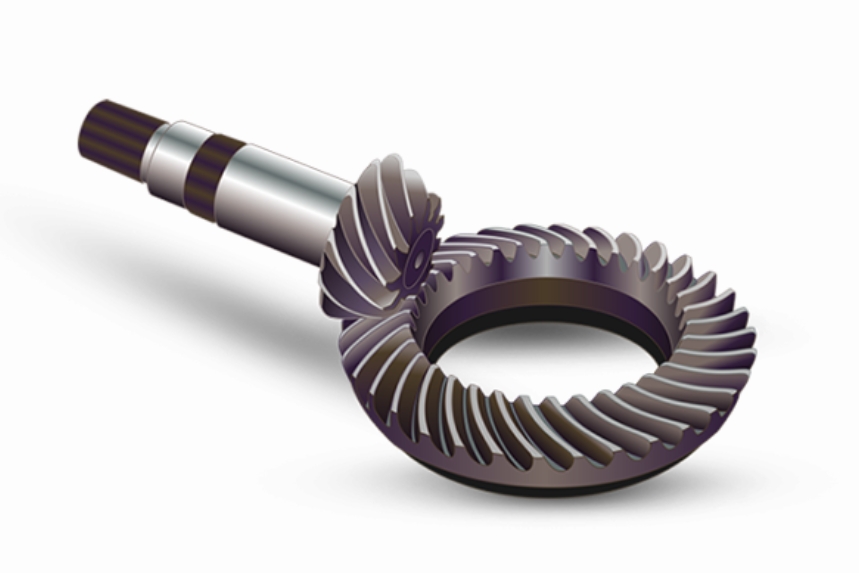
While substantial research has been devoted to the nonlinear dynamics of parallel-axis spur and helical gears, the complex spatial geometry of spiral bevel gears has rendered their dynamic analysis more challenging and less explored. Existing studies often establish torsional vibration models or multi-degree-of-freedom (DOF) models incorporating time-varying mesh stiffness, transmission error, and backlash. These models confirm that such internal excitations can lead to rich nonlinear phenomena, including sub-harmonic resonances, bifurcations, and chaotic motion. A critical, yet often oversimplified, aspect in manufacturing is the assembly backlash. In a batch of produced spiral bevel gear pairs, the actual backlash value for each pair is not a fixed nominal number but rather a random variable, influenced by cumulative errors from gear cutting, heat treatment, and housing assembly. This randomness must be accounted for to predict the dynamic performance of the entire batch reliably.
This article presents a comprehensive investigation into the nonlinear dynamic behavior of spiral bevel gear pairs, with a specific focus on the effects of stochastically distributed assembly backlash. An eight-DOF dynamic model coupling torsional, axial, and transverse vibrations is developed. The system’s response under deterministic backlash is first analyzed to identify stable and unstable parameter regions. Subsequently, the concept of stochastic assembly backlash is introduced, where the backlash is treated as a normally distributed random parameter. By employing the system’s chaotic index, defined via the largest Lyapunov exponent, the relationship between the mean backlash and a critical variance is established. This relationship provides a crucial theoretical guideline for selecting appropriate manufacturing tolerances to ensure stable dynamic performance for the entire batch of spiral bevel gear transmissions.
1. Dynamic Modeling of the Spiral Bevel Gear System
Establishing an accurate dynamic model is the foundational step for analyzing the nonlinear behavior of spiral bevel gear pairs. The complex three-dimensional contact necessitates a model that accounts for coupling between different vibration modes. The lumped-parameter method is employed here to derive an eight-degree-of-freedom model.
1.1 Coordinate System and Displacement Variables
Consider a spiral bevel gear pair with a shaft angle of 90°. The global coordinate system \(Oxyz\) is established at the intersection point \(O\). The pinion and gear rotational axes are aligned with the \(y\)- and \(x\)-axes, respectively. The gear bodies are simplified as lumped masses and inertias concentrated at their mid-face width points, \(O_p\) and \(O_g\). The supporting bearings are modeled by linear stiffness and damping elements in three translational directions: \(k_{ij}, c_{ij}\) where \(i = x, y, z\) and \(j = p, g\). The gear mesh is represented by an equivalent time-varying mesh stiffness \(k_h(t)\) and a constant mesh damping \(c_h\) acting along the line of action.
The generalized displacement coordinate vector \(\mathbf{q}\) is defined as:
$$ \mathbf{q} = [X_p, Y_p, Z_p, \theta_p, X_g, Y_g, Z_g, \theta_g]^T $$
where \(X_j, Y_j, Z_j\) (\(j = p, g\)) are the translational displacements of the pinion and gear along the \(x\)-, \(y\)-, and \(z\)-axes, and \(\theta_p, \theta_g\) are the rotational displacements (angular vibrations) about their respective axes.
1.2 Nonlinear Mesh Force and Backlash Function
The cornerstone of the nonlinear model is the calculation of the dynamic mesh force. This begins with defining the relative displacement along the normal direction of the tooth surfaces at the mesh point, which includes contributions from gear body vibrations and manufacturing errors.
The normal relative displacement \(\lambda_n\) is given by:
$$ \lambda_n = (X_p – X_g)c_1 – (Y_p – Y_g)c_2 – (Z_p – Z_g + r_p \theta_p – r_g \theta_g)c_3 – e_n(t) $$
where:
- \(c_1 = \cos \delta_p \sin \alpha_n\), \(c_2 = \cos \delta_p \cos \alpha_n \sin \beta_m\), \(c_3 = \cos \alpha_n \cos \beta_m\).
- \(\delta_p\) is the pinion pitch cone angle.
- \(\alpha_n\) is the normal pressure angle.
- \(\beta_m\) is the mean spiral angle at the face width center.
- \(r_p, r_g\) are the radii at the mean point of contact for the pinion and gear, respectively.
- \(e_n(t)\) is the static transmission error, often modeled as a periodic excitation: \(e_n(t) = \sum_{r=1}^n E_r \cos(r \Omega_h t + \phi_{er})\), with \(\Omega_h\) as the mesh frequency.
The dynamic mesh force \(F_n\) along the line of action is then:
$$ F_n = k_h(t) f(\lambda_n) + c_h \dot{\lambda}_n $$
The time-varying mesh stiffness \(k_h(t)\) is periodic with the mesh frequency: \(k_h(t) = k_m + \sum_{r=1}^n \Delta k_r \cos(r \Omega_h t + \phi_{kr})\), where \(k_m\) is the mean stiffness.
The critical nonlinear element is the backlash function \(f(\lambda_n)\), which is piecewise-linear:
$$ f(\lambda_n) =
\begin{cases}
\lambda_n – b_m, & \lambda_n > b_m \\
0, & |\lambda_n| \le b_m \\
\lambda_n + b_m, & \lambda_n < -b_m
\end{cases} $$
where \(b_m\) is half of the mean normal backlash at the mid-face width. This function models the loss of contact when the gears separate and the re-establishment of contact on the opposite flank.
The mesh force components in the \(x\)-, \(y\)-, and \(z\)-directions are:
$$
\begin{aligned}
F_x &= -F_n (\sin \alpha_n \cos \delta_p + \cos \alpha_n \sin \beta_m \sin \delta_p) = -d_1 F_n \\
F_y &= F_n (\sin \alpha_n \sin \delta_p – \cos \alpha_n \sin \beta_m \cos \delta_p) = d_2 F_n \\
F_z &= F_n \cos \alpha_n \cos \beta_m = d_3 F_n
\end{aligned}
$$
1.3 Equations of Motion
Applying Newton’s second law to the pinion and gear masses and inertias yields the following eight equations of motion:
$$
\begin{aligned}
m_p \ddot{X}_p + c_{xp} \dot{X}_p + k_{xp} X_p &= F_x \\
m_p \ddot{Y}_p + c_{yp} \dot{Y}_p + k_{yp} Y_p &= F_y \\
m_p \ddot{Z}_p + c_{zp} \dot{Z}_p + k_{zp} Z_p &= F_z \\
J_p \ddot{\theta}_p &= T_p(t) – F_z r_p \\
m_g \ddot{X}_g + c_{xg} \dot{X}_g + k_{xg} X_g &= -F_x \\
m_g \ddot{Y}_g + c_{yg} \dot{Y}_g + k_{yg} Y_g &= -F_y \\
m_g \ddot{Z}_g + c_{zg} \dot{Z}_g + k_{zg} Z_g &= -F_z \\
J_g \ddot{\theta}_g &= T_g(t) – F_z r_g
\end{aligned}
$$
where \(m_p, m_g\) and \(J_p, J_g\) are the masses and polar moments of inertia of the pinion and gear, respectively. \(T_p(t)\) and \(T_g(t)\) are the input and load torques. The load torque can include a constant part and a fluctuating part: \(T_p(t) = T_{pm} + T_{pv}(t) = T_{pm} + \sum_{r=1}^n T_{pr} \cos(r \Omega_F t + \phi_{Tr})\).
1.4 Dimensionless Formulation
To facilitate numerical analysis and generalize the results, the equations are nondimensionalized. The following dimensionless parameters and variables are introduced:
- Characteristic displacement: \(b_c\) (often related to \(b_m\))
- Natural frequency: \(\omega_n = \sqrt{k_m / m_e}\), where \(m_e = \frac{J_p J_g}{r_p^2 J_g + r_g^2 J_p}\) is the equivalent mass.
- Dimensionless time: \(\tau = \omega_n t\).
- Dimensionless displacements: \(x_j = X_j / b_c,\ y_j = Y_j / b_c,\ z_j = Z_j / b_c,\ \lambda = \lambda_n / b_c\).
- Dimensionless backlash: \(b = b_m / b_c\).
- Frequency ratios: \(\omega_h = \Omega_h / \omega_n,\ \omega_F = \Omega_F / \omega_n\).
- Dimensionless stiffness and damping ratios:
$$ \kappa_{ij} = \frac{k_{ij}}{m_j \omega_n^2},\ \zeta_{ij} = \frac{c_{ij}}{2 m_j \omega_n};\quad \kappa_h = \frac{k_h(\tau)}{m_e \omega_n^2},\ \zeta_h = \frac{c_h}{2 m_e \omega_n} $$
Substituting and combining the equations, a single dimensionless equation governing the mesh relative displacement \(\lambda\) can be derived, assuming rigid body modes are of primary interest for the backlash nonlinearity study. The simplified dimensionless equation is:
$$ \ddot{\lambda} + 2 \zeta_h d_3 \dot{\lambda} + \kappa_h d_3 f(\lambda) = f_{m} + f_{v}(\tau) + f_{e}(\tau) $$
where:
- \(\ddot{\lambda}\) and \(\dot{\lambda}\) denote derivatives with respect to \(\tau\).
- \(f_{m} = \frac{T_{pm}}{m_e b_c \omega_n^2 r_p}\) is the dimensionless mean force.
- \(f_{v}(\tau) = \sum A_{Fr} \cos(r \omega_F \tau + \phi_{Fr})\) is the dimensionless fluctuating force.
- \(f_{e}(\tau) = -\ddot{e}(\tau)/b_c = \sum \frac{A_{er}}{b_c} (r \omega_h)^2 \cos(r \omega_h \tau + \phi_{er})\) is the dimensionless excitation from transmission error.
- The nonlinear function becomes:
$$ f(\lambda) =
\begin{cases}
\lambda – b, & \lambda > b \\
0, & |\lambda| \le b \\
\lambda + b, & \lambda < -b
\end{cases} $$
2. Nonlinear Dynamic Analysis Under Deterministic Backlash
Before introducing randomness, it is essential to understand the system’s behavior under a fixed, deterministic backlash value \(b\). The dimensionless equation is solved numerically (e.g., using the Runge-Kutta method) for a representative set of parameters. A typical bifurcation diagram and the corresponding plot of the largest Lyapunov exponent (LLE) versus backlash \(b\) reveal the system’s dynamic regimes.
For parameters \(f_m = 0.5\), \(f_v\) amplitude = 2.092, \(\epsilon = 0.2\), \(\omega_h = 1\), and \(\zeta_h = 0.05\), with \(b\) varying in the range [0, 2], the following behavior is observed:
- Stable Periodic/Quasi-Periodic Regions:
- For \(b \in [0, 0.96815]\), the system exhibits a stable periodic-1 (P-1) or quasi-periodic motion.
- For \(b \in [1.045836, 1.685265]\), the response is again a stable P-1 or quasi-periodic motion.
- For \(b \in [1.852593, 2]\), stable quasi-periodic motion prevails.
- Critical Backlash Values & Transitions: At the boundaries of these stable intervals—specifically at \(b \approx 0.968150\), \(1.045836\), \(1.685265\), and \(1.852593\)—the system undergoes bifurcations. These specific backlash values are termed critical backlash values, where the system’s dynamic state changes abruptly, potentially entering chaotic or higher-periodic orbits in the intervening ranges.
The Largest Lyapunov Exponent (LLE) serves as a quantitative measure: an LLE \(\approx 0\) indicates a periodic limit cycle, an LLE \(< 0\) indicates a stable fixed point (or a periodic orbit in some contexts, but typically for maps), and an LLE \(> 0\) is a definitive signature of chaotic motion. The analysis confirms that within the stable regions mentioned, the LLE is non-positive, while it becomes positive in the transitional ranges between critical backlash values.
This analysis provides a crucial baseline: if every spiral bevel gear pair in a batch had a fixed backlash \(b\) chosen from one of these stable intervals, its dynamic response would be predictable and non-chaotic. However, this is not the reality of mass production.
3. Dynamic Stability Analysis with Stochastic Assembly Backlash
In practical manufacturing, a batch of spiral bevel gear pairs will exhibit a distribution of actual backlash values due to tolerances in gear cutting, housing bore locations, bearing clearances, and other assembly factors. Empirical evidence suggests this distribution can often be approximated as normal (Gaussian). Therefore, for the batch, the backlash \(B\) is a random variable: \(B \sim \mathcal{N}(\mu, \sigma^2)\), where \(\mu\) is the mean (or nominal design) backlash and \(\sigma^2\) is the variance representing manufacturing precision.
3.1 Defining the Chaotic Index for a Batch
To assess the dynamic quality of the entire batch, we introduce the concept of a Chaotic Index \(R\). Consider a large sample of \(N\) gear pairs from the batch, each assigned a backlash value \(b_i\) drawn from the distribution \(\mathcal{N}(\mu, \sigma^2)\). For each \(b_i\), the nonlinear dynamic equation is solved, and its Largest Lyapunov Exponent \(LLE_i\) is computed.
The Chaotic Index \(R\) is defined as the proportion of gear pairs in the sample that exhibit chaotic dynamics:
$$ R(\mu, \sigma^2) = \frac{\text{num}\{i : LLE_i > 0\}}{N} \times 100\% $$
Thus, \(R\) quantifies the probability that a randomly selected spiral bevel gear pair from the batch will operate chaotically. A lower \(R\) is desirable for stable and predictable performance. We can also compute the ensemble statistics of the LLE, such as its mean \(E[LLE]\) and standard deviation \(STD[LLE]\), for the batch.
3.2 The Critical Variance and Its Relation to Mean Backlash
For a given target mean backlash \(\mu\) selected from a deterministic stable region (e.g., \(\mu = 0.9\)), we investigate the effect of increasing variance \(\sigma^2\). Initially, with \(\sigma^2 = 0\) (perfect precision), all pairs have \(b = \mu\), and \(R = 0\%\). As \(\sigma^2\) increases, some gear pairs will have backlash values that fall outside the stable deterministic interval and into the chaotic or bifurcation zones. Consequently, \(R\) becomes greater than 0.
We define the Critical Variance \(\sigma_c^2(\mu)\) as the value of variance at which the Chaotic Index \(R\) first becomes statistically significantly greater than zero (e.g., \(R > 0\%\)). In engineering practice, to ensure a high yield of stable gear pairs, the actual process variance should be kept below this critical value.
Numerical experiments for \(\mu = 0.9\) yield the following illustrative data:
| Variance (\(\sigma^2\)) | Chaotic Index \(R\) (%) | Mean LLE, \(E[LLE]\) | Std. Dev. of LLE, \(STD[LLE]\) |
|---|---|---|---|
| 0.0 | 0.00 | -0.0317 | 0.0000 |
| 0.012 | 0.00 | -0.0279 | 0.0058 |
| 0.019² ≈ 0.000361 | ≈ 0.00 (Threshold) | N/A | N/A |
| 0.025² ≈ 0.000625 | 0.33 | -0.0249 | 0.0080 |
| 0.032 | 1.67 | -0.0244 | 0.0097 |
| 0.042 | 4.33 | -0.0221 | 0.0126 |
The table shows that as \(\sigma^2\) increases, \(R\) increases, and both \(E[LLE]\) and \(STD[LLE]\) tend to increase. The critical variance for \(\mu=0.9\) is approximately \(\sigma_c^2 \approx 0.000361\) (\(\sigma_c \approx 0.019\)). For variances larger than this, the batch will contain a non-negligible fraction of chaotically behaving spiral bevel gear pairs.
Performing this analysis across different mean backlash values within the stable intervals reveals the functional relationship \(\sigma_c^2(\mu)\). The general trends, summarized from the analysis, are as follows:
- For \(\mu\) in the first stable region \([0, b_{c1}]\) (e.g., \([0, 0.96815]\)): As the mean backlash \(\mu\) increases towards the first critical backlash \(b_{c1}\), the critical variance \(\sigma_c^2\) decreases. This implies that if a design operates with a mean backlash near the upper limit of the stable zone, the manufacturing tolerances must be tighter to prevent instability in the batch.
- For \(\mu\) in the second stable region \([b_{c2}, b_{c3}]\) (e.g., \([1.045836, 1.685265]\)): The relationship is not monotonic. The critical variance is lowest near the boundaries \(b_{c2}\) and \(b_{c3}\) and reaches a maximum near the midpoint of this interval. This indicates a larger “tolerance band” for the mean backlash located centrally within this region. Different mean values can share the same critical variance.
- For \(\mu\) in the third stable region \([b_{c4}, \text{higher bound}]\) (e.g., \([1.852593, 2.0]\)): In this region, the critical variance \(\sigma_c^2\) generally increases with the mean backlash \(\mu\). This counter-intuitive result suggests that choosing a larger nominal backlash from this region can actually allow for looser manufacturing tolerances while still maintaining batch stability.
4. Conclusion and Engineering Significance
This investigation into the nonlinear dynamics of spiral bevel gear pairs, incorporating the reality of stochastic assembly backlash, yields significant insights for both analysis and design.
Key Findings:
- The dynamic response of a spiral bevel gear system is highly sensitive to the backlash value, with clearly demarcated regions of stable periodic motion separated by critical backlash values where bifurcations occur.
- For a batch of gears, where backlash is a normally distributed random variable characterized by a mean \(\mu\) and variance \(\sigma^2\), the stability of the entire batch can be assessed via the Chaotic Index \(R\). The statistics of the Largest Lyapunov Exponent (\(E[LLE]\), \(STD[LLE]\)) also serve as effective batch performance indicators.
- For every chosen mean backlash \(\mu\) from a deterministic stable region, there exists a Critical Variance \(\sigma_c^2(\mu)\). To ensure stable dynamic performance for the majority of the batch, the actual manufacturing process variance must be maintained below this critical level. The functional relationship \(\sigma_c^2(\mu)\) exhibits distinct trends across different stable backlash intervals.
Engineering Implications:
- Cost-Performance Optimization: The classical approach to avoid instability is to specify a very small, tight-tolerance backlash. This study provides a more nuanced strategy. A designer can potentially select a larger, more economical mean backlash \(\mu\) (e.g., from the third stable region) and, using the \(\sigma_c^2(\mu)\) relationship, determine the maximum permissible variance. This allows for a deliberate trade-off: accepting a larger nominal clearance (which is easier and cheaper to achieve) while controlling the spread (which relates to precision and cost).
- Manufacturing Guidance: The critical variance serves as a direct target for quality control in the production of spiral bevel gear assemblies. It informs the required precision in gear cutting, heat treatment, and housing machining to ensure that the final assembled backlash distribution remains within the stable “envelope” for the chosen design mean.
- Reliable Batch Performance: By applying this methodology, the dynamic performance—particularly the absence of chaotic vibration and noise—can be assured for the entire population of produced spiral bevel gear drives, enhancing reliability and consistency in the field.
In summary, integrating stochastic analysis with nonlinear dynamics moves the modeling of spiral bevel gear systems closer to industrial reality. It provides a powerful framework for making informed decisions about design parameters and manufacturing tolerances, ultimately leading to more robust, predictable, and cost-effective power transmission systems.