
The manufacturing of spiral bevel gears presents a significant challenge in mechanical engineering due to their complex geometry characterized by long, curved tooth lines with differing convex and concave flank profiles. Conventional machining methods, while established, often involve multi-step, material-wasting processes. Rotary forging, also known as orbital forging, emerges as a promising near-net-shape plastic forming technology for such complex components. This process utilizes a tilted upper die (the punch or oscillating die) that applies localized, incremental pressure as it rolls over the workpiece. This mode of deformation offers distinct advantages over conventional die forging, including substantially reduced forming loads, improved dimensional accuracy, and potentially superior mechanical properties due to continuous grain flow. The primary challenge in forging spiral bevel gears is the immense force required to completely fill the intricate tooth cavities, especially in the final corner-filling stage where excessive flash formation can lead to prohibitive load demands. This study employs the Finite Element Method (FEM) to conduct a comprehensive analysis of the rotary forging process for a spiral bevel gear, dissecting its deformation mechanics, load characteristics, and proposing a critical die geometry optimization to mitigate the final-stage load spike. The feasibility of the process is further validated through physical experimentation.
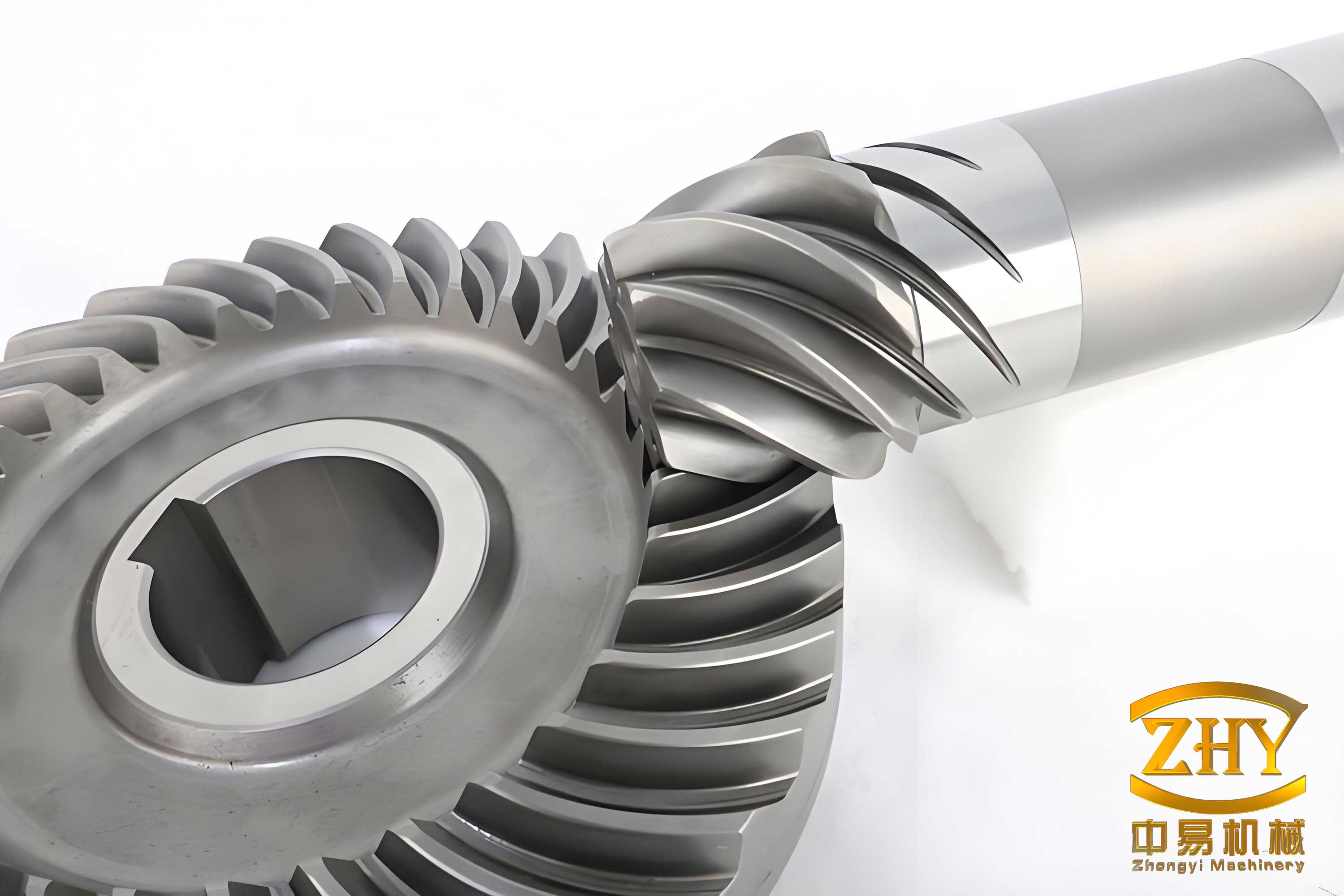
The core of this investigation is a specific spiral bevel gear component, typical for automotive differential applications. The gear possesses 39 teeth, a pressure angle of 22.5°, a spiral angle of 32.22°, a face width of 27 mm, a pitch circle diameter of 172 mm, and a right-hand spiral direction. The target forged gear shape and the corresponding preform billet geometry are central to the simulation setup. The billet material is modeled as AISI 1045 steel (45 steel in Chinese standard), a common grade for such components. Its plastic deformation behavior under the conditions of rotary forging is simulated using a rigid-plastic material model. The workpiece is discretized using approximately 110,000 four-node tetrahedral elements to accurately capture the complex flow into the gear teeth.
The kinematic setup of the rotary forging process is defined by the motion of the oscillating punch. The punch rotates around its own axis (spin) and simultaneously revolves around the vertical press axis (orbital motion) at a constant speed of 10 rad/s. It also advances axially towards the stationary lower die (containing the female gear cavity) at a feed rate of 1.5 mm/s, with its axis inclined at a constant tilt angle of 3°. The billet is centrally located and constrained on a mandrel within the lower die. The contact conditions between the dies and the workpiece are modeled using a constant shear friction law with a coefficient of 0.12. The critical simulation parameters are summarized in the table below.
| Parameter | Value / Description |
|---|---|
| Gear Teeth | 39 |
| Spiral Angle | 32.22° |
| Pitch Circle Diameter | 172 mm |
| Workpiece Material | AISI 1045 Steel |
| Friction Model | Constant Shear (μ=0.12) |
| Punch Tilt Angle (γ) | 3° |
| Punch Orbital Speed (ω) | 10 rad/s |
| Axial Feed Rate (v) | 1.5 mm/s |
| Element Type | 4-Node Tetrahedron |
| Approx. Element Count | 110,000 |
The simulation of the spiral bevel gear rotary forging process reveals a distinct three-stage deformation sequence, directly correlated with the evolution of the forming load. The load-time curve, a critical output of the FEM analysis, serves as the roadmap for understanding these stages.
Stage 1: Free Upsetting (0 s – 1.5 s). This initial stage begins with the punch contacting the upper surface of the billet. Due to the initial gap and the simple geometry of contact, the material deforms primarily through free axial compression (upsetting). The metal flows radially outwards without significant constraint from the gear tooth cavities. The forming load increases relatively rapidly but remains low in absolute terms, reaching a maximum of approximately 1 MN (Meganewton) in this phase. The mechanics can be initially described by a simplified upsetting load formula, though it quickly becomes more complex:
$$ P_{upset} \approx \sigma_y \cdot A_0 \cdot \left(1 + \frac{\mu d}{3h}\right) $$
where $P_{upset}$ is the upsetting force, $\sigma_y$ is the flow stress of the material, $A_0$ is the initial contact area, $\mu$ is the friction coefficient, $d$ is the workpiece diameter, and $h$ is the instantaneous height. As the punch advances, the billet expands to make initial contact with the walls of the lower die cavity.
Stage 2: Tooth Filling (1.5 s – 4.5 s). Once the billet contacts the lower die’s profile, the deformation mode shifts dramatically. The metal adjacent to the die’s tooth impressions is forced to flow into these cavities. This stage resembles a constrained forward extrusion process with a very small semi-cone angle. The material flow becomes multi-directional: a portion flows radially inward and outward to form the tooth flanks, another portion flows axially backward (rebound) due to obstruction from the rising tooth volumes, and yet another flows circumferentially. The load increase during this prolonged stage is more gradual and steady, rising from 1 MN to about 3 MN. The filling of the spiral bevel gear teeth proceeds progressively from the root towards the tip and along the curved length of the tooth. The rate of load increase is governed by the increasing contact area between the deforming material and the complex die surface, as well as the growing resistance to metal flow into the narrowing tooth spaces. The effective strain rate during this phase can be related to the punch kinematics:
$$ \dot{\epsilon} \propto \frac{v \cdot \tan \gamma}{h} $$
where $v$ is the axial feed rate, $\gamma$ is the tilt angle, and $h$ is the instantaneous workpiece height. The metal flow model becomes complex, involving three primary velocity components:
$$ \vec{v}_{material} = v_r \hat{r} + v_\theta \hat{\theta} + v_z \hat{z} $$
where the radial ($v_r$), circumferential ($v_\theta$), and axial ($v_z$) components are highly interdependent and vary spatially throughout the spiral bevel gear preform.
Stage 3: Corner & Flash Formation (4.5 s – 5.6 s). The final stage is the most critical and demanding. It involves the filling of the sharp corners at the tooth tips and the sidewalls of the gear. The remaining unfilled volumes are small but geometrically challenging, requiring high pressure to force material into them. Simultaneously, as the cavity is nearly completely filled, excess material is forced out radially, forming a thin flash at the parting line (both inner and outer diameters of the gear). The area of this flash grows rapidly. The forming load in this stage exhibits a severe, non-linear spike, soaring from 3 MN to a peak of approximately 7.5 MN. This spike is attributed to two main factors: the drastic increase in the required pressure for corner filling (often modeled by an exponential rise in flow stress due to high localized strain and hydrostatic pressure), and the significant frictional resistance at the large flash-land interface. The final load can be conceptually approximated by a combination of an idealized extrusion force and a flash forging force:
$$ P_{final} \approx \sigma_{y,corner} \cdot A_{corner} \cdot Q_{corner} + \sigma_{y,flash} \cdot A_{flash} \cdot \left(1 + \frac{3\mu l_{flash}}{t_{flash}}\right) $$
Here, $Q_{corner}$ is a complex shape factor > 1 accounting for the difficulty of filling sharp features, $A_{flash}$ and $l_{flash}$ are the area and length of the flash contact zone, and $t_{flash}$ is the flash thickness. The high effective strain is concentrated in the flash regions, as confirmed by the simulation results, indicating where the majority of the deformation energy is consumed in the final moments. This excessive load is detrimental, posing risks of press overloading, accelerated die wear, and potential die failure.
The analysis clearly identifies the massive flash formation in Stage 3 as the primary driver for the excessive final load during the rotary forging of the spiral bevel gear. The contact area between the punch and the workpiece directly influences the size and pressure required to form the flash. The original punch design had a flat, full-faced contact. To mitigate the load, an optimized punch geometry is proposed. The key principle is to reduce the effective contact area of the punch main body with the billet during the final stages, thereby limiting the volume of material available to be squeezed into the flash. This is achieved by designing the punch with a central protruding feature whose end-face area matches the target final contact area on the gear’s top land. The main body of the punch is recessed around this protrusion.
| Design Feature | Original Punch | Optimized Punch |
|---|---|---|
| Contact Surface | Flat, full face | Protruding central feature with recessed main body |
| Primary Function in Stage 3 | Compresses entire top surface, forcing material radially into flash | Localizes pressure to central feature, reduces radial flow incentive |
| Effective Pressing Area (Final Stage) | Large (~Full gear face area) | Small (~Area of gear top land) |
The simulation was repeated with this optimized punch geometry. The results are striking. The deformation progression in Stages 1 and 2 remains virtually identical to the original process; the tooth filling mechanism is unchanged. However, in Stage 3, the formation of extensive flash is markedly suppressed. The reduced contact area on the punch main body means less material is pushed radially outward towards the flash gap. Consequently, the severe load spike is dramatically attenuated. The final forming load peaks at approximately 5 MN, representing a reduction of about one-third compared to the 7.5 MN required with the original design. This optimization achieves the critical goal of enabling the complete forming of the spiral bevel gear under a significantly lower and more manageable press capacity.
| Process Stage | Original Punch Peak Load (MN) | Optimized Punch Peak Load (MN) | Load Reduction |
|---|---|---|---|
| Free Upsetting (End of S1) | ~1.0 | ~1.0 | Negligible |
| Tooth Filling (End of S2) | ~3.0 | ~3.0 | Negligible |
| Corner & Flash Formation (End of S3) | ~7.5 | ~5.0 | ~33% |
To validate the numerical findings and physically demonstrate the tooth-filling capability of the rotary forging process for spiral bevel gears, a forming experiment was conducted. Due to equipment force limitations and to confirm the essential deformation mechanics, the test utilized the original punch design (as the filling mechanics for Stages 1 & 2 are identical in both designs). Lead was chosen as the model material to simulate the hot forging of steel, leveraging its room-temperature plasticity and similarity in deformation behavior under scaled conditions. The preform geometry was scaled according to volume constancy principles. The experimental results successfully produced a gear shape with clearly formed teeth. The sequence of deformation observed—initial upsetting, progressive tooth cavity filling, and final flash formation—closely matched the patterns predicted by the FEM simulation. The teeth were filled satisfactorily, confirming that the rotary forging process is fundamentally feasible for manufacturing complex spiral bevel gears. The experiment provided crucial qualitative validation of the metal flow and forming sequence analyzed computationally.
In conclusion, the rotary forging process for manufacturing spiral bevel gears has been systematically investigated through finite element simulation and experimental validation. The process is characterized by three distinct stages: free upsetting, progressive tooth filling, and a final corner-filling stage accompanied by heavy flash formation which demands the highest forming load. The core challenge was identified as the excessive load in the final stage, primarily due to the large flash area. A strategic optimization of the oscillating punch geometry—introducing a protruding feature to reduce the main body contact area—was proposed and simulated. This modification successfully suppressed excessive flash formation, leading to a substantial one-third reduction in the peak forming load without compromising the tooth-filling quality in the earlier stages. The physical experiment using lead as a model material confirmed the validity of the simulated deformation sequence and demonstrated the practical feasibility of forming spiral bevel gears via rotary forging. This study provides a foundational analysis and a effective load-reduction strategy, contributing to the advancement of efficient, high-quality net-shape manufacturing processes for complex power transmission components like the spiral bevel gear.