
In the realm of precision engineering, the machining quality of spiral bevel gears has always been a critical focus. These gears are essential components in various mechanical systems, such as automotive differentials and aerospace transmissions, where high precision and durability are paramount. Traditional machining methods, including milling and grinding, often leave behind undesirable surface features like sharp peaks and micro-cracks, which can compromise performance and longevity. To address these limitations, I have explored the application of electrochemical finishing (ECF) as a non-traditional machining process for enhancing the surface quality of spiral bevel gears. This research delves into the development of a rotational scanning cathode-based ECF process integrated with mechanical spiral bevel gear milling machines, aiming to achieve superior surface finish and dimensional accuracy.
The motivation for this work stems from the inherent challenges in spiral bevel gear manufacturing. Even with advanced CNC-based methods from companies like Gleason and Klingelnberg, mechanical finishing processes are constrained by their fundamental mechanisms, leading to surface irregularities and approximation errors. Electrochemical finishing, which utilizes controlled anodic dissolution in an electrolyte, offers a promising alternative by enabling material removal at the atomic level, thereby producing smooth, stress-free surfaces. However, adapting ECF to the complex geometry of spiral bevel gears requires careful consideration of factors such as electrode design, current field stability, and fluid dynamics. In this article, I present a comprehensive study on the implementation of ECF for spiral bevel gears, drawing insights from successful applications in other gear types and validating the approach through experimental investigations.
To begin, it is essential to understand the principles of electrochemical finishing. In ECF, the workpiece acts as the anode in an electrochemical cell, while a tool cathode is positioned close to the surface to be finished. When an electric potential is applied across the electrodes in the presence of an electrolyte, metal ions are dissolved from the anode surface, leading to material removal. The process can be described by Faraday’s law of electrolysis: $$ m = \frac{I \cdot t \cdot M}{n \cdot F} $$ where \( m \) is the mass of material removed, \( I \) is the current, \( t \) is the time, \( M \) is the molar mass of the material, \( n \) is the valence number, and \( F \) is Faraday’s constant. For spiral bevel gears, the key challenge lies in maintaining a uniform inter-electrode gap and stable current density across the curved tooth surfaces, which is crucial for achieving consistent finishing.
Previous research on ECF for cylindrical spur gears has demonstrated significant improvements in surface roughness and accuracy. For instance, in a typical setup for spur gears, a planar cathode with a geometry conforming to the tooth profile is used in a linear scanning motion to finish the gear surfaces. This approach ensures a stable gap and efficient electrolyte flow, but its direct application to spiral bevel gears is complicated by their three-dimensional curvature. Analyzing these successful cases reveals that cathode design often exhibits planar characteristics, meaning that the cathode can be represented as a superposition of similar cross-sectional shapes along a specific direction. This simplifies manufacturing and facilitates motion control. For spiral bevel gears, I propose a rotational scanning cathode that mimics the generating motion used in traditional milling, thereby aligning with the gear’s geometric formation process.
The formation process of spiral bevel gears is fundamental to designing an effective ECF process. In essence, a spiral bevel gear can be conceptualized as being generated by a planar gear with an infinite number of teeth, known as a crown gear or planar ring gear. When two conjugate spiral bevel gears mesh, their interaction resembles that of two conical surfaces rolling without slipping. The tooth surfaces are generated by the relative motion between a cutter with straight-edged blades and the gear blank. This generation principle implies that at any instant, the contact line between the cutter and gear surface is straight, which can be leveraged to design a cathode with planar features. Specifically, for a spiral bevel gear, the tooth surface can be approximated by a series of planar sections along the tooth length, allowing for a cathode that maintains a constant gap during rotation.
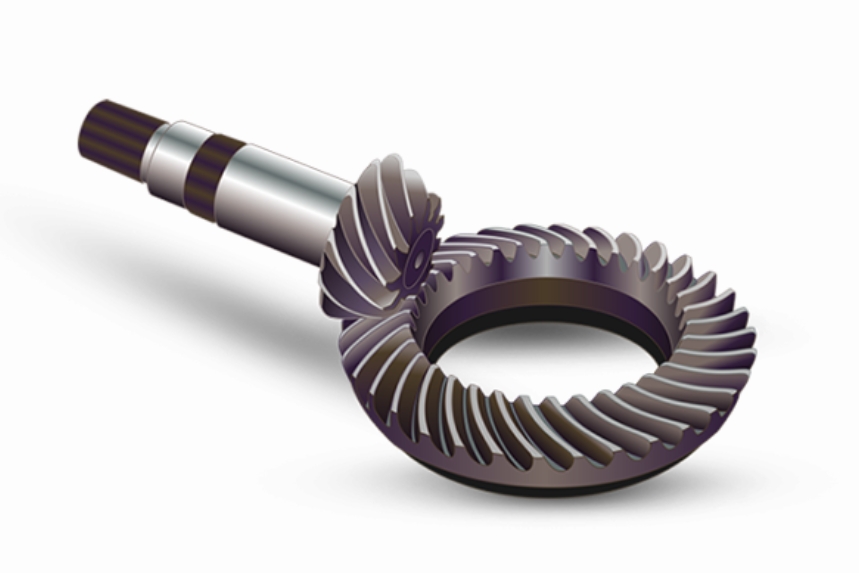
Building on this analysis, I developed an ECF process for spiral bevel gears that integrates with existing mechanical milling machines, such as the Gleason No. 16 universal mill. The process employs a rotational scanning cathode mounted on a tool holder, which rotates to scan the tooth surfaces while the gear acts as the anode. The cathode is designed with separate sections for the convex and concave sides of the spiral bevel gear teeth, enabling simultaneous finishing of both surfaces. The inter-electrode gap, typically set between 0.1 mm and 0.5 mm, is filled with an electrolyte, such as a sodium nitrate solution, and a pulsed power supply is used to enhance process control. The rotational motion of the cathode ensures a uniform gap and stable hydrodynamic conditions, which are critical for achieving high-quality finishes on spiral bevel gears.
To optimize the ECF process for spiral bevel gears, several parameters must be carefully controlled. These include the electrolyte composition, current density, pulse frequency, and cathode geometry. In my experiments, I used a sodium nitrate electrolyte at a concentration of 15-20% by weight, as it provides good conductivity and non-passivating characteristics for steel alloys commonly used in spiral bevel gears. The pulsed power supply operated at frequencies up to 3 kHz, with voltages ranging from 0 to 50 V and currents up to 400 A. The use of pulsed current helps in improving surface finish by allowing time for electrolyte renewal and heat dissipation. The material removal rate in ECF can be modeled using the equation: $$ R_a = k \cdot J \cdot t $$ where \( R_a \) is the surface roughness reduction, \( k \) is a process constant, \( J \) is the current density, and \( t \) is the machining time. For spiral bevel gears, the current density must be adjusted based on the local tooth geometry to prevent over-etching or under-finishing.
The design of the cathode is pivotal for the success of the ECF process on spiral bevel gears. Based on the planar generation principle, I designed a cathode with a simplified geometry that approximates the tooth profile of the spiral bevel gear. The cathode consists of two main parts: one for the convex side and one for the concave side, each shaped to maintain a constant gap relative to the gear surface during rotation. The cathode’s motion is purely rotational, aligning with the gear’s generating motion, which eliminates approximation errors and ensures consistent finishing across the entire tooth surface. This approach contrasts with linear scanning methods used for spur gears, as the complex curvature of spiral bevel gears necessitates a rotational strategy. The cathode geometry can be derived from the gear parameters using the following relations for spiral bevel gears: $$ r_p = \frac{m \cdot Z}{2 \cdot \cos \beta} $$ where \( r_p \) is the pitch radius, \( m \) is the module, \( Z \) is the number of teeth, and \( \beta \) is the spiral angle. By incorporating these geometric constraints, the cathode can be fabricated to match the spiral bevel gear’s tooth flank accurately.
In experimental validation, I tested the ECF process on spiral bevel gears made of 20CrNiMo steel with a hardness of HRC 58-63 after heat treatment. The initial gear quality was at DIN 10 grade with surface roughness values between Ra 2.5 μm and 3.2 μm. The experimental setup utilized a Gleason No. 16 milling machine, retrofitted with the ECF system. Key adjustment parameters for the machine were calculated based on the gear geometry, as summarized in Table 1. These parameters ensured proper alignment and motion synchronization between the cathode and the spiral bevel gear.
| Parameter Name | Value |
|---|---|
| Tool Tip Distance (mm) | 6.10 |
| Machine Installation Angle (°) | 75°12′ |
| Horizontal Wheel Position (mm) | 26.324 |
| Eccentric Distance (mm) | 6.2302 |
| Cradle Angle (°) | 50°43′ |
The ECF process was conducted under optimized conditions derived from orthogonal experiments. The primary process parameters are listed in Table 2. These parameters were selected to balance material removal rate and surface quality for the spiral bevel gear. The pulsed current mode was particularly effective in reducing surface roughness without compromising dimensional accuracy.
| Parameter | Value |
|---|---|
| Electrolyte Composition | Sodium Nitrate (NaNO₃) |
| Electrolyte Concentration (wt%) | 15-20% |
| Power Supply Type | Pulsed, 0-3 kHz |
| Voltage Range (V) | 0-50 |
| Current Range (A) | 0-400 |
| Inter-electrode Gap (mm) | 0.1-0.5 |
| Machining Time per Tooth (s) | 60-120 |
The results from the ECF process on spiral bevel gears were remarkable. After finishing in a single cycle equivalent to the fine milling operation on the Gleason machine, the surface roughness of the spiral bevel gear teeth was significantly reduced. For the convex side, the Ra value dropped to 0.1362 μm, while for the concave side, it reached 0.1060 μm. Moreover, the surface microstructure transformed from a sharp-peaked profile to a rounded “plateau” type, which enhances wear resistance and load-bearing capacity. The dimensional accuracy of the spiral bevel gear also improved, with the gear grade advancing from DIN 10 to DIN 7. Detailed measurements are presented in Table 3, highlighting the reductions in pitch error and cumulative error for both sides of the spiral bevel gear teeth.
| Surface Type | Maximum Pitch Error \( f_{p,max} \) (μm) | Maximum Tooth-to-Tooth Error \( f_{u,max} \) (μm) | Cumulative Pitch Error \( F_p \) (μm) | Surface Roughness \( R_a \) (μm) |
|---|---|---|---|---|
| Convex Side | 37.9 | 32.8 | 89.6 | 0.1362 |
| Concave Side | 26.6 | 24.5 | 69.6 | 0.1060 |
To further analyze the improvements, the material removal mechanism in ECF for spiral bevel gears can be described using electrochemical kinetics. The current density distribution across the tooth surface is critical for uniform finishing. For a given point on the spiral bevel gear tooth, the current density \( J \) can be expressed as: $$ J = \kappa \cdot \frac{\Delta V}{\delta} $$ where \( \kappa \) is the electrolyte conductivity, \( \Delta V \) is the applied voltage, and \( \delta \) is the local inter-electrode gap. In the rotational scanning setup, the gap \( \delta \) remains nearly constant due to the cathode design, leading to a uniform \( J \) and consistent material removal. The surface roughness evolution during ECF can be modeled by a differential equation: $$ \frac{dR_a}{dt} = -C \cdot J \cdot R_a^{1/2} $$ where \( C \) is a constant dependent on material and electrolyte properties. Integrating this equation shows that surface roughness decreases exponentially with time, explaining the rapid improvement observed in spiral bevel gears.
The fluid dynamics of the electrolyte flow also play a vital role in the ECF process for spiral bevel gears. The rotational motion of the cathode creates a centrifugal force that enhances electrolyte renewal in the gap, preventing stagnation and heat accumulation. The flow velocity \( v \) in the gap can be estimated using the Navier-Stokes equations for thin films: $$ \frac{\partial p}{\partial r} = \mu \frac{\partial^2 v}{\partial z^2} $$ where \( p \) is pressure, \( r \) is radial distance, \( \mu \) is dynamic viscosity, and \( z \) is the gap height. For spiral bevel gears, the curved geometry introduces additional complexities, but the rotational scanning motion helps maintain a steady flow profile. Empirical adjustments were made to the electrolyte pressure and flow rate to optimize finishing performance on the spiral bevel gear teeth.
Comparing the ECF process with traditional finishing methods for spiral bevel gears reveals several advantages. Mechanical grinding, for instance, can induce thermal damage and residual stresses, whereas ECF is a cold process that preserves the material’s metallurgical properties. Moreover, ECF is not limited by gear hardness, making it suitable for hardened spiral bevel gears without the need for post-heat treatment. The productivity of ECF is also high, as it can finish multiple tooth surfaces simultaneously using a multi-section cathode. In terms of accuracy, the rotational scanning approach eliminates approximation errors associated with CNC interpolation in grinding, leading to better conformity to the ideal spiral bevel gear geometry.
To quantify the economic and technical benefits, a cost-benefit analysis was conducted for the ECF process applied to spiral bevel gears. The initial investment includes retrofitting the milling machine with an ECF system, but the operating costs are lower due to reduced tool wear and energy consumption compared to grinding. The improvement in gear quality translates to longer service life and reduced noise in applications, which is particularly important for high-performance spiral bevel gears in automotive and aerospace industries. The process also supports sustainable manufacturing by minimizing waste and avoiding cutting fluids used in traditional methods.
Future research directions for ECF of spiral bevel gears include the development of adaptive cathode designs that can compensate for gear distortions after heat treatment. By incorporating real-time monitoring systems, such as sensors for current density and gap measurement, the process can be dynamically adjusted to maintain optimal conditions. Additionally, hybrid processes combining ECF with mechanical abrasion, known as electrochemical mechanical finishing (ECMF), could further enhance surface quality for spiral bevel gears. The integration of artificial intelligence for parameter optimization is another promising avenue, enabling smart manufacturing of precision spiral bevel gears.
In conclusion, the application of electrochemical finishing to spiral bevel gears represents a significant advancement in gear manufacturing technology. Through a rotational scanning cathode design based on the planar generation principle, I have demonstrated that ECF can achieve surface roughness values below Ra 0.15 μm and improve gear accuracy by multiple DIN grades in a single machining cycle. The process leverages existing mechanical milling infrastructure, making it accessible for industrial adoption. The key factors for success include maintaining a stable inter-electrode gap, optimizing electrolyte flow, and using pulsed current for controlled material removal. This research underscores the potential of non-traditional machining methods to overcome the limitations of conventional processes for complex components like spiral bevel gears. As industries demand higher performance and efficiency, ECF offers a viable solution for producing high-quality spiral bevel gears with enhanced durability and precision.
To further elaborate on the technical aspects, the mathematical modeling of the ECF process for spiral bevel gears can be extended to include multi-physics simulations. For example, finite element analysis (FEA) can be used to predict the current density distribution and temperature field in the inter-electrode gap. The governing equations for electric potential \( \phi \) in the electrolyte are given by Laplace’s equation: $$ \nabla^2 \phi = 0 $$ with boundary conditions at the anode (spiral bevel gear surface) and cathode. Coupling this with fluid flow equations allows for comprehensive process optimization. Experimental validation of such models can lead to more robust ECF systems for spiral bevel gears.
Moreover, the impact of ECF on the functional performance of spiral bevel gears can be assessed through tribological testing. Finished spiral bevel gears can be subjected to load endurance tests to evaluate wear resistance and contact fatigue. The improved surface topography from ECF, characterized by reduced peak heights and increased bearing area, typically results in lower friction coefficients and higher efficiency in gear transmissions. This is crucial for applications where spiral bevel gears operate under high loads and speeds, such as in wind turbines or industrial machinery.
In summary, the electrochemical finishing process for spiral bevel gears not only enhances surface quality but also contributes to overall system reliability. By integrating this technology into manufacturing lines, producers can achieve competitive advantages through superior product performance. The continuous evolution of ECF parameters and cathode designs will further push the boundaries of what is possible in spiral bevel gear fabrication, paving the way for next-generation mechanical systems. As I continue to refine this process, the focus will remain on scalability and adaptability to diverse spiral bevel gear geometries, ensuring broad applicability across sectors.