
In modern industrial applications, spiral bevel gears are critical components in power transmission systems, particularly in automotive, aerospace, and heavy machinery due to their ability to transmit motion between non-parallel shafts with high efficiency and load capacity. The precision and surface quality of spiral bevel gears directly influence performance metrics such as noise, vibration, and longevity. Post-heat treatment finishing processes are essential to achieve these qualities, but traditional methods like lapping and grinding present limitations. Lapping, while common, often results in non-interchangeable gear sets and inconsistent meshing characteristics, whereas grinding offers high precision but at prohibitive costs for mass production. This has driven research into alternative finishing techniques, with gear honing emerging as a promising solution. Honing, widely successful in cylindrical gear production, involves using an abrasive honing wheel to refine gear surfaces through micro-cutting actions, offering a balance of efficiency, cost-effectiveness, and interchangeability. This article delves into the honing technology for spiral bevel gears, focusing on the design and optimization of honing wheels to ensure effective finishing while maintaining geometric integrity. We explore the theoretical foundations, mathematical modeling, and practical implementations, aiming to provide a comprehensive framework that can meet industrial demands for high-volume manufacturing of spiral bevel gears.
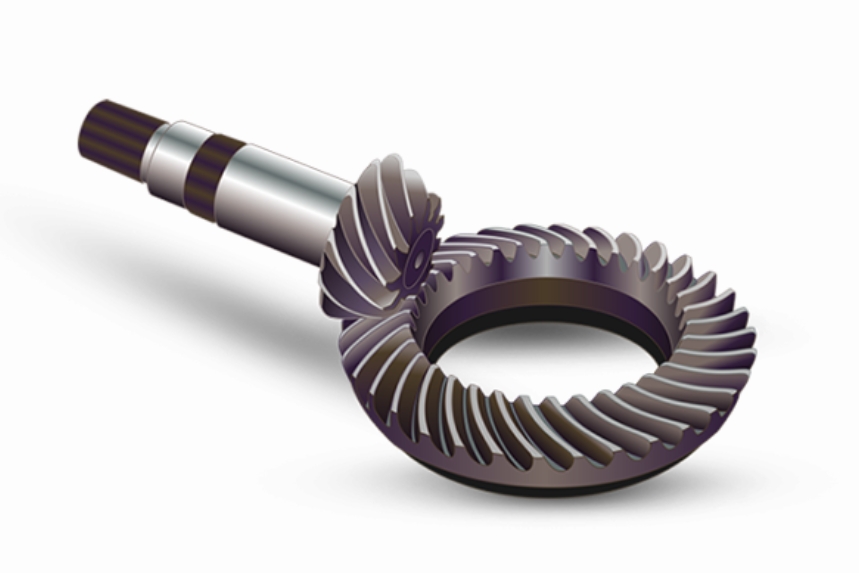
The core of honing technology for spiral bevel gears lies in the design of the honing wheel’s pitch cone, which must be non-orthogonal to accommodate the complex geometry of spiral bevel gears. Unlike conventional gear pairs, the honing wheel and the workpiece gear interact through a carefully defined pitch cone interface that ensures relative motion is aligned along the tooth trace direction, maximizing honing efficiency by promoting sliding in the lengthwise direction of the tooth. This alignment is crucial because it controls material removal rates and prevents pressure angle distortions that could compromise meshing quality. To achieve this, we propose a design method that adjusts the distance from the pitch cone contact point to the honing wheel axis, thereby tuning the relative velocity vector. Let the unit vector along the honing wheel axis be denoted as $\mathbf{a}_H$, and that along the workpiece gear axis as $\mathbf{a}_{GH}$. The pitch cones of both the gear and honing wheel are designed to be tangent at a predetermined point, which serves as the honing node. The position of this node is determined based on the effective working area of the spiral bevel gear tooth flank, typically at the midpoint of the working tooth height along the face width. For a spiral bevel gear, parameters such as the face cone angle $\gamma_0$, root cone angle $\gamma_R$, and offsets from the crossing point are used to compute the node coordinates. For instance, at the front end of the gear, the radius $R_{Mf}$ and distance $S_{Mf}$ to the crossing point are given by:
$$ R_{Mf} = 0.5[(S_f + G_0) \tan \gamma_0 + (S_f + G_R) \tan \gamma_R + c / \cos \gamma_R] $$
$$ S_{Mf} = S_f $$
where $c$ is the tip clearance, $S_f$ is the front-end distance, $G_0$ is the face cone vertex offset, and $G_R$ is the root cone vertex offset. Similarly, at the back end, we have:
$$ R_{Mb} = -0.5[l \tan(\gamma_0 – \gamma_R) – c] \cos \gamma_R + (S_c + G_0) \tan \gamma_0 $$
$$ S_{Mb} = S_c + 0.5[l \tan(\gamma_0 – \gamma_R) – c] \sin \gamma_R $$
with $l = (S_c + G_R) \cos(\gamma_0 – \gamma_R) / \cos \gamma_0 – (G_R – G_0) \sin \gamma_0 / \sin(\gamma_0 – \gamma_R)$. The honing pitch cone angle $\gamma_{GH}$ and its vertex offset $S_{GH}$ for the workpiece gear are then derived as:
$$ \gamma_{GH} = \arctan\left( \frac{R_{Mb} – R_{Mf}}{S_{Mb} – S_{Mf}} \right) $$
$$ S_{GH} = \frac{R_{Mf}}{\tan \gamma_{GH}} – S_f $$
The cone distance at the midpoint is $A_{GH} = 0.5(S_{Mf} + S_{Mb}) / \cos \gamma_{GH}$. To design the honing wheel’s pitch cone, we establish a coordinate system where the gear axis is along the y-axis, so $\mathbf{a}_{GH} = -\mathbf{j}$. The common normal vector $\mathbf{n}$ to both pitch cones at the contact point is expressed as a function of an angle $\theta$, which represents the deviation from the plane parallel to both axes:
$$ \mathbf{n} = \{ -\cos \gamma_{GH} \sin \theta, -\sin \gamma_{GH}, -\cos \gamma_{GH} \cos \theta \} $$
The position vector of the contact point on the gear pitch cone is:
$$ \mathbf{r}_{GH} = \{ -A_{GH} \sin \gamma_{GH} \sin \theta, A_{GH} \cos \gamma_{GH} – S_{GH}, -A_{GH} \sin \gamma_{GH} \cos \theta \} $$
Assuming the gear angular velocity is unity, the velocity at this point is $\mathbf{v}_{GH} = \mathbf{a}_G \times \mathbf{r}_{GH}$. The unit vector of relative sliding velocity along the tooth trace, given the spiral angle $\psi_{GH}$, is:
$$ \mathbf{v}_s = (\cos \psi_{GH} \sin \gamma_{GH} \sin \theta – \sin \psi_{GH} \cos \theta) \mathbf{i} – \cos \psi_{GH} \gamma_{GH} \mathbf{j} + (\cos \psi_{GH} \sin \gamma_{GH} \cos \theta – \sin \psi_{GH} \sin \theta) \mathbf{k} $$
Let $l_G = A_{GH} \cdot \tan \gamma_{GH}$ be the distance from the contact point to the intersection of the common normal with the gear axis, and $l_H$ be the corresponding distance to the honing wheel axis intersection. The position vector to the honing wheel axis intersection is $\mathbf{T}_H = \mathbf{T}_G + \mathbf{n}(l_G + l_H)$, where $\mathbf{T}_G = \{0, A_{GH} / \cos \gamma_{GH} – S_{GH}, 0\}$. The honing wheel axis vector is $\mathbf{A}_H = \{0, T_{H,y}, T_{H,z}\}$, with unit vector $\mathbf{a}_H = \mathbf{A}_H / |\mathbf{A}_H|$. The radius vector from the honing wheel axis to the contact point is:
$$ \mathbf{r}_H = \{ -l_H n_x, T_{G,y} + l_G n_y, l_G n_z \} $$
The velocity at this point on the honing wheel is $\mathbf{v}_H = (n_G / n_H) \mathbf{a}_H \times \mathbf{r}_H$, where $n_G$ and $n_H$ are the tooth numbers of the gear and honing wheel, respectively. The relative velocity is $\mathbf{v}_R = \mathbf{v}_{GH} – \mathbf{v}_H$. By adjusting $l_H$, we can enforce $\mathbf{v}_R \parallel \mathbf{v}_s$, ensuring the contact point becomes a true node with sliding purely along the tooth trace. This design process yields key honing wheel parameters: offset distance $E_H = -(l_G + l_H) n_x$, axis angle $\Sigma_H = 90^\circ – \arctan(T_{H,y} / T_{H,z})$, pitch cone vertex offset $S_H = (\mathbf{A}_H \cdot \mathbf{n} – \mathbf{r}_H \cdot \mathbf{n}) / (\mathbf{a}_H \cdot \mathbf{n}) – |\mathbf{A}_H|$, and pitch cone angle $\gamma_H = \arcsin(\mathbf{a}_H \cdot \mathbf{n})$. The face and root cones of the honing wheel are then determined by making them tangent to the gear’s root and face cones, respectively, at points perpendicular to the pitch cone midpoint.
To ensure the honing process effectively covers the entire working area of the spiral bevel gear tooth flank, it is essential to analyze the boundary of engagement, which includes the limit of meshing and the limit of undercutting. Since the honing wheel is dressed with abrasive grains and any interference is removed during dressing, undercutting is less critical, but we still aim to avoid it. The primary concern is whether points in the effective working area fall outside the meshing boundary, which occurs if the induced curvature becomes negative or if corresponding points on the honing wheel lie outside its face cone. We evaluate this by computing the induced curvature and distances for a series of points along the tooth flank boundaries. Consider a set of points on the gear tooth surface, such as along the tip and root lines, with position vectors $\mathbf{r}_{Gi}$ and unit normals $\mathbf{n}_{Gi}$. For each point, the rotation angle $\theta_i$ required for it to become a contact point is solved from the meshing equation:
$$ \theta_i = \arctan\left( \frac{w}{\sqrt{u^2 + v^2 – w^2}} \right) – \arctan\left( \frac{v}{u} \right) $$
where:
$$ u = i_{HG}[n_{Gi,x} E_H \cos \Sigma_H – n_{Gi,z} S_H \sin \Sigma_H + (n_{Gi,z} r_{Gi,y} – n_{Gi,y} r_{Gi,z}) \sin \Sigma_H] $$
$$ v = i_{HG}[n_{Gi,z} E_H \cos \Sigma_H – n_{Gi,x} S_H \sin \Sigma_H + (n_{Gi,y} r_{Gi,x} – n_{Gi,x} r_{Gi,y}) \sin \Sigma_H] $$
$$ w = (1 + i_{HG} \cos \Sigma_H)(n_{Gi,z} r_{Gi,x} – n_{Gi,x} r_{Gi,z}) + i_{HG} n_{Gi,y} E_H \sin \Sigma_H $$
with $i_{HG} = n_G / n_H$. After rotating $\mathbf{n}_{Gi}$ and $\mathbf{r}_{Gi}$ by $\theta_i$ around $\mathbf{a}_{GH}$, we obtain the updated vectors $\mathbf{n}_{Gi}’$ and $\mathbf{r}_{Gi}’$ at the meshing instant. The corresponding point on the honing wheel is:
$$ \mathbf{r}_{Hi} = \{ r_{Gi,x}’ – E_H, r_{Gi,y}’ – S_G + S_H \cos \Sigma_H, r_{Gi,z}’ + S_H \sin \Sigma_H \} $$
The velocities are $\mathbf{v}_{Gi} = \mathbf{a}_G \times \mathbf{r}_{Gi}’$ and $\mathbf{v}_{Hi} = i_{HG} \mathbf{a}_H \times \mathbf{r}_{Hi}$, giving relative sliding velocity $\mathbf{v}_{HGi} = \mathbf{v}_{Hi} – \mathbf{v}_{Gi}$. The curvature tensor at the gear point is $\Phi_{\mathbf{n}_{Gi}’} = -\kappa_{1i} \mathbf{e}_{1i} \mathbf{e}_{1i} – \kappa_{2i} \mathbf{e}_{2i} \mathbf{e}_{2i}$, where $\kappa_{1i}$ and $\kappa_{2i}$ are principal curvatures along directions $\mathbf{e}_{1i}$ and $\mathbf{e}_{2i}$. The induced curvature is then:
$$ \kappa_{HGi} = -\frac{\mathbf{P}_i \cdot \mathbf{P}_i}{s_i} $$
with $\mathbf{P}_i = \mathbf{v}_{HGi} \cdot \Phi_{\mathbf{n}_{Gi}’} – \boldsymbol{\omega}_{HG} \times \mathbf{n}_{Gi}’$ and $s_i = \mathbf{n}_{Gi}’ \cdot \mathbf{q}_i + \mathbf{v}_{HGi} \cdot \mathbf{P}_i$, where $\boldsymbol{\omega}_{HG} = i_{HG} \mathbf{a}_H – \mathbf{a}_G$ and $\mathbf{q}_i = \boldsymbol{\omega}_{HG} \times \mathbf{v}_{Gi} – \mathbf{a}_G \times \mathbf{v}_{HGi}$. If $s_i > 0$, the point lies outside the meshing boundary. Additionally, we compute the angle between $\mathbf{r}_{Hi}$ and $\mathbf{a}_H$; if it exceeds the honing wheel’s face cone angle, the point is outside the practical meshing boundary. This analysis ensures the entire effective area of the spiral bevel gear tooth flank is within engagement limits, guaranteeing complete honing coverage.
The design of honing wheels for spiral bevel gears involves multiple parameters, offering a degree of freedom that can be exploited for optimization. Given a fixed gear geometry, there exists a range of possible honing wheel configurations, each characterized by tooth number $n_H$ and the angle $\theta$ of the common normal. We formulate an optimization problem to select the best combination that maximizes performance metrics while satisfying constraints. The objective function incorporates weighted factors such as honing wheel longevity, honing efficiency, and meshing quality. Key considerations include:
- Tooth number $n_H$: A higher $n_H$ increases honing wheel life and the number of gears honed between dressings, but it must not share a common divisor with $n_G$ to avoid uneven wear and pitch errors.
- Relative sliding speed $|\mathbf{v}_R|$ at the node: Higher speeds enhance honing efficiency by promoting material removal.
- Spiral angle $\psi_H$ of the honing wheel: This affects overlap ratio and error correction capability. Large differences in spiral angles between the gear and honing wheel may necessitate reverse offset designs, which impact life and overlap.
Constraints are imposed to ensure manufacturability and functionality: $\gamma_H < 85^\circ$ and $\Sigma_H < 160^\circ$ to avoid extreme geometries, and all effective working points must lie within meshing boundaries as verified earlier. The optimization is performed via a two-parameter search over $n_H$ and $\theta$, using enumeration within feasible ranges. For each candidate $(n_H, \theta)$, we compute the honing wheel parameters and evaluate the objective function. A simple expert system or weighted sum approach can rank designs, prioritizing factors like longevity for high-volume production. The optimization process can be summarized in the following table, which outlines key parameters and their influence:
| Parameter | Symbol | Influence on Honing | Typical Range |
|---|---|---|---|
| Honing wheel tooth number | $n_H$ | Longevity, wear uniformity | 20–60 (no common divisor with $n_G$) |
| Common normal angle | $\theta$ | Sliding direction, axis orientation | -30° to 30° |
| Pitch cone angle | $\gamma_H$ | Geometry compatibility | < 85° |
| Axis angle | $\Sigma_H$ | Machine setup feasibility | < 160° |
| Relative sliding speed | $|\mathbf{v}_R|$ | Honing efficiency | Maximized |
The objective function $F(n_H, \theta)$ can be constructed as a weighted combination: $F = w_1 \cdot n_H + w_2 \cdot |\mathbf{v}_R| + w_3 \cdot \psi_H$, where $w_i$ are weights based on industrial priorities. Alternatively, more complex functions can include penalties for boundary violations. The optimization yields an optimal set $(n_H^*, \theta^*)$ that balances all factors, ensuring the honing wheel is both effective and durable for spiral bevel gear finishing.
To demonstrate the applicability of our methodology, we present a detailed calculation example for a spiral bevel gear pair. The gear parameters are as follows: pinion tooth number $n_p = 13$, gear tooth number $n_G = 46$, gear pitch diameter $D = 215.9 \text{ mm}$, pinion offset $38.1 \text{ mm}$, shaft angle $\Sigma = 90^\circ$, pinion pitch cone angle $\gamma = 19^\circ 22’$, face cone angle $\gamma_0 = 23^\circ 34’$, root cone angle $\gamma_R = 17^\circ 28’$, and various vertex offsets. The gear is a hypoid type with spiral angles $\psi_p = 50^\circ 30’$ and $\psi_G = 28^\circ 08’$. Using the design equations, we first compute the honing pitch cone for the gear: $\gamma_{GH} = 67^\circ 52’45”$, $S_{GH} = -1.063 \text{ mm}$, $A_{GH} = 98.928 \text{ mm}$. Through optimization with the two-parameter method, we obtain an optimal honing wheel design with $n_H = 39$ and $\theta = -7^\circ 10’33”$. The resulting honing wheel parameters are:
| Parameter | Value |
|---|---|
| Offset distance $E_H$ | -21.4276 mm |
| Axis angle $\Sigma_H$ | 133°03’22” |
| Pitch cone angle $\gamma_H$ | 64°53’05” |
| Spiral angle $\psi_H$ | 40°40’49” |
| Pitch cone midpoint distance $A_H$ | 99.566 mm |
| Pitch cone vertex offset $S_H$ | 1.658 mm |
| Face cone angle $\gamma_{H0}$ | 68°10’47” |
| Face cone vertex offset $S_{H0}$ | 0.714 mm |
| Root cone angle $\gamma_{HR}$ | 61°35’25” |
| Root cone vertex offset $S_{HR}$ | 2.798 mm |
| Outer cone distance $A_{H0}$ | 117.769 mm |
| Tooth face width $F_H$ | 35.886 mm |
Verification via induced curvature and distance calculations confirms that all effective working points on the spiral bevel gear tooth flank lie within the meshing boundary, ensuring complete honing coverage. This example illustrates the practicality of our design and optimization approach, showing that it can produce feasible honing wheel configurations for industrial applications.
The honing technology for spiral bevel gears, as explored in this article, offers a viable alternative to traditional finishing methods, combining efficiency, cost-effectiveness, and interchangeability. By developing a non-orthogonal pitch cone design for honing wheels, we ensure that relative sliding velocities are aligned with the tooth trace, optimizing material removal. The analysis of meshing boundaries through induced curvature and distance computations guarantees that the entire effective working area is honed without defects. Furthermore, the two-parameter optimization method, based on tooth number and common normal angle, allows for tailored honing wheel designs that maximize longevity and performance. The calculation example validates the methodology, demonstrating its ability to meet industrial needs for high-volume production of precision spiral bevel gears. Future work could focus on experimental validation, dressing techniques for honing wheels, and extending the approach to other gear types. Overall, this research lays a foundation for advancing honing technology in the realm of spiral bevel gear manufacturing, contributing to improved gear quality and reduced production costs.
In summary, the intricate geometry of spiral bevel gears necessitates sophisticated finishing processes, and honing presents a compelling solution. The key lies in the precise design of the honing wheel, which we have addressed through mathematical modeling and optimization. The formulas and tables provided herein serve as a guide for engineers seeking to implement honing for spiral bevel gears. As industries demand higher performance and lower costs, such advancements in gear finishing technology will become increasingly vital. We hope this comprehensive treatment inspires further innovation and adoption of honing for spiral bevel gears across various sectors.