
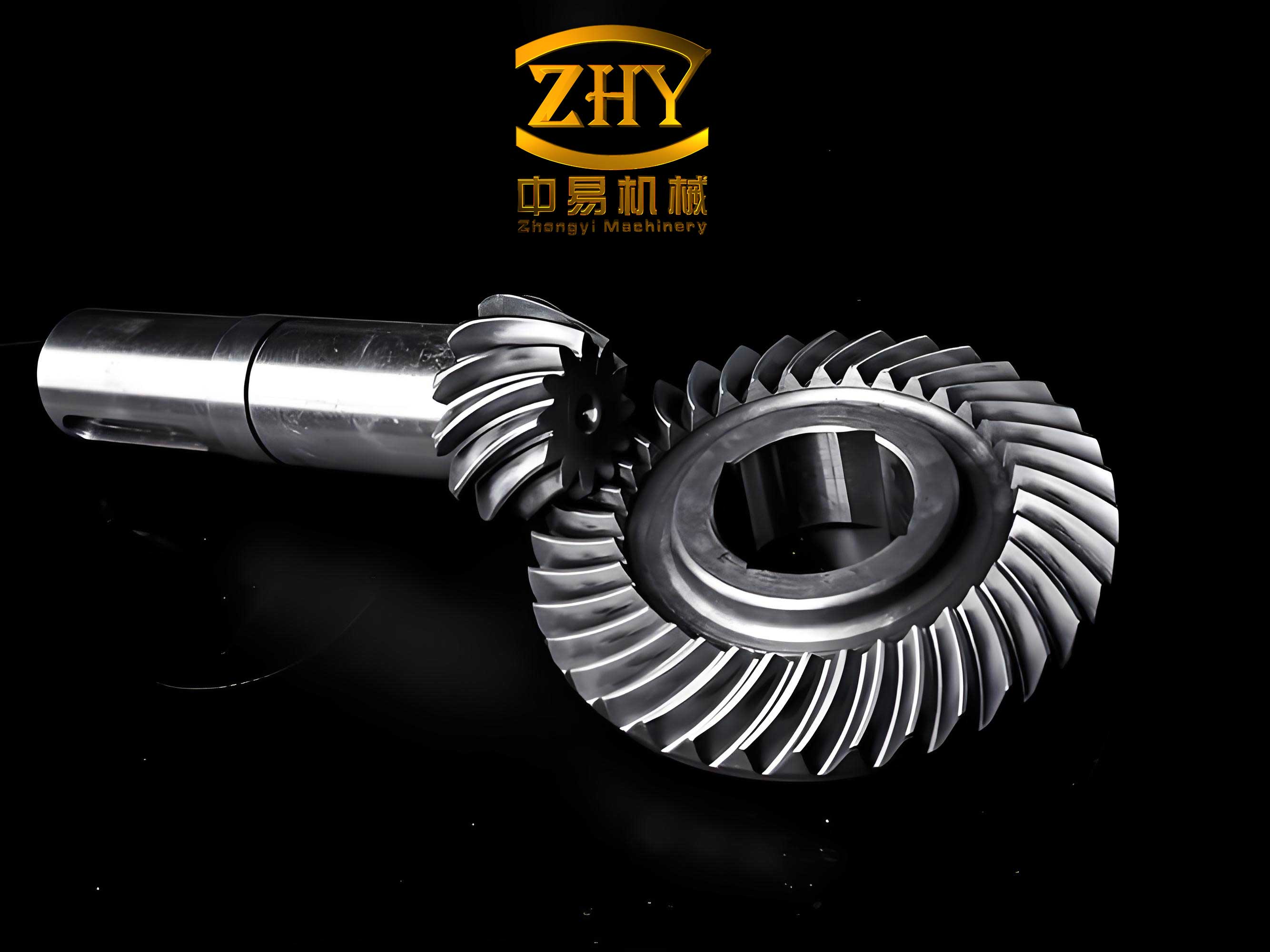
The transition from conventional mechanical spiral bevel gear generators to Computer Numerical Control (CNC) platforms represents a fundamental shift in gear manufacturing technology. As someone deeply involved in this field, I have observed and participated in the intricate process of translating traditional machining kinematics, particularly the Tilted Cutter or “Tilt” method, into the language of multi-axis CNC interpolation. The core challenge lies not merely in replicating motion but in re-expressing decades-old mechanical adjustment parameters as precise, time-synchronized digital commands for a machine tool that has fundamentally different architecture—lacking a physical cradle, eccentric, or a mechanical tilt mechanism. This article details the methodology, mathematical foundation, and practical implications of executing the Tilted Cutter method on a modern six-axis CNC spiral bevel gear mill, a process critical for leveraging legacy process knowledge on next-generation manufacturing platforms.
The superiority of the CNC spiral bevel gear machine is undeniable. It replaces complex trains of gears, cams, and linkages with software-controlled servo axes, leading to remarkable advantages: unparalleled flexibility for rapid job changeovers, intrinsic improvements in static and dynamic stiffness due to simpler mechanical structure, the virtual elimination of setup trial cuts through simulation, and the capability to implement advanced tooth contact analysis theories that were impractical on mechanical machines. However, the vast repository of proven process data for spiral bevel and hypoid gears is largely based on the adjustment parameters of mechanical generators. Therefore, a reliable and precise algorithm to convert these parameters into CNC axis positions is essential for the practical adoption and full utilization of this advanced technology.
A typical six-axis CNC spiral bevel gear mill features the following programmable axes, which collectively define the relative motion between the cutter head (tool) and the workpiece:
* **X-axis:** Horizontal linear motion of the cutter spindle/carriage.
* **Y-axis:** Vertical linear motion of the cutter spindle/carriage.
* **Z-axis:** Linear motion along the workpiece axis direction (often controlling the distance to the gear blank’s theoretical apex).
* **A-axis:** Rotary motion of the workpiece spindle.
* **C-axis:** Rotary motion of the cutter spindle (for speed).
* **A supplemental rotary axis** (often another *A* or a *B* axis) for tilting the workpiece column or the cutter carriage.
The primary task is to use these axes to simulate the relative orientation and position between the cutter head axis and the workpiece axis at every instant during the generating roll, as defined by the Tilted Cutter method.
The Tilted Cutter method for machining a spiral bevel gear pinion is defined by a set of classic machine settings. Their geometric interpretation on a theoretical mechanical machine is as follows:
* **Machine Plane:** A plane perpendicular to the workpiece axis, passing through the point where the cutter axis intersects the cut-plane (the plane containing the cutter tip edges).
* **Machine Center:** The intersection point of the workpiece axis and the Machine Plane.
* **Radial Distance ($S_R$):** The distance from the cutter center to the Machine Center.
* **Angular Position ($q$):** The angle in the Machine Plane from the machine’s horizontal reference line to the line connecting the Machine Center and the cutter center.
* **Cutter Tilt Angle ($i$):** The angle between the cutter axis and the workpiece axis.
* **Basic Cutter Rotation ($\gamma$):** The angular orientation of the tilt direction, measured from a reference in the Machine Plane.
The workpiece is positioned via the **Machine Root Angle ($\Sigma$)**, **Sliding Base ($\Delta X$)** or “Vertical Offset”, and the **Work Offset ($\Delta Y$)** or “Horizontal Offset”. For a given spiral bevel gear design, these parameters ($S_R$, $q$, $i$, $\gamma$, $\Sigma$, $\Delta X$, $\Delta Y$) are determined through established gear theory and face-milling synthesis software. The objective is to replicate the kinematic relationship dictated by these settings using the linear and rotary axes of the CNC machine.
Let us establish the coordinate system. Consider a reference state where the workpiece axis is aligned along the global Z-direction. The fundamental relationship defined by the Tilted Cutter method is the fixed spatial relationship between the **cutter axis vector ($\mathbf{\hat{u}_c}$)** and the **workpiece axis vector ($\mathbf{\hat{u}_w}$)**, along with the relative position of a key point on each axis, typically the **cutter center ($\mathbf{P_c}$)** and the **workpiece theoretical apex ($\mathbf{P_w}$)**.
The cutter axis orientation, defined by the tilt $i$ and basic rotation $\gamma$, can be expressed as a unit vector. With the workpiece axis initially along Z: $\mathbf{\hat{u}_w} = (0, 0, 1)$.
The cutter axis vector is obtained by rotating the workpiece axis vector first by angle $i$ about an axis in the XY-plane at angle $\gamma$, or equivalently, by a sequence of rotations. A common formulation is:
1. Rotate $\mathbf{\hat{u}_w}$ by angle $\gamma$ about the Z-axis.
2. Then rotate the resulting vector by angle $i$ about the Y-axis of the new, rotated system.
3. Finally, rotate back by angle $-\gamma$ about the Z-axis to apply the tilt in the correct plane.
This yields the cutter axis unit vector $\mathbf{\hat{u}_c}$ in the global coordinate system (aligned with the initial workpiece position):
$$
\mathbf{\hat{u}_c} = R_z(-\gamma) \cdot R_y(i) \cdot R_z(\gamma) \cdot \mathbf{\hat{u}_w}
$$
Where $R_z(\theta)$ and $R_y(\theta)$ are standard 3×3 rotation matrices about the Z and Y axes, respectively. Performing this multiplication gives the components:
$$
\mathbf{\hat{u}_c} = \begin{pmatrix}
\sin i \sin \gamma \\
-\sin i \cos \gamma \\
\cos i
\end{pmatrix}
$$
This vector remains constant in the *machine setting coordinate system* attached to the workpiece. However, during generation, the workpiece (and its attached coordinate system) rotates relative to the machine bed. This is the crux of the kinematic transformation.
The position of the cutter center relative to the workpiece apex is defined by $S_R$ and $q$. In the Machine Plane (XY-plane of the workpiece coordinate system), this vector is:
$$
\mathbf{P_{c/w}} = (S_R \cos q, \quad S_R \sin q, \quad 0)
$$
where $\mathbf{P_{c/w}}$ is the position of the cutter center relative to the workpiece apex, expressed in the workpiece coordinate system.
Now, we introduce the **generating roll motion**. Let $\phi$ be the rotation angle of the imaginary generating gear (cradle or work gear). According to the roll ratio $R_{roll}$ (ratio between cradle and workpiece angular velocities), the corresponding rotation of the workpiece coordinate system relative to the machine bed is $\psi = \phi / R_{roll}$. This is the motion of the CNC’s A-axis (workpiece spindle).
Therefore, at any instant during the cut defined by cradle angle $\phi$, the following conditions must be satisfied by the CNC axes:
1. **Workpiece Spindle Angle (A-axis):** $A(\phi) = \psi(\phi) = \phi / R_{roll}$.
2. **Relative Axis Orientation:** The cutter axis vector in the *machine bed coordinate system* must equal the workpiece-axis-relative vector $\mathbf{\hat{u}_c}$ rotated by the workpiece angle $\psi$.
3. **Relative Point Position:** The position of the cutter center relative to the workpiece apex in the *machine bed coordinate system* must equal the vector $\mathbf{P_{c/w}}$ rotated by the workpiece angle $\psi$, plus any fixed offsets ($\Delta X$, $\Delta Y$).
Let’s formalize this. The transformation from the workpiece coordinate system (W) to the machine bed system (M) is a rotation about the Z-axis by angle $\psi$:
$$
\mathbf{v}^{(M)} = R_z(\psi) \cdot \mathbf{v}^{(W)}
$$
Therefore, the **required cutter axis direction in machine coordinates** is:
$$
\mathbf{\hat{u}_c}^{(M)}(\phi) = R_z(\psi(\phi)) \cdot \mathbf{\hat{u}_c} = R_z(\phi/R_{roll}) \cdot \begin{pmatrix} \sin i \sin \gamma \\ -\sin i \cos \gamma \\ \cos i \end{pmatrix}
$$
This orientation is achieved by the combined angles of the machine’s tilting axis (e.g., B-axis) and the orientation of the cutter carriage. On a typical CNC machine where the cutter spindle is mounted on a wrist-type assembly with two rotary axes, the required angles (e.g., B and C’) are calculated by solving the inverse kinematics for this vector direction.
More critically, the **required position of the cutter center in machine coordinates** is:
$$
\mathbf{P_c}^{(M)}(\phi) = R_z(\psi(\phi)) \cdot \mathbf{P_{c/w}} + \mathbf{P_w}^{(M)} + \mathbf{\Delta}^{(M)}
$$
Where:
* $\mathbf{P_w}^{(M)}$ is the fixed position of the workpiece apex in machine coordinates. In an ideal setup, this coincides with the intersection of the workpiece axis (A-axis) and the machine’s main tilting axis. Let’s denote its coordinates as $(X_w, Y_w, Z_w)$.
* $\mathbf{\Delta}^{(M)} = (\Delta X, \Delta Y, 0)$ is the applied sliding base and work offset, transformed into machine coordinates as needed (often $\Delta X$ is along X, $\Delta Y$ along Y).
Thus, the explicit commands for the linear axes X, Y, Z are derived from $\mathbf{P_c}^{(M)}(\phi)$:
$$
X(\phi) = S_R \cos(q) \cos\psi – S_R \sin(q) \sin\psi + X_w + \Delta X
$$
$$
Y(\phi) = S_R \cos(q) \sin\psi + S_R \sin(q) \cos\psi + Y_w + \Delta Y
$$
$$
Z(\phi) = Z_w \quad \text{(often constant, or has a component from $\mathbf{P_{c/w}}$ if not strictly in XY-plane)}
$$
Where $\psi = \phi / R_{roll}$. This traces a **circular path for the cutter center** in the XY-plane when viewed from the rotating workpiece reference frame, which is exactly the kinematic effect of the eccentric and cradle on a mechanical machine. The CNC’s X and Y axes interpolate this path.
**Special Case – Non-Intersecting Apex:** The above assumes the workpiece theoretical apex $\mathbf{P_w}$ is on the A-axis rotation center. If it is offset by a distance $e$ (as in some hypoid setups), then $\mathbf{P_w}^{(M)}$ is not stationary but rotates with the A-axis. If the offset $e$ is along the initial X-direction, then:
$$
\mathbf{P_w}^{(M)}(\phi) = R_z(\psi(\phi)) \cdot (e, 0, Z_w)^T = (e \cos\psi, \quad e \sin\psi, \quad Z_w)^T
$$
This adds an eccentric component to the X and Y axis commands, modifying the equations accordingly.
The following table summarizes the mapping from traditional Tilted Cutter parameters to the instantaneous commands for a 6-axis CNC spiral bevel gear mill with X, Y, Z, A, B, C axes, assuming a workpiece-tilting (B-axis) configuration:
| CNC Axis | Physical Motion | Instantaneous Command Formula (Derived from Tilt Method) | Key Parameter Dependencies |
| :— | :— | :— | :— |
| **X-axis** | Cutter Horizontal | $X(\phi) = S_R \cos(q-\psi) + e \cos\psi + X_w + \Delta X$ | $S_R$, $q$, Roll ($\psi$), Eccentricity ($e$), Offsets |
| **Y-axis** | Cutter Vertical | $Y(\phi) = S_R \sin(q-\psi) + e \sin\psi + Y_w + \Delta Y$ | $S_R$, $q$, Roll ($\psi$), Eccentricity ($e$), Offsets |
| **Z-axis** | Workpiece In/Out | $Z(\phi) = Z_w + \text{(possible constant offset)}$ | Workpiece Apex Z-location |
| **A-axis** | Workpiece Rotation | $A(\phi) = \psi(\phi) = \phi / R_{roll}$ | Generating Roll Ratio ($R_{roll}$) |
| **B-axis** | Workpiece/Column Tilt | $\text{Inverse Kinematic Solution from } \mathbf{\hat{u}_c}^{(M)}(\phi)$ | Cutter Tilt Angle ($i$), Basic Rotation ($\gamma$), Roll ($\psi$) |
| **C-axis** | Cutter Spindle Speed | Constant Speed ($\omega_c$) | Surface Speed Requirement |
The calculation of the B-axis angle requires solving the inverse kinematics for the specific machine configuration. For a common configuration where the B-axis is a tilt axis perpendicular to the Z-direction, the required B-axis angle $B(\phi)$ to achieve the cutter axis direction $\mathbf{\hat{u}_c}^{(M)}(\phi) = (u_x, u_y, u_z)$ is given by:
$$
B(\phi) = \arctan\left(\frac{\sqrt{u_x^2 + u_y^2}}{u_z}\right) \quad \text{or} \quad B(\phi) = \arccos(u_z)
$$
with careful consideration of the quadrant. The direction of the tilt in the XY-plane is managed by the coordinated motion of X, Y, and A.
This mathematical framework allows for the precise emulation of the Tilted Cutter method. It is implemented as a post-processor that takes the static machine settings ($S_R$, $q$, $i$, $\gamma$, $\Sigma$, $\Delta X$, $\Delta Y$, $R_{roll}$) and generates a time-synchronized NC program with commands for X($\phi$), Y($\phi$), Z, A($\phi$), and B($\phi$). The process can be validated by comparing the relative tool-workpiece motion envelope generated by this NC code with the theoretical kinematics of a mechanical spiral bevel gear generator.
The advantages of implementing the method this way on a CNC spiral bevel gear machine are significant:
* **Fidelity to Proven Processes:** Allows the use of extensive existing libraries of gear design and process data developed for the Tilted Cutter method.
* **Dynamic Optimization:** While the basic kinematics are replicated, the CNC platform allows for subtle modifications of the roll, motion, or cutter orientation as a function of roll angle to optimize tooth contact or tool life, which was mechanically impossible.
* **Simplified Setup:** The physical setup involves aligning the workpiece and setting the root angle ($\Sigma$) on the B-axis. All other “settings” ($S_R$, $q$, $i$, $\gamma$) are executed by the CNC program, eliminating mechanical adjustment of eccentrics, tilt mechanisms, and cradle angular positions.
Beyond mere replication, the CNC platform unlocks the potential for more advanced manufacturing theories for spiral bevel gears. One such area is the implementation of **Elastic Meshing Theory**. Traditional contact analysis assumes rigid bodies. However, under load, tooth surfaces deflect elastically, altering the contact pattern and transmission error. On a mechanical machine, compensating for this was nearly impossible. On a CNC spiral bevel gear mill, it becomes feasible. The predicted loaded contact pattern and transmission error can be calculated via Finite Element Analysis or analytical methods. Then, the machine’s tool path (the relationship between cradle angle $\phi$ and the cutter position/orientation) can be deliberately modified from the nominal rigid-body kinematics to pre-correct the unloaded tooth geometry. The goal is that once the spiral bevel gear pair is under design load, the contact pattern shifts to the desired location and shape, and the transmission error is minimized for low noise. The modification is applied by superimposing small, calculated deviations $\delta X(\phi)$, $\delta Y(\phi)$, $\delta B(\phi)$ onto the axis commands derived from the standard Tilted Cutter formulas. This represents the ultimate synthesis of design, analysis, and manufacturing for high-performance spiral bevel gears.
The process chain for manufacturing a spiral bevel gear pinion using this methodology is systematized below:
| Stage | Activity | Key Inputs | Output/Objective |
| :— | :— | :— | :— |
| **1. Design & Synthesis** | Gear geometry design, tooth contact analysis (TCA). | Power, ratio, geometry constraints. | Optimal machine settings for the chosen method (Tilted Cutter). Parameters: $S_R$, $q$, $i$, $\gamma$, $R_{roll}$, etc. |
| **2. Kinematic Conversion** | Application of mathematical model to convert settings to axis trajectories. | Machine settings from Stage 1; CNC machine kinematic model. | Time-synchronized functions for X($\phi$), Y($\phi$), A($\phi$), B($\phi$) defining the toolpath. |
| **3. Post-Processing & Simulation** | Generation of specific NC code; virtual machining simulation. | Axis trajectory functions; machine tool specifics (limits, codes). | Collision-free NC program; predicted geometry from material removal simulation. |
| **4. Setup & Machining** | Physical setup of workpiece, tool, and fixtures; program execution. | NC program; blank; cutter head. | A physically cut spiral bevel gear pinion. |
| **5. Inspection & Validation** | Coordinate measurement (CMM) or gear roll tester. | Cut pinion; design specification. | Verification of tooth flank geometry, contact pattern check under light load. |
The successful implementation of the Tilted Cutter method on a CNC spiral bevel gear machine hinges on precise calibration. The following machine parameters must be known accurately to ensure the mathematical model reflects physical reality:
* **Axis Orthogonality and Offsets:** The mutual perpendicularity of X, Y, Z axes and the positional offsets between the A-axis centerline, B-axis centerline, and the cutter spindle centerline.
* **Tool Geometry Constants:** The precise radius point of the cutter (effective cutting radius) and the location of the cutter center relative to the spindle nose.
* **Workpiece Alignment Constants:** The position of the gear blank’s theoretical apex relative to the machine’s A-axis center when the B-axis is at zero.
Modern CNC spiral bevel gear grinders and mills incorporate sophisticated metrology systems, often using touch probes, to measure these constants directly on the machine, creating a “closed-loop” manufacturing system that ensures accuracy.
In conclusion, the migration of the Tilted Cutter method to CNC spiral bevel gear machinery is not a simple one-to-one mapping but a re-engineering of kinematic principles. By expressing the fixed geometrical relationships of the traditional method as dynamic, coordinated motions of individual servo axes, we preserve the wealth of existing spiral bevel gear technology while gaining the precision, flexibility, and capability of digital manufacturing. The core mathematical model, centered on the time-dependent transformation of the cutter axis vector and cutter center position relative to the rotating workpiece coordinate system, provides a robust and general foundation. This enables not just replication, but also the advancement of gear manufacturing through techniques like loaded tooth contact optimization. As the industry continues its shift towards fully digital process chains for spiral bevel gears, mastering this translation from classical settings to CNC kinematics remains a fundamental competency, bridging the proven past with the high-performance future of gear transmission systems.