
In my extensive experience within manufacturing and metallurgy, I have dedicated significant effort to addressing persistent quality issues in high-performance components, particularly hydraulic castings and spiral bevel gears. The journey toward eliminating defects and minimizing distortion involves a deep understanding of material science, process control, and innovative techniques. This article synthesizes my firsthand knowledge and practical applications, focusing on the casting of high-manganese gray iron hydraulic parts and the heat treatment of spiral bevel gears to achieve superior integrity and performance. I will elaborate on the methodologies, supported by data tables and mathematical models, to provide a comprehensive guide.
The foundation of reliable hydraulic components lies in impeccable casting. Shrinkage porosity is a common adversary, often leading to failure under pressure. Through rigorous experimentation, I have identified and refined several effective strategies tailored to different casting geometries. For castings with wall thicknesses less than 50 mm, the key is to promote directional solidification. This involves strategically placing chills in isolated thick sections and hot spots away from risers. Utilizing a specific grade of iron melt, designated as Grade A, ensures a controlled solidification sequence that effectively eliminates shrinkage defects. The principle can be summarized by Chvorinov’s rule, which governs solidification time:
$$ t_f = B \left( \frac{V}{A} \right)^n $$
where \( t_f \) is the total solidification time, \( V \) is the volume of the casting, \( A \) is its surface area, and \( B \) and \( n \) are constants dependent on the mold material and metal properties. By manipulating chilling, we effectively increase the local cooling rate, altering the \( V/A \) ratio in critical zones to shorten solidification time and prevent porosity.
For more challenging scenarios with wall thicknesses greater than 50 mm and the presence of isolated heavy sections, a more integrated approach is necessary. I have found that modifying the casting design itself—simplifying it into a rectangular block and segmenting a single casting into multiple pieces—yields remarkable improvements. Employing a higher-grade iron melt, such as Grade B, and combining it with elongated risers, along with either a “horizontal pouring, vertical solidification” process or a “horizontal pouring, horizontal solidification with vertical cooling” process, proves highly effective. This strategy not only enforces directional solidification through the gating system design but also increases the metallostatic pressure head, enhancing feeding and density. The pressure contribution can be conceptualized as:
$$ P_{\text{metallostatic}} = \rho g h $$
where \( \rho \) is the molten metal density, \( g \) is acceleration due to gravity, and \( h \) is the height of the metal column above the point in question. This increased pressure compacts the solidifying metal, further eliminating shrinkage.
A pivotal advancement has been the adoption of compacted graphite iron (CGI) for hydraulic castings. In my practice, switching to CGI has completely eliminated the subsurface shrinkage defects that typically appear after internal machining. The unique vermicular graphite morphology in CGI offers a superior combination of thermal conductivity and mechanical properties, reducing the tendency for shrinkage formation during solidification.
While high-manganese gray iron can also address shrinkage, my experience highlights a significant challenge: when multiple melt grades are required in production, controlling the chemical composition becomes exceedingly difficult. Precise control is paramount, as minor deviations can lead to inconsistent mechanical properties. The table below summarizes the target chemical composition and resulting mechanical properties for high-manganese gray iron used in these applications, based on my process specifications.
| Element/Property | Target Range | Role/Effect |
|---|---|---|
| Carbon (C) | 3.2 – 3.6 % | Graphite formation, fluidity |
| Silicon (Si) | 1.8 – 2.4 % | Graphitizer, strength |
| Manganese (Mn) | 1.2 – 1.8 % | Pearlite stabilization, strength |
| Phosphorus (P) | < 0.15 % | Minimize embrittlement |
| Sulfur (S) | < 0.12 % | Control graphite shape |
| Tensile Strength | 250 – 320 MPa | Measures load-bearing capacity |
| Hardness (HB) | 200 – 250 | Indicates wear resistance |
Transitioning from casting to another critical component, the spiral bevel gear, particularly the driven gear in vehicle differentials, presents a distinct set of challenges. The complex geometry of a spiral bevel gear makes it exceptionally prone to distortion during heat treatment, specifically carburizing and quenching. This distortion manifests as out-of-roundness in the bore and warping of the mounting face, jeopardizing precise meshing and leading to noise, vibration, and premature failure. My work has centered on mastering heat treatment to minimize this distortion without compromising the essential surface hardness and core toughness.
After thorough analysis, I concluded that while carburizing contributes to some distortion, the predominant source is the quenching process. The rapid cooling generates significant thermal stress and transformation stress. Therefore, solving the quenching distortion is the key to stabilizing the spiral bevel gear dimensions. Inspired by literature on martempering and austempering, I pioneered the implementation of an isothermal, or hot bath, interrupted quenching process for these gears. The core idea is to reduce the temperature gradient between the gear’s surface and core during the critical martensite transformation phase.
The standard process sequence I developed is as follows: Forging → Normalizing → Rough Machining → Stress Relieving → Finish Machining & Gear Cutting → Deburring → Carburizing → Interrupted Quenching & Tempering → Grinding. Each step is crucial, but the heat treatment steps are most vital for distortion control. Normalizing is conducted at \( 950 \pm 10^\circ \text{C} \), followed by air cooling to refine the microstructure. Stress relieving at \( 600 – 650^\circ \text{C} \) removes machining stresses. Carburizing, whether via liquid salt bath or gas atmosphere, is performed at \( 930 \pm 10^\circ \text{C} \). Careful fixturing during carburizing, often stacking gears on a mandrel with spacers, is essential to minimize sagging and warping at this stage.
The revolutionary step is the interrupted quench. The carburized spiral bevel gear is heated to an austenitizing temperature of \( 850 \pm 10^\circ \text{C} \) in a salt bath, held for sufficient time to achieve temperature uniformity, and then quenched into a hot bath maintained between \( 200^\circ \text{C} \) and \( 250^\circ \text{C} \). The bath medium can be an aqueous alkali mixture or an aqueous nitrate-nitrite salt. The gear is held in this bath for 3 to 5 minutes, allowing the temperature to equalize throughout its cross-section while avoiding the immediate formation of martensite. Subsequently, it is removed and air-cooled to room temperature, during which the martensitic transformation occurs more uniformly at a slower rate. Finally, tempering at \( 180^\circ \text{C} \) relieves residual stresses and completes the process. The thermal profile can be modeled using the heat transfer equation during quenching:
$$ \frac{\partial T}{\partial t} = \alpha \nabla^2 T + \frac{\dot{q}}{\rho c_p} $$
where \( \alpha \) is thermal diffusivity, \( \dot{q} \) is the heat generation rate due to phase transformation, \( \rho \) is density, and \( c_p \) is specific heat. The interrupted quench dramatically reduces the \( \nabla^2 T \) term (temperature gradient), thereby minimizing distortion.
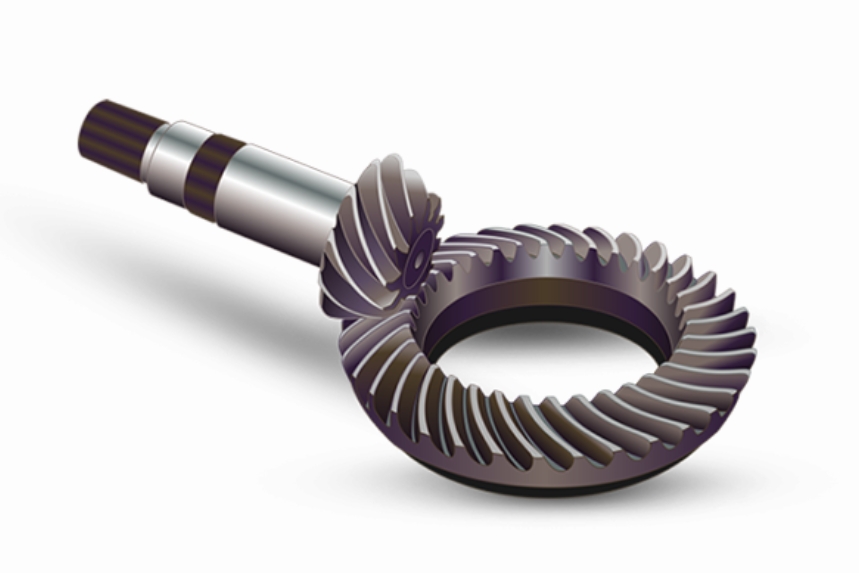
The results for the spiral bevel gear have been consistently excellent. For a gear made from 20CrMnTi steel, requiring a case depth of 1.2-1.6 mm and surface hardness of 58-62 HRC, the distortion metrics improved dramatically. Bore ovality was reduced to less than 0.05 mm, and face flatness across key datums was kept within 0.08 mm. Surface hardness consistently met specifications. The table below contrasts the distortion outcomes between conventional oil quenching and my developed isothermal interrupted quenching process for a typical production batch of spiral bevel gears.
| Quenching Method | Bore Ovality (mm, max) | Face Flatness (mm, max) | Surface Hardness (HRC) | Process Stability |
|---|---|---|---|---|
| Conventional Oil Quench | 0.10 – 0.15 | 0.15 – 0.25 | 58-62 (variable) | Low |
| Isothermal Interrupted Quench | 0.03 – 0.05 | 0.05 – 0.08 | 60-62 (consistent) | High |
To ensure consistent success with the spiral bevel gear, several auxiliary measures are indispensable. First, leveraging the “transformation superplasticity” phenomenon present during the martensitic transformation after the hot bath quench is valuable. If a gear exhibits excessive face warpage after carburizing, it can be corrected immediately after removal from the hot bath. Before it cools to room temperature, while it still possesses this temporary plasticity, it is placed on a flat plate (optionally preheated), a fixture block is positioned, and a slight pressure is applied using a standard straightening press. This simple post-quench straightening effectively brings flatness within the 0.08 mm tolerance. Second, meticulous attention to carburizing fixture design and loading orientation is non-negotiable; uniform heating and cooling during carburizing set the stage for low final distortion. Third, during the quenching heating stage, I always suspend the spiral bevel gear sideways to prevent droop, and it is quenched into the hot bath in the same lateral orientation. Finally, to avoid turbulence and uneven cooling, I recommend quenching only one spiral bevel gear into the bath at a time and minimizing agitation of the medium.
The principles underlying both successful casting and heat treatment converge on the concept of controlling thermal gradients and stresses. In casting, it is the management of solidification gradients through chills and gating design. For the spiral bevel gear, it is the management of cooling gradients during the austenite-to-martensite transformation through interrupted quenching. The mathematical essence can be captured by models for stress evolution. For example, the total stress \( \sigma_{\text{total}} \) during quenching can be considered as the sum of thermal stress \( \sigma_{\text{th}} \) and transformation stress \( \sigma_{\text{tr}} \):
$$ \sigma_{\text{total}} = \sigma_{\text{th}} + \sigma_{\text{tr}} = E \alpha \Delta T + \frac{E \beta \Delta V}{3(1-\nu)} $$
where \( E \) is Young’s modulus, \( \alpha \) is the coefficient of thermal expansion, \( \Delta T \) is the temperature difference, \( \beta \) is a transformation strain coefficient, \( \Delta V \) is the volumetric change due to phase transformation, and \( \nu \) is Poisson’s ratio. The interrupted quench strategy directly reduces \( \Delta T \), thereby minimizing \( \sigma_{\text{total}} \) and the resulting distortion in the spiral bevel gear.
In conclusion, my hands-on journey in manufacturing underscores that defect elimination and distortion control are not merely procedural tasks but require a fundamental grasp of materials behavior under thermal cycles. For hydraulic castings, the strategic use of chills, melt grade selection, design modification, and the superior properties of compacted graphite iron provide a robust toolkit against shrinkage. For the geometrically sensitive spiral bevel gear, the adoption of an isothermal interrupted quenching process, complemented by careful fixturing and post-quench correction techniques, delivers exceptional dimensional stability and mechanical properties. The consistent performance of the spiral bevel gear after this treatment is a testament to the effectiveness of managing transformation stresses. Both domains highlight that precision in manufacturing is achieved by harmonizing material composition, process physics, and practical ingenuity, ensuring the reliability of critical components in demanding applications.