
The pursuit of enhanced fatigue resistance in spiral bevel gears, commonly used in automotive axles, necessitates a hard-tooth surface treatment process typically involving carburizing, quenching, and tempering. A critical challenge in this process is controlling heat treatment distortion, which directly impacts the final dimensional accuracy and meshing performance of the gear pair. A primary driver of this distortion is the non-uniform temperature distribution across the tooth surface and within the internal volume of the spiral bevel gear during the heating and cooling cycles. Significant temperature gradients induce complex thermal stresses and, upon phase transformation, internal stresses that lead to undesirable geometric changes. Therefore, achieving a uniform temperature field is paramount for distortion control. This study focuses on the numerical analysis and optimization of the temperature field during the hard-surface heat treatment of a 20CrMnTi steel spiral bevel gear, employing a coupled thermal-fluid-solid modeling approach to understand and improve temperature uniformity.
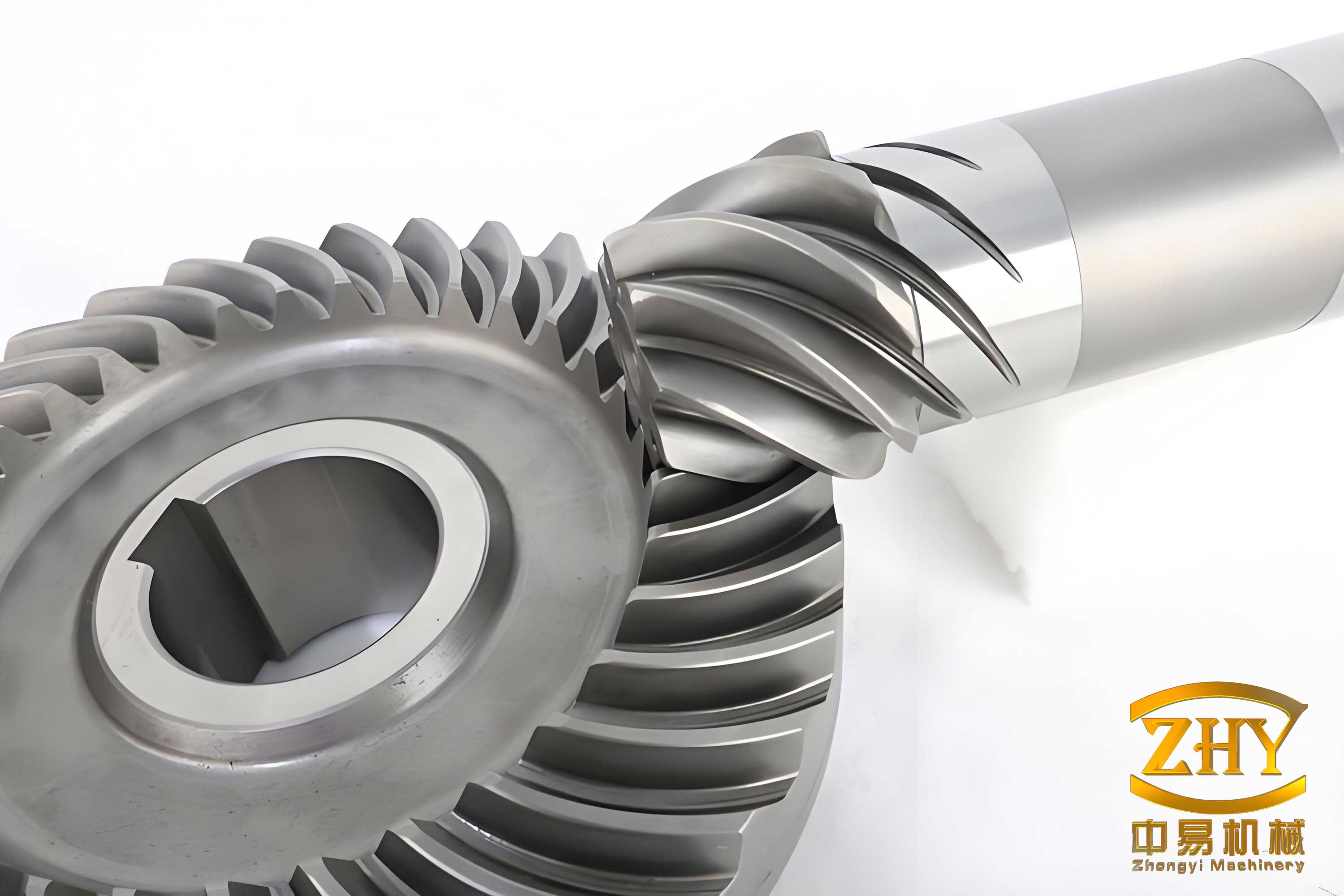
The geometry of a spiral bevel gear is inherently complex, with varying section thicknesses from the tooth tip to the root and along the curved tooth length. This complexity makes it highly susceptible to uneven heating and cooling. During carburizing, rapid heating can cause the thin sections like the tooth tip to reach temperature much faster than the massive core, creating large thermal gradients. Similarly, during quenching, the cooling rate varies dramatically across the surface due to differences in the local heat transfer coefficient, which is heavily influenced by the flow of the quenchant. To accurately capture these phenomena, a sophisticated numerical model that couples the solid’s heat conduction and phase transformation with the fluid dynamics of the quenching medium is essential. This work utilizes such a multi-physics model to simulate the entire heat treatment cycle, with particular emphasis on optimizing the quenching stage—the most critical and complex phase for distortion.
1. Multiphysics Modeling Framework
The accurate prediction of the temperature field in a spiral bevel gear during heat treatment requires the integration of three core physical models: solid heat conduction with phase change, fluid flow and heat transfer in the quenchant, and the coupling between them.
1.1 Solid Thermal and Microstructural Model
The transient temperature distribution within the solid gear is governed by the three-dimensional Fourier heat conduction equation, which incorporates the latent heat released or absorbed during phase transformations:
$$ \nabla \cdot (\lambda \nabla T) + \dot{Q} = \rho c_p \frac{\partial T}{\partial t} $$
where \( \lambda \) is the thermal conductivity, \( T \) is the temperature, \( \rho \) is the density, \( c_p \) is the specific heat capacity, \( t \) is time, and \( \dot{Q} \) is the volumetric heat generation rate due to phase change.
The latent heat \( \dot{Q} \) is a summation of the contributions from each phase transformation (e.g., austenite to ferrite, pearlite, bainite, or martensite):
$$ \dot{Q} = \sum_{i} \Delta H_i \frac{dV_i}{dt} $$
Here, \( \Delta H_i \) is the enthalpy change for the i-th transformation and \( V_i \) is the volume fraction of the product phase.
For diffusion-controlled transformations (ferrite, pearlite, bainite) under continuous cooling conditions, the kinetics are modeled using an adapted Johnson-Mehl-Avrami (JMA) equation combined with the Scheil’s additive rule:
$$ f_{i+1} = 1 – \exp\left[-b_{i+1}(t^*_{i+1} + \Delta t)^{n_{i+1}}\right] $$
$$ t^*_{i+1} = \left[ \frac{-\ln(1-f_i)}{b_{i+1}} \right]^{1/n_{i+1}} $$
where \( f \) is the transformed volume fraction, \( n \) and \( b \) are kinetic parameters, \( t^* \) is an “equivalent time,” and \( \Delta t \) is the time increment.
The martensitic transformation, a diffusionless process, is described by the Koistinen-Marburger (K-M) relationship:
$$ V_m = 1 – \exp[-\alpha (M_s – T)] $$
where \( V_m \) is the martensite volume fraction, \( \alpha \) is a material constant (often ~0.011), and \( M_s \) is the martensite start temperature.
1.2 Fluid Flow and Boiling Heat Transfer Model
During oil quenching, the cooling mechanism involves complex boiling phenomena. The heat flux from the hot gear surface to the quenchant (\( q_w \)) is modeled using the Rensselaer Polytechnic Institute (RPI) boiling model, which partitions the heat transfer into three components:
$$ q_w = q_{conv} + q_{evap} + q_{quench} $$
$$ q_w = h_{conv} A_{conv}(T_w – T_l) + f \cdot N \cdot \frac{\pi}{6} d_w^3 \rho_g h_{lg} + 2 A_b \sqrt{\frac{\lambda_l \rho_l c_{pl}}{\pi \tau_w}} (T_w – T_l) $$
where \( q_{conv} \), \( q_{evap} \), and \( q_{quench} \) represent single-phase convection, evaporation due to bubble departure, and transient conduction during bubble waiting periods, respectively. \( h_{conv} \) is the convective coefficient, \( A_{conv} \) and \( A_b \) are area fractions, \( T_w \) and \( T_l \) are wall and liquid temperatures, \( f, N, d_w, \tau_w \) are bubble frequency, nucleation site density, departure diameter, and waiting time, and \( \rho_g, h_{lg}, \lambda_l, \rho_l, c_{pl} \) are vapor density, latent heat, and liquid thermal properties.
1.3 Thermal-Fluid-Solid Coupling
The interaction between the fluid flow and the solid gear is a two-way coupled problem. The fluid flow determines the convective boundary condition (heat flux) on the gear surface, which in turn affects the solid’s temperature field. The changing surface temperature alters the local boiling regime and thus the heat flux. This coupling is implemented by exchanging data at the fluid-solid interface. The heat flux into the solid is calculated from the fluid side using wall functions. The variables at the interface are mapped between the non-matching fluid and solid meshes using interpolation functions and Gaussian integration to ensure conservation.
2. Numerical Simulation Methodology
The simulation workflow leverages the strengths of multiple software packages. The solid domain model of the spiral bevel gear, including its temperature-dependent material properties and phase transformation kinetics, is built and solved using a finite element package. User subroutines are employed to integrate the latent heat models (via HETVAL) and track the evolution of microstructure state variables (via USDFLD and SDVINI). The fluid domain (quench tank with oil) is modeled using computational fluid dynamics (CFD) software, where the Reynolds-Averaged Navier-Stokes (RANS) equations are solved along with the energy equation and the boiling model. A specialized coupling platform manages the concurrent execution and bidirectional data exchange (temperature and heat flux) at the gear-fluid interface at each time step, enabling a true transient coupled simulation.
3. Temperature Field Evolution During Heat Treatment
3.1 Carburizing Heating Stage
A controlled heating strategy is vital to minimize initial thermal gradients. A process involving preheating, followed by stepwise heating and soaking, was simulated. Key characteristic points were monitored: Point A (tooth tip), Point B (pitch point on the tooth surface), Point C (tooth root fillet), and Point D (core). The results showed that without controlled heating, the tip-to-core temperature difference (\(\Delta T_{A-D}\)) could exceed 200°C during rapid ramp-up. The implemented stepwise strategy significantly reduced this gradient. The first preheat and soak stage brought the entire gear to a more uniform intermediate temperature. During the final ramp to the austenitizing temperature (~930°C), the maximum \(\Delta T_{A-D}\) was contained below 40°C. At the end of the final diffusion soak, the temperature was nearly uniform across the gear, with variations less than 5°C, as shown by the following representative data at the end of soak:
| Location | Temperature (°C) |
|---|---|
| Tooth Tip (A) | 850.2 |
| Tooth Pitch (B) | 849.9 |
| Tooth Root (C) | 848.5 |
| Core (D) | 845.7 |
This uniformity is crucial for achieving a consistent austenitic microstructure prior to quenching, forming a better foundation for subsequent cooling.
3.2 Quenching Cooling Stage
The quenching stage, modeled with full fluid coupling, reveals the most severe temperature gradients. Immediately upon immersion (t=0.5s), the thin tooth tip cools rapidly, dropping below 600°C while the core remains above 800°C. This creates an immense thermal stress. The cooling sequence always follows: tooth tip and thin edges cool fastest, followed by the tooth flank, with the tooth root and the bulky core cooling slowest. The temperature difference between the surface and core reaches its maximum (often >450°C) within the first 10-20 seconds. As time progresses, the core gradually cools, and the overall temperature range diminishes. After about 160s, the entire gear approaches the quenchant temperature. The non-uniform cooling is the direct origin of quenching distortion and residual stresses in the spiral bevel gear.
3.3 Low-Temperature Tempering Stage
Tempering involves reheating the quenched gear to a low temperature (e.g., 170°C). Simulation shows that during the initial heating period, a reverse gradient occurs: the surface heats faster than the core, creating a small temporary温差. However, due to the relatively low temperature and the smaller scale of the gear compared to the furnace, this gradient is minor (typically less than 20°C) and quickly equilibrates. The entire component reaches a stable, uniform tempering temperature within a few minutes, relieving a portion of the quenching stresses without introducing significant new thermal gradients.
4. Optimization of Temperature Uniformity During Quenching
Since quenching induces the largest and most detrimental temperature non-uniformity, optimization efforts are concentrated here. Two main approaches are combined: (1) optimizing the quenchant flow field to provide even cooling, and (2) optimizing key process parameters.
4.1 Quench Tank Flow Field Design
A baseline quench tank with a simple agitator was simulated. The flow field was highly non-uniform, with dead zones and vortices near the gear, leading to inconsistent local heat transfer coefficients. To rectify this, the tank design was optimized with the addition of flow guides (e.g., a draft tube around the agitator) and flow straighteners. The optimized design produced a more uniform, directed, and turbulent flow through the workpiece zone. The table below summarizes the improvement in flow uniformity, characterized by the standard deviation of velocity magnitude in the critical gear region.
| Tank Configuration | Mean Velocity in Gear Zone (m/s) | Std. Dev. of Velocity | Flow Character |
|---|---|---|---|
| Baseline (Agitator only) | 0.8 | 0.52 | Vortical, Unstable |
| Optimized (with Guides/Straighteners) | 1.2 | 0.18 | Directional, Stable |
The more uniform flow field is a prerequisite for achieving a uniform surface heat extraction rate on the spiral bevel gear.
4.2 Parameter Optimization via Orthogonal Experimental Design
Even with a good flow field, process parameters significantly affect the through-thickness temperature gradient. An L16(4^3) orthogonal array was designed to investigate three key factors at four levels each:
1. Quenchant Temperature (T_q): 70, 80, 90, 100°C
2. Inlet Flow Velocity (v_in): 0.5, 1.0, 1.5, 2.0 m/s
3. Initial Quenching Temperature (T_i): 810, 830, 850, 870°C (Gear temperature at immersion)
The response variable was the temperature non-uniformity, quantified as the standard deviation of temperature across 15 points along the tooth length direction and 10 points along the tooth width direction at the moment of maximum gradient during quenching. Analysis of Variance (ANOVA) was performed on the simulation results.
The ANOVA for the tooth-length direction temperature standard deviation yielded the following significance results:
| Factor | Sum of Squares | F-Value | p-Value | Significance |
|---|---|---|---|---|
| Quenchant Temp. (T_q) | 0.466 | 139.39 | 0.000 | Extremely Significant |
| Inlet Flow Velocity (v_in) | 0.047 | 13.97 | 0.040 | Significant |
| Quenching Temp. (T_i) | 0.002 | 0.59 | 0.664 | Not Significant |
Similar results were obtained for the tooth-width direction. The analysis leads to the following conclusions and optimal level selection:
- Quenchant Temperature (T_q): This is the most critical factor. A higher oil temperature reduces the thermal shock and the cooling severity, allowing heat to be extracted more evenly from thick and thin sections. This drastically reduces the temperature standard deviation. Level 4 (100°C) is optimal, provided it still meets the required hardness specification.
- Inlet Flow Velocity (v_in): A higher, uniform flow velocity increases the overall heat transfer coefficient and minimizes the formation of stable vapor blankets, promoting uniformity. Level 4 (2.0 m/s) is optimal, corresponding to an agitator speed that maintains vigorous, uniform flow without causing excessive turbulence or air entrainment.
- Initial Quenching Temperature (T_i): Its effect on the temperature gradient during cooling is statistically insignificant within the fully austenitic range tested. However, from a metallurgical perspective, a temperature that ensures complete and homogeneous austenitization is necessary. Level 3 (850°C) is selected as a robust choice.
Thus, the optimal parameter combination is identified as: Quenchant Temperature = 100°C, Inlet Flow Velocity = 2.0 m/s, and Initial Quenching Temperature = 850°C.
4.3 Validation of the Optimal Configuration
A final coupled simulation was run using the optimized flow tank design and the optimal process parameters. The temperature profiles along the tooth length and width at the time of peak gradient were significantly flatter compared to all other combinations in the orthogonal array. The quantitative improvement is summarized below:
| Configuration | Temp. Std. Dev. (Tooth Length) | Temp. Std. Dev. (Tooth Width) |
|---|---|---|
| Baseline (Non-optimal params, simple tank) | ~58.2 °C | ~55.8 °C |
| Optimized (T_q=100°C, v_in=2 m/s, T_i=850°C, improved tank) | 38.68 °C | 38.40 °C |
The reductions of approximately 33% in temperature non-uniformity are substantial. This demonstrates that the combined strategy of flow field optimization and parameter selection effectively enhances the temperature field homogeneity during the quenching of the spiral bevel gear.
5. Conclusion
This study successfully implemented a thermal-fluid-solid coupling framework to analyze and optimize the temperature field during the hard-surface heat treatment of a 20CrMnTi steel spiral bevel gear. The key findings are:
1. A controlled heating strategy involving preheating and stepwise soaking is highly effective in minimizing initial thermal gradients during carburizing, achieving core-to-surface temperature differences of less than 5°C at the austenitizing temperature.
2. The quenching stage is identified as the most critical for temperature non-uniformity. Optimizing the quench tank hydrodynamic design with flow guides and straighteners is essential to create a uniform flow field around the complex geometry of the spiral bevel gear.
3. Among the process parameters, quenchant temperature has the most significant impact on cooling uniformity, followed by flow velocity. A higher quenchant temperature (100°C) and a higher, uniform flow velocity (2.0 m/s) were found to be optimal. The initial quenching temperature within the austenitic range showed negligible effect on the cooling gradient.
4. The validated optimal configuration—combining an optimized tank design with a quenchant temperature of 100°C, an inlet velocity of 2.0 m/s, and a quenching start temperature of 850°C—reduced the intra-gear temperature standard deviation by about one-third compared to non-optimal conditions.
By systematically improving temperature field uniformity through both equipment design and process parameter optimization, this work provides a validated numerical approach to mitigate one of the primary drivers of heat treatment distortion in spiral bevel gears, contributing to the production of higher precision and more reliable transmission components.