
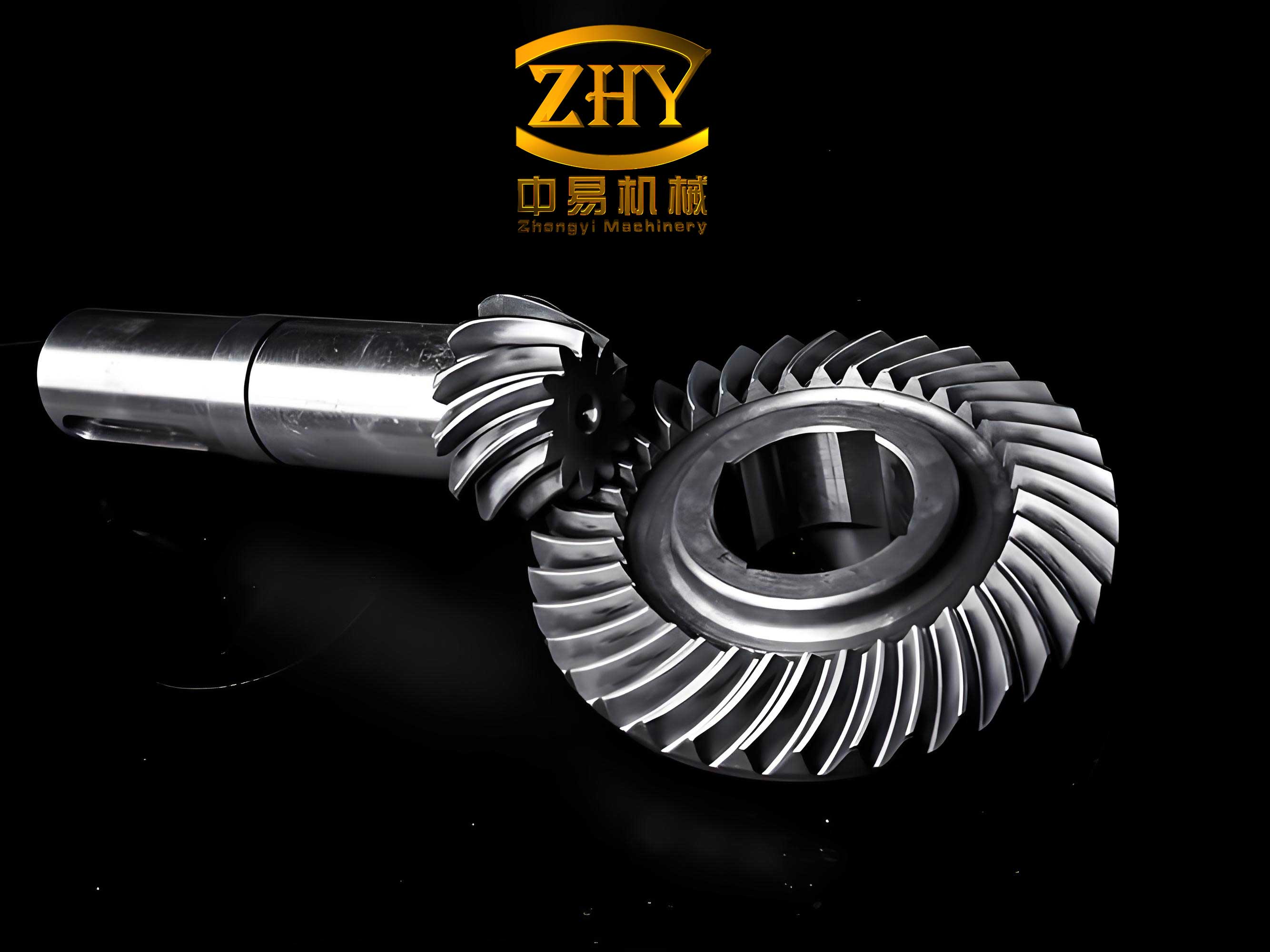
In the realm of precision mechanical transmission, spiral bevel gears stand as critical components for high-speed, heavy-load, and high-accuracy applications. Their design and manufacturing sophistication often serve as a benchmark for a nation’s manufacturing capabilities. Among various tooth systems, the Klingelnberg spiral bevel gear system, introduced from Germany in the 1980s, represents a significant advancement. From my engineering perspective, this system not only retains the inherent benefits of spiral bevel gears—such as smooth transmission and high load capacity—but also introduces advantages like continuous cutting, contact pattern correction, soft-cutting (completing roughing and finishing in one setup), and the ability to perform hard-skiving. This article delves into the fundamental formation principles of the Klingelnberg spiral bevel gear tooth system, employing a first-person narrative to unpack the theoretical underpinnings and mechanical processes involved.
The core of the Klingelnberg system lies in its use of a hypothetical plane generating gear and a fully generating method, specifically for cycloidal spiral bevel gears. Unlike other systems, the Klingelnberg milling machine’s cutter head axis is non-tilting. The generation process simulates the meshing of a pair of spiral bevel gears with a common crown gear. When the pinion (gear 1) and the gear (gear 2) are in mesh at the reference point M, their imaginary generating gears coincide in axis and have no relative motion. Their pitch planes also coincide and are tangent to the pitch cones of the actual gears. The generating surface Σ3 (forming the pinion tooth surface Σ1) and Σ4 (forming the gear tooth surface Σ2) are fixed along a line passing through point M. These surfaces are generated by the inner and outer blades of a dual-layer cutter head, respectively. The initial theoretical condition yields line contact between the conjugate tooth surfaces. However, for practical spiral bevel gears, line contact is highly sensitive to misalignment, leading to stress concentration and noise. Therefore, intentional modification, or mismatch, is introduced to achieve point contact. Under load, this point expands into an instantaneous contact ellipse, ensuring robust performance and lower error sensitivity. This modification, often called crowning, is achieved in Klingelnberg machines by eccentrically offsetting the cutter head’s rotation center, altering the curvature of the convex and concave flanks.
To mathematically describe the conjugate condition at the reference point M, let the theoretical speed ratio be defined by the number of teeth:
$$ i_{12} = \frac{\omega_1}{\omega_2} = \frac{z_2}{z_1} $$
where $\omega_1$ and $\omega_2$ are the angular velocities, and $z_1$ and $z_2$ are the tooth numbers of the pinion and gear, respectively. For the generating process, the relationship between the generating gear (P) and the workpiece (B) must satisfy:
$$ \frac{\omega_P}{\omega_B} = \frac{z_B}{z_P} $$
where $z_P$ is the virtual number of teeth of the plane generating gear. The crowning modifies the local curvatures, which can be expressed through changes in the principal curvatures and directions on the tooth surface.
| Feature | Description | Advantage |
|---|---|---|
| Tooth Form | Cycloidal (Epicycloidal) curve in length direction | Continuous engagement, smooth transmission |
| Generation Method | Fully generated via hypothetical plane generating gear | High accuracy, controllable contact pattern |
| Contact Pattern | Point contact (designed), elliptical under load | Low sensitivity to misalignment, high durability |
| Machining Process | Soft-cutting (roughing & finishing in one setup) | Reduced setup time, improved consistency |
| Cutter Head | Dual-layer with inner and outer blade groups | Simultaneous generation of convex and concave flanks |
The AMK series of bevel gear milling machines embody the mechanical realization of these principles. The machine’s kinematic chain can be simplified into a model comprising several key components: the cutter head (O), the workpiece (B), the hypothetical plane generating gear (P), the cradle (H), a differential mechanism (W), and the indexing change gears (T). The cradle axis and the workpiece axis are fixed in position. The cutter head rotates on its own axis (spin) and also revolves around the cradle axis (public rotation), simulating the generating gear’s motion.
Let’s analyze the machining motions in two distinct phases: the plunging or infeed phase (roughing) and the generating phase (finishing).
Phase 1: Plunging (No Cradle Rotation). In this phase, the cradle does not rotate ($\omega_H = 0$). The machine executes three synchronized motions:
- Axial feed of the cradle (and attached cutter head) towards the workpiece.
- Rotation of the workpiece with angular velocity $\omega_B$.
- Rotation of the cutter head with angular velocity $\omega_O$.
The indexing gear train (T) establishes a fixed relationship between the cutter head spin and the workpiece rotation to enable continuous indexing: $z_O \omega_O = \omega_P z_P = \omega_B z_1$. Here, $z_O$ is related to the number of cutter blade groups. During this phase, each blade group cuts its trace in the tooth slot. Since the cradle is stationary, all trace surfaces from different blade groups coincide, forming a ruled surface on the workpiece whose tooth line is an extended epicycloid. This forms the basic tooth length geometry of the spiral bevel gear.
The equation for the cutter head blade path can be described parametrically. For a point on a blade, its position vector in the cutter head coordinate system is $\mathbf{r}_c(u, \theta)$, where $u$ is a profile parameter and $\theta$ is the rotation angle. Transforming this through the machine kinematics during plunging gives the family of surfaces on the workpiece. The condition for the envelope (the actual tooth surface) is not fully active here, as the surfaces coincide.
Phase 2: Generating (With Cradle Rotation). This is the core finishing process that generates the precise tooth profile, essentially forming an involute in the profile direction. Now, the cradle rotates with an angular velocity $\omega_H \neq 0$. This imparts an additional angular velocity increment $\Delta \omega_P$ to the hypothetical generating gear P, and a corresponding increment $\Delta \omega_B$ to the workpiece B. The differential mechanism (W) ensures the ratio:
$$ \frac{\Delta \omega_P}{\Delta \omega_B} = \frac{z_B}{z_P} $$
Consequently, the overall motion satisfies the generating condition:
$$ \frac{\omega_P + \Delta \omega_P}{\omega_B + \Delta \omega_B} = \frac{z_B}{z_P} $$
During this motion, the trace surfaces from different blade groups no longer coincide. The final tooth surface $\Sigma_B$ becomes the envelope of the entire family of trace surfaces $\{\Sigma_i\}$ generated by all blade groups as the cradle swings.
The mathematical formulation for the generating phase is more complex. The coordinate transformation chain involves multiple moving frames: cutter head, cradle, machine base, and workpiece. Let $\phi_H$ be the cradle rotation angle and $\phi_B$ the workpiece rotation angle. Their relationship is governed by the machine settings, which include the basic ratio and the modified roll via the differential. The equation of the family of surfaces on the workpiece is $\mathbf{R}_B(u, \theta, \phi_H)$. The envelope condition requires that the normal vector is orthogonal to the relative velocity vector between the generating surface and the workpiece:
$$ \mathbf{n}(u, \theta, \phi_H) \cdot \mathbf{v}^{(PB)}(u, \theta, \phi_H) = 0 $$
Solving this equation together with the surface equation yields the meshing relation between $\theta$ and $\phi_H$, and ultimately defines the generated spiral bevel gear tooth surface.
| Symbol | Component | Description | Role in Generation |
|---|---|---|---|
| $\omega_O$, $z_O$ | Cutter Head | Spin angular velocity & effective tooth number | Creates cutting edges, enables indexing |
| $\omega_B$, $z_B$ | Workpiece (Gear) | Rotation angular velocity & tooth number | Determines part geometry, receives cut |
| $\omega_H$ | Cradle | Swing angular velocity | Drives the generating motion (finishing) |
| $\omega_P$, $z_P$ | Hypothetical Generating Gear | Virtual angular velocity & tooth number | Serves as the generating tool counterpart |
| $\Delta \omega_P$, $\Delta \omega_B$ | Differential Outputs | Incremental velocities for generating roll | Ensures correct conjugate motion per tooth |
The geometry of the generated spiral bevel gear tooth surface is paramount. The tooth flank is a complex three-dimensional surface. Its principal curvatures and directions influence the contact pattern and stress distribution. For a spiral bevel gear pair, the local synthesis aims to control the mismatch. The induced crowning can be quantified by the normal curvature difference between the pinion and gear flanks at the design point. If $\kappa_{1n}$ and $\kappa_{2n}$ are the normal curvatures of the pinion and gear along a common direction, the mismatch $\Delta \kappa_n$ is:
$$ \Delta \kappa_n = \kappa_{1n} – \kappa_{2n} $$
This controlled mismatch transforms the theoretical line contact into a point contact. Under load $F$, the contact area expands into an ellipse. The dimensions of this contact ellipse can be approximated by Hertzian contact theory. For two elastic bodies with principal relative curvatures, the semi-major axis $a$ and semi-minor axis $b$ of the contact ellipse are given by:
$$ a = \alpha \sqrt[3]{\frac{3F}{2E’ \Sigma \kappa}} , \quad b = \beta \sqrt[3]{\frac{3F}{2E’ \Sigma \kappa}} $$
where $\alpha$ and $\beta$ are coefficients dependent on the curvature geometry, $E’$ is the equivalent elastic modulus, $\Sigma \kappa$ is the sum of principal curvatures, and $\kappa$ is a function of the curvature difference. This highlights the importance of precise curvature control in spiral bevel gear design.
From my analysis, the Klingelnberg machine’s ability to introduce crowning via eccentric adjustment of the cutter head is a key feature. This eccentricity $e$ modifies the effective radius of the cutter head blades during the generating roll. For the convex side, the effective radius increases or decreases slightly, altering the generated path. This can be modeled as a time-varying cutter radius $R_c(\phi_H) = R_{c0} + e \cdot f(\phi_H)$, where $R_{c0}$ is the nominal radius and $f(\phi_H)$ is a function related to the cradle angle. This variation changes the local curvature of the generated spiral bevel gear tooth surface.
To further elaborate on the tooth surface equations, let’s define coordinate systems. Let $S_c(X_c, Y_c, Z_c)$ be attached to the cutter head, rotating with $\omega_O$. $S_h(X_h, Y_h, Z_h)$ is attached to the cradle, rotating with $\omega_H$. $S_m$ is the fixed machine coordinate system. $S_b(X_b, Y_b, Z_b)$ is attached to the workpiece, rotating with $\omega_B$. The transformation from $S_c$ to $S_b$ involves a series of homogeneous transformations:
$$ \mathbf{R}_b = \mathbf{M}_{bm} \cdot \mathbf{M}_{mh} \cdot \mathbf{M}_{hc} \cdot \mathbf{r}_c $$
where $\mathbf{M}_{ij}$ are 4×4 transformation matrices. The cutter blade surface in $S_c$ is known, often a straight-line surface for simplicity (forming a conical surface). A point on the blade is:
$$ \mathbf{r}_c(u, \theta) = \begin{bmatrix} (R_0 \pm u \sin \alpha) \cos \theta \\ (R_0 \pm u \sin \alpha) \sin \theta \\ u \cos \alpha \end{bmatrix} $$
Here, $u$ is the parameter along the blade edge, $R_0$ is the nominal point radius, $\alpha$ is the blade pressure angle, and $\theta$ is the angular position on the cutter head. The $\pm$ sign distinguishes between inner (concave) and outer (convex) blades. The relationship between $\theta$, the cradle angle $\phi_H$, and the workpiece angle $\phi_B$ is derived from the kinematic chain and the envelope condition. This results in a complex implicit equation that defines the spiral bevel gear tooth surface parametrically via $u$ and $\phi_H$.
The contact pattern analysis between a pair of Klingelnberg spiral bevel gears requires solving the conditions for continuous tangency under load. The tooth surfaces must satisfy the equation of meshing:
$$ \mathbf{n}^{(1)} \cdot \mathbf{v}^{(12)} = 0 $$
where $\mathbf{n}^{(1)}$ is the unit normal on the pinion surface, and $\mathbf{v}^{(12)}$ is the relative velocity at the potential contact point. For a given pinion rotation angle $\phi_1$, this equation is solved to find the corresponding gear rotation angle $\phi_2$ and the contact point coordinates. The transmission error, defined as $\Delta \phi_2 = \phi_2 – (z_1/z_2) \phi_1$, is a critical performance indicator. A well-designed spiral bevel gear pair with proper crowning will have a small, parabolic transmission error, which helps reduce noise and dynamic loads.
| Aspect | Klingelnberg (Cycloidal) | Gleason (Arc-Teeth) | Formate/Non-Generated |
|---|---|---|---|
| Tooth Line Curve | Extended Epicycloid | Circular Arc | Defined by Cutter |
| Generation Principle | Fully generated via plane crown gear | Generated via imaginary crown gear with tilted cutter | Form copying, no generating roll |
| Contact Pattern Control | Via cutter eccentricity and machine settings | Via machine adjustments (tilt, etc.) | Limited, fixed at machining |
| Machine Complexity | High (differential, precise indexing) | High (complex cradle kinematics) | Relatively lower |
| Typical Application | High-precision, heavy-duty drives | Automotive, aerospace | Simpler, lower-speed drives |
In my exploration of spiral bevel gear technology, the advantages of the Klingelnberg system become evident. The continuous cutting action reduces cyclical loading on the cutter and machine, enhancing tool life and surface finish. The soft-cutting capability, where roughing and finishing are done in a single clamping, significantly reduces positioning errors and increases productivity. Furthermore, the hard-skiving process for hardened spiral bevel gears is a remarkable extension, allowing for final finishing after heat treatment to correct distortions and achieve ultra-high accuracy. This process relies on the same generating principle but uses a carbide-tipped cutter head to shave minute amounts from the hardened surface.
The mathematical optimization of machine settings for a given spiral bevel gear pair design is a sophisticated task. It involves selecting parameters such as cutter diameter, blade angle, machine root angle, offset distances, and the generating roll coefficients to achieve desired tooth bearing and geometry. Modern computer-aided engineering (CAE) tools simulate the entire cutting process and tooth contact analysis (TCA) to predict performance before physical manufacturing. The TCA solves the system of equations comprising the surface geometries and the meshing condition to determine the path of contact and transmission error.
Let’s consider a simplified numerical example to illustrate the curvature relationship. Assume a spiral bevel gear pair with the following data at the design point:
- Mean cone distance: $R_m = 100$ mm
- Spiral angle: $\beta_m = 35^\circ$
- Normal pressure angle: $\alpha_n = 20^\circ$
- Number of teeth: $z_1=15$, $z_2=45$
The theoretical transverse pressure angle $\alpha_t$ can be found from:
$$ \tan \alpha_n = \tan \alpha_t \cos \beta_m $$
The equivalent radius of curvature in the transverse plane can be approximated. However, the actual curvatures are derived from the generated surface equations. The crown gear’s virtual radius $r_p$ is related to the mean cone distance: $r_p = R_m / \sin \delta_1$, where $\delta_1$ is the pinion pitch angle. The introduction of crowning modifies these curvatures. If the eccentricity $e$ is set to 0.1 mm, the change in effective cutter radius might be on the order of a few micrometers per degree of cradle roll, leading to a controlled mismatch $\Delta \kappa_n$ in the range of $0.001 – 0.01$ mm$^{-1}$.
The development of domestic CNC machining capabilities for cycloidal spiral bevel gears, inspired by systems like Klingelnberg’s, holds profound significance. It represents mastering a key technology in high-end gear manufacturing. A deep understanding of the formation principle—from the hypothetical plane generating gear to the intricate kinematics of the milling machine—is foundational for such innovation. Research efforts should focus on precise digital modeling of the tooth surfaces, advanced TCA algorithms, and the development of adaptive CNC systems that can implement optimized machine settings in real-time.
In conclusion, the Klingelnberg spiral bevel gear system exemplifies a harmonious blend of mechanical ingenuity and mathematical precision. Its formation principle, centered on the fully generated cycloidal tooth via a plane generating gear and sophisticated machine kinematics, enables the production of high-performance gears capable of meeting the demands of modern machinery. The ability to control the contact pattern through intentional crowning makes these spiral bevel gears exceptionally robust against real-world imperfections. As I reflect on the intricacies of this technology, it is clear that ongoing research and development in this field are crucial for advancing the state of the art in power transmission and strengthening the core competencies of precision manufacturing industries worldwide.