
In the evolving landscape of mechanical engineering, the trend toward heavier and more robust machinery has intensified the demand for high-precision, large-module spiral bevel gears. These components are critical in power transmission systems, especially in industries such as aerospace, automotive, and heavy equipment. However, manufacturing large-module, high-accuracy spiral bevel gears presents significant challenges, often leading to bottlenecks in production. Traditional specialized gear-cutting machines are expensive and less flexible, prompting the exploration of alternative solutions. One promising approach is the use of general five-axis CNC machining centers, which offer versatility and precision. To enable this, an accurate geometric model of the spiral bevel gear is essential for effective CNC programming. This article delves into a method for designing and modeling spiral bevel gears based on general CNC machining, focusing on precise tooth surface generation using differential geometry and gear theory.
The fundamental challenge in spiral bevel gear modeling stems from the spherical nature of the tooth profile. In actual spiral bevel gear transmission, the distance from any point on the tooth to the apex of the pitch cone remains constant, implying that the tooth profile curve should be a spherical curve centered at the pitch cone apex. This provides a scientific basis for applying spherical involute theory in model design. Early research on gears primarily addressed geometric characteristics and design parameters, but advancements have led to more accurate modeling techniques. For instance, some studies have proposed methods based on exact spherical involute curves, while others rely on differential geometry and spatial meshing principles through complex coordinate transformations. However, many existing approaches approximate the theoretical spherical involute with a planar involute on the back cone, which introduces errors, especially when the ratio of spherical radius to gear module is small, and hinders parameterization. To address these limitations for CNC machining, this study proposes an exact modeling method for spiral bevel gears. The process involves establishing parametric equations for the tooth surface, then trimming the gear blank with these surfaces to obtain precise tooth forms. This yields an accurate geometric model conducive to CNC programming.
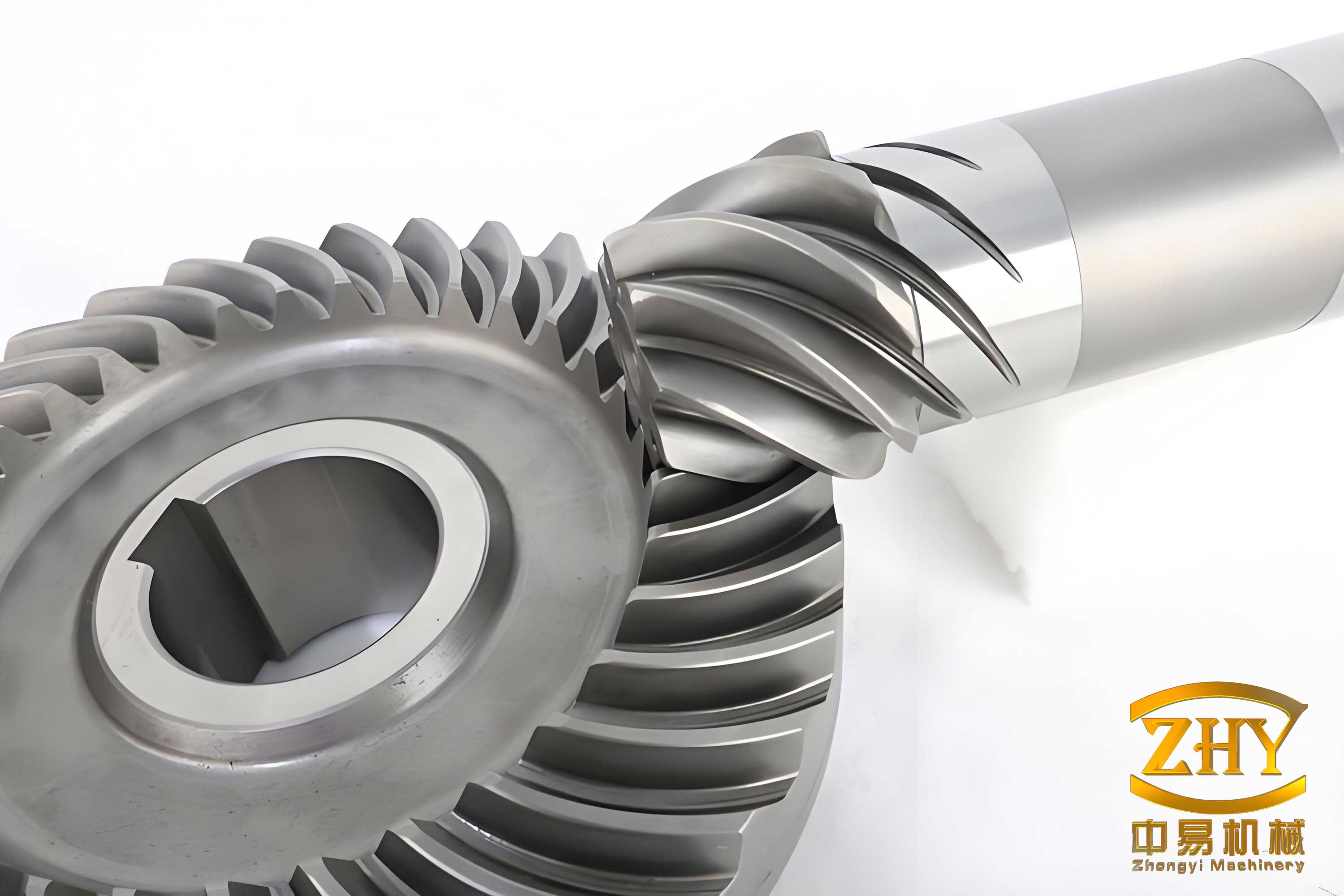
To begin, the tooth surface of a spiral bevel gear can be conceptualized as a combination of two key curves: the tooth trace (or tooth line) and the tooth profile. The tooth trace is represented as a spiral line on the base cone, while the tooth profile is an involute curve. This dual-curve approach allows for a parametric representation that facilitates exact modeling. In this context, the spiral bevel gear’s geometry is defined by several parameters, including module, number of teeth, spiral angle, pressure angle, and cone angles. These parameters are summarized in Table 1 for clarity.
| Parameter | Symbol | Description |
|---|---|---|
| Module | m | Standard size parameter for gear teeth |
| Number of Teeth | z | Total teeth count on the gear |
| Spiral Angle at Small End | β_n | Helix angle at the smaller diameter of the gear |
| Pressure Angle | α | Angle defining tooth flank inclination |
| Base Cone Angle | δ | Angle of the base cone relative to the axis |
| Base Circle Radius | R_b | Radius of the base circle for involute generation |
The tooth trace on a spiral bevel gear is modeled as a spiral curve on the base cone. Specifically, it is defined as an Archimedean spiral, where a point moves uniformly upward along the cone while rotating around the axis. The spiral angle β at any point is constant relative to the cone generatrix. Let the base cone have a half-angle δ, and consider a point moving on its surface. The spiral curve can be expressed in parametric form. Denote the spiral parameter as φ, which represents the rotational angle around the cone axis. Then, the coordinates of a point on the spiral line in a local coordinate system attached to the cone apex can be given by:
$$ x = k \varphi \sin \alpha \cos \varphi $$
$$ y = k \varphi \sin \alpha \sin \varphi $$
$$ z = k \varphi \cos \alpha $$
Here, k is a constant that depends on the gear geometry, and α is related to the spiral angle. The spiral angle β is defined as the angle between the tangent to the spiral and the cone generatrix. From geometry, the relationship between φ and β is given by:
$$ \tan \varphi = \frac{\beta}{\sin \alpha} $$
However, to align with standard gear terminology, we redefine parameters. Let the spiral angle at the small end of the base cone be β_n. Then, the constant k can be derived from the base circle radius R_b and spiral angle. The base circle radius for a spiral bevel gear is calculated as:
$$ R_b = \frac{m z \cos \alpha}{2 \cos \delta} $$
And the constant k is:
$$ k = \frac{R_b}{\tan \beta_n} $$
Thus, the spiral line equation becomes a function of φ, with α representing the pressure angle in the context of the cone. This spiral serves as the tooth trace, guiding the path along which the tooth profile evolves. For a spiral bevel gear, both left and right flanks have distinct spiral directions, often symmetric.
Next, the tooth profile is based on the involute curve, which is preferred in gear design due to its advantages in transmission, such as constant velocity ratio and ease of manufacturing. An involute is generated by unwinding a taut string from a base circle. In parametric form, for a base circle of radius r, the involute equations are:
$$ x_i = r (\cos \theta + \theta \sin \theta) $$
$$ y_i = r (\sin \theta – \theta \cos \theta) $$
Here, θ is the involute parameter, representing the angle of unwinding. For a spiral bevel gear, this involute lies in a plane normal to the spiral line at each point, ensuring proper meshing. The base radius r for the involute is related to the local geometry of the gear tooth. In spherical terms, the involute should ideally be spherical, but for practical modeling, we use a planar approximation that becomes exact when transformed to the spherical surface via coordinate changes.
To form the complete tooth surface of a spiral bevel gear, we combine the spiral line and involute curve using vector mathematics. Let the tooth surface be parameterized by two parameters: u for the spiral line (tooth trace) and v for the involute (tooth profile). Denote the position vector of a point on the spiral line as \(\mathbf{r}_d(u)\) and on the involute as \(\mathbf{r}_j(v)\). Then, the tooth surface vector \(\mathbf{R}(u,v)\) is given by the sum of these vectors in appropriate coordinate frames. However, due to the spatial orientation, we must apply coordinate transformations to align the involute plane with the spiral tangent.
Specifically, consider a local coordinate system {O1, x1, y1, z1} attached to a point on the spiral line, where z1 is tangent to the spiral, x1 is normal to the cone surface, and y1 is binormal. In this system, the involute lies in the x1-y1 plane. The tooth surface equation in the local frame can be written as:
$$ \mathbf{R}_{\text{local}}(u,v) = \mathbf{r}_d(u) + \mathbf{r}_j(v) $$
To express this in the global coordinate system {O, x, y, z} fixed to the gear blank, we need a series of transformations. First, transform from the involute plane system to an intermediate system aligned with the cone, then to the global system. This involves rotation matrices that account for the spiral angle and cone angle. Let M01 be the transformation matrix from the involute local system to a system {O2, x2, y2, z2} aligned with the cone generatrix, and M12 from there to the global system. The overall transformation matrix M is the product of these matrices.
Define the angles involved. Let the spiral parameter φ correspond to u, and the involute parameter θ correspond to v. The spiral line vector in global coordinates can be expressed as:
$$ \mathbf{r}_d(\varphi) = k \varphi (\sin \alpha \cos \varphi \mathbf{i} + \sin \alpha \sin \varphi \mathbf{j} + \cos \alpha \mathbf{k}) $$
For the involute, in its local plane, the vector is:
$$ \mathbf{r}_j(\theta) = r [(\cos \theta + \theta \sin \theta) \mathbf{i}’ + (\sin \theta – \theta \cos \theta) \mathbf{j}’] $$
Where \(\mathbf{i}’\) and \(\mathbf{j}’\) are unit vectors in the involute plane. To combine these, we rotate \(\mathbf{r}_j\) into the global system. The rotation depends on the position along the spiral. At any point on the spiral, the orientation of the involute plane is defined by the tangent vector to the spiral and the normal to the cone surface. Using differential geometry, the Darboux frame or Frenet-Serret formulas can be applied, but for simplicity, we use pre-defined rotation matrices.
Let the transformation from the involute local system to the global system be represented by a rotation matrix \( \mathbf{R}(\varphi) \) that is a function of φ. This matrix accounts for the spiral angle β and the cone angle δ. In practice, it is easier to break the transformation into steps. First, align the involute with the spiral line’s normal plane, then rotate by the cone angle. The detailed transformation steps are summarized in Table 2.
| Step | Transformation | Matrix Representation | Purpose |
|---|---|---|---|
| 1 | From involute local system {O1, x1, y1, z1} to system {O2, x2, y2, z2} aligned with cone | M01 = Rotation(α, β, γ) where angles depend on φ | Align involute plane with spiral tangent plane |
| 2 | From {O2, x2, y2, z2} to global system {O, x, y, z} | M12 = Rotation(δ, 0, 0) followed by translation | Account for cone angle and position |
| 3 | Overall transformation | M = M12 · M01 | Combine to get global coordinates |
The rotation matrices can be defined using Euler angles. For step 1, let the angles α1, β1, γ1 be the direction cosines of the x2, y2, z2 axes relative to x, y, z. From the geometry of the spiral on the cone, these angles can be derived. For example, the z2 axis is along the spiral tangent, which has components proportional to (sin α cos φ, sin α sin φ, cos α) in global coordinates. The x2 axis can be taken as the normal to the cone surface, and y2 as the cross product. This yields:
$$ \alpha_1 = \sin \alpha \cos \varphi, \quad \beta_1 = \sin \alpha \sin \varphi, \quad \gamma_1 = \cos \alpha $$
For the other axes, we compute based on orthogonality. The transformation matrix M01 is then:
$$ \mathbf{M}_{01} = \begin{bmatrix} \cos \alpha_1 & \cos \beta_1 & \cos \gamma_1 & 0 \\ \cos \alpha_2 & \cos \beta_2 & \cos \gamma_2 & 0 \\ \cos \alpha_3 & \cos \beta_3 & \cos \gamma_3 & 0 \\ 0 & 0 & 0 & 1 \end{bmatrix} $$
Where the cosines are for the axes of {O2} relative to {O}. In practice, we often use simpler rotations. For step 2, the matrix M12 involves a rotation by the cone angle δ around the y-axis, followed by a translation to the gear blank position. The combined matrix M allows us to transform the local involute vector to global coordinates:
$$ \mathbf{r}_j^{\text{global}}(\theta, \varphi) = \mathbf{M} \cdot \mathbf{r}_j(\theta) $$
Then, the total tooth surface vector in global coordinates is:
$$ \mathbf{R}(\varphi, \theta) = \mathbf{r}_d(\varphi) + \mathbf{r}_j^{\text{global}}(\theta, \varphi) $$
This equation represents the parametric surface for one flank of the spiral bevel gear. For the opposite flank, the spiral direction is reversed, and the involute may have a different sign for the pressure angle. Specifically, for the left and right flanks of a spiral bevel gear, the equations become:
Left flank: $$ \mathbf{R}_l(\varphi_l, \theta_l) = \mathbf{r}_{dl}(\varphi_l) + \mathbf{r}_{jl}^{\text{global}}(\theta_l, \varphi_l) $$
Right flank: $$ \mathbf{R}_r(\varphi_r, \theta_r) = \mathbf{r}_{dr}(\varphi_r) + \mathbf{r}_{jr}^{\text{global}}(\theta_r, \varphi_r) $$
Where the spiral vectors differ in the sign of the spiral angle, and the involute vectors may have θ defined with opposite signs. The exact forms can be derived by substituting the parameter expressions. For instance, the left spiral line vector is:
$$ \mathbf{r}_{dl}(\varphi_l) = k \varphi_l (\sin \alpha \cos \varphi_l \mathbf{i} + \sin \alpha \sin \varphi_l \mathbf{j} + \cos \alpha \mathbf{k}) $$
And the right spiral line vector is similar but with φ_r having a negative sign in the trigonometric terms for the opposite helix hand. The involute vectors in global coordinates are obtained through the same transformation matrix but with adjusted angles.
To illustrate the coordinate transformation process, consider a specific example. Suppose we have a spiral bevel gear with parameters: m = 5 mm, z = 20, α = 20°, δ = 30°, β_n = 35°. Then, compute R_b = (5 * 20 * cos 20°)/(2 * cos 30°) ≈ 46.98 mm, and k = 46.98 / tan 35° ≈ 67.15 mm. The spiral line equation becomes:
$$ \mathbf{r}_d(\varphi) = 67.15 \varphi ( \sin 20° \cos \varphi \mathbf{i} + \sin 20° \sin \varphi \mathbf{j} + \cos 20° \mathbf{k} ) $$
For the involute, with base radius r = R_b, the local equation is:
$$ \mathbf{r}_j(\theta) = 46.98 [ (\cos \theta + \theta \sin \theta) \mathbf{i}’ + (\sin \theta – \theta \cos \theta) \mathbf{j}’ ] $$
The transformation matrix M involves rotations. First, at any φ, the spiral tangent direction is given by the derivative of \(\mathbf{r}_d\) with respect to φ. After normalization, we get the z2 axis. The x2 axis can be the radial direction on the cone, and y2 the cross product. Then, rotate by δ around the y-axis to align with the gear axis. The detailed matrix multiplication yields the global involute vector. This process generates discrete points on the tooth surface, which can be used for modeling.
In practice, to create a 3D model suitable for CNC machining, we use CAD software. The steps are as follows: first, generate the gear blank model based on the cone dimensions. Then, compute point clouds for the left and right tooth surfaces using the parametric equations above. Import these points into CAD software (e.g., Siemens NX or CATIA) to create surface patches. Trim the gear blank with these surfaces to form the tooth slots. Finally, pattern the tooth slot around the gear axis to complete the spiral bevel gear model. This model is then used for CNC toolpath generation.
The advantages of this method are numerous. It provides an exact geometric representation of the spiral bevel gear tooth surface, reducing errors compared to approximate methods. The parameterization allows for easy modification of design parameters, facilitating iterative design and optimization. Moreover, the model is directly applicable to general five-axis CNC machining, as the surface data can be converted into G-code for milling. This approach bridges the gap between design and manufacturing, enabling flexible production of custom spiral bevel gears.
For CNC machining, the spiral bevel gear model must be converted into toolpaths. This involves selecting cutting tools, defining machining strategies (e.g., flank milling or point milling), and generating NC code. The exact surface model ensures accurate tool positioning, which is critical for achieving high precision in large-module gears. Additionally, simulation of the machining process can verify the toolpaths and avoid collisions. The integration of modeling and machining underscores the importance of precise geometry in modern manufacturing.
To further elaborate, let’s discuss the mathematical details of the coordinate transformations. The transformation from the local involute system to the global system can be broken into two main rotations: one that aligns the involute plane with the spiral line’s normal plane, and another that accounts for the cone angle. Denote the local involute system as {O1, x1, y1, z1}, where x1 is along the involute radial direction, y1 is along the involute tangent, and z1 is normal to the involute plane. In this system, the involute vector is as given earlier. We want to transform this to a system {O2, x2, y2, z2} where z2 is tangent to the spiral line, and x2 is normal to the cone surface at the point on the spiral.
First, find the orientation of {O2} relative to {O1}. The spiral line on the base cone has a parametric equation in spherical coordinates. Let the base cone have apex at origin, axis along z-axis. The cone surface equation is: $$ x^2 + y^2 = (z \tan \delta)^2 $$ But in terms of the spiral, we use the earlier parametric form. The tangent vector to the spiral is obtained by differentiating \(\mathbf{r}_d(\varphi)\):
$$ \mathbf{t} = \frac{d\mathbf{r}_d}{d\varphi} = k [ (\sin \alpha \cos \varphi – \varphi \sin \alpha \sin \varphi) \mathbf{i} + (\sin \alpha \sin \varphi + \varphi \sin \alpha \cos \varphi) \mathbf{j} + \cos \alpha \mathbf{k} ] $$
This vector is used as the z2 axis. The x2 axis can be the outward normal to the cone surface, which is given by the gradient of the cone equation. However, since the point lies on the cone, the normal vector \(\mathbf{n}\) has components proportional to (x, y, -z cot² δ) but simplified. Alternatively, for a cone, the normal at a point (x, y, z) is (x, y, -z / tan² δ). Normalizing this gives the x2 direction. The y2 axis is then \(\mathbf{y2} = \mathbf{z2} \times \mathbf{x2}\).
Once {O2} is defined, the transformation from {O1} to {O2} is a rotation matrix \(\mathbf{R}_{12}\) that depends on φ. Then, from {O2} to the global system {O}, we need a rotation by the cone angle δ around the y-axis if {O2} is aligned with the cone generatrix. Actually, {O2} is already oriented relative to the cone, so additional rotation may be needed to align with the gear blank axis. Let the gear blank have its axis along the global z-axis. Then, the cone axis is at an angle δ from the z-axis. So, we rotate {O2} by -δ around an appropriate axis to align with the global system.
In matrix form, let the overall rotation be \(\mathbf{R} = \mathbf{R}_{\text{global}} \cdot \mathbf{R}_{12}\). The translation part is included by adding the spiral point position \(\mathbf{r}_d(\varphi)\). Thus, the global involute vector is:
$$ \mathbf{r}_j^{\text{global}} = \mathbf{R} \cdot \mathbf{r}_j + \mathbf{r}_d $$
This is a compact representation. For implementation, we can compute \(\mathbf{R}\) explicitly. Suppose we define the angles as follows: let the spiral line have a helix angle β relative to the cone generatrix. Then, at any point, the local frame on the cone can be defined by the tangent, normal, and binormal vectors. Using differential geometry, the Darboux frame on a surface is suitable. For a cone, the surface is developable, so the geometry simplifies.
An alternative approach is to use the spherical involute directly, but that requires working in spherical coordinates. The method described here uses planar involute in the normal plane, which is an approximation to the spherical involute, but the coordinate transformation ensures it maps to the correct spherical surface when integrated over the spiral. This is valid for small teeth relative to the sphere radius, but for large-module gears, the error may need assessment. However, for CNC machining, the discrete points generated from the equations can be made arbitrarily accurate by increasing the point density.
To validate the model, we can compare with standard gear design software or physical measurements. But for this study, the focus is on the modeling process for CNC. The key is that the surface is defined parametrically, allowing for direct use in CAM systems.
Now, let’s delve into the generation of the gear tooth in CAD. After obtaining the surface equations, we discretize the parameters φ and θ over their ranges. For example, φ from 0 to φ_max, where φ_max corresponds to the face width of the gear, and θ from θ_min to θ_max, defining the tooth height. The discretization step affects accuracy; finer steps yield smoother surfaces but more data points. A typical step might be 0.01 radians for φ and 0.005 radians for θ. The points are then exported as a CSV file or directly used in CAD.
In CAD, we create a new part, define the gear blank as a conical solid based on pitch cone dimensions. Then, import the point cloud for the left flank and fit a B-spline surface through the points. Repeat for the right flank. These surfaces are then used to trim the gear blank, creating a single tooth slot. The trimming operation involves subtracting the volume between the surfaces from the blank. Then, circular pattern this tooth slot around the axis z times to complete the gear. The result is a solid model of the spiral bevel gear ready for machining.
For CNC programming, the solid model is imported into CAM software. The machining strategy for spiral bevel gears often involves five-axis simultaneous milling, where the tool moves along the tooth slots while maintaining proper orientation. The tool path is generated by intersecting the tool geometry with the tooth surfaces. With the exact model, this intersection can be computed accurately, leading to high-quality gears. Post-processing converts the tool paths into NC code for the specific CNC machine.
This method is particularly beneficial for prototyping and small-batch production, where dedicated gear cutters are not economical. It also allows for customization, such as modifying tooth geometry for noise reduction or increased strength. The integration of design and manufacturing through digital models is a cornerstone of Industry 4.0.
In conclusion, the precise modeling of spiral bevel gears for general CNC machining is a multifaceted process that combines differential geometry, gear theory, and computer-aided design. By representing the tooth surface as a combination of a base cone spiral line and an involute curve, and applying careful coordinate transformations, we achieve an accurate parametric model. This model facilitates direct use in CAD/CAM systems, enabling efficient production of high-precision spiral bevel gears on five-axis CNC machining centers. The approach addresses the manufacturing bottlenecks associated with large-module gears and offers flexibility for modern mechanical applications. Future work could explore real-time simulation, advanced toolpath optimization, and integration with additive manufacturing for hybrid gear production.
Throughout this discussion, the term spiral bevel gear has been emphasized to highlight its centrality in the methodology. The spiral bevel gear’s unique geometry requires sophisticated modeling techniques, and the proposed method provides a robust solution. As industries continue to demand higher performance and customization, such approaches will become increasingly valuable in the engineering toolkit.