
The manufacturing of spiral bevel gear components represents a significant challenge in modern mechanical engineering due to their complex geometry and stringent performance requirements. As a researcher focused on digital manufacturing technologies, I have explored methods to streamline their design and virtual prototyping. This article details a first-principles approach for the parametric modeling and visual simulation of the form milling process for spiral bevel gears. The core of this methodology lies in establishing a precise mathematical model that defines the gear blank, the cutting tool, and their relative kinematic relationship during machining. By solving for critical surface points and visualizing the results through a custom-built software platform, this approach enables the rapid, parameter-driven generation and verification of spiral bevel gear designs before physical production.
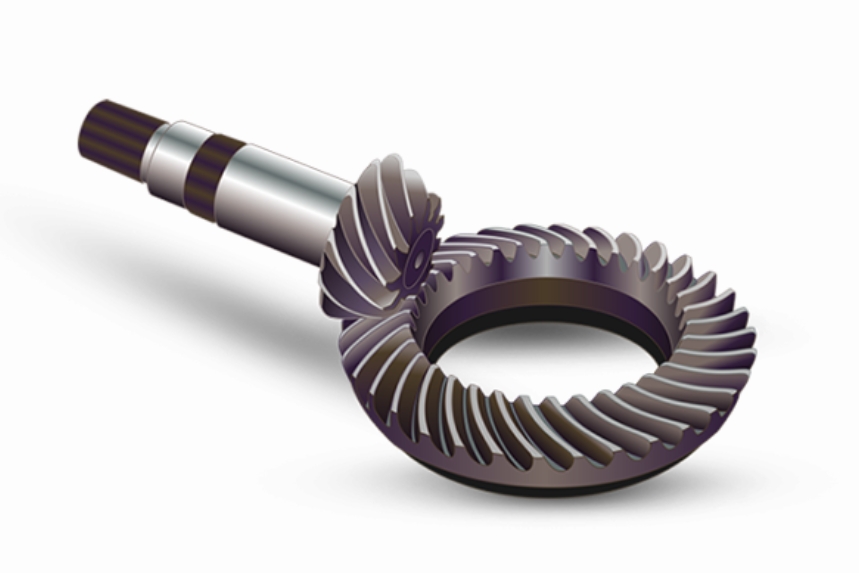
The inherent complexity of a spiral bevel gear tooth surface, which is typically a local conjugate to its mating gear, necessitates careful control over machining parameters. Traditional trial-and-error methods for achieving the correct contact pattern are time-consuming and costly. Therefore, a parametric digital manufacturing model is not just a convenience but a necessity. My work is based on the forming (or formate) milling principle, often applied to the larger member of a Gleason-type spiral bevel gear pair, particularly when its pitch angle is substantial. In this process, a cutter head with straight-sided blades directly forms the tooth slot, generating both the convex and concave flanks of the spiral bevel gear simultaneously.
Fundamental Principles and Parameter Definition
The visual simulation of spiral bevel gear form milling parametric manufacturing is predicated on acquiring a visual model of both the cutter and the gear blank based on their key geometric parameters. Subsequently, the machining process is simulated according to machine tool setup parameters to generate the final visual model of the spiral bevel gear. A single tooth slot features a convex and a concave flank, each bounded by specific surfaces. The core algorithmic challenge involves calculating the intersection points of these bounding surfaces to define the tooth profile’s key boundary curves.
The primary surfaces involved are the gear blank’s front cone, face cone, and root cone, and the cutter’s inner blade cone and outer blade cone. The eight critical vertices of a tooth slot are formed by the intersection of three specific surfaces. The relationships defining these vertices for the convex and concave flanks are summarized below.
| Point Label | Associated Surface 1 | Associated Surface 2 | Associated Surface 3 |
|---|---|---|---|
| B (Convex) | Front Cone | Face Cone | Inner Blade Cone |
| D (Convex) | Front Cone | Root Cone | Inner Blade Cone |
| F (Convex) | Back Cone | Face Cone | Inner Blade Cone |
| H (Convex) | Back Cone | Root Cone | Inner Blade Cone |
| B’ (Concave) | Front Cone | Face Cone | Outer Blade Cone |
| D’ (Concave) | Front Cone | Root Cone | Outer Blade Cone |
| F’ (Concave) | Back Cone | Face Cone | Outer Blade Cone |
| H’ (Concave) | Back Cone | Root Cone | Outer Blade Cone |
By systematically varying a parameter along the tooth length (e.g., the distance from the front cone apex) and calculating its intersection with the other two relevant surfaces, a sequence of points can be determined for each of the four boundary curves on a flank. Connecting these points using triangular faceting principles allows for the reconstruction of the complete tooth surface of the spiral bevel gear. The accuracy of this model is directly governed by three sets of parameters: the gear blank geometry, the cutter geometry, and the machine tool settings.
The form milling cutter is simplified as a revolving body with distinct inner and outer conical blade surfaces. The primary parameters defining a standard cutter head and a sample spiral bevel gear blank are listed below. These parameters serve as the foundational variables for the mathematical model.
| Parameter Name | Symbol | Value (Example) |
|---|---|---|
| Cutter Radius | D/2 | 152.4 mm |
| Blade Edge Offset | W | 5.33 mm |
| Cutter Body Base Distance | K | 138.9 mm |
| Inner Blade Pressure Angle | \(\alpha_1\) | 24.5° |
| Outer Blade Pressure Angle | \(\alpha_2\) | 20.5° |
| Parameter Name | Symbol | Value (Example) |
|---|---|---|
| Number of Teeth | Z | 29 |
| Hand of Spiral | Dir | Left |
| Spiral Angle | \(\beta\) | 35° |
| Face Width | B | 56 mm |
| Outer Cone Distance | \(L_1\) | 194.71 mm |
| Face Angle | \(\beta_3\) | 53.10° |
| Pitch Angle | \(\beta_2\) | 50.23° |
| Root Angle | \(\beta_1\) | 46.52° |
The spatial relationship between the workpiece (gear blank) and the tool during the machining simulation is controlled by machine setup parameters. These parameters define the coordinate system transformations essential for calculating the points of intersection between the gear and tool surfaces in a common reference frame.
| Parameter Name | Symbol | Value (Example) |
|---|---|---|
| Horizontal Work Offset | H | 79.29 mm |
| Vertical Work Offset | V | 124.84 mm |
| Machine Root Angle | \(\beta_{1m}\) | 46.50° |
Development of the Mathematical Model for Key Points
The cornerstone of achieving an accurate parametric model for the spiral bevel gear is the mathematical derivation of the coordinates for points lying on the tooth surface boundaries. This process involves defining the relevant surfaces in their respective coordinate systems and then solving for their intersections after applying the appropriate kinematic transformations.
Gear Blank Surfaces in the Workpiece Coordinate System
First, key surfaces of the spiral bevel gear blank are defined in the workpiece coordinate system \(O_w-X_wY_wZ_w\). The front cone surface (a conical surface passing through the tooth’s inner end) and the face cone surface (defining the top of the tooth) are particularly important. Their equations can be expressed as follows.
The equation for the front cone surface is:
$$ X_w – q = -\sqrt{Z_w^2 + Y_w^2} \cdot \cot \beta_2 $$
where \( q = \frac{L_1 – B}{\cos \beta_2} \).
The equation for the face cone surface is:
$$ X_w = -\sqrt{Z_w^2 + Y_w^2} \cdot \cot \beta_3 $$
Coordinate Transformations and Surface Equations in the Machine Coordinate System
To calculate intersections, all surfaces must be represented in a common coordinate system, typically the machine coordinate system \(O_m-X_mY_mZ_m\). The workpiece coordinate system is related to the machine system through a translation and a rotation, defined by the machine setup parameters horizontal offset \(X_p\), vertical offset \(E_m\) (often related to \(V\)), and the machine root angle \(\beta_{1m}\). The homogeneous transformation matrix \(\mathbf{T}\) is:
$$
\mathbf{T} = \begin{bmatrix}
1 & 0 & 0 & X_p \\
0 & 1 & 0 & -E_m \\
0 & 0 & 1 & 0 \\
0 & 0 & 0 & 1
\end{bmatrix}
\cdot
\begin{bmatrix}
\cos \beta_{1m} & 0 & \sin \beta_{1m} & 0 \\
0 & 1 & 0 & 0 \\
-\sin \beta_{1m} & 0 & \cos \beta_{1m} & 0 \\
0 & 0 & 0 & 1
\end{bmatrix}
=
\begin{bmatrix}
\cos \beta_{1m} & 0 & \sin \beta_{1m} & X_p \\
0 & 1 & 0 & -E_m \\
-\sin \beta_{1m} & 0 & \cos \beta_{1m} & 0 \\
0 & 0 & 0 & 1
\end{bmatrix}
$$
Therefore, the relationship between coordinates is:
$$
\begin{bmatrix} X_w \\ Y_w \\ Z_w \\ 1 \end{bmatrix} = \mathbf{T} \cdot \begin{bmatrix} X_m \\ Y_m \\ Z_m \\ 1 \end{bmatrix}
$$
which yields the transformation equations:
$$
\begin{aligned}
X_w &= Z_m \sin \beta_{1m} + X_m \cos \beta_{1m} + X_p \\
Y_w &= Y_m – E_m \\
Z_w &= Z_m \cos \beta_{1m} – X_m \sin \beta_{1m}
\end{aligned}
$$
Substituting these equations into the gear surface equations transforms them into the machine coordinate system. The front cone equation becomes:
$$
Z_m \sin \beta_{1m} + X_m \cos \beta_{1m} + X_p – q = -\sqrt{ (Z_m \cos \beta_{1m} – X_m \sin \beta_{1m})^2 + (Y_m – E_m)^2 } \cdot \cot \beta_2
$$
The face cone equation becomes:
$$
Z_m \sin \beta_{1m} + X_m \cos \beta_{1m} + X_p = -\sqrt{ (Z_m \cos \beta_{1m} – X_m \sin \beta_{1m})^2 + (Y_m – E_m)^2 } \cdot \cot \beta_3
$$
Similarly, the conical surfaces representing the inner and outer blades of the cutter head are defined in the machine coordinate system. Their general equation is:
$$
Z_m + R_t \cos \alpha_t = \sqrt{ (X_m – H)^2 + (Y_m – V)^2 } \cdot \cot \alpha_t
$$
where for the inner blade cone: \(R_t = \frac{D – W}{2}\), \(\alpha_t = \alpha_1\), and for the outer blade cone: \(R_t = -\frac{D – W}{2}\), \(\alpha_t = \alpha_2\).
Solving for Intersection Points
As indicated in Table 1, each key vertex point is the solution to a system of three simultaneous nonlinear equations, where each equation represents one of the intersecting surfaces. This system is of the form:
$$
\begin{cases}
f_1(X_m, Y_m, Z_m) = 0 \\
f_2(X_m, Y_m, Z_m) = 0 \\
f_3(X_m, Y_m, Z_m) = 0
\end{cases}
$$
By substituting and manipulating these equations (e.g., squaring to eliminate radicals, substituting variables), the problem for a given point can often be reduced to finding the roots of a single-variable polynomial equation. In many configurations, this polynomial is a quartic equation of the form:
$$
Ax_m^4 + Bx_m^3 + Cx_m^2 + Dx_m + E = 0 \quad (A \neq 0)
$$
The solution of the quartic equation can be achieved algorithmically using Ferrari’s method. This method involves a series of transformations that reduce the quartic to a depressed cubic (a cubic equation without a quadratic term), which is then solved using Cardano’s method. The roots of the cubic are subsequently used to factor the quartic into quadratics, which are easily solved. The general steps are:
- Make the quartic monic (divide by A).
- Eliminate the cubic term via a linear substitution, obtaining a depressed quartic: \( x^4 + px^2 + qx + r = 0 \).
- Introduce an auxiliary variable \(y\) to factor the depressed quartic into two quadratics: \( (x^2 + \frac{p}{2} + y)^2 – ( (\sqrt{2y})x – \frac{q}{2\sqrt{2y}} )^2 = 0 \). This requires \(y\) to satisfy the resolvent cubic: \( y^3 + \frac{5p}{2}y^2 + (2p^2 – r)y + \frac{p^3}{2} – \frac{pr}{2} – \frac{q^2}{8} = 0 \).
- Solve this cubic for a real root \(y\).
- Use this \(y\) to complete the square and factor the quartic, leading to two quadratic equations.
- Solve the two quadratics to obtain up to four roots for \(x_m\).
From the multiple mathematical roots obtained, a unique, physically meaningful solution must be selected based on geometric constraints (e.g., the point must lie within the boundaries of the gear blank and the cutter path). This process is repeated for a sequence of points along each boundary curve by varying the parameter \(q\) (related to the position along the face width) within its valid range \( \frac{L_1 – B}{\cos \beta_2} \le q \le \frac{L_1}{\cos \beta_2} \). The density of points \(N\) controls the resolution of the final mesh; a higher \(N\) yields a smoother surface approximation at the cost of increased computation time. This mathematical framework forms the computational engine for the parametric generation of any spiral bevel gear designed for form milling.
Implementation of Parametric Visualization
The practical realization of this methodology was achieved by developing a specialized software application. The Delphi integrated development environment was chosen for its strong support for rapid application development and graphical user interfaces. The core 3D visualization capability was provided by the OpenGL-based GLScene component library, which allows for efficient rendering of complex geometric models.
The software architecture features a dedicated control panel containing text boxes and input fields for all relevant parameters: the spiral bevel gear blank parameters (Table 3), the cutter parameters (Table 2), and the machine adjustment parameters (Table 4). This interface embodies the principle of parametric manufacturing; modifying any input value immediately alters the underlying mathematical model. The workflow within the application is sequential and interactive:
- Parameter Input & Calculation: The user inputs or modifies the parameters. Clicking a “Calculate Points” button triggers the execution of the mathematical model described in the previous section. The coordinates of all calculated points for the tooth flanks are computed and stored in a structured data file (e.g., a .TXT file). This step achieves the parameterization.
- Gear Blank Generation: Clicking a “Generate Gear” button reads the point data file. The application then uses a triangular faceting algorithm to connect the calculated boundary points. For each quadrilateral patch defined by four adjacent points along and across the tooth, two triangles are created. This process is repeated for all teeth around the gear circumference (using rotational duplication) to construct a complete 3D mesh model of the spiral bevel gear blank, which is rendered in the GLScene viewport.
- Tool Generation: Clicking a “Generate Tool” button creates a simplified 3D model of the cutter head. This is done by discretizing the inner and outer blade circles into \(M\) points and constructing conical surfaces. The tool model is also displayed in the machine coordinate system within the same 3D viewport.
- Process Simulation: A “Simulate Cutting” button initiates an animation sequence. The software visually simulates the relative motion between the rotating cutter and the gear blank according to the machine setup parameters. While a full physical material removal simulation is complex, the visual outcome is the display of the final machined spiral bevel gear model, which is the result of the Boolean intersection between the gear blank volume and the swept volume of the cutter.
The triangular mesh generation is critical for visualization. Given an ordered set of points \(P_{i,j}\) where \(i\) indexes points along the tooth length and \(j\) indexes points across the tooth profile (from root to top), a facet is created between points \(P_{i,j}\), \(P_{i+1,j}\), \(P_{i,j+1}\) and another between points \(P_{i+1,j}\), \(P_{i+1,j+1}\), \(P_{i,j+1}\). This creates a continuous, manifold surface that accurately represents the complex curvature of the spiral bevel gear tooth.
Verification and Applications
To validate the correctness of the mathematical model and the visualization output, a critical step involved cross-verification with an established industry-standard simulation tool. For the example spiral bevel gear defined by the parameters in Tables 2, 3, and 4, an identical set of data was used to create a machining simulation in Vericut, a renowned CNC machine simulation and optimization software. The 3D model of the gear generated by the parametric Delphi/GLscene system was compared qualitatively and quantitatively with the model produced by Vericut’s simulation engine.
The visual comparison showed excellent agreement in the overall tooth geometry, including the curvature of the convex and concave flanks, the tooth profile shape, and the lead (lengthwise) curvature. This successful comparison confirms the fidelity of the derived mathematical models for the gear blank and cutter surfaces, as well as the correctness of the coordinate transformations and intersection-solving algorithms. It demonstrates that the parametric visualization method is capable of producing accurate digital twins of spiral bevel gears manufactured via form milling.
The implications of this work are significant for the field of gear manufacturing. The primary application is in the digital prototyping and virtual verification of spiral bevel gear designs. Engineers can use this system to instantly visualize the impact of changing design parameters (like pressure angle, spiral angle, or face width) or manufacturing parameters (like cutter diameter or blade angles) on the final tooth geometry. This enables rapid iteration and optimization without the need for physical trial cuts, saving substantial time and cost in the development of new spiral bevel gear sets.
Furthermore, the system generates a dense point cloud representing the tooth surface. This data serves as a valuable foundation for subsequent advanced analyses, such as Tooth Contact Analysis (TCA) and Loaded Tooth Contact Analysis (LTCA). The point data can be exported to finite element analysis (FEA) software to study contact patterns, transmission errors, and stress distributions under load, all based on the precise geometry derived from the actual manufacturing process simulation. This creates a seamless digital thread from gear design and machining planning to performance prediction.
Conclusion and Future Perspectives
This article has presented a detailed, first-principles methodology for the parametric modeling and visual simulation of the form milling process for spiral bevel gears. By establishing rigorous mathematical models for the gear blank and cutting tool surfaces within the machine tool coordinate framework, and by algorithmically solving for their intersection points, a precise digital representation of the tooth geometry is achieved. The implementation of this model within a Delphi/GLScene environment provides an effective and interactive platform for parameter-driven visualization, allowing for instantaneous feedback on design and manufacturing choices.
The verification of the results against a commercial simulation package confirms the method’s accuracy and reliability. This approach fundamentally supports the paradigm of digital manufacturing for complex components like the spiral bevel gear, reducing reliance on physical prototyping. The generated geometric data also paves the way for integrated design-analysis workflows.
Future enhancements to this methodology could focus on several areas. First, increasing the computational efficiency of the point calculation algorithm would allow for real-time updates of the model with even higher point densities. Second, extending the model to simulate the generation process (e.g., for the pinion member) would provide a complete digital solution for the entire spiral bevel gear pair. Third, integrating a more sophisticated material removal simulation and collision detection would enhance the fidelity of the machining process visualization. Finally, coupling this geometric engine with optimization algorithms could automate the search for parameter sets that minimize transmission error or maximize load capacity, pushing the digital manufacturing of spiral bevel gears towards fully automated, performance-driven design.