
In my extensive experience with power transmission systems, particularly in agricultural machinery, I have consistently found that the proper meshing of spiral bevel gears is one of the most critical yet challenging aspects of maintenance and assembly. The unique geometry of a spiral bevel gear, with its curved teeth and conical shape, makes achieving the correct contact pattern—or ‘bearing’—essential for efficient power transfer, minimal wear, and long operational life. The fundamental challenge lies in the fact that along the tooth width, the module and linear velocity are not constant; they vary. True and proper meshing only occurs when the apexes of the two gear cones coincide and their pitch cone generatrices align perfectly. This condition ensures that the state of simultaneously meshing points is identical across the tooth flank, thereby reducing wear to an absolute minimum. However, adjusting the contact pattern for spiral bevel gears is notoriously difficult. Traditional methods often rely on consulting complex charts and diagrams, a process that is not only inconvenient but also prone to error, especially when confused with the adjustment procedures for straight bevel gears. In this article, I will share and elaborate on a simple, intuitive, and highly effective method I have developed and refined for adjusting the central drive contact pattern of spiral bevel gears. This method revolves around two core principles: using hand gestures to adjust the pattern along the tooth width and leveraging the relative positional relationship of the gears to adjust it along the tooth height.
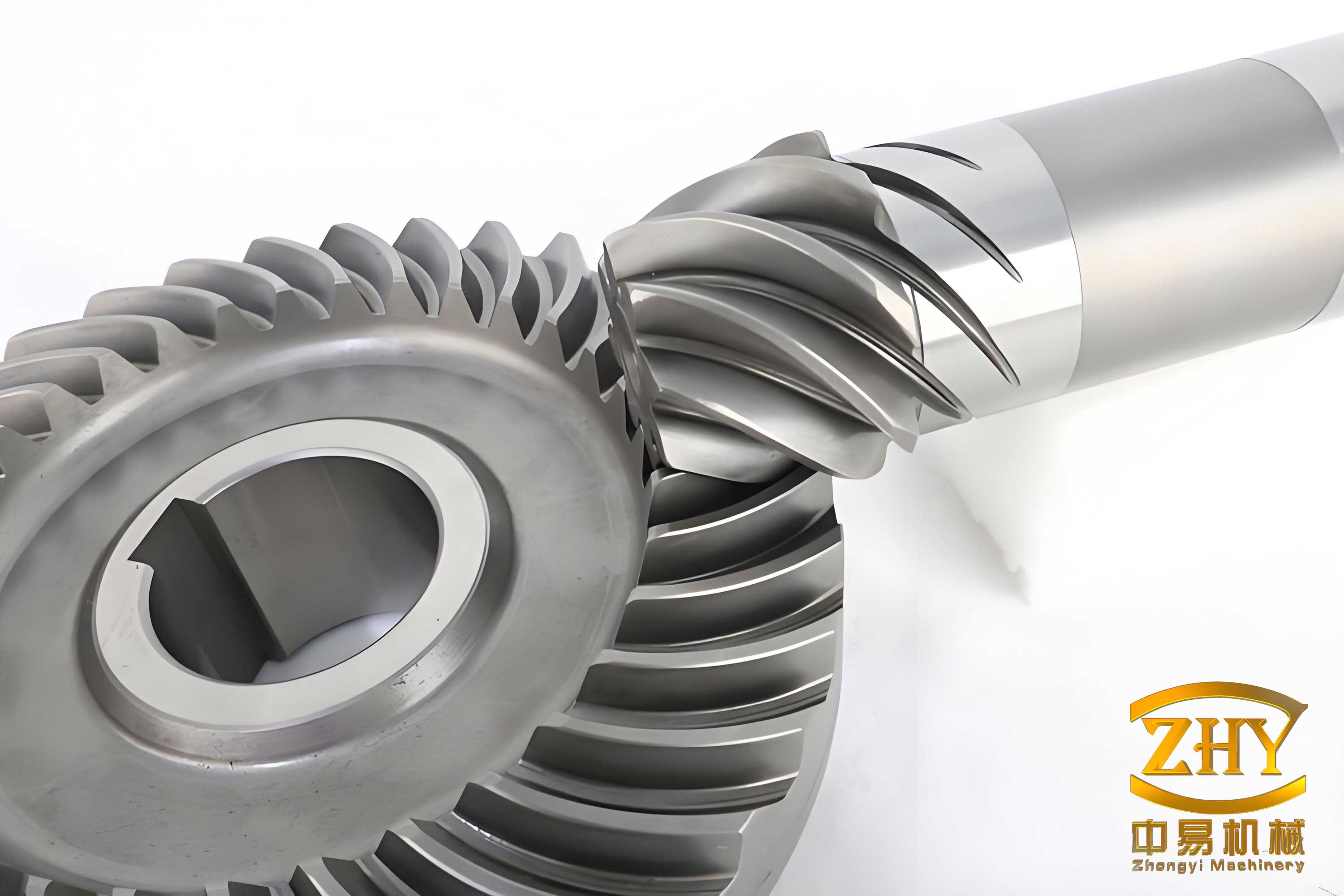
The core of the challenge with any spiral bevel gear setup stems from its kinematic design. The tooth geometry is defined by a spiral angle, which introduces a gradual engagement and disengagement, reducing noise and increasing load capacity compared to straight bevel gears. However, this very advantage complicates the contact pattern analysis. The contact between the convex and concave flanks of a mating spiral bevel gear pair must be centered and of the correct size and shape. An incorrect pattern, such as one biased toward the toe (small end) or heel (large end) of the tooth, or toward the tip or root, leads to concentrated stress, premature pitting, noise, and ultimately, catastrophic failure. The mathematical relationship governing the conjugate action of spiral bevel gears is complex, but a simplified view of the pitch cone alignment can be expressed. For two spiral bevel gears to mesh correctly, their pitch cones must be tangent along a common generatrix, and their apexes must meet at a single point. If we denote the pitch angles as $\delta_1$ and $\delta_1$, and the shaft angle as $\Sigma$, for most agricultural gearboxes where $\Sigma = 90^\circ$, the fundamental relationship is $\delta_1 + \delta_2 = 90^\circ$. Any axial displacement of either gear disrupts this delicate alignment, shifting the contact pattern.
The Hand Gesture Method for Tooth Width Adjustment
I have found that the most intuitive way to diagnose and correct tooth-width-related contact pattern issues is through a simple hand gesture simulation. This method bypasses the need for memorizing charts and directly relates physical adjustment to visual outcome. Here is the procedure I always follow:
- Designation: I let my left hand represent the large spiral bevel gear (the driven gear, often on the differential) and my right hand represent the small spiral bevel gear (the drive pinion). The index finger of each hand, slightly curved, represents a single meshing tooth pair.
- Orientation: I define that the fingernail end of each index finger corresponds to the toe or small end of the respective spiral bevel gear tooth. The base of the finger (near the knuckle) represents the heel or large end.
- Configuration: I observe the actual convex or concave nature of the working tooth flanks for the specific gear set and model. For a typical spiral bevel gear pair, in the forward drive direction, the active flank of the large gear is convex, and that of the small pinion is concave. I then position my curved index fingers to mimic this. The convex finger (left) and concave space of the right finger are brought together to represent meshing.
Once this physical model is set up, diagnosing the pattern is straightforward. After applying engineer’s blue or Prussian blue to the large spiral bevel gear teeth and rotating the assembly under slight load, I observe the transferred pattern on the small spiral bevel gear. If the pattern is biased, for instance, toward the heel (large end) of the small gear’s tooth, it indicates that in my hand model, the gap between the left finger’s toe (large gear’s small end) and the right finger’s heel (small gear’s large end) is too small. To correct this, I mentally simulate moving my right hand’s index finger. For a forward gear pattern, moving the right finger forward (away from my body) tends to equalize the gap along the entire finger length. This forward movement of the right finger directly translates to the required physical adjustment: moving the pinion shaft axially forward. Conversely, if the pattern is toward the toe, the right finger must be moved backward. This hand gesture method provides an immediate, logical connection between the observed flaw and the corrective action for the spiral bevel gear set.
Adjusting Tooth Height Pattern Based on Gear Position
The second pillar of my method addresses the contact pattern’s position on the tooth profile—that is, whether it is too close to the tip or the root. This adjustment is primarily controlled by changing the axial position of the large spiral bevel gear, which alters the working distance between the two gear cones. The rule depends on the relative layout of the gears when viewed along the direction of travel. Through years of working on various tractors, I have codified this rule:
- For configurations where the large spiral bevel gear is positioned to the left of the small spiral bevel gear (looking in the forward direction):
- Moving the large gear to the left increases the distance between the gears, causing the contact pattern to shift toward the tooth tip.
- Moving the large gear to the right decreases the distance, shifting the pattern toward the tooth root.
- For configurations where the large spiral bevel gear is to the right of the small pinion:
- The opposite holds true: Moving the large gear right increases distance (pattern to tip), and moving it left decreases distance (pattern to root).
This rule is universal for spiral bevel gears and is independent of the spiral angle or tooth flank designation (convex/concave). It is a purely geometric consequence of changing the apex separation of the pitch cones.
Practical Application: Case Studies in Tabular Form
To demonstrate the universality and application of my two-pronged method, I have compiled adjustments for several common tractor models employing spiral bevel gears in their central drives. The table below summarizes the gear flank geometry, adjustment mechanisms, and the specific application of the hand gesture and positional rules. Note that ‘Forward’ refers to the pattern observed on the driving flank during forward travel.
| Tractor Model | Gear Type (Spiral Angle) | Forward Gear Working Flanks | Hand Finger Configuration (Left=Large, Right=Small) | Pinion Shaft Axial Adjustment | Large Gear Position (View: Forward) | Large Gear Axial Adjustment for Height |
|---|---|---|---|---|---|---|
| Example A (e.g., Dongfang Hong-75 type) | Spiral Bevel Gear (e.g., 25° spiral) | Large: Convex; Small: Concave | Left finger convex, right finger concave space. | Pattern at Heel: Move pinion forward. Pattern at Toe: Move pinion backward. |
Left of small gear | Pattern at Tip: Move large gear left. Pattern at Root: Move large gear right. |
| Example B (e.g., Dongfang Hong-28 type) | Zerol®/Circular Arc Bevel Gear (0° spiral) | Large: Concave; Small: Convex | Left finger concave space, right finger convex. | Pattern at Heel: Move pinion backward. Pattern at Toe: Move pinion forward. |
Left of small gear | Pattern at Tip: Move large gear left. Pattern at Root: Move large gear right. |
| Example C (e.g., Tieniu-55 type) | Zerol®/Circular Arc Bevel Gear (0° spiral) | Large: Concave; Small: Convex | Left finger concave space, right finger convex. | Pattern at Heel: Move pinion backward. Pattern at Toe: Move pinion forward. |
Right of small gear | Pattern at Tip: Move large gear right. Pattern at Root: Move large gear left. |
The table clearly shows how the hand gesture method flips its directional command based on whether the active flank of the small spiral bevel gear is concave or convex. Meanwhile, the rule for tooth height adjustment flips based solely on the left/right positioning of the large spiral bevel gear relative to the pinion. This systematic approach eliminates confusion.
Mathematical and Theoretical Underpinnings
While the hand method is practical, understanding the underlying theory solidifies one’s expertise. The varying module and velocity along a spiral bevel gear tooth can be described. If we consider a point on the tooth at a distance $r$ from the cone apex along the pitch cone generatrix, the transverse module $m_t$ at that point is proportional to $r$. The pitch line velocity $v$ at that point is given by $v = \omega r$, where $\omega$ is the angular velocity. For a pair of perfectly aligned spiral bevel gears, the ratio $\frac{\omega_1}{\omega_2}$ is constant and equal to the ratio of the number of teeth, ensuring $v$ is matched at conjugating points. Misalignment introduces a mismatch. The condition for correct meshing—apex coincidence—can be expressed vectorially. If the position vector of the large gear apex relative to the pinion apex is $\vec{d}$, correct alignment requires $\vec{d} = \vec{0}$. Axial adjustments of the pinion by $\Delta a_p$ and the gear by $\Delta a_g$ change this vector, affecting the contact pattern. The resulting shift $\Delta C$ of the pattern centroid along the tooth length can be approximated for small adjustments by a linear relation involving the spiral angle $\beta$ and pitch cone angles:
$$\Delta C \approx k_1 \Delta a_p + k_2 \Delta a_g$$
where $k_1$ and $k_2$ are coefficients dependent on the specific spiral bevel gear geometry. Similarly, the shift along the tooth profile (height) is more directly tied to $\Delta a_g$ and the shaft angle. The hand gesture method effectively internalizes the sign of $k_1$ based on flank curvature, and the positional rule internalizes the sign of the primary component of $k_2$ based on assembly layout.
Step-by-Step Adjustment Procedure and Integration
Based on my methodology, here is the integrated procedure I recommend for any spiral bevel gear central drive adjustment:
- Preliminary Checks: Before any contact pattern check, ensure the axle (carrying the large spiral bevel gear) has its bearing preload or axial clearance correctly set. Also, verify the pinion shaft bearing preload/clearance. These are foundational; adjusting the pattern on a shaft with incorrect bearing setting is futile.
- Initial Pattern Check: Apply a thin, even layer of marking compound on the active flanks of the large spiral bevel gear teeth (usually 3-4 teeth spaced around). Rotate the assembly in both forward and reverse directions under slight braking load to get clear, representative patterns on the small spiral bevel gear.
- Diagnosis with Hand Gesture:
- Identify the active flank geometry for the direction being checked (e.g., forward = large gear convex).
- Form the corresponding finger configuration.
- Observe where the pattern is on the small gear’s tooth: Heel or Toe?
- In your hand model, note which finger needs to move and in which direction to center the gap. The direction for the right finger is the adjustment direction for the pinion shaft.
- Execute Pinion Adjustment: Use the machine’s specific mechanism (adding/removing shims behind the pinion bearing cup, or turning an adjusting nut) to move the pinion shaft axially as dictated by step 3.
- Re-check and Diagnose Height: After correcting the tooth-width pattern, check the pattern’s position on the tooth profile. Is it near the tip or the root?
- Apply Positional Rule: Determine if the large spiral bevel gear is left or right of the pinion. Apply the rule: For left-side gear, move it left to send pattern to tip (increase distance), right to send to root (decrease distance). For right-side gear, the opposite.
- Execute Large Gear Adjustment: Adjust the large gear’s axial position using its side adjusters (nuts or shims). CRITICAL: Always maintain the pre-set axle bearing clearance. If you loosen one side’s adjuster by a certain amount, you must tighten the other side by an equal amount to keep the net axial play constant while shifting the gear.
- Iterate and Finalize: Re-check the pattern after each major adjustment. It may take 2-3 iterations to perfect both width and height. Always prioritize obtaining the correct pattern for the forward drive direction and the correct tooth height position over a perfect tooth-width centering if a compromise is forced. A slightly off-center width pattern is often more tolerable than a pattern running off the edge of the tooth at the tip or root.
The integration of these steps ensures a logical, repeatable process for spiral bevel gear setup.
Extended Discussion on Spiral Bevel Gear Design Variations
The world of spiral bevel gears is not monolithic. Understanding variations helps in applying my method universally. The spiral angle $\beta$ is a key parameter. High spiral angles (e.g., 35°-45°) are common in aerospace for smoothness, while agricultural drives often use moderate angles (20°-25°) or even Zerol® gears ($\beta \approx 0^\circ$) which have curved teeth but a zero spiral angle at the mean point. The hand gesture method works for all because it is based on flank convexity/concavity, which is a function of the tooth curvature design (e.g., Gleason, Klingelnberg systems) and not solely the spiral angle. A Zerol bevel gear still has defined convex and concave flanks. The generation process for these spiral bevel gear sets ensures that the mating flanks are conjugate. The local tooth geometry can be described by complex machine-tool settings, but the final contact condition on the assembly line boils down to the relative axial positions I’ve described. Furthermore, the formula for the instantaneous contact ellipse under load involves the principal curvatures of the mating surfaces. When misaligned, this ellipse deforms and moves to an undesirable location. The adjustments I prescribe essentially manipulate the relative curvature relationship to restore the ellipse to its nominal, centered position on the spiral bevel gear tooth flank.
Common Pitfalls and Essential Precautions
Throughout my career, I have seen several recurring mistakes during spiral bevel gear adjustment. Here is a list of critical precautions, framed as lessons learned:
- Never Adjust Backlash First: The gear backlash (side clearance) is a result of the correct pinion and gear positions that yield a good contact pattern. Attempting to set backlash to a specific value before establishing the correct pattern for your spiral bevel gear will almost certainly ruin the pattern. Set the pattern correctly, then measure the backlash. If it is outside the allowable range, it may indicate excessive wear or an incorrect gear set, not an adjustment fault.
- Maintain Bearing Settings: As mentioned, when shifting the large spiral bevel gear laterally, you must do so by an equal-and-opposite adjustment of the two side bearings. Failing to do this will change the differential bearing preload, leading to overheating, bearing failure, or altered gear alignment.
- Understand Your Mechanism: Know which shim pack or nut on your specific tractor controls pinion depth and which controls large gear position. Confusing them leads to chaotic, non-converging adjustments. Refer to technical manuals for the layout, but use my logic for the direction.
- Cleanliness is Paramount: Any dirt or debris on shims, bearing seats, or marking compound can lead to false readings and imprecise adjustments. Clean all parts and mounting surfaces meticulously before reassembly and adjustment of the spiral bevel gear drive.
- Check Both Drive Directions: Always check the pattern in both forward and reverse. While the forward pattern is primary, the reverse pattern should not be severely compromised. A significant disparity might indicate a potential issue with the gear cutting or a fundamental mismatch.
Conclusion: The Value of an Intuitive System
In summary, the art and science of adjusting spiral bevel gear contact patterns can be demystified and systemized. By internalizing the hand gesture method for tooth-width correction and the simple left/right positional rule for tooth-height correction, any technician can confidently approach this task without reliance on easily misplaced or confusing adjustment charts. This first-person perspective, born from hands-on experience across countless gear sets, emphasizes logic and spatial reasoning over rote memorization. The spiral bevel gear, with its elegant but demanding geometry, is the heart of many durable power transmission systems. Mastering its setup with this straightforward, integrated methodology ensures optimal performance, longevity, and reliability for the machinery it drives. Whether dealing with a high-spiral-angle aerospace gearbox or a robust agricultural central drive, the fundamental principles of apex alignment and controlled axial positioning remain the universal keys to success for any spiral bevel gear pair.