
The pursuit of higher quality and performance in power transmission systems has consistently driven advancements in gear manufacturing. Among critical components, spiral bevel gears are renowned for their efficiency in transmitting power between non-parallel, intersecting axes. However, the finishing processes for these geometrically complex gears have historically lagged behind their design capabilities. Traditional methods like grinding are precise but costly and slow, while conventional lapping struggles with low material removal rates and inadequate correction of heat treatment distortions. This gap in manufacturing technology presents a significant bottleneck. In this analysis, I explore an innovative hybrid process: ultrasonic vibration-assisted lapping for spiral bevel gears. By integrating high-frequency mechanical vibrations with the classic lapping motion, this method promises to revolutionize the finishing stage. The core of its efficacy lies in the elastodynamic interactions—the behavior of stress waves within the gear tooth’s elastic body. Here, I will dissect the fundamental principles, model the propagation and reflection of ultrasonic waves at the tooth surface, analyze the resulting complex stress states that act on abrasive particles, and demonstrate through comprehensive calculation how this leads to a superior, multi-mode finishing mechanism unattainable by traditional means.
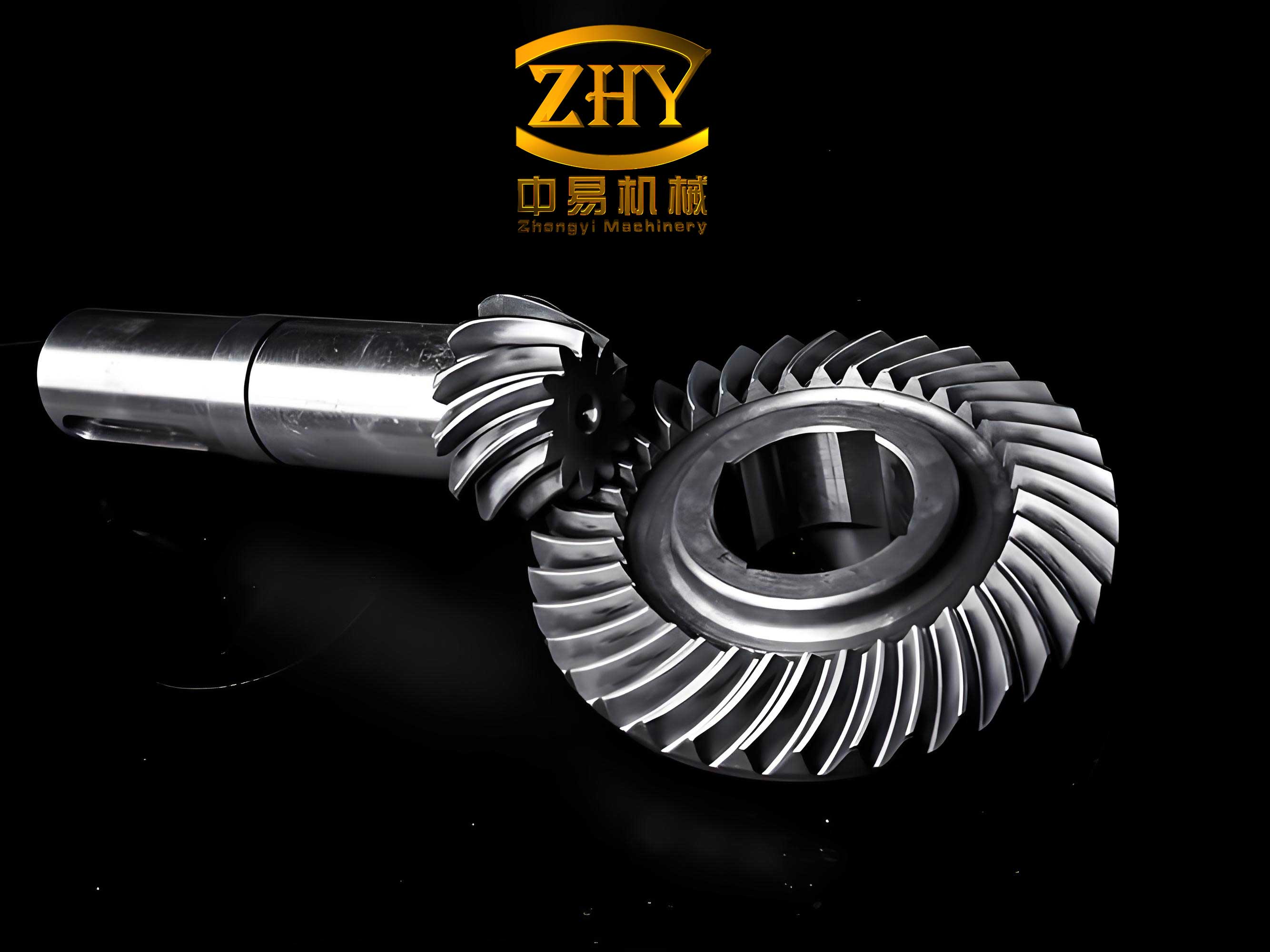
The fundamental principle of ultrasonic vibration lapping for spiral bevel gears is a synergistic combination of macro kinematic motion and microdynamic excitation. In a standard lapping setup for spiral bevel gears, the pinion and gear are run together under a controlled load, with positional adjustments (typically denoted as V, H, and J) to guide the contact pattern across the tooth flank. The novel integration involves axially exciting the pinion (or the gear) with ultrasonic frequency vibrations, typically in the range of 20-40 kHz, while the lapping kinematics proceed. The ultrasonic transducer and horn (amplitude transformer) are coupled to the gear shaft, transmitting high-frequency, low-amplitude vibrations directly into the gear body and, consequently, to the active tooth surfaces. The primary objective is to utilize the energy from these elastic waves to energize the abrasive grains suspended in the lapping fluid, dramatically enhancing their micro-cutting action beyond what is provided by the relative sliding velocity of the gear mesh alone. This compound action aims to efficiently correct heat treatment distortions, homogenize surface errors, reduce roughness, and improve the overall contact pattern and meshing quality of the spiral bevel gear pair.
To understand the mechanics at play, one must model the tooth as an elastic continuum. When ultrasonic energy is injected, it propagates as stress waves. For analysis, the tooth surface region can be idealized as an elastic half-space boundary. Consider a coordinate system where the free surface (or a contacting surface under stress) defines the plane \( x_3 = 0 \), and the solid gear material occupies the region \( x_3 \geq 0 \). An incident plane wave, generated by the ultrasonic system, strikes this boundary. In the most general case for an incident longitudinal wave (P-wave), the interaction at the boundary generates both a reflected P-wave and a converted reflected shear wave (SV-wave). This phenomenon is governed by the principles of elastodynamics and the boundary conditions. The key physical properties of the gear material are essential inputs, typically summarized as follows:
| Material Property | Symbol | Typical Value (Case Steel) |
|---|---|---|
| Young’s Modulus | \( E \) | \( 195 \times 10^3 \, \text{MPa} \) |
| Poisson’s Ratio | \( \mu \) | 0.28 |
| Density | \( \rho \) | \( 7700 \, \text{kg/m}^3 \) |
| Shear Modulus | \( G = \frac{E}{2(1+\mu)} \) | \( \approx 7.62 \times 10^4 \, \text{MPa} \) |
| Lame’s First Parameter | \( \lambda = \frac{E \mu}{(1+\mu)(1-2\mu)} \) | \( \approx 1.06 \times 10^5 \, \text{MPa} \) |
From these, the velocities of wave propagation in the infinite solid can be derived:
$$
c_P = \sqrt{\frac{\lambda + 2G}{\rho}} \quad \text{(P-wave velocity)}, \qquad c_S = \sqrt{\frac{G}{\rho}} \quad \text{(S-wave velocity)}.
$$
For the given material, \( c_P \approx 5950 \, \text{m/s} \) and \( c_S \approx 3150 \, \text{m/s} \). The ratio \( D = c_P / c_S \) is a critical non-dimensional parameter. For an incident P-wave with amplitude \( A_1 \), angular frequency \( p = 2\pi f \) (where \( f \) is the ultrasonic frequency), and incident angle \( \alpha_1 \), the potentials for the incident and reflected waves can be expressed. The reflection angles are determined by Snell’s Law analogue for elastic waves:
$$
\alpha_2 = \alpha_1, \quad \sin \beta_2 = \frac{c_S}{c_P} \sin \alpha_1 = \frac{1}{D} \sin \alpha_1.
$$
The amplitudes of the reflected waves relative to the incident wave are complex functions of the incident angle and material properties:
$$
\frac{A_2}{A_1} = \frac{\sin 2\alpha_1 \sin 2\beta_2 – D^2 \cos^2 2\beta_2}{\sin 2\alpha_1 \sin 2\beta_2 + D^2 \cos^2 2\beta_2}, \qquad \frac{A_3}{A_1} = \frac{-2 \sin 2\alpha_1 \cos 2\beta_2}{\sin 2\alpha_1 \sin 2\beta_2 + D^2 \cos^2 2\beta_2}.
$$
Here, \( A_2 \) and \( A_3 \) correspond to the reflected P-wave and SV-wave amplitudes, respectively. It’s notable that for a wide range of angles, the reflected P-wave undergoes a 180° phase shift (negative \( A_2 / A_1 \)).
The superposition of these reflected waves at the boundary \( x_3 = 0 \) determines the resultant particle displacement, velocity, and acceleration that drive the abrasive action. The combined displacement amplitude \( A_0 \) at the surface is the vector sum of the normal and tangential components from both reflected waves. This directly translates to maximum particle velocity \( v_{\text{max}} = p A_0 \) and acceleration \( a_{\text{max}} = p^2 A_0 \), which are colossal—often reaching the order of \( 10^5 \, \text{g} \). This intense, high-frequency oscillation is the engine of the enhanced micro-cutting process for the spiral bevel gear tooth surface.
More critically, the stress fields generated at and near the surface dictate the interaction forces between the abrasive grains and the spiral bevel gear tooth flank. The stress amplitudes associated with the P and SV waves are:
$$
\sigma_r^{\text{max}} = (\lambda + 2G) \frac{p}{c_P} |A_2|, \qquad \tau_r^{\text{max}} = G \frac{p}{c_S} |A_3|.
$$
Resolving these onto the surface normal (\( n \)) and tangential (\( t \)) directions yields the alternating stress amplitudes applied to any interface at the boundary:
$$
\sigma_{n}^{\text{max}} = \sigma_r^{\text{max}} \cos \alpha_1 + \tau_r^{\text{max}} \sin \beta_2, \qquad \sigma_{t}^{\text{max}} = \sigma_r^{\text{max}} \sin \alpha_1 – \tau_r^{\text{max}} \cos \beta_2.
$$
The maximum principal stress amplitude is \( \sigma_{0}^{\text{max}} = \sqrt{(\sigma_{n}^{\text{max}})^2 + (\sigma_{t}^{\text{max}})^2} \). The variation of these stress amplitudes with the incident angle \( \alpha_1 \) is highly nonlinear and pivotal for process design. For a typical spiral bevel gear, the local surface normal at different points (root, flank, topland) presents different effective incident angles to the incoming wave from the gear body, leading to a spatially varied ultrasonic stress field across the tooth profile.
The actual finishing process is governed by the superposition of this dynamic ultrasonic stress field and the quasi-static contact pressure \( p_s \) arising from the lapping load torque. The interaction defines distinct regimes of abrasive engagement. Let \( \sigma_{n}^{\text{max}} \) and \( \sigma_{t}^{\text{max}} \) be the ultrasonic stress amplitudes at a specific point on the spiral bevel gear tooth. The contact condition between an abrasive grain and the surface falls into one of several states:
- Intermittent Contact / Micro-Hammering Regime: When \( p_s < \sigma_{n}^{\text{max}} \). The normal contact force is pulsating. The grain periodically indents and detaches from the surface. The effective pulse width \( \delta \) per cycle \( T = 1/f \) is:
$$
\delta = \frac{T}{\pi} \left( \frac{\pi}{2} – \arcsin\left(\frac{p_s}{\sigma_{n}^{\text{max}}}\right) \right).
$$
In this regime, both normal hammering and tangential plowing actions are maximized by the ultrasound. - Continuous Contact with Micro-Slip Regime: When \( p_s \ge \sigma_{n}^{\text{max}} \) but the static friction limit \( \mu_d p_s \) (where \( \mu_d \) is the dynamic friction coefficient) is less than \( \sigma_{t}^{\text{max}} \). The grain remains in constant normal contact but experiences a tangential oscillatory slip. The tangential force is a pulse with width:
$$
\delta = \frac{T}{\pi} \left( \frac{\pi}{2} – \arcsin\left(\frac{\mu_d p_s}{\sigma_{t}^{\text{max}}}\right) \right).
$$
This micro-slip is highly effective in shearing off micro-asperities. - Continuous Contact with Gross Sliding Regime: When \( p_s \ge \sigma_{n}^{\text{max}} \) and \( \mu_d p_s \ge \sigma_{t}^{\text{max}} \). The tangential ultrasonic stress cannot overcome static friction. The grain slides only due to the macro kinematic relative velocity of the gear mesh. This is effectively traditional lapping, with ultrasound providing only potential sub-surface energy dissipation.
To quantitatively evaluate these mechanisms for a spiral bevel gear, a detailed case study is essential. Consider a hypoid gear pair (a type of spiral bevel gear) with the following key parameters: Pinion teeth: 11, Gear teeth: 41, Offset: 25.4 mm, Gear outer diameter: ~182 mm. The pinion has a spiral angle of \( 50.26^\circ \), face angle of \( 23.27^\circ \), and root angle of \( 15.57^\circ \). For ultrasonic excitation, assume: Frequency \( f = 25 \, \text{kHz} \), Incident P-wave amplitude at source \( A_1 = 25.0 \, \mu \text{m} \). The lapping load torque is set to 400 Nm, generating a significant contact pressure \( p_s \). A comprehensive Loaded Tooth Contact Analysis (LTCA) is first performed to determine the contact stress distribution \( p_s \) across the path of contact and within the instantaneous contact ellipse. The results typically show a semi-elliptical pressure distribution with a maximum at the center.
Using the elastodynamic equations, the key parameters are calculated for three characteristic points on the pinion tooth, corresponding to different wave incident angles relative to the local surface normal:
| Tooth Location (Pinion) | Effective Incident Angle \( \alpha_1 \) | Resultant Displ. Amp. \( A_0 \) (µm) | Max. Velocity \( v_{\text{max}} \) (m/min) | Max. Acc. \( a_{\text{max}} \) (10⁵ m/s²) | Stress Amplitudes |
|---|---|---|---|---|---|
| Root Conical Surface | \( 74.43^\circ \) | 6.53 | 61.54 | 1.61 | \( \sigma_{n}^{\text{max}} \approx 75.1 \, \text{MPa} \), \( \sigma_{t}^{\text{max}} \) lower |
| Face Conical Surface (Topland) | \( 66.73^\circ \) | 9.04 | 85.20 | 2.23 | \( \sigma_{n}^{\text{max}} \approx 106.4 \, \text{MPa} \) |
| Active Flank (Mid-Spiral) | \( 39.74^\circ \) | 11.53 (normal), 4.96 (tangential) | 108.67 / 46.74 | 2.84 / 1.22 | \( \sigma_{n}^{\text{max}} \approx 173.4 \, \text{MPa} \), \( \sigma_{t}^{\text{max}} \approx 32.1 \, \text{MPa} \). |
The data reveals that the active flank experiences the highest normal stress amplitude and significant tangential stress. Comparing \( \sigma_{t}^{\text{max}} = 32.1 \, \text{MPa} \) to the frictional stress \( \mu_d p_s \) (where \( p_s \) varies across the contact ellipse) allows us to map the instantaneous contact ellipse into the three abrasive regimes. The contact ellipse can be subdivided into concentric zones:
| Zone | Condition | Dominant Mechanism | Effect on Spiral Bevel Gear Surface |
|---|---|---|---|
| Outer Ring (Micro-Hammering) | \( p_s < \sigma_{n}^{\text{max}} \) | Periodic grain impact and detachment. Strong normal hammering and tangential plowing. | Efficient removal of material, effective for error correction. |
| Middle Ring (Micro-Slip) | \( p_s \ge \sigma_{n}^{\text{max}} \), \( \mu_d p_s < \sigma_{t}^{\text{max}} \) | Continuous normal contact with high-frequency tangential micro-slip of abrasive. | Excellent for smoothing and finishing, generating fine surface texture. |
| Central Region (Gross Sliding) | \( p_s \ge \sigma_{n}^{\text{max}} \), \( \mu_d p_s \ge \sigma_{t}^{\text{max}} \) | Ultrasound-induced tangential slip is suppressed. Cutting relies on macro gear sliding velocity. | Similar to conventional lapping, contributes to overall pattern conformity. |
Critically, as the gears roll through mesh, every point on the spiral bevel gear tooth flank successively passes through all these zones within the moving contact ellipse. This ensures a highly uniform and comprehensive finishing action across the entire active profile. Furthermore, the non-contacting regions of the spiral bevel gear pair, such as the fillet and tip relief areas, are subjected to intense, cyclical pressure fluctuations from the ultrasonic stress waves transmitted through the lubricant-abrasive mixture. These fluctuations, reaching hundreds of MPa (thousands of atmospetrics), induce powerful cavitation and hydrodynamic effects that contribute to polishing these geometrically sensitive areas, which are often neglected in traditional lapping.
The complete mechanism of ultrasonic vibration lapping for spiral bevel gears thus emerges as a multifaceted, synergistic process. It combines: 1) Enhanced Micro-Cutting: The extreme accelerations imparted to abrasive grains vastly increase their kinetic energy and cutting capability during each oscillation cycle. 2) Multi-Mode Stress Interaction: The interplay of static and dynamic stresses creates alternating hammering, plowing, and micro-slip actions, preventing abrasive dulling and promoting efficient chip formation. 3) Improved Surface Integrity: The high-frequency peening action can induce beneficial compressive residual stresses, and the fine, multi-directional cutting paths lead to a more isotropic “plateau-like” surface texture, as opposed to the directional “peak-and-valley” pattern from simple sliding. 4) Non-Contact Polishing: Cavitation and fluid agitation in non-meshing zones provide a comprehensive finishing effect over the entire spiral bevel gear tooth geometry.
In conclusion, the elastodynamic analysis confirms that ultrasonic vibration-assisted lapping is not merely an incremental improvement but a fundamentally different finishing paradigm for spiral bevel gears. By harnessing the principles of stress wave propagation and reflection within the elastic gear tooth, the process actively engineers a complex, transient stress field that energizes the abrasive media far beyond the limits of conventional kinematic lapping. The method simultaneously addresses efficiency (through high dynamic stresses and multi-mode cutting), accuracy (through controlled, uniform material removal across the contact ellipse), and surface quality (through micro-peening and cavitation polishing). This approach effectively bridges the gap between design and manufacturing for high-performance spiral bevel gears, offering a potent solution to the long-standing challenges of heat treatment distortion correction and final quality refinement. The insights from this elastodynamic foundation provide clear guidelines for optimizing parameters such as ultrasonic frequency, amplitude, incident angle via horn design, and lapping load to tailor the process for specific spiral bevel gear applications.