
In the field of power transmission systems, spiral bevel gears play a critical role due to their ability to transmit motion between intersecting shafts with high efficiency and load capacity. These gears are widely used in aerospace, automotive, and industrial machinery, where precision and reliability are paramount. However, the performance of spiral bevel gears is highly sensitive to installation conditions, as alignment errors—deviations from the theoretical mounting positions—can significantly degrade contact quality, leading to increased vibration, noise, and premature failure. This study focuses on investigating the sensitivity and tolerance limits of alignment errors in spiral bevel gears, aiming to establish a theoretical foundation for improving manufacturing quality and installation processes. The research develops a universal tooth surface model for spiral bevel gears processed by cutter-tilt and modified-roll methods, incorporates alignment errors into tooth contact analysis (TCA), and analyzes the effects of these errors on contact patterns and transmission behavior. By defining concepts such as alignment error sensitivity and tolerance, this work provides insights into how installation deviations impact gear performance and offers guidelines for permissible error ranges in practical applications.
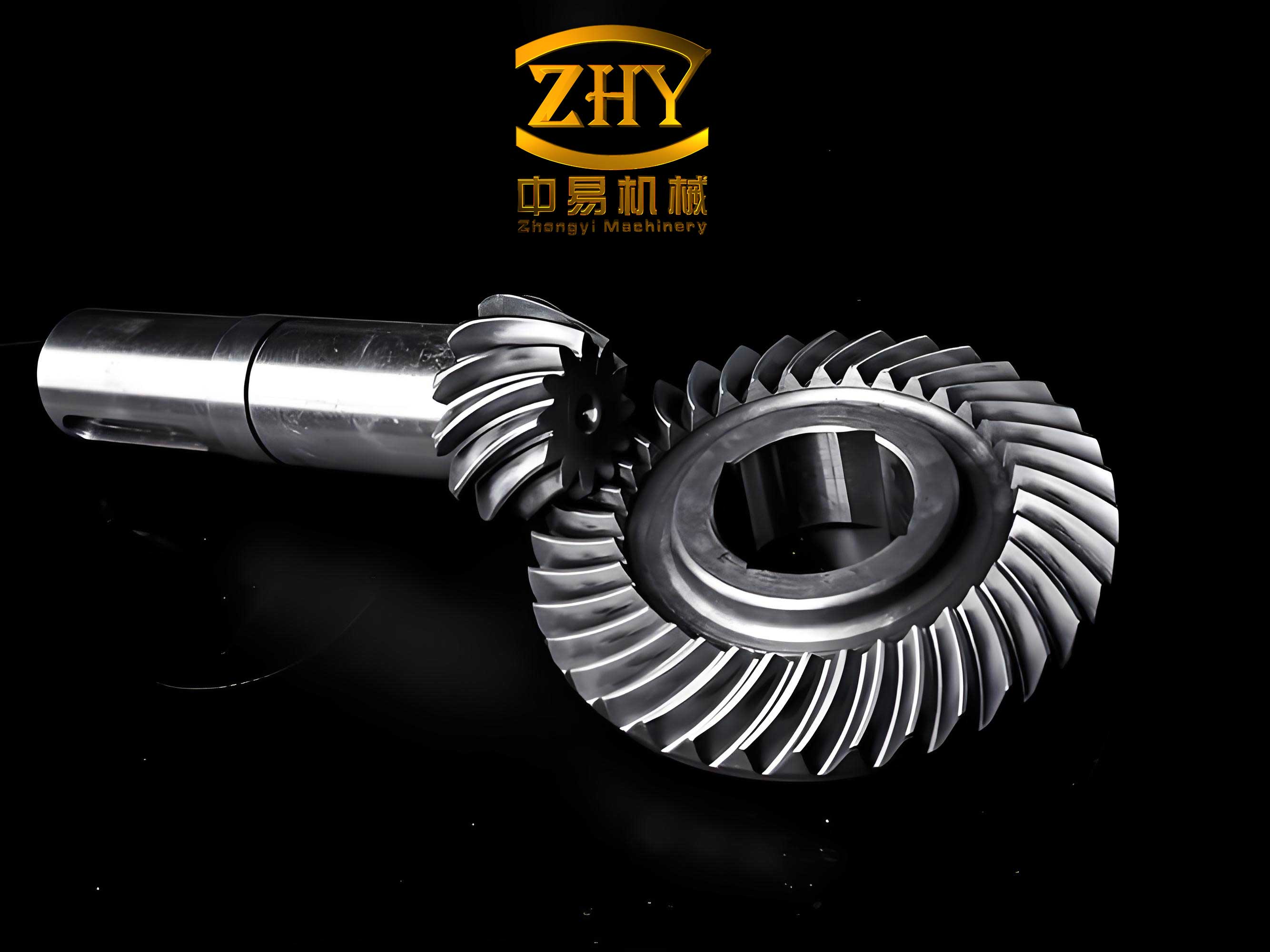
The tooth surface geometry of spiral bevel gears is complex, often generated using traditional machine tools with adjustments for cutter tilt and modified roll. To analyze alignment errors, a universal mathematical model of the tooth surface is essential. This model is derived based on machine tool settings, where the cutting process is represented through coordinate transformations from the tool coordinate system to the workpiece coordinate system. The spiral bevel gear tooth surface is described using homogeneous transformation matrices that account for various machine components, such as the cradle, workpiece, and cutter head. For a spiral bevel gear, the position vector of a point on the cutting edge in the tool coordinate system \( S_i \) is given by:
$$ \mathbf{r}_i = \mathbf{r}_i(u, \theta) $$
where \( u \) and \( \theta \) are parameters describing the cutting surface. The unit tangent vector is:
$$ \mathbf{t}_i = \mathbf{t}_i(u, \theta) $$
Through coordinate transformations, the position and tangent vectors in the workpiece coordinate system \( S_w \) are:
$$ \mathbf{r}_w = \mathbf{M}_{wi} \cdot \mathbf{r}_i(u, \theta) $$
$$ \mathbf{t}_w = \mathbf{M}_{wi} \cdot \mathbf{t}_i(u, \theta) $$
The transformation matrix \( \mathbf{M}_{wi} \) is a product of multiple matrices representing the relative positions and movements of machine tool components:
$$ \mathbf{M}_{wi} = \mathbf{M}_{wo} \cdot \mathbf{M}_{op} \cdot \mathbf{M}_{pr} \cdot \mathbf{M}_{rs} \cdot \mathbf{M}_{sm} \cdot \mathbf{M}_{mc} \cdot \mathbf{M}_{ce} \cdot \mathbf{M}_{ej} \cdot \mathbf{M}_{ji} $$
Each matrix corresponds to a specific adjustment, such as the machine root angle \( \gamma_m \), sliding base setting \( X_b \), or cutter phase angle \( \varphi \). In the workpiece coordinate system, the tooth surface can be expressed as:
$$ \mathbf{r}_w = \mathbf{r}_w(u, \theta, \varphi) $$
$$ \mathbf{t}_w = \mathbf{t}_w(u, \theta, \varphi) $$
The unit normal vector \( \mathbf{n}_w \) is derived from the partial derivatives:
$$ \mathbf{n}_w = \frac{\partial \mathbf{r}_w}{\partial \theta} \times \mathbf{t}_w $$
According to the gear meshing principle, the velocity vector during tooth generation is:
$$ \mathbf{v}_w = \frac{\partial \mathbf{r}_w}{\partial \varphi} \omega_c $$
where \( \omega_c \) is the angular velocity of the cradle. For simplification, \( \omega_c = 1 \) is often used. The pinion and gear tooth surfaces are represented in their respective coordinate systems \( S_1 \) and \( S_2 \), which are aligned with the workpiece coordinates. The pinion surface equations are:
$$ \mathbf{r}_1 = \mathbf{r}_1(u_1, \theta_1, \varphi_1) $$
$$ \mathbf{t}_1 = \mathbf{t}_1(u_1, \theta_1, \varphi_1) $$
$$ \mathbf{n}_1 = \mathbf{n}_1(u_1, \theta_1, \varphi_1) $$
$$ f_1(u_1, \theta_1, \varphi_1) = 0 $$
Similarly, the gear surface equations are:
$$ \mathbf{r}_2 = \mathbf{r}_2(u_2, \theta_2, \varphi_2) $$
$$ \mathbf{t}_2 = \mathbf{t}_2(u_2, \theta_2, \varphi_2) $$
$$ \mathbf{n}_2 = \mathbf{n}_2(u_2, \theta_2, \varphi_2) $$
$$ f_2(u_2, \theta_2, \varphi_2) = 0 $$
These equations form the basis for tooth contact analysis, which simulates the meshing of spiral bevel gears under ideal conditions. However, in real-world applications, alignment errors such as offset error (\( \Delta E \)), gear axial distance error (\( \Delta G \)), pinion axial distance error (\( \Delta P \)), and shaft angle error (\( \Delta \Sigma_0 \)) are inevitable due to manufacturing tolerances, thermal deformations, and assembly inaccuracies. To account for these, a modified TCA algorithm that includes alignment errors is developed. The installation coordinate system \( S_f \) is used as a fixed reference, and transformation matrices incorporate the alignment errors. For the gear, the transformation matrix is:
$$ \mathbf{M}_{f2} = \begin{bmatrix}
1 & 0 & 0 & 0 \\
0 & 1 & 0 & 0 \\
0 & 0 & 1 & -(G + \Delta G) \\
0 & 0 & 0 & 1
\end{bmatrix} $$
For the pinion, the matrix is:
$$ \mathbf{M}_{f1} = \begin{bmatrix}
0 & -1 & 0 & E + \Delta E \\
-\cos(\Sigma_0 + \Delta \Sigma_0) & 0 & \sin(\Sigma_0 + \Delta \Sigma_0) & P + \Delta P \\
-\sin(\Sigma_0 + \Delta \Sigma_0) & 0 & -\cos(\Sigma_0 + \Delta \Sigma_0) & 0 \\
0 & 0 & 0 & 1
\end{bmatrix} $$
The tooth contact analysis conditions, including alignment errors, are expressed as:
$$ \mathbf{M}_{f1} \cdot \mathbf{r}_1(u_1, \theta_1, \varphi_1, \phi_1) = \mathbf{M}_{f2} \cdot \mathbf{r}_2(u_2, \theta_2, \varphi_2, \phi_2) $$
$$ \mathbf{M}_{f1} \cdot \mathbf{n}_1(u_1, \theta_1, \varphi_1, \phi_1) = \mathbf{M}_{f2} \cdot \mathbf{n}_2(u_2, \theta_2, \varphi_2, \phi_2) $$
$$ f_1(u_1, \theta_1, \varphi_1) = 0 $$
$$ f_2(u_2, \theta_2, \varphi_2) = 0 $$
where \( \phi_1 \) and \( \phi_2 \) are the rotation angles of the pinion and gear from their initial positions to the contact point. This system of nonlinear equations is complex, but it can be simplified using the Euler-Rodrigues formula and meshing principles. The simplified contact condition reduces to:
$$ \mathbf{r}_{1f}(\theta_1, \varphi_1) = \mathbf{r}_{2f}(\theta_2, \varphi_2) $$
This equation is solved iteratively to determine contact points, paths, and transmission errors under various alignment error conditions. The modified TCA algorithm enables the analysis of how alignment errors affect the contact quality of spiral bevel gears, providing a tool for sensitivity and tolerance studies.
Alignment error sensitivity refers to the degree to which contact quality is influenced by deviations in installation parameters. This sensitivity is evaluated by analyzing changes in contact point location, contact path direction, and contact pattern shape. For instance, consider a spiral bevel gear pair designed with specific parameters, as shown in the table below. The gear pair is processed using the modified-roll method for the pinion and the generating method for the gear, with machine settings tailored to achieve optimal contact.
| Design Parameter | Pinion | Gear |
|---|---|---|
| Number of Teeth (z) | 37 | 37 |
| Module (m) | 8 | |
| Face Width (b) in mm | 63 | 63 |
| Pressure Angle (\(\alpha_0\)) in degrees | 20 | |
| Shaft Angle (\(\Sigma\)) in degrees | 90 | |
| Addendum (\(h_f\)) in mm | 6.8 | 6.8 |
| Dedendum (\(h_a\)) in mm | 8.3 | 8.3 |
| Whole Depth (h) in mm | 15.1 | 15.1 |
| Pitch Cone Angle (\(\delta\)) in degrees | 45 | 45 |
| Face Cone Angle (\(\delta_a\)) in degrees | 47.267 | 47.267 |
| Root Cone Angle (\(\delta_f\)) in degrees | 42.733 | 42.733 |
| Root Angle (\(\theta_f\)) in degrees | 2.267 | 2.267 |
| Hand of Spiral | Left | Right |
The machine tool settings for processing this spiral bevel gear pair are as follows:
| Machine Setting | Pinion | Gear |
|---|---|---|
| Cutter Radius (\(r_0\)) in mm | 145.923 | 152.4 |
| Outer Blade Angle (\(c_1\)) in degrees | 18.75 | 18.75 |
| Inner Blade Angle (\(c_2\)) in degrees | 21.25 | 21.25 |
| Blade Top Width (\(b_s\)) in mm | 1.651 | 3.81 |
| Radial Distance (s) in mm | 154.127 | 146.886 |
| Cutter Tilt Angle (i) in degrees | 0 | 0 |
| Cutter Swivel Angle (j) in degrees | 0 | 0 |
| Vertical Offset (\(E_m\)) in mm | -1.463 | 0 |
| Workpiece Installation Angle (\(\gamma_m\)) in degrees | 42.728 | 42.728 |
| Machine Center to Back (\(X_b\)) in mm | 4.374 | 0 |
| Horizontal Offset (\(X_p\)) in mm | -6.446 | 0 |
| Cutter Phase Angle (\(\varphi_0\)) in degrees | 55.706 | 54.093 |
| Ratio of Roll (\(i_0\)) | 1.365 | 1.413 |
Using the modified TCA algorithm, the sensitivity of contact point location to alignment errors is analyzed. The contact point at the theoretical transmission ratio is selected as a reference. In the gear coordinate system \( S_2 \), this point has coordinates \((L_2, r_2)\). Under alignment errors, the contact point shifts to \((L_2′, r_2′)\), and the displacement vector is:
$$ \Delta \mathbf{r} = \mathbf{r}_2′ – \mathbf{r}_2 = (L_2 – L_2′) \mathbf{I}_2 + (r_2 – r_2′) \mathbf{I}_1 = \Delta L_2 \mathbf{I}_2 – \Delta r_2 \mathbf{I}_1 $$
The effects of individual alignment errors on \(\Delta L_2\) and \(\Delta r_2\) are plotted, showing that offset error (\(\Delta E\)) has the most significant impact on contact point displacement, while shaft angle error (\(\Delta \Sigma_0\)) has negligible influence. This indicates that for this spiral bevel gear pair, offset error is the most sensitive parameter during installation, and efforts should be made to minimize it to maintain proper contact positioning.
Alignment errors also alter the direction and shape of the contact path on the tooth surface. The contact path is characterized by its angle relative to the root cone and the radius of contact points. Sensitivity analysis reveals that gear axial distance error (\(\Delta G\)) and pinion axial distance error (\(\Delta P\)) have similar effects on contact path direction and radius, whereas offset error (\(\Delta E\)) exhibits an opposite trend. For instance, as \(\Delta E\) increases, the contact path angle may decrease, while \(\Delta G\) and \(\Delta P\) cause it to increase. The radius of contact points is most affected by \(\Delta E\), with changes exceeding those from other errors. These findings highlight the complex interactions between alignment errors and tooth geometry in spiral bevel gears, underscoring the need for precise installation to achieve desired contact patterns.
Beyond sensitivity, alignment error tolerance defines the allowable range of installation deviations that still ensure acceptable gear performance. Tolerance limits are determined based on operational criteria, such as continuous transmission error curves and contact pattern coverage exceeding 60% of the tooth face. For the example spiral bevel gear pair, tolerance limits for various alignment errors are computed using the modified TCA algorithm. The results are summarized in the table below, which shows the positive and negative error limits and the total tolerance bandwidth.
| Alignment Error | Positive Error Limit | Negative Error Limit | Tolerance Bandwidth |
|---|---|---|---|
| Gear Axial Distance Error (\(\Delta G\)) in mm | 0.27 | -0.25 | 0.52 |
| Pinion Axial Distance Error (\(\Delta P\)) in mm | 0.24 | -0.20 | 0.44 |
| Offset Error (\(\Delta E\)) in mm | 0.25 | -0.27 | 0.52 |
| Shaft Angle Error (\(\Delta \Sigma_0\)) in arcminutes | 21 | -5.5 | 26.5 |
Within these tolerance bands, the spiral bevel gear pair maintains satisfactory contact quality, with unbroken transmission error curves and adequate contact pattern size. The contact path on the gear convex side, for example, remains stable and centered, as verified through simulation. This tolerance information is valuable for setting installation specifications, as it allows for some leeway in assembly without compromising performance. In practice, this can reduce manufacturing costs for auxiliary components like bearings and housings, as tighter tolerances may not be necessary.
The universal tooth surface model for spiral bevel gears, encompassing both cutter-tilt and modified-roll methods, provides a robust framework for analyzing installation effects. The model is derived from machine tool kinematics, using homogeneous transformation matrices to represent the cutting process. The tooth surface equation in the workpiece coordinate system is:
$$ \mathbf{r}_w = \mathbf{M}_{wi}(u, \theta, \varphi) $$
where \(\mathbf{M}_{wi}\) integrates all machine adjustments. The inclusion of alignment errors in TCA involves modifying the installation transformation matrices. For instance, with offset error \(\Delta E\), the pinion matrix becomes:
$$ \mathbf{M}_{f1} = \mathbf{M}_{f1}(E + \Delta E, \Sigma_0 + \Delta \Sigma_0, P + \Delta P) $$
This approach enables the simulation of real-world installation conditions, where errors are present. The sensitivity analysis quantifies how each alignment error parameter affects contact characteristics. Mathematical expressions for sensitivity metrics, such as the rate of change of contact point position with respect to error, can be derived. For offset error, the sensitivity \( S_E \) is defined as:
$$ S_E = \frac{\partial \Delta \mathbf{r}}{\partial \Delta E} $$
Similarly, for other errors, sensitivity coefficients are computed to compare their influences. In the case study, \( S_E \) is found to be larger than sensitivities for \(\Delta G\) or \(\Delta P\), confirming that offset error is the most critical for this spiral bevel gear design.
Tolerance analysis involves solving inverse problems: given performance constraints, determine the maximum allowable alignment errors. This is achieved by iteratively applying the TCA algorithm with varying error values until the contact quality criteria are violated. The tolerance limits table is generated through such simulations, providing actionable data for engineers. For example, if the contact pattern width must be at least 60% of the face width, the algorithm identifies the error values at which this condition fails. The process can be expressed as an optimization problem:
$$ \text{Maximize } |\Delta \varepsilon| \text{ subject to } Q(\Delta \varepsilon) \geq Q_{\text{min}} $$
where \(\Delta \varepsilon\) represents an alignment error, \( Q \) is a quality metric (e.g., contact pattern ratio), and \( Q_{\text{min}} \) is the minimum acceptable value. This methodology ensures that tolerance limits are based on functional requirements, enhancing the practicality of spiral bevel gear applications.
In addition to geometric effects, alignment errors can induce dynamic issues in spiral bevel gears, such as increased vibration and noise. The modified TCA algorithm can be extended to include dynamic factors, but this study focuses on static contact analysis. However, the sensitivity and tolerance findings indirectly contribute to dynamic performance, as proper contact reduces excitations. For instance, minimizing offset error sensitivity helps maintain stable meshing, which is crucial in high-speed applications like aerospace transmissions. The research emphasizes that understanding alignment error behavior is key to optimizing spiral bevel gear systems across industries.
The development of sensitivity and tolerance models bridges the gap between theoretical design and practical installation of spiral bevel gears. By quantifying how installation deviations impact contact, manufacturers can establish better assembly protocols and quality control measures. For the example gear pair, the tolerance bandwidths indicate that shaft angle error has the largest allowable range in arcminutes, while axial distance errors have tighter limits in millimeters. This insight guides the prioritization of inspection during installation, focusing on parameters with higher sensitivity. Furthermore, the models support the design of robust spiral bevel gears that are less susceptible to installation variations, potentially through tooth surface modifications or optimized machine settings.
In conclusion, this comprehensive analysis of alignment error sensitivity and tolerance in spiral bevel gears provides a foundation for improving gear performance and reliability. The universal tooth surface model and modified TCA algorithm enable detailed studies of installation effects, revealing that offset error is often the most sensitive parameter for contact point location, while axial distance errors significantly influence contact path shape. Tolerance limits derived from functional requirements offer practical guidelines for installation, allowing for cost-effective manufacturing of components. Future work could explore the integration of load effects and thermal deformations into the analysis, further enhancing the accuracy of sensitivity and tolerance predictions. Overall, this research underscores the importance of precise installation in achieving optimal contact quality for spiral bevel gears, contributing to advancements in gear technology and application.