
In the field of high-performance mechanical transmissions, spiral bevel gears play a critical role due to their high overlap ratio, smooth operation, and low noise. However, with the increasing demand for power density and reliability in applications such as aerospace systems, heavy-duty vehicles, and precision machine tools, tooth surface contact fatigue failure has become a predominant issue. Statistics indicate that over one-third of aviation gear failures are attributed to contact fatigue, making the prediction of contact fatigue life essential for determining maintenance intervals and ensuring operational safety. To enhance the load-bearing capacity and fatigue life of gears, surface treatments like carburizing, grinding, and shot peening are commonly employed to induce residual stresses. These residual stresses significantly influence the fatigue behavior of spiral bevel gears, yet their integration into life prediction models remains complex due to the intricate geometry and loading conditions of spiral bevel gears. This study aims to address this gap by developing a comprehensive method for calculating contact fatigue crack initiation and propagation life in spiral bevel gears, accounting for the compound stress field comprising both contact stresses and residual stresses.
The fatigue failure of spiral bevel gears involves two primary stages: crack initiation and crack propagation. Under rolling-sliding contact cycles, cracks typically initiate at or near the subsurface of the tooth surface, then propagate until failure occurs. Traditional standards such as AGMA and ISO for bevel gear contact fatigue strength are based on Hertzian contact theory and extensive experimental data, but they often neglect the multiaxial cyclic loading and failure mechanisms, leading to conservative estimates. Recent research has advanced understanding through finite element analysis, multiaxial fatigue criteria, and fracture mechanics, but the incorporation of residual stresses, especially for complex spatial surfaces like those of spiral bevel gears, is limited. The challenge lies in the variable curvature of spiral bevel gear tooth surfaces, which affects the distribution of residual stresses from manufacturing processes, and the multiaxial stress state under operational loads. Therefore, this study proposes a novel approach that combines numerical simulation, experimental measurement, and fatigue modeling to predict the contact fatigue life of spiral bevel gears under a compound stress field.
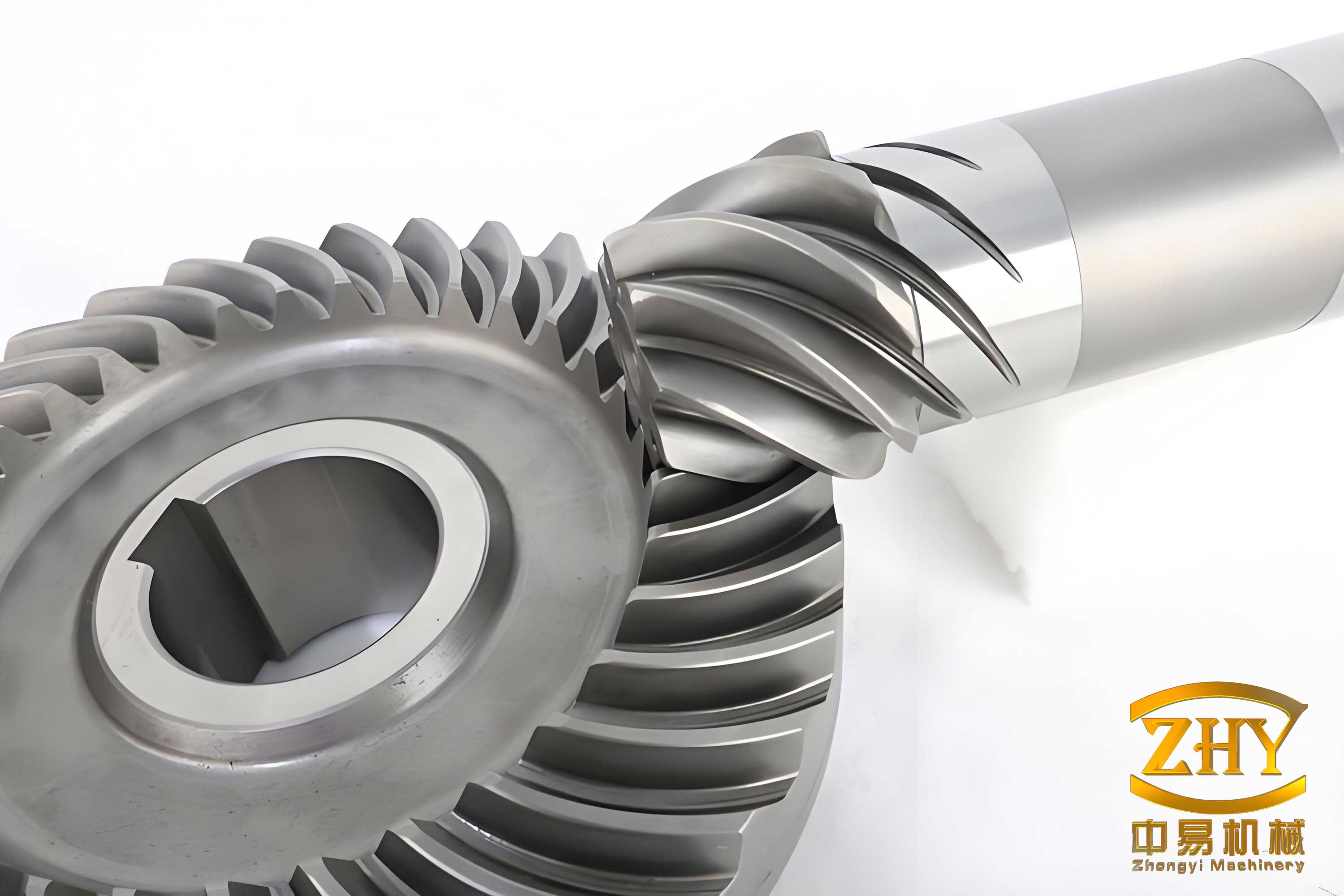
To begin, a detailed geometric model of the spiral bevel gear is essential. The tooth surface of a spiral bevel gear is a complex spatial curved surface generated through envelope cutting processes. Based on the universal motion concept (UMC), a general modeling method can be applied to represent any machining configuration. The motion parameters, including cutter radial setting, workpiece offset, and machine tool angles, are expressed as functions of the cradle rotation angle. For instance, the coordinate transformation from the cutter coordinate system to the workpiece coordinate system is given by a series of matrices that account for these motions. The tooth surface equation is derived by combining the tool surface equation with the meshing principle, solved via nonlinear iterative methods to obtain discrete points. These points are then fitted to generate the three-dimensional geometric model. The geometric parameters for the spiral bevel gears used in this study are summarized in Table 1.
| Parameter | Pinion (Left-Hand) | Gear (Right-Hand) |
|---|---|---|
| Number of Teeth | 23 | 86 |
| Module at Large End (mm) | 4.25 | 4.25 |
| Shaft Angle (°) | 90 | 90 |
| Mean Spiral Angle (°) | 35 | 35 |
| Normal Pressure Angle (°) | 20 | 20 |
| Face Width (mm) | 32 | 32 |
| Outer Cone Distance (mm) | 189.2 | 189.2 |
The material properties of the spiral bevel gears, made from 20CrMnTi steel, are crucial for stress analysis. These properties include elastic modulus, yield strength, tensile strength, and Poisson’s ratio, as listed in Table 2. The finite element contact analysis model is constructed using ABAQUS software, where the gear pair is discretized with structured meshes, and the contact regions are refined to capture stress gradients accurately. The mesh element type is C3D8R, a linear reduced integration element. Contact pairs are defined between the pinion concave surface and the gear convex surface, with a friction coefficient of 0.11 based on lubrication conditions. The loading process involves applying a torque of 800 N·m to the pinion and allowing rotational displacement to simulate meshing. The contact stress distribution reveals an elliptical contact patch, with maximum von Mises and shear stresses occurring in the subsurface region at depths of approximately 60–120 μm, indicating potential crack initiation sites.
| Material | Elastic Modulus (GPa) | Yield Strength (MPa) | Tensile Strength (MPa) | Poisson’s Ratio |
|---|---|---|---|---|
| 20CrMnTi | 206 | 834.9 | 897.7 | 0.3 |
The residual stress field on the tooth surface of spiral bevel gears is introduced through manufacturing processes like carburizing, grinding, and shot peening. Due to the variable curvature of the spiral surface, the residual stress distribution is non-uniform. To characterize this, the tooth surface is discretized into a network of nodes (e.g., 3×5 grid), and X-ray diffraction measurements are taken at each node for both surface and subsurface layers. Electrolytic layer removal is performed to measure residual stresses at depths up to 300 μm, with increments of 20 μm. The shot peening parameters are detailed in Table 3. The measured data show that residual compressive stresses peak at a depth of about 60 μm, with values around -579 MPa at the center of the tooth surface, and decrease toward the edges. This variation is attributed to the curvature effects; the central region experiences higher residual compressive stresses than the edge regions by approximately 20%. To generalize the analysis, multiple residual stress profiles with different peak values are considered, ranging from compressive to tensile stresses.
| Parameter | Value |
|---|---|
| Shot Type | S70 |
| Air Pressure (GPa) | 4.5 |
| Shot Flow Rate (kg/min) | 5 |
| Surface Coverage (%) | 100 |
| Peening Intensity (mm·A) | 0.3 |
The compound stress field is established by superimposing the residual stresses onto the contact stresses from the finite element analysis. The residual stresses in the global coordinate system are transformed using direction cosines based on the tooth surface normal vectors. For a node with normal vector components \( l, m, n \), the residual stress tensor in the global coordinates is computed as:
$$ \sigma_{r,O}(i) = \beta_n(i)^{-1} \cdot \sigma_{r}(i) \cdot (\beta_n(i)^{-1})^T $$
where \( \beta_n(i) = [l, m, n] \) for node \( i \). These stresses are applied to the refined mesh nodes in the subsurface region. The resulting stress field combines cyclic contact loads with static residual stresses, creating a multiaxial non-proportional loading condition critical for fatigue assessment.
For crack initiation life prediction, the Dang Van multiaxial fatigue criterion is employed, as it is suitable for high-cycle fatigue under non-proportional loading. This criterion defines the critical plane as the one experiencing the maximum shear stress amplitude. The equivalent stress parameter is given by:
$$ \sigma_{eq} = \max \left[ \tau_a(t) + \alpha_{dv} \cdot \sigma_H(t) \right] \leq \beta_{dv} $$
where \( \tau_a(t) \) is the maximum shear stress amplitude, \( \sigma_H(t) \) is the hydrostatic stress at time \( t \), and \( \alpha_{dv} \) and \( \beta_{dv} \) are material parameters derived from bending and torsional fatigue limits:
$$ \alpha_{dv} = 3 \left( \frac{\tau_{-1}}{\sigma_{-1}} – \frac{1}{2} \right) $$
$$ \beta_{dv} = \tau_{-1} $$
Here, \( \tau_{-1} \) is the torsional fatigue limit and \( \sigma_{-1} \) is the bending fatigue limit. The hydrostatic stress is computed as:
$$ \sigma_H(t) = \frac{\sigma_x(t) + \sigma_y(t) + \sigma_z(t)}{3} $$
Combining with the material S-N curve, the crack initiation life \( N_i \) at a node is calculated as:
$$ N_i = \left( \frac{\tau_{-1}}{\max \left[ \tau_a(t) + 3 \left( \frac{\tau_{-1}}{\sigma_{-1}} – \frac{1}{2} \right) \cdot \sigma_H(t) \right]} \right)^{1/b} $$
where \( b \) is the fatigue strength exponent and \( \sigma_f’ \) is the fatigue strength coefficient, obtained from material tests. For 20CrMnTi steel, typical values are \( \sigma_f’ = 3060 \) MPa and \( b = -0.1237 \).
Crack propagation life is modeled using linear elastic fracture mechanics. The Paris law describes the crack growth rate:
$$ \frac{da}{dN} = C (\Delta K)^m $$
where \( da/dN \) is the crack growth rate, \( \Delta K \) is the stress intensity factor range, and \( C \) and \( m \) are material constants. For subsurface cracks in spiral bevel gears, mode II (sliding) crack propagation is dominant due to shear stresses. The stress intensity factor for a mode II crack is expressed as:
$$ K_{II} = \sqrt{\frac{2}{\pi L}} \int_0^L \frac{\tau_m(x) \cdot (L – l)}{\sqrt{L – l}} \, dl $$
Considering crack closure effects, an adjustment factor \( U(L) \) is introduced:
$$ K_{II} = U(L) \cdot \sqrt{\frac{2}{\pi L}} \int_0^L \frac{\tau_m(x) \cdot (L – l)}{\sqrt{L – l}} \, dl $$
$$ U(L) = 0.89 + 0.11 e^{-L/10} $$
The stress intensity factor range \( \Delta K \) is the difference between maximum and minimum values during a load cycle. The initial crack length \( l_0 \) is estimated based on the threshold stress intensity factor \( \Delta K_{th} \) and the fatigue limit \( \Delta \sigma_e \):
$$ l_0 = \frac{1}{\pi} \left( \frac{\Delta K_{th}}{\Delta \sigma_e} \right)^2 $$
The crack propagation life \( N_p \) is then integrated from the initial to the critical crack length:
$$ N_p = \int_{l_0}^{L} \frac{dl}{C (\Delta K)^m} $$
Material constants for 20CrMnTi steel are determined through fatigue crack growth rate tests on compact tension (CT) specimens. The results yield \( \Delta K_{th} = 125 \, \text{MPa} \cdot \text{mm}^{0.5} \), \( \lg(C) = -18.41498 \), and \( m = 4.76 \).
The total contact fatigue life \( N \) is the sum of initiation and propagation lives:
$$ N = N_i + N_p $$
To evaluate the effect of residual stresses, calculations are performed both with and without residual stresses. For the case without residual stresses, the contact fatigue life distribution along the tooth surface and depth is analyzed. The minimum life typically occurs at a subsurface depth of about 90 μm, near the pitch line and mid-face width, correlating with the maximum von Mises and shear stresses. For instance, at a depth of 90 μm, the fatigue life at different face width positions (0.25w, 0.50w, 0.75w) shows that the central region has higher life due to the contact ellipse location. The life variation with depth follows a trend: decreasing to a minimum at 90 μm and then increasing.
When residual stresses are included, the compound stress field alters the fatigue life. Residual compressive stresses increase the fatigue life, while tensile stresses decrease it. Analysis of a central node at 90 μm depth reveals that residual stresses do not change the amplitudes of shear stress or hydrostatic stress but shift the mean hydrostatic stress. This shift affects the Dang Van equivalent stress, thereby influencing crack initiation life. For example, with a peak residual compressive stress of -696 MPa, the contact fatigue life increases by approximately 35%, whereas with a peak tensile stress of 696 MPa, life decreases by about 65%. The crack propagation life constitutes around 10% of the total life, indicating that once a crack initiates, propagation to failure is relatively rapid.
To quantify these effects, a series of calculations with varying peak residual stresses \( \sigma_{Mr} \) are performed. The results are summarized in Table 4, showing the crack initiation life \( N_i \), propagation life \( N_p \), and total life \( N \) for different \( \sigma_{Mr} \) values. The data demonstrate that residual compressive stresses significantly enhance fatigue resistance, while tensile stresses are detrimental. This underscores the importance of controlling residual stresses through manufacturing processes to optimize the performance of spiral bevel gears.
| Peak Residual Stress \( \sigma_{Mr} \) (MPa) | Crack Initiation Life \( N_i \) (cycles) | Crack Propagation Life \( N_p \) (cycles) | Total Life \( N \) (cycles) | Life Change Relative to No Residual Stress |
|---|---|---|---|---|
| -696 | 1.45 × 10^7 | 1.60 × 10^6 | 1.61 × 10^7 | +35% |
| -579 | 1.28 × 10^7 | 1.42 × 10^6 | 1.42 × 10^7 | +20% |
| -464 | 1.15 × 10^7 | 1.27 × 10^6 | 1.28 × 10^7 | +10% |
| -348 | 1.05 × 10^7 | 1.16 × 10^6 | 1.17 × 10^7 | +5% |
| -232 | 9.80 × 10^6 | 1.08 × 10^6 | 1.09 × 10^7 | +2% |
| 0 | 9.60 × 10^6 | 1.06 × 10^6 | 1.07 × 10^7 | 0% |
| +232 | 8.50 × 10^6 | 9.40 × 10^5 | 9.44 × 10^6 | -12% |
| +348 | 7.20 × 10^6 | 7.95 × 10^5 | 7.99 × 10^6 | -25% |
| +464 | 5.80 × 10^6 | 6.40 × 10^5 | 6.44 × 10^6 | -40% |
| +579 | 4.50 × 10^6 | 4.97 × 10^5 | 4.99 × 10^6 | -53% |
| +696 | 3.40 × 10^6 | 3.75 × 10^5 | 3.78 × 10^6 | -65% |
The distribution of residual stresses across the tooth surface of spiral bevel gears is influenced by the spatial curvature. Measurements indicate that the central region of the tooth surface exhibits higher residual compressive stresses than the edges. This non-uniformity must be accounted for in life predictions, as it affects the local stress state. The finite element model with applied residual stresses captures this variation, allowing for a more accurate assessment of fatigue life. The method presented here enables the evaluation of spiral bevel gear performance under realistic operating conditions, considering both mechanical loads and manufacturing-induced stresses.
In conclusion, this study develops a comprehensive method for calculating contact fatigue crack initiation and propagation life in spiral bevel gears, incorporating the effects of residual stresses. The approach combines finite element contact analysis, experimental residual stress measurement, multiaxial fatigue criteria, and fracture mechanics. Key findings include: (1) The variable curvature of spiral bevel gear tooth surfaces leads to non-uniform residual stress distributions, with central regions having about 20% higher compressive stresses than edges. (2) The crack initiation location and life are primarily determined by contact stresses, but residual stresses alter the mean hydrostatic stress, significantly impacting fatigue life. (3) Crack propagation life constitutes approximately 10% of the total life, representing the rapid failure phase. (4) Residual compressive stresses enhance fatigue life, while tensile stresses reduce it, emphasizing the importance of process control. This research provides a valuable framework for the design of high-performance spiral bevel gears with improved longevity and reliability, particularly in demanding applications like aerospace and heavy machinery. Future work could explore the effects of other factors such as lubrication, surface roughness, and dynamic loads to further refine the life prediction model for spiral bevel gears.