
In the precision manufacturing of spiral bevel gears, surface quality is paramount for ensuring optimal performance, durability, and noise reduction in power transmission systems. One critical factor affecting surface finish is the scallop height, which arises from the discontinuous nature of the cutting process in generated cutting methods. This article delves into a numerical algorithm for accurately calculating the scallop height during the tilt-generated cutting of spiral bevel gears. By integrating design parameters of the cutter and process parameters, a mathematical model of the tooth surface is established, elucidating the relationship between scallop height and variables such as the number of blade inserts, cutter rotational speed, roll rate, and roll rotation angle range. The developed methodology not only aids in predicting surface roughness but also provides a reference for optimizing cutting parameters to balance manufacturing efficiency and quality. Throughout this discussion, the term ‘spiral bevel gear’ will be frequently emphasized to underscore its centrality in this manufacturing context.
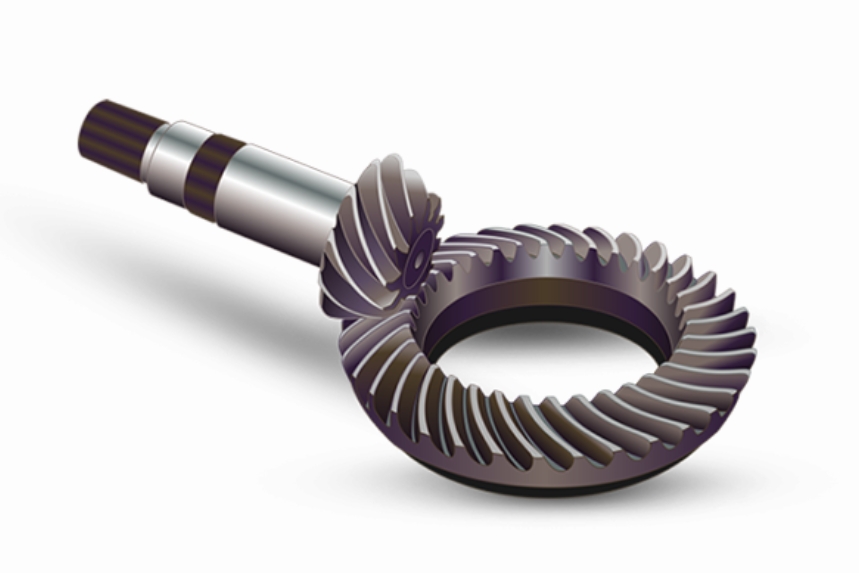
The manufacturing of spiral bevel gears involves complex gear geometry and precise machining techniques. Generated cutting, particularly using the tilt method, is widely employed due to its ability to produce high-quality tooth surfaces. However, the process inherently involves discrete cutting edges on the cutter head, leading to non-continuous material removal. This discontinuity results in residual material between successive cutter paths, manifesting as scallops or刀纹 on the finished surface. Controlling these scallops is essential for meeting surface roughness specifications and ensuring the functional integrity of the spiral bevel gear. Traditional approaches often rely on empirical adjustments, but a precise computational model can significantly enhance process control. In this work, I present a detailed numerical framework for scallop height calculation, validated through simulation and practical considerations, specifically tailored for spiral bevel gear production.
The formation of scallop height is intrinsically linked to the kinematics of the cutting process. In ideal continuous cutting, as assumed in design simulations, the cutter head is treated as a conical surface where every infinitesimal element participates in cutting, yielding a smooth tooth surface that satisfies meshing conditions. However, in actual machining, only the discrete cutting edges of the blade inserts engage the gear blank. For a spiral bevel gear, the cutter head typically houses multiple blade inserts arranged uniformly around its periphery. As the cutter rotates, these inserts intermittently contact the workpiece, creating a series of overlapping but distinct cut surfaces. The envelope of these surfaces constitutes the machined tooth face, but at the intersections of adjacent cut paths, material remains uncut, forming ridges known as scallops. The height of these scallops determines the局部 surface roughness and can affect the contact pattern and stress distribution in the spiral bevel gear under load. Therefore, understanding and quantifying this phenomenon is crucial for advanced manufacturing strategies.
To mathematically describe the scallop formation, we begin by modeling the cutting edge of a single blade insert. Consider a cutter head coordinate system $o_c(x_c, y_c, z_c)$ with origin at the center of the cutter head in the tip plane, where the $z_c$-axis is along the cutter axis direction (pointing outward from the paper). The cutter head is discretized into $k$ cutting edges, indexed from $0$ to $k-1$. Initially, the $x_c$-axis coincides with cutting edge $0$, so the initial angular position of the $i$-th edge is given by:
$$ \theta_i = \frac{2\pi}{k} i \quad (i = 0, 1, 2, \ldots, k-1) $$
Each cutting edge can be modeled as a line on the conceptual cutter cone. For any point $M$ on the $i$-th edge, parameterized by distance $u$ along the edge from the reference point, the position vector in the cutter coordinate system is:
$$ \mathbf{r}_i(u, \theta_i) = \begin{bmatrix} (r \pm u \sin \alpha) \cos \theta_i \\ (r \pm u \sin \alpha) \sin \theta_i \\ -u \cos \alpha \end{bmatrix} $$
where $r$ is the nominal cutter radius, $\alpha$ is the pressure angle, and the $\pm$ sign denotes outer cut (positive) or inner cut (negative) for spiral bevel gear machining. The unit normal vector to the cutting edge is:
$$ \mathbf{n}_i(\theta_i) = \begin{bmatrix} \cos \alpha \cos \theta_i \\ \cos \alpha \sin \theta_i \\ \pm \sin \alpha \end{bmatrix} $$
These equations define the geometry of a single cutting edge, which is essential for后续 kinematic analysis. The parameter $u$ varies along the edge, typically from the tip to the root of the cutter blade, covering the active cutting portion.
The cutting process involves relative motion between the cutter and the gear blank. Key process parameters for tilt-generated cutting include the cutter rotational speed $\omega_c$ (in rad/min or deg/min), the number of blade inserts $k$, the roll rotation angle range $[q_0, q_s]$, and the roll rate $\omega_q$ (angular speed of the cradle or roll). The total cutting time $T$ for generating one tooth flank is:
$$ T = \frac{q_s – q_0}{\omega_q} $$
At any cutting time $t$ (where $0 \leq t \leq T$), the roll angle $q_t$ and the angular position of the $i$-th cutting edge $\theta_{it}$ evolve as:
$$ q_t = q_0 + \omega_q t $$
$$ \theta_{it} = \theta_i + \omega_c t $$
These time-dependent parameters capture the dynamic nature of the machining process for spiral bevel gears. The relative motion between cutter and workpiece can be represented by a homogeneous transformation matrix $\mathbf{M}(q_t, \theta_{it})$, which accounts for the machine settings such as tilt angle, swivel angle, radial distance, and other adjustments specific to the spiral bevel gear generator.
The cut surface generated by the $i$-th cutting edge over time is a swept surface. For a given time $t$ and parameter $u$, a point on this surface in the workpiece coordinate system is:
$$ \mathbf{R}_j(t, u) = \mathbf{M}(q_t, \theta_{it}) \cdot \mathbf{r}_i(u, \theta_i) $$
with the corresponding normal vector:
$$ \mathbf{N}_j(t, u) = \mathbf{M}(q_t, \theta_{it}) \cdot \mathbf{n}_i(\theta_i) $$
Here, $j$ indexes the segment of the tooth surface cut by this edge. Since each cutting edge rotates multiple times during the cut, it generates multiple segments. Overall, the entire tooth surface of the spiral bevel gear is composed of approximately $K = \omega_c T k$ such segments, equivalent to the total number of effective cutting engagements. This discrete representation is fundamental for analyzing scallop height.
To compute the scallop height, we need to compare the actual cut surface with the ideal theoretical tooth surface. The theoretical surface is derived from gear meshing theory and satisfies the equation of contact. For a given point on the theoretical surface, defined by parameters $u$ and $\phi$ (a motion parameter), we can obtain its position and normal via standard gear geometry formulations. The actual cut surface, however, consists of points that may not satisfy the meshing condition exactly, except along certain curves. The scallop height at any location is the perpendicular distance from the actual surface to the theoretical surface, typically measured along the normal direction.
For points on the cut surface that lie on the meshing curve (where the cutting edge is tangent to the ideal surface), the scallop height is zero. These points can be found by solving the meshing equation for given $u$ and unknown $t$. However, the scallop height is most significant at the boundaries between adjacent cut segments, i.e., along the cutter marks or刀纹. At these boundaries, two adjacent cut surfaces intersect, and the theoretical surface lies between them. To compute the scallop height at such a boundary, consider two consecutive cutting edges $i$ and $i+1$, generating surfaces $j$ and $j+1$. Assume a virtual cutting edge with an angular position $\theta$ between $\theta_i$ and $\theta_{i+1}$. At time $t$, this virtual edge would cut a point $\mathbf{M}_0$ on the theoretical surface, with position $\mathbf{R}(\theta)$ and normal $\mathbf{N}(\theta)$. Now, consider a ray emanating from $\mathbf{M}_0$ along the normal direction $\mathbf{N}(\theta)$. This ray intersects the actual cut surfaces $j$ and $j+1$ at points $\mathbf{M}_1$ and $\mathbf{M}_2$, respectively. If the distances $|\mathbf{M}_0 \mathbf{M}_1|$ and $|\mathbf{M}_0 \mathbf{M}_2|$ are nearly equal, the scallop height can be approximated as $|\mathbf{M}_0 \mathbf{M}_1|$. Mathematically, we solve:
$$ \mathbf{R}_j(t_1, u_1) – \mathbf{R}(\theta) = d_1 \mathbf{N}(\theta) $$
$$ \mathbf{R}_{j+1}(t_2, u_2) – \mathbf{R}(\theta) = d_2 \mathbf{N}(\theta) $$
$$ |d_1 – d_2| < \epsilon $$
where $d_1 = |\mathbf{M}_0 \mathbf{M}_1|$, $d_2 = |\mathbf{M}_0 \mathbf{M}_2|$, and $\epsilon$ is a small tolerance (e.g., $\epsilon = 0.01 d_1$). By varying $\theta$ in $[\theta_i, \theta_{i+1}]$ and using a bisection search, we can find the $\theta$ that minimizes the difference, yielding the scallop height $d_1$. This numerical algorithm efficiently computes the scallop height at cutter marks for spiral bevel gears.
The magnitude of scallop height is influenced by several process parameters. From the model, the total number of cut segments $K = \omega_c T k$ plays a dominant role. For fixed gear design parameters, increasing $K$ reduces the scallop height. Since $K$ is proportional to the cutting time $T$, cutter speed $\omega_c$, and number of inserts $k$, adjustments in these parameters can control surface finish. However, practical constraints such as cutter life, machine dynamics, and productivity must be considered. For instance, increasing $\omega_c$ may raise cutting forces and heat generation, while increasing $k$ might be limited by cutter design. Thus, optimizing these parameters requires a balance, and the computational model provides a quantitative basis for decision-making in spiral bevel gear manufacturing.
To illustrate the application, let’s consider a practical example of machining a spiral bevel gear pinion using a Gleason-type hypoid generator with tilt method. The relevant machine settings, blank data, and cutter parameters are summarized in the table below. This example focuses on the concave side cutting with a single outer blade cutter.
| Parameter Name | Value |
|---|---|
| Tilt Angle (degrees) | 19.76 |
| Swivel Angle (degrees) | 324.42 |
| Vertical Wheel Setting (mm) | 32.4229 |
| Radial Cutter Distance (mm) | 145.3965 |
| Blank Offset (mm) | 33.3892 |
| Installation Root Angle (degrees) | 356.08 |
| Roll Ratio | 3.482666 |
| Machine Center to Crossing Point (mm) | -5.0885 |
| Start Roll Angle (degrees) | 94.77 |
| End Roll Angle (degrees) | 60.55 |
| Roll Rate (deg/min) | 5.4272 |
| Number of Teeth | 10 |
| Module | 9.73 |
| Hand of Spiral | Left |
| Spiral Angle at Concave Midpoint (degrees) | 45°9′ |
| Pressure Angle on Concave (degrees) | 22°6′ |
| Face Angle (degrees) | 22°5′ |
| Distance from Crossing Point to Front Crown (mm) | 120.01 |
| Distance from Crossing Point to Rear Crown (mm) | 175.13 |
| Distance from Face Apex to Crossing Point (mm) | 1.78 |
| Cutter Diameter (mm) | 307 |
| Cutter Pressure Angle (degrees) | 14 |
| Number of Blade Inserts | 24 |
| Cutter Rotational Speed (deg/min) | 111 |
Using these parameters, the total cutting time $T$ is computed as $T = (94.77 – 60.55) / 5.4272 \approx 6.30$ minutes. The effective number of cut segments $K = \omega_c T k = (111 \, \text{deg/min}) \times (6.30 \, \text{min}) \times (24 / 360 \, \text{per revolution}) \approx 280$ segments. This indicates that approximately 280 discrete cutting engagements occur per tooth flank for this spiral bevel gear.
To compute scallop heights at various locations on the tooth surface, I implemented the numerical algorithm in MATLAB. The parameter $u$ (along the cutting edge) was varied to sample different points from root to tip. For each $u$ value, multiple scallop heights were calculated along the cutter marks. The table below presents the average scallop heights at three regions of the tooth surface: region A (near the start of cut), region B (middle), and region C (near the end of cut), corresponding to equal divisions of the cutting time.
| $u$ (mm) | Scallop Height in Region A (μm) | Scallop Height in Region B (μm) | Scallop Height in Region C (μm) |
|---|---|---|---|
| 12 | 0.339 | 0.276 | 0.219 |
| 10 | 0.326 | 0.259 | 0.197 |
| 8 | 0.302 | 0.228 | 0.174 |
| 6 | 0.273 | 0.194 | 0.147 |
| 4 | 0.235 | 0.167 | 0.118 |
The results show that scallop height increases with $u$ (i.e., from root to tip) and decreases from the start to the end of cut (i.e., from toe to heel in gear terms). This trend is consistent with the geometry of spiral bevel gears, where cutting velocity and engagement vary along the tooth. Moreover, the scallop heights are in the range of 0.1 to 0.34 μm, which is relatively small. To relate this to surface roughness, consider the arithmetic mean roughness $R_a$. For a sampling length containing $n$ scallops, with scallop heights $y_j$, $R_a$ can be approximated as:
$$ R_a \approx \frac{1}{2n} \sum_{j=1}^{n} |y_j| $$
Given the average scallop heights in Table 2, $R_a$ values would be roughly half of these averages, i.e., between 0.06 and 0.17 μm. According to surface finish standards for spiral bevel gears, fine cutting often requires $R_a$ between 0.4 and 1.6 μm. Our computed $R_a$ is below 0.4 μm, indicating that the surface痕迹 from scallops would be barely discernible, meeting high-quality requirements. This aligns with practical experiences where such parameter sets yield acceptable finishes for spiral bevel gears.
The influence of process parameters on scallop height can be further analyzed through sensitivity studies. For instance, if we increase the number of blade inserts $k$ from 24 to 36 while keeping other parameters constant, $K$ increases proportionally, reducing scallop height. Similarly, increasing cutter speed $\omega_c$ or extending cutting time $T$ (by widening the roll angle range) can enhance surface finish. However, these changes may affect other aspects like productivity or tool wear. The mathematical model allows for rapid what-if analyses to optimize the process for specific spiral bevel gear applications.
To validate the computational results, a simulation of the cutting process was conducted using SolidWorks to generate a 3D model of the spiral bevel gear tooth. Measurements of scallop heights near cutter marks on the simulated surface were taken and compared with the calculated values. The discrepancies were minimal, typically within 0.02 μm, confirming the accuracy of the numerical algorithm. This validation step is crucial for establishing confidence in the model for real-world spiral bevel gear manufacturing.
In summary, this article has presented a comprehensive numerical approach for calculating scallop height in the generated cutting of spiral bevel gears. By modeling the cutting edges and incorporating process kinematics, we established a mathematical framework that relates scallop height to key manufacturing parameters. The algorithm efficiently computes scallop heights at cutter marks, enabling prediction of surface roughness. Through an example, we demonstrated how the method can be applied to assess and optimize cutting conditions for spiral bevel gears. The results indicate that with proper parameter selection, scallop heights can be controlled to achieve desired surface quality, often surpassing standard requirements. This work contributes to the precision manufacturing of spiral bevel gears, offering a tool for engineers to balance efficiency and quality in production.
Future work could extend this model to account for dynamic effects such as cutter vibrations, wear, or thermal deformations, which might influence scallop formation. Additionally, integration with real-time monitoring systems could enable adaptive control during machining of spiral bevel gears. Nevertheless, the current methodology provides a solid foundation for understanding and improving the surface finish in gear manufacturing, emphasizing the importance of scallop height control for high-performance spiral bevel gears.