
Spiral bevel gears are critical power transmission components extensively employed in high-speed and heavy-duty machinery such as automobiles, machine tools, chemical equipment, and mining machinery. Their primary function is to transmit torque and motion between intersecting, typically perpendicular, shafts with high efficiency and load-carrying capacity. The conventional manufacturing method for these complex gears involves multi-axis CNC milling or grinding. While effective in achieving precise geometry, this subtractive machining process suffers from significant material waste, as a large portion of the gear blank is cut away into chips. More importantly, it severs the natural metal fiber flow lines, which can detrimentally affect the component’s mechanical properties, particularly its bending fatigue strength and resistance to crack propagation. For high-volume production, precision forging has been adopted for the larger gear (the gear) in a set, offering near-net-shape benefits. However, this process requires expensive, high-performance die steels capable of withstanding extreme thermal and mechanical fatigue, and its application to the more geometrically complex smaller pinion remains challenging.
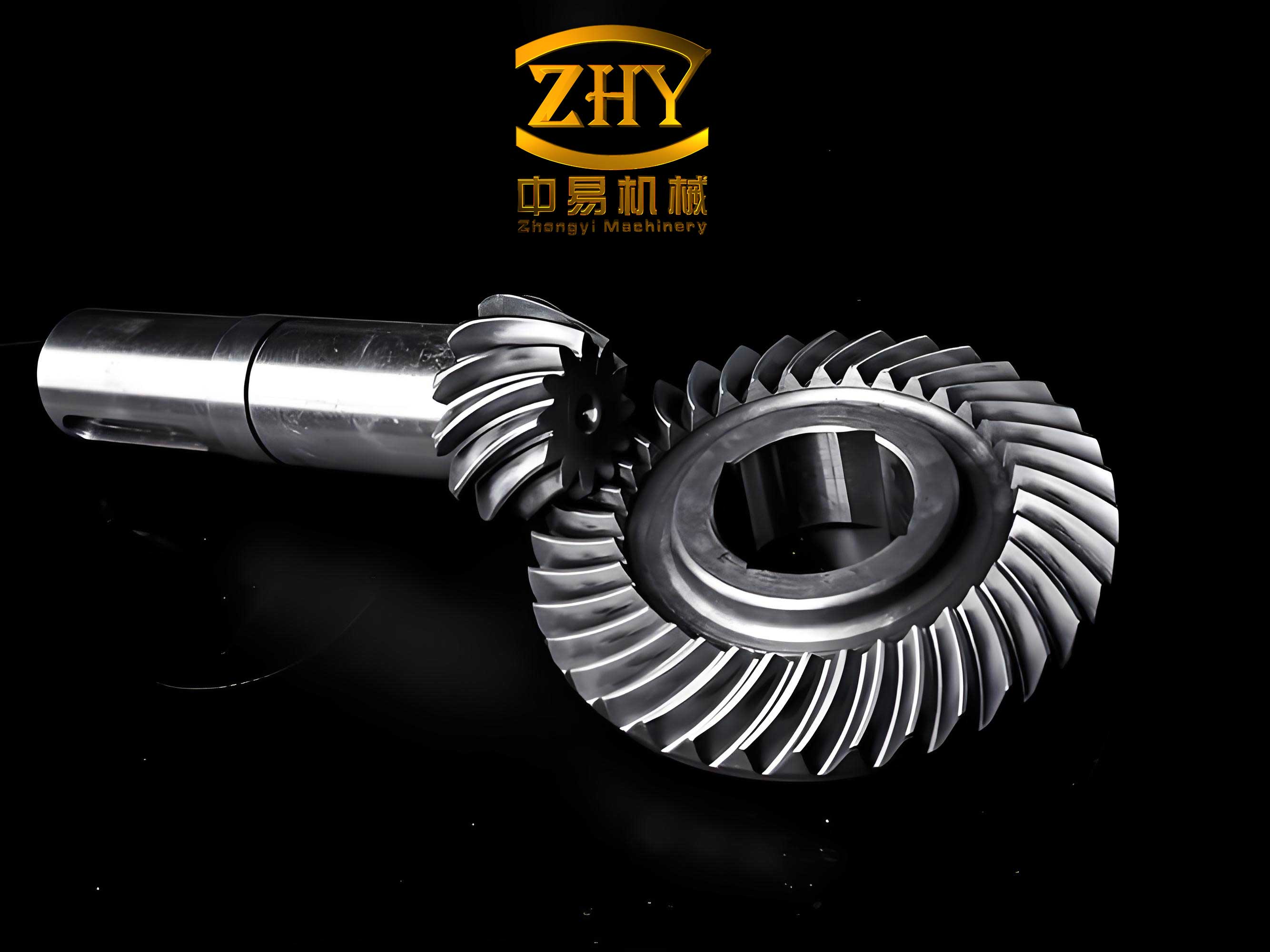
To overcome these limitations and to develop a complementary near-net-shape process for the spiral bevel gear pinion, this study investigates the application of rolling forming technology. Rolling, a chipless forming process, is well-established for manufacturing components like threads, splines, and cylindrical gears (both spur and helical). In thread rolling, high volumes of fasteners are produced with superior surface finish and strength compared to cutting. Spline rolling has also seen breakthroughs, with experimental studies successfully revealing metal flow patterns and producing parts with significantly enhanced mechanical properties and quality. Gear rolling, while presenting challenges in tool design and process control, offers compelling advantages including improved material utilization, strengthened grain structure, and higher production rates. This research aims to extend this technology to the domain of spiral bevel gear forming. By establishing a mathematical model based on conjugate surface theory and gear design principles, conducting numerical simulations, and performing experimental trials, the feasibility and characteristics of rolling for spiral bevel gear pinions are explored.
Principles and Modeling of the Rolling Process
The core of the rolling process for a spiral bevel gear involves using a profiled tool roller to plastically deform a heated cylindrical blank into the desired tooth form. The geometric accuracy of the final gear is fundamentally dependent on the precision of the roller design and the established kinematic relationship between the roller and the workpiece.
Geometric Modeling of the Forming Roller
The design of the forming roller is derived from the conjugate geometry of the target spiral bevel gear pinion. The methodological flowchart is based on the following sequence: First, the gear member of the pair is designed according to standard gear geometry. Second, the pinion tooth surface is designed and modified (e.g., via flank corrections) to ensure optimal meshing contact patterns with the gear. Third, applying the principle of conjugate surfaces, the tooth surface of the pinion is used to generate the corresponding inverse surface on the forming roller. Essentially, the roller is designed as the mating conjugate tool to the finished pinion. Finally, this roller is then used to form the pinion from a blank. The designed pinion and its mating gear must undergo tooth contact analysis (TCA) to verify performance. An iterative loop is necessary to adjust the roller geometry if the TCA results or measured points on the formed pinion are unsatisfactory.
Using this fully conjugate method, a three-dimensional model of the forming roller is constructed. The fundamental geometric parameters defining this roller are summarized in the table below.
| Parameter | Symbol | Value (Roller) |
|---|---|---|
| Number of Teeth | \( Z_r \) | 39 |
| Hand of Spiral | – | Right Hand |
| Module | \( m_n \) (mm) | 5.69 |
| Face Width | \( F \) (mm) | 32 |
| Pressure Angle | \( \alpha \) (°) | 22.5 |
Design of the Preform Blank
The initial shape of the workpiece blank is crucial for successful forming. It must contain sufficient volume to completely fill the tooth spaces of the roller without causing excessive flash or forming defects. The design is guided by the principle of volume constancy, a fundamental axiom in plastic deformation stating that the volume of material before and after forming remains constant (ignoring minor elastic recovery).
The volume of the solid tooth portion of the target spiral bevel gear pinion is first calculated from its 3D model. Let this volume be denoted as \( V_{teeth} \). The blank is designed as a simple solid of revolution (e.g., a frustum of a cone) whose volume \( V_{blank} \) is slightly greater than \( V_{teeth} \) to account for process variations and ensure complete tooth filling. The key dimensions of the target pinion required for this calculation are listed below.
| Parameter | Symbol | Value (Pinion) |
|---|---|---|
| Number of Teeth | \( Z_p \) | 9 |
| Module | \( m_n \) (mm) | 5.69 |
| Pressure Angle | \( \alpha \) (°) | 22.5 |
| Pitch Cone Angle | \( \delta \) (°) | 12.99 |
The volume of a conical frustum blank can be expressed as:
$$ V_{blank} = \frac{1}{3} \pi h (R^2 + Rr + r^2) $$
where \( h \) is the axial height, \( R \) is the major radius, and \( r \) is the minor radius. By setting \( V_{blank} = \kappa \cdot V_{teeth} \) (where \( \kappa > 1 \) is a fullness factor, typically 1.05-1.10), and relating \( R \), \( r \), and \( h \) to the pinion’s back cone and pitch cone geometry, the blank dimensions can be solved.
Kinematic Model and Process Setup
The rolling process model employs two forming rollers positioned symmetrically on opposite sides of the workpiece blank. This configuration helps balance radial forces, reducing machine deflection and improving geometric accuracy. It also facilitates a double-sided forming action which can enhance the uniformity of material flow. The fundamental kinematics involve coordinated rotational and translational motions.
The two rollers rotate about their own axes while simultaneously feeding along their axes towards the workpiece centerline. The workpiece blank, mounted on a spindle, is driven to rotate by frictional contact with the rollers. The precise synchronization of these motions is vital for correct tooth generation. The relationship is governed by the ratio of the number of teeth on the roller to the number of teeth on the finished pinion. The theoretical rotational speed of the workpiece \( \omega_w \) relative to the roller speed \( \omega_r \) is given by:
$$ \frac{\omega_w}{\omega_r} = \frac{Z_r}{Z_p} $$
where \( Z_r \) is the number of tool grooves on the roller (corresponding to its “teeth”) and \( Z_p \) is the number of teeth on the target spiral bevel gear pinion. In practice, slight deviations from this ratio may be applied to aid material flow. The axial feed velocity \( v_f \) is a critical process parameter controlling the forming depth per revolution.
Numerical Simulation and Analysis
To investigate the forming mechanics, predict defects, and optimize process parameters, finite element method (FEM) simulation is an indispensable tool. The established 3D rolling model was imported into the DEFORM-3D software, a specialized program for metal forming analysis.
Simulation Setup and Parameters
In the simulation setup, the workpiece was modeled as a plastic body, with its elastic deformation considered negligible compared to the large plastic strain. The forming rollers were defined as rigid bodies to reduce computational cost. The material selected for the workpiece was 20CrNiMo alloy steel, whose properties closely resemble the commonly used 20CrMnTi for automotive spiral bevel gears. The chemical composition is provided below.
| Element | C | Si | Mn | Cr | Ni | Mo |
|---|---|---|---|---|---|---|
| Wt. % | 0.20 | 0.29 | 0.76 | 0.53 | 0.50 | 0.25 |
The rolling process was simulated under hot-forming conditions to reduce flow stress and improve formability. The initial temperature of the workpiece was set to 950°C, which is above the recrystallization temperature for the steel, promoting dynamic recovery and recrystallization. The rollers were set at a lower temperature. The friction at the roller-workpiece interface was modeled using a shear factor, set to 0.8, representing high friction typical in hot forming. Heat transfer to the environment and the tools was accounted for. A key aspect of the simulation was studying the effect of roller rotational speed. Three different speeds were analyzed, as shown below, while the axial feed rate was maintained constant at 0.1 mm/s.
| Case | Roller Speed, \( \omega_r \) (rad/s) | Roller Speed (rpm) |
|---|---|---|
| 1 (Low) | 0.0453 | ~0.43 |
| 2 (Medium) | 0.0906 | ~0.87 |
| 3 (High) | 0.1449 | ~1.38 |
The corresponding workpiece speeds were calculated based on the theoretical kinematic ratio and slight modifications for formability.
Simulation Results and Discussion
The simulation revealed the progressive formation of the tooth spaces. A significant phenomenon observed from the initial stages was the development of “ears” or flashes on the sides of the workpiece, in the gaps between the two rollers. As the axial feed increased, these protrusions became more pronounced. This is a common issue in open-die forging or rolling processes where material is free to flow laterally. The simulation suggested a process strategy involving periodic reversal of the roller rotation direction. This alternating motion can help work the material back towards the tooth cavity, promoting filling in the height direction and utilizing the roller root to finish the crest of the pinion tooth.
The simulation output key physical variables over time. The trends for forming load, workpiece surface area, and roller torque under different roller speeds are critical for machine design and process control.
Forming Load: The load required to press the rollers into the workpiece increases non-linearly with time (and therefore with feed depth). The load-time history is pulsating due to the discrete engagement of the tool lobes with the workpiece. The peak load increased significantly with higher roller speeds. At the lowest speed (0.0453 rad/s), the maximum load was approximately 100 kN, while it rose substantially for higher speeds. This is attributed to higher strain rates increasing the material’s flow stress and less time for thermal softening at higher speeds.
Torque: The torque on the roller spindle follows a similar trend. It is required to overcome friction and the plastic work of deforming the material. The maximum torque also increased with roller speed, with the lowest speed case requiring the smallest torque (on the order of \( 2 \times 10^3 \) N·m).
Effective Strain and Temperature: The distribution of effective strain (\( \bar{\epsilon} \)) is highly non-uniform. Maximum strain is concentrated in the surface layers where tooth forming occurs, while the core experiences lower strain. The effective strain increases with time as deformation accumulates. Conversely, the workpiece temperature decreases over time due to heat loss to the cooler tools and environment. Higher roller speeds result in slightly higher average temperatures in the deformation zone because there is less time for heat conduction away from the surface between engagements. The equivalent stress distribution mirrors the strain, showing high stress in the actively deforming regions.
The quantitative analysis from the simulation strongly indicated that a lower roller speed (Case 1: 0.0453 rad/s) is preferable, as it leads to lower forming loads, lower torque, and a more manageable thermal profile, all of which are beneficial for tool life and process stability. This parameter was selected as the basis for subsequent experimental trials.
Experimental Investigation
To validate the feasibility of the rolling process and the findings from the numerical simulation, a series of experimental trials were conducted on a custom-built rolling test rig.
Experimental Materials and Setup
The workpiece material was 20CrMnTi steel, a common case-hardening steel for automotive transmission spiral bevel gears. The preform blanks were machined to the dimensions calculated via the volume constancy principle. The forming rollers, manufactured from high-hot-strength tool steel, were machined with the conjugate tooth profile derived for the target pinion.
Experimental Procedure and Parameters
Given the complexity, cost, and time associated with each trial, the experiments were designed based on the simulation insights. The primary roller rotational speed was set to the low-speed condition identified as optimal (0.0453 rad/s). Due to limitations in the hydraulic feed system’s minimum stable velocity, a segmented feed approach was adopted instead of a continuous 0.1 mm/s feed. The experiment was divided into three sequential stages with increasing total feed depth to observe the forming progression and intermediate geometries.
| Stage | Cumulative Feed Depth (mm) | Objective |
|---|---|---|
| 1 | 2.0 | Initial tooth impression, check alignment |
| 2 | 4.0 | Partial tooth forming, observe material flow |
| 3 | 5.7 | Near-full depth forming |
The blanks were heated to approximately 950°C in a furnace prior to loading into the rolling rig. The process was conducted in a single heat, with the workpiece temperature dropping throughout the operation.
Experimental Results and Defect Analysis
The experiments successfully demonstrated the fundamental feasibility of forming a spiral bevel gear pinion via rolling. The staged results showed the progressive development of the tooth spaces. The final formed part exhibited a recognizable spiral bevel gear tooth pattern, confirming that the conjugate roller design can transfer its geometry to the workpiece.
However, several forming defects were observed, aligning with the simulation predictions:
- Prominent Flash (“Ears”): Significant lateral flash was formed in the gaps between the two symmetric rollers. This is the most apparent defect, resulting from the open-die nature of the current setup and unrestricted material flow perpendicular to the feed direction.
- Incomplete Tooth Filling: Especially at the toe (inner end) of the gear and near the dedendum (tooth root) region, the material did not completely fill the cavity of the roller. This indicates insufficient volume distribution or inadequate flow stress/ temperature in those zones.
- Surface Folding: Inspection revealed traces of surface folding near the root fillet at the gear’s heel (outer end). This defect occurs when surface material flows over itself, often due to improper preform shape or excessive single-pass feed causing unstable flow.
- Surface Oxidation and Roughness: As expected in hot forming without a protective atmosphere, severe scale formation occurred, leading to a poor surface finish on the formed teeth.
Notably, the fundamental tooth spacing was correctly generated without overlapping or gross misplacement, proving the kinematic model’s validity. The defect analysis clearly points to areas for process improvement: preform shape optimization, implementation of a controlled flash-land or confinement, and potential multi-stage rolling with intermediate preforms.
Discussion and Conclusions
This integrated study, encompassing theoretical modeling, numerical simulation, and physical experimentation, provides a comprehensive investigation into the rolling forming technology for spiral bevel gear pinions. The following key conclusions are drawn:
- Process Feasibility and Model Foundation: The research establishes that rolling is a technically feasible near-net-shape route for manufacturing spiral bevel gears. A robust methodological framework was developed, utilizing conjugate surface theory for precise roller design, the volume constancy principle for preform sizing, and coordinated kinematics for motion control.
- Insights from Numerical Simulation: The FEM simulations proved invaluable in predicting process behavior. They successfully forecasted the formation of lateral flash and provided quantitative data on critical parameters. The analysis revealed that forming load, torque, and workpiece surface area increase with both time (depth) and roller speed. Conversely, workpiece temperature decreases over time. A lower roller speed was found advantageous, minimizing loads and torque while maintaining a favorable forming temperature.
- Experimental Validation and Defect Identification: The rolling trials confirmed the basic formability of the spiral bevel gear tooth geometry. However, the experiments also conclusively identified the primary challenges: uncontrolled flash formation, incomplete filling in critical regions, and surface folding. These defects highlight that while the principle is viable, the specific process design—particularly concerning preform geometry, die confinement, and thermal management—requires significant refinement to achieve a net-shape or near-net-shape outcome suitable for industrial application.
- Path Forward for Spiral Bevel Gear Rolling: The current process, as tested, is not mature for direct production of finished gears. The formed components would require subsequent finish machining (e.g., grinding) to achieve the necessary dimensional accuracy and surface quality. However, rolling holds great potential as a high-efficiency pre-forming operation. Future work must focus on: (a) designing a multi-stage process with optimized preform shapes to ensure uniform material distribution and complete die filling; (b) implementing controlled-draft rolling or closed-die concepts to manage flash; (c) exploring warm or isothermal forming conditions to improve accuracy and reduce scale; and (d) conducting detailed studies on the resultant microstructure and mechanical properties (e.g., fatigue life) to quantify the potential benefits over cut gears.
In summary, this research lays a solid foundation for the development of rolling technology as a complementary or alternative manufacturing method for spiral bevel gears. It transitions the concept from pure theory towards practical application, clearly defining both its promising advantages for material savings and property enhancement, and the critical engineering hurdles that must be overcome to realize its full potential in the production of high-performance power transmission components.