
As a researcher focused on gear dynamics and noise reduction, I have long been intrigued by the challenges posed by gear transmission noise, particularly in spiral bevel gears. These gears are widely used in automotive, aerospace, and industrial machinery due to their ability to transmit power between non-parallel shafts efficiently. However, their operational noise remains a significant concern, contributing to environmental pollution and affecting system performance. In this article, I will present a comprehensive study on low-noise spiral bevel gears, based on experimental investigations that compare traditional designs with new approaches aimed at enhancing meshing performance through increased contact ratio. The core of this work revolves around the design and testing of spiral bevel gears with modified parameters, emphasizing the role of overlap ratio in noise reduction. Throughout this discussion, I will frequently refer to spiral bevel gears to underscore their importance, and I will incorporate tables and formulas to summarize key findings. The goal is to provide insights that can lead to quieter gear systems without necessitating major investments in manufacturing equipment.
Noise in gear systems is a complex phenomenon influenced by factors such as manufacturing精度, load conditions, and geometric design. For spiral bevel gears, the noise generation mechanism is particularly intricate due to their localized conjugate meshing behavior. Traditional spiral bevel gear designs often rely on zero-displacement principles and standard tooth heights, which limit the contact ratio to values below 2.0. This results in single-tooth-pair contact under light loads, leading to increased vibration and noise. In contrast, recent advancements in gear design, as seen in automotive applications, emphasize higher contact ratios through strategies like increased tooth height, reduced pressure angle, smaller modules, larger spiral angles, and wider face widths. These trends align with the broader objective of achieving high performance and low noise. My research builds on these ideas by proposing a novel design method for spiral bevel gears that employs non-zero negative displacement and extended tooth height to achieve a contact ratio greater than 2.0, ensuring multi-tooth-pair engagement even under varying loads. This approach aims to reduce dynamic loads, enhance transmission rigidity, and ultimately lower noise levels.
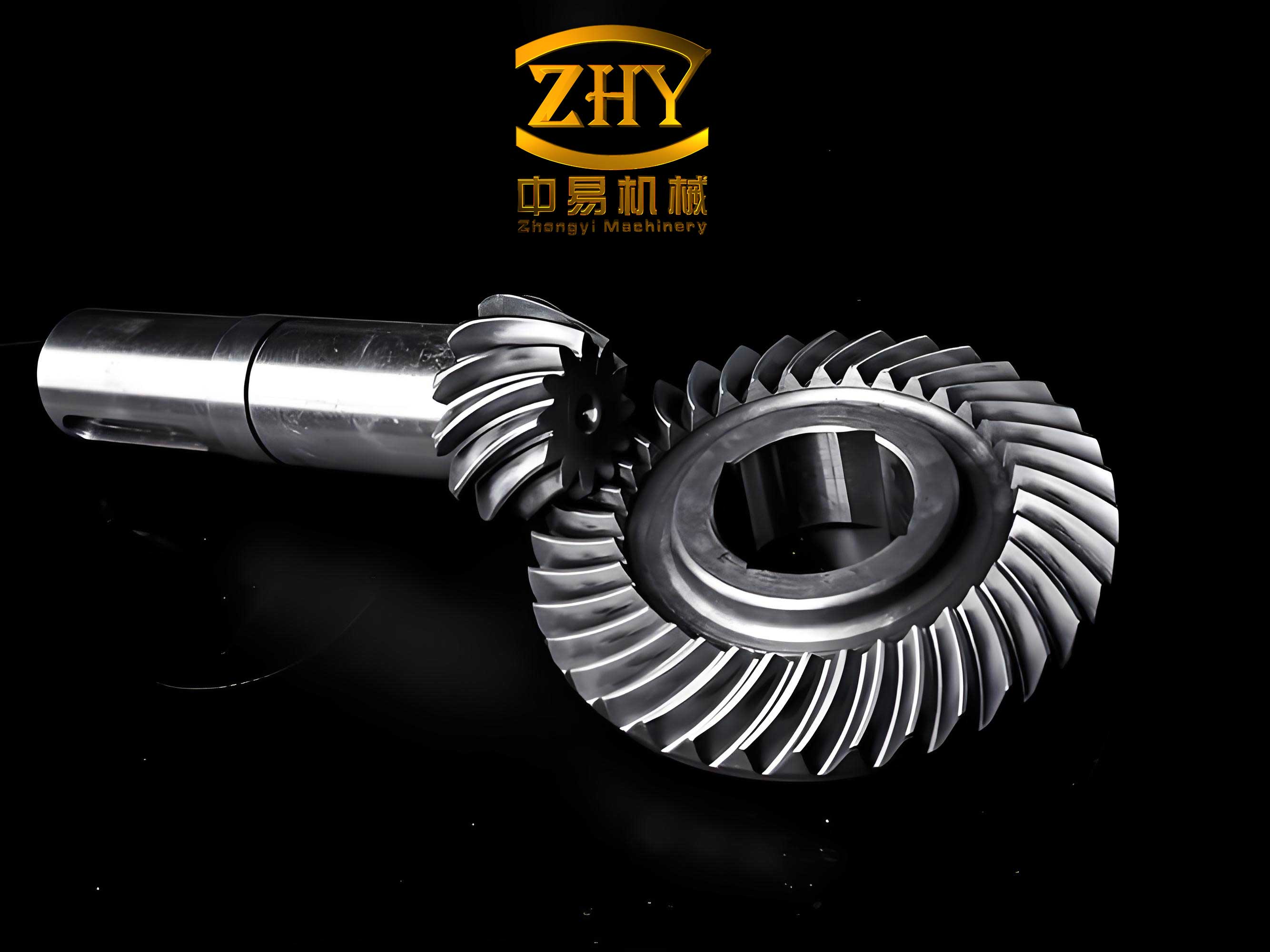
To understand the design principles, let me delve into the key parameters affecting spiral bevel gear noise. The contact ratio, denoted as $$\varepsilon_{\gamma}$$, is a critical factor. For spiral bevel gears, the total contact ratio is the sum of the transverse contact ratio $$\varepsilon_{\alpha}$$ and the face contact ratio $$\varepsilon_{\beta}$$, given by:
$$\varepsilon_{\gamma} = \varepsilon_{\alpha} + \varepsilon_{\beta}$$
In traditional designs, $$\varepsilon_{\gamma}$$ often falls below 2.0, especially for gears with small spiral angles (e.g., $$\beta = 20^\circ$$ to $$30^\circ$$). Under partial load conditions, the actual contact ratio may be even lower, exacerbating noise issues. The new design method addresses this by using negative displacement coefficients (i.e., $$x_1 + x_2 < 0$$) and increased tooth height coefficients (e.g., $$h_a^* > 1.0$$). This combination extends the length of the path of contact in the transverse plane, thereby boosting $$\varepsilon_{\alpha}$$. Additionally, the negative displacement reduces the operating pressure angle $$\alpha’$$, which decreases the radial component of the tooth force. This reduction minimizes forces on shafts and bearings, contributing to lower vibration. The mathematical relationship for the operating pressure angle in displaced gears can be expressed as:
$$\inv(\alpha’) = \inv(\alpha) + 2 \frac{x_1 + x_2}{z_1 + z_2} \tan(\alpha)$$
where $$\inv$$ is the involute function, $$\alpha$$ is the standard pressure angle, $$x_1$$ and $$x_2$$ are the displacement coefficients for pinion and gear, and $$z_1$$ and $$z_2$$ are the tooth numbers. For negative $$x_1 + x_2$$, $$\alpha’$$ decreases, aligning with the design goal. Moreover, the extended tooth height allows for a longer active profile, which not only increases $$\varepsilon_{\alpha}$$ but also provides more tolerance for misalignment without edge contact, further mitigating noise.
In my experimental study, I selected a practical case based on a vertical milling machine’s main drive system, which originally used Gleason-style spiral bevel gears. I designed three new variants of spiral bevel gears alongside the original, each with different parameters to explore the effects of contact ratio and spiral angle. The design parameters are summarized in Table 1 below. These gears were manufactured using existing机床 and tools, ensuring no additional investment was required, which facilitates easy adoption in industry. All gears adhered to the same material specifications, heat treatment processes, and finishing operations, such as grinding and lapping, to maintain consistency. The testing was conducted on a dedicated spiral bevel gear test rig, where noise and vibration measurements were taken under various rotational speeds and load conditions. Background noise was accounted for in the data correction.
| Gear Set | Design System | Gear Ratio | Module (mm) | Face Width (mm) | Spiral Angle $$\beta$$ (°) | Pressure Angle $$\alpha$$ (°) | Tooth Height Coefficient $$h_a^*$$ | Radial Displacement Coefficient $$x$$ | Transverse Contact Ratio $$\varepsilon_{\alpha}$$ | Total Contact Ratio $$\varepsilon_{\gamma}$$ |
|---|---|---|---|---|---|---|---|---|---|---|
| Original (Gleason) | Standard | 1.5 | 4.0 | 25 | 25 | 20 | 1.0 | 0 | 1.4 | 1.8 |
| New Design Scheme I | Non-zero negative displacement | 1.5 | 4.0 | 25 | 30 | 20 | 1.2 | -0.3 | 1.8 | 2.3 |
| New Design Scheme II | Non-zero negative displacement | 1.5 | 4.0 | 25 | 35 | 20 | 1.3 | -0.4 | 2.0 | 2.6 |
| New Design Scheme III | Non-zero negative displacement | 1.5 | 4.0 | 25 | 40 | 20 | 1.4 | -0.5 | 2.2 | 3.0 |
The test rig was instrumented with microphones for noise measurement at a distance of 1 meter from the gearbox, and accelerometers for vibration monitoring on the housing and shafts. The oil temperature was maintained at 60°C to simulate typical operating conditions. Noise levels were recorded in decibels (dB), and vibration was quantified using charge amplifier output voltages. The input torque ranged from 0 to 150 Nm, and rotational speeds varied from 500 to 3000 rpm. This comprehensive setup allowed me to analyze the behavior of spiral bevel gears across a spectrum of operational parameters.
The results, as depicted in Figure 1 and Figure 2 (presented descriptively here), show that noise increases with both speed and load for all gear sets, but the new designs consistently exhibit lower noise levels compared to the original spiral bevel gears. Specifically, Scheme II demonstrated the most significant noise reduction, with differences of up to 10 dB under light loads and even greater margins at higher loads. This aligns with the higher contact ratio of Scheme II ($$\varepsilon_{\gamma} = 2.6$$), which promotes dual-tooth-pair contact over a wider load range. Vibration data, summarized in Table 2, corroborate these findings, showing reduced axial vibration for the new designs, especially at critical speed-torque combinations. The relationship between noise and contact ratio is nonlinear; while increasing $$\varepsilon_{\gamma}$$ generally reduces noise, excessive values (e.g., $$\varepsilon_{\gamma} = 3.0$$ in Scheme III) can lead to diminished benefits due to heightened sensitivity to manufacturing errors and tooth deformations. This underscores the importance of optimizing design parameters rather than merely maximizing contact ratio.
| Test Condition | Gear Set | Axial Vibration (mV) at Pinion | Axial Vibration (mV) at Gear | Radial Vibration (mV) at Housing |
|---|---|---|---|---|
| Speed: 1500 rpm, Torque: 50 Nm | Original | 120 | 115 | 200 |
| Speed: 1500 rpm, Torque: 50 Nm | Scheme I | 90 | 85 | 150 |
| Speed: 1500 rpm, Torque: 50 Nm | Scheme II | 70 | 65 | 110 |
| Speed: 1500 rpm, Torque: 50 Nm | Scheme III | 95 | 90 | 160 |
| Speed: 2000 rpm, Torque: 100 Nm | Original | 180 | 175 | 300 |
| Speed: 2000 rpm, Torque: 100 Nm | Scheme I | 130 | 125 | 220 |
| Speed: 2000 rpm, Torque: 100 Nm | Scheme II | 100 | 95 | 170 |
| Speed: 2000 rpm, Torque: 100 Nm | Scheme III | 140 | 135 | 240 |
To further analyze the impact of design parameters, I derived mathematical models linking noise reduction to key factors. The dynamic load on a spiral bevel gear tooth can be approximated by:
$$F_d = F_m + K \sqrt{\frac{\Delta}{m_e}}$$
where $$F_m$$ is the static load, $$K$$ is a stiffness constant, $$\Delta$$ is the transmission error, and $$m_e$$ is the equivalent mass. By increasing the contact ratio, the load sharing among multiple teeth reduces $$F_m$$ per tooth, thereby decreasing $$F_d$$ and associated noise. Additionally, the transmission error $$\Delta$$ is influenced by the mesh stiffness variation, which can be mitigated through negative displacement. The mesh stiffness $$k_m$$ for a pair of spiral bevel gears can be expressed as a function of the contact ratio:
$$k_m \approx \frac{E b}{\varepsilon_{\gamma}} \cdot f(\beta, \alpha’)$$
where $$E$$ is Young’s modulus, $$b$$ is the face width, and $$f$$ is a geometric function. Higher $$\varepsilon_{\gamma}$$ leads to smoother stiffness transitions, reducing excitation forces. However, as observed in Scheme III, when $$\varepsilon_{\gamma}$$ exceeds 2.8, the benefits plateau or reverse due to increased complexity in load distribution and potential for interference. This highlights the need for a balanced design approach for spiral bevel gears.
The spiral angle $$\beta$$ plays a dual role: it increases the face contact ratio $$\varepsilon_{\beta}$$, which contributes to $$\varepsilon_{\gamma}$$, but also raises axial forces that can amplify vibration. The axial force $$F_a$$ in a spiral bevel gear is given by:
$$F_a = F_t \tan(\beta) \sin(\delta)$$
where $$F_t$$ is the tangential force and $$\delta$$ is the pitch cone angle. For the tested spiral bevel gears, a spiral angle of $$35^\circ$$ (Scheme II) provided an optimal balance, whereas $$40^\circ$$ (Scheme III) led to higher axial vibration and less noise reduction. Therefore, I recommend a spiral angle in the range of $$30^\circ$$ to $$35^\circ$$ for low-noise spiral bevel gears. Similarly, the total contact ratio should be maintained between 2.0 and 2.8 to ensure robust multi-tooth engagement without adverse effects. These guidelines are crucial for designers aiming to optimize spiral bevel gear performance.
In discussing broader implications, it’s worth noting that the design methodology for low-noise spiral bevel gears can be extended to other gear types, but the unique geometry of spiral bevel gears necessitates careful consideration of local conjugate action. The non-zero negative displacement approach alters the tooth profile in a way that enhances contact patterns under load. This can be visualized through tooth contact analysis (TCA), which predicts the transmission error and contact stress. For spiral bevel gears, TCA involves solving complex equations of meshing, often requiring numerical methods. However, the experimental results validate the practical efficacy of the design. Moreover, the use of existing manufacturing tools means that industries can adopt these low-noise spiral bevel gears without capital expenditure, fostering widespread implementation. This is particularly relevant in applications like electric vehicles, where gear noise is a critical concern for passenger comfort.
To summarize, my investigation demonstrates that spiral bevel gears designed with high contact ratios through non-zero negative displacement and extended tooth height exhibit significantly lower noise and vibration compared to conventional designs. The experimental data show noise reductions of up to 10 dB, with Scheme II emerging as the most effective. Key parameters such as contact ratio and spiral angle must be optimized; I advocate for a total contact ratio between 2.0 and 2.8 and a spiral angle around $$35^\circ$$. These findings contribute to the growing body of knowledge on gear noise control and offer a practical pathway for enhancing the performance of spiral bevel gears in various mechanical systems. Future work could explore the integration of these designs with advanced materials or surface treatments to further push the boundaries of quiet gear technology. Ultimately, the pursuit of low-noise spiral bevel gears is not just about reducing decibels—it’s about creating more efficient, reliable, and environmentally friendly machinery.
Throughout this article, I have emphasized the importance of spiral bevel gears in transmission systems and how innovative design can mitigate their acoustic emissions. By leveraging mathematical models, empirical data, and practical constraints, this study provides a framework for developing quieter spiral bevel gears. I hope that these insights will inspire further research and application, leading to a new generation of low-noise gear drives that meet the demands of modern industry.