
In modern mechanical engineering, the precise installation of spiral bevel gears is critical for ensuring optimal performance in applications such as automotive drivetrains, agricultural machinery, and industrial equipment. As a practitioner in gear technology, I have extensively studied the challenges associated with achieving accurate mounting distances and backlash control for spiral bevel gears. The inherent complexity of spiral bevel gear systems, due to their curved teeth and high load-bearing capacity, necessitates a scientific approach to installation, moving beyond subjective judgments. This article presents a comprehensive dimensional chain calculation model developed to determine adjustment shim sizes for spiral bevel gears, leveraging measurements from gear manufacturing check machines. The model incorporates custom-designed measurement fixtures and gauges, enabling repeatable and traceable installation processes. By emphasizing the use of formulas and tables, this methodology aims to standardize spiral bevel gear assembly, reducing labor intensity and enhancing quality assurance. Throughout this discussion, the term spiral bevel gear will be frequently highlighted to underscore its centrality in this research.
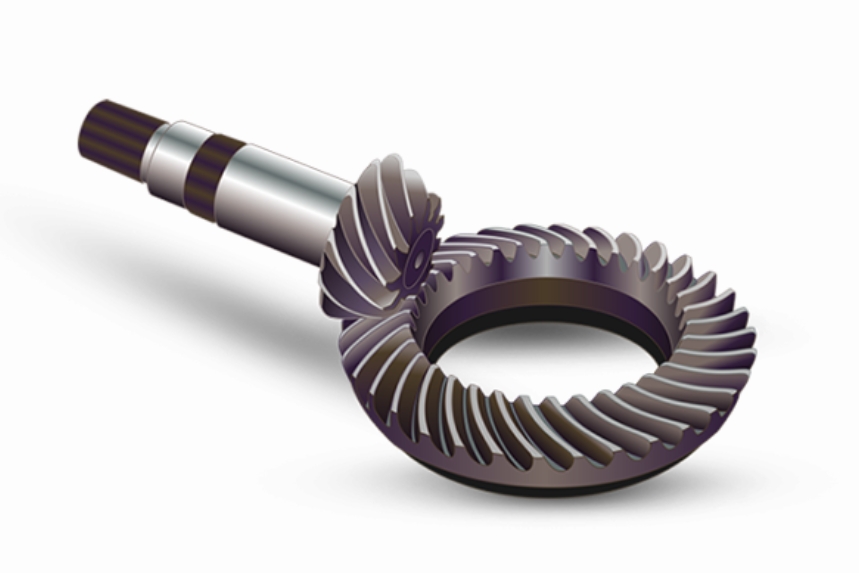
The effectiveness of any spiral bevel gear installation relies on several foundational requirements. These prerequisites ensure that the gears are manufactured and prepared to specifications, allowing the adjustment model to function accurately. Below is a summary of these critical conditions in tabular form, which must be met before proceeding with the installation calculations.
| Requirement | Description |
|---|---|
| Gear Finishing Process | Spiral bevel gears must undergo a lapping or grinding工序 as part of their manufacturing. Lapping is essential for improving meshing quality, reducing surface roughness, and minimizing noise, especially when grinding is not used as the primary tooth-finishing method. |
| Pairing and Inspection | Each spiral bevel gear pair is subjected to a pairing process on a check machine. This involves verifying contact patterns, mounting distances, backlash, and noise under simulated installation conditions. Corrections, denoted as A and B, are engraved on the gear faces to indicate adjustments for the active spiral bevel gear’s mounting distance and reference plane, respectively. |
| Component Compliance | All associated assembly parts, including bearings, must meet工艺 specifications. Bearings should be installed with proper preload values within operational limits to ensure stability and longevity of the spiral bevel gear system. |
| Dimensional Accuracy | Gears must be produced with high precision, typically using CNC spiral bevel gear milling machines, to guarantee consistent geometry and facilitate accurate measurement during installation. |
With these requirements satisfied, we can delve into the core of the adjustment model. The primary goal is to compute the adjustment shim size, denoted as ξ, for the active spiral bevel gear assembly. This involves establishing dimensional chains for both the gear assembly and the housing, using measurement fixtures and gauges to capture actual dimensions. The process begins with the active spiral bevel gear, where we design a measurement fixture and gauge to determine the distance from the gear’s reference point to the bearing housing flange.
For the active spiral bevel gear, we define a measurable position L_s, which corresponds to a theoretical nominal dimension L_t from the gear drawings. A measurement gauge, referred to as Gauge 1, is fabricated with a fixed size L_b, such that it relates to L_t through an error term λ: $$L_b + \lambda = L_t$$. Here, λ is a constant after gauge fabrication; it is positive if L_b is less than L_t, and negative otherwise. A measurement fixture is then used in conjunction with a dial indicator to capture deviations. The steps are outlined below:
- Place the measurement fixture on Gauge 1 and zero the dial indicator, setting the pointer to a mid-range value for optimal measurement.
- Transfer the fixture to the bearing housing assembly of the active spiral bevel gear and record the dial indicator reading x_1. A clockwise deviation is considered positive, and counterclockwise negative.
- Compute the actual distance C from the gear center to the bearing housing flange using the engraved correction values A and B from the gear, along with the nominal dimensions M_1 and M_2 from the drawings. The formula is derived as follows:
$$C = (M_1 + A) – (M_2 + B) + L_s$$
Since L_s = L_b + x_1 and L_b = L_t – λ, we substitute to get:
$$C = (M_1 + A) – (M_2 + B) + (L_t – \lambda) + x_1$$
This expression accounts for manufacturing tolerances and measurement errors, ensuring accuracy for the spiral bevel gear installation.
Next, we focus on the housing installation distance. A similar approach is employed, but with a different measurement setup. We define a position G_s on the housing, corresponding to a nominal dimension G_t. A second gauge, Gauge 2, is made with size G_b, related to G_t by an error σ: $$G_b + \sigma = G_t$$. Here, σ is constant after fabrication, positive if G_b < G_t, and negative otherwise. The measurement fixture is designed to reference a plane P for the dial indicator. The procedure is summarized in the table below:
| Step | Action |
|---|---|
| 1 | Position the housing on the fixture’s locating element. |
| 2 | Attach the measurement fixture to Gauge 2 and calibrate the dial indicator to zero. |
| 3 | Fix the fixture to the housing and record the dial indicator reading x_2, with clockwise as positive and counterclockwise as negative. |
| 4 | Calculate the distance D from the housing center to its outer face using the housing bore diameter φ_D and an additional measured value G_c from the fixture. The formula is: $$D = (\phi_D/2 + G_c) + G_s$$ Given G_s = G_b + x_2 and G_b = G_t – σ, we derive: $$D = (\phi_D/2 + G_c) + (G_t – \sigma) + x_2$$ Here, φ_D is taken at the midpoint of its tolerance range, and G_c is an empirically determined constant from the fixture, enhancing precision for the spiral bevel gear system. |
With both C and D determined, the adjustment shim size ξ for the active spiral bevel gear is computed as their difference: $$\xi = C – D$$. Substituting the expressions for C and D, we obtain a comprehensive equation that integrates all nominal dimensions, errors, and measurements:
$$\xi = [(M_1 + A) – (M_2 + B) + (L_t – \lambda) + x_1] – [(\phi_D/2 + G_c) + (G_t – \sigma) + x_2]$$
Simplifying this, we group the nominal terms and error corrections:
$$\xi = [M_1 – M_2 + L_t – (\phi_D/2 + G_c) – G_t] – \lambda + \sigma + (A – B + x_1 – x_2)$$
In this formula, the bracketed term represents the nominal shim size based on design drawings, while the remaining components account for gauge errors (λ and σ), gear corrections (A and B), and measurement deviations (x_1 and x_2). This model provides a scientific basis for determining the exact shim thickness, eliminating guesswork in spiral bevel gear installation. To illustrate the variables involved, the following table defines each symbol used in the calculations, emphasizing their relevance to spiral bevel gear adjustment.
| Symbol | Description | Role in Spiral Bevel Gear Installation |
|---|---|---|
| M_1 | Nominal mounting distance from gear reference to节锥点 | Defines theoretical position of active spiral bevel gear |
| M_2 | Nominal distance from gear reference to small end face | Provides baseline for gear geometry corrections |
| A | Correction value for mounting distance (engraved on gear) | Adjusts for deviations from nominal in spiral bevel gear pairing |
| B | Correction value for reference plane distance (engraved) | Fine-tunes gear orientation during assembly |
| L_t | Theoretical measurable dimension on active gear assembly | Serves as reference for gauge design and measurement |
| λ | Error between Gauge 1 size L_b and nominal L_t | Compensates for gauge fabrication inaccuracies |
| x_1 | Dial indicator reading from active gear measurement | Captures actual deviations in gear assembly dimensions |
| φ_D | Housing bore diameter (mid-tolerance value) | Influences housing center calculation for spiral bevel gear alignment |
| G_c | Measured constant from housing fixture | Ensures consistent referencing in housing measurements |
| G_t | Nominal measurable dimension on housing | Base value for housing gauge design |
| σ | Error between Gauge 2 size G_b and nominal G_t | Accounts for housing gauge imperfections |
| x_2 | Dial indicator reading from housing measurement | Reflects real housing dimensional variations |
| ξ | Adjustment shim size | Final output ensuring proper spiral bevel gear mounting distance and backlash |
The same principled approach can be extended to the driven spiral bevel gear in a pair. By designing appropriate measurement fixtures and gauges tailored to the driven gear’s geometry and housing interface, we can compute its adjustment shim size using an analogous dimensional chain model. This involves defining new measurable positions, fabricating gauges with associated errors, and recording dial indicator readings to derive a similar formula. The versatility of this methodology allows it to adapt to various spiral bevel gear configurations, whether in automotive differentials or agricultural machinery like tillers and bulldozers. For instance, in a driven gear assembly, we might denote the nominal dimensions as N_1 and N_2, corrections as C and D, and measurement terms as y_1 and y_2, leading to a shim size η calculated through a parallel process. The underlying logic remains: isolate measurable features, account for errors, and integrate corrections to achieve precise installation for every spiral bevel gear in the system.
To further elucidate the model’s robustness, consider the impact of temperature and material expansion on spiral bevel gear installations. While the basic calculation assumes standard conditions, in practice, we can incorporate correction factors into the dimensional chain. For example, if a spiral bevel gear operates in high-temperature environments, the nominal dimensions M_1, L_t, etc., might be adjusted using thermal expansion coefficients. This can be expressed as: $$M_{1,adj} = M_1 \cdot (1 + \alpha \cdot \Delta T)$$, where α is the coefficient of thermal expansion and ΔT is the temperature deviation. Integrating such factors into the shim calculation ensures the spiral bevel gear maintains optimal performance under varying operational conditions. Additionally, statistical methods can be applied to the measurement readings x_1 and x_2 to account for variability; for instance, taking multiple readings and using the average: $$\bar{x}_1 = \frac{1}{n} \sum_{i=1}^n x_{1,i}$$. This enhances the reliability of the adjustment for critical spiral bevel gear applications.
In conclusion, the dimensional chain calculation model presented here offers a scientific and reproducible method for installing spiral bevel gears. By leveraging measurement fixtures and gauges, along with formulas that encapsulate nominal dimensions, errors, and corrections, we eliminate subjective judgments in setting mounting distances and backlash. This approach has been successfully implemented in products such as bulldozers and rotary tillers, where spiral bevel gears are pivotal components. The model not only reduces assembly labor and time but also provides traceable data for quality control, ensuring consistent performance across spiral bevel gear systems. As industries continue to demand higher precision and efficiency, such methodologies will become increasingly vital for mastering spiral bevel gear installation challenges. Future work may explore automation of this process using digital sensors and real-time data analysis, further advancing the science behind spiral bevel gear technology.
The integration of this model into standard operating procedures highlights its practical utility. For example, in a manufacturing setting, technicians can use pre-calibrated gauges and fixtures to quickly measure x_1 and x_2, plug values into the derived formula, and obtain the required shim size without trial-and-error adjustments. This not only streamlines production but also minimizes the risk of damage to spiral bevel gears from improper installation. Moreover, the model’s reliance on empirical measurements ensures adaptability to batch-to-batch variations in gear manufacturing, making it a valuable tool for maintaining quality in high-volume spiral bevel gear production. As we continue to refine these techniques, the goal remains to achieve perfect meshing and longevity for every spiral bevel gear assembly, driven by data and precision engineering.