
In my extensive experience with gear manufacturing, spiral bevel gears represent one of the most complex and critical components in power transmission systems, especially in heavy-duty applications like mining and engineering machinery. The Klingelnberg system for spiral bevel gear production stands distinct from the more universally known Gleason system, particularly in its machining philosophy, equipment, and procedural methodologies. This article delves deeply into the nuances of processing and adjusting Klingelnberg spiral bevel gears, drawing from practical insights to provide a comprehensive guide. I will emphasize the term ‘spiral bevel gear’ throughout to underscore its centrality in this discussion.
The fundamental distinction lies in the tooth geometry: Klingelnberg spiral bevel gears feature constant-height teeth, whereas Gleason gears have tapered-height teeth. This difference necessitates entirely separate machining approaches. The Klingelnberg method employs a continuous indexing process using a specialized cutter head, which I will elaborate on with technical depth. Understanding these distinctions is paramount for anyone involved in the production of high-precision spiral bevel gears.
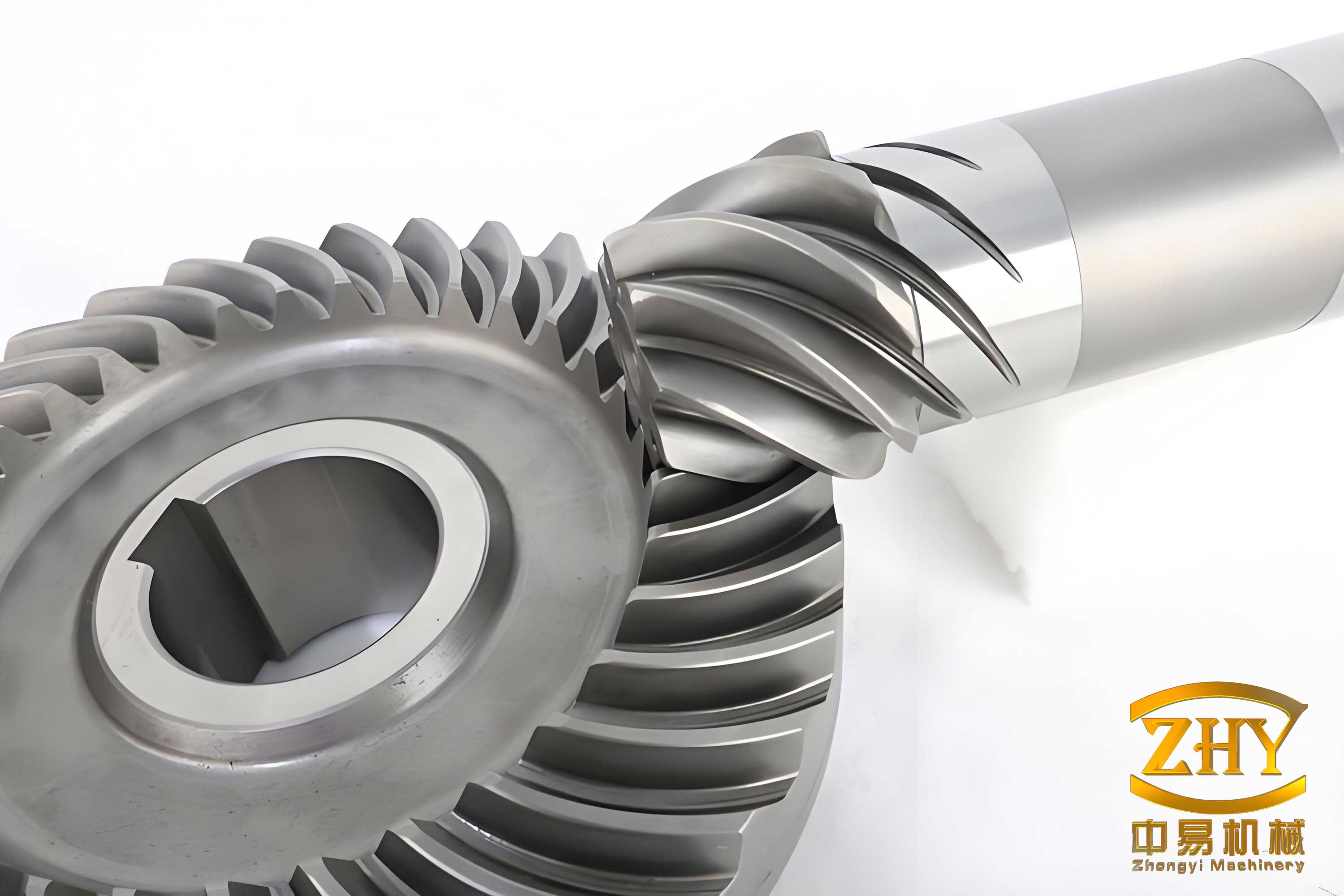
At the core of Klingelnberg spiral bevel gear machining is the principle of continuous generation. The standard cutter head comprises five groups of tool bits, each group responsible for cutting a single tooth space. As the cutter head rotates continuously, the workpiece also rotates in a synchronized, conjugated motion to generate the tooth flank. Each tool group consists of four blades, arranged to cut the convex and concave sides of the tooth respectively. This process can be described by the kinematic relationship between the cutter and the workpiece. The fundamental equation governing the relative motion is derived from the gear geometry. For a spiral bevel gear, the relationship between the cutter head axis and the workpiece axis is critical. The generating roll ratio $\(G\)$ is defined as:
$$ G = \frac{N_c}{N_w} $$
where $\(N_c\)$ is the number of cuts per revolution of the cutter head (related to the number of blade groups) and $\(N_w\)$ is the number of teeth on the spiral bevel gear workpiece. In practice, this ratio is finely adjusted to achieve the correct tooth form.
The tooth profile of a spiral bevel gear is defined by a complex set of parameters. The basic geometry can be summarized using the following key formulas. The mean spiral angle $\(\beta_m\)$ is crucial for determining the tooth orientation:
$$ \beta_m = \arcsin\left(\frac{m_n \cdot z}{2 \cdot R_m}\right) $$
where $\(m_n\)$ is the normal module, $\(z\)$ is the number of teeth, and $\(R_m\)$ is the mean cone distance. The cone distance $\(A\)$ itself, a vital mounting dimension, is calculated from the pitch cone angle $\(\delta\)$ and the pitch diameter $\(d\)$:
$$ A = \frac{d}{2 \sin \delta} $$
For a Klingelnberg spiral bevel gear pair, ensuring equal top clearance between the pinion and gear is essential, which is a direct consequence of the constant-height tooth design. This contrasts with the Gleason system where top clearance varies. The table below provides a comparative overview of the two major spiral bevel gear systems.
| Feature | Klingelnberg Spiral Bevel Gear | Gleason Spiral Bevel Gear |
|---|---|---|
| Tooth Height | Constant (Equal along tooth length) | Tapered (Varies along tooth length) |
| Basic Machining Principle | Continuous indexing with multi-group cutter head | Formate or generating with single-point or face mill cutters |
| Cutter Head Structure | 5 groups of blades (4 blades per group) | Single set of inner and outer blades for face milling |
| Primary Cutting Motion | Continuous rotation of cutter and workpiece | Interrupted generating roll or form cutting |
| Typical Post-Heat-Treatment Process | Hard cutting or lapping | Grinding or lapping |
| Optimal Application Field | High-volume, high-precision industrial drives | Automotive and general industrial applications |
Now, let us explore the detailed manufacturing process for a typical spiral bevel gear set. The process is bifurcated for the pinion (often integral with a shaft) and the gear. I will outline a generalized, yet detailed, process flow incorporating critical quality checkpoints.
Process Route for Spiral Bevel Gear Pinion (Shaft):
- Forging of Raw Blank: Ensuring material grain flow aligns with gear teeth for strength.
- Pre-heat Treatment: Normalizing or annealing to refine microstructure and relieve stresses.
- Rough Machining: Turning major diameters and faces, leaving ample stock.
- Semi-Finish Turning: Machining the tooth region to near-net shape. Critical dimensions like the cone distance $\(A_1\)$ and face cone angle are controlled using gauge blocks and sine bars. An alignment boss (e.g., surface P1 in technical drawings) is machined for subsequent setup. Surfaces for features like keyways and threads are left with extra stock for carburizing allowance.
- Spiral Bevel Gear Tooth Cutting: This is the core operation on a Klingelnberg spiral bevel gear generator. The machine is set up according to a pre-calculated adjustment card. The alignment boss is used to ensure workpiece runout is less than 0.010 mm. The cutter head, either for soft cutting (pre-hardening) or hard cutting (post-hardening), is mounted.
- Carburizing Heat Treatment: The entire component is gas carburized to achieve a high surface carbon concentration, typically targeting a case depth defined by the effective case depth $\(CH_d\)$:
$$ CH_d = k \sqrt{t} $$
where $\(k\)$ is a diffusion constant dependent on temperature and steel grade, and $\(t\)$ is time. For a material like 20Cr2Ni4A, the carburizing temperature is around 930°C. - Post-Carburize Turning: Removal of carburized layer from non-functional surfaces like keyway areas. Final turning of threads to specification.
- Keyway Milling.
- Hardening and Tempering: Quenching to achieve a martensitic case with hardness HRC 58-62, followed by low-temperature tempering to relieve quenching stresses.
- Center Hole Refinishing: Re-grinding of center holes to restore precision datum for grinding operations.
- Cylindrical Grinding: Final grinding of journal diameters.
- Lapping (or Hard Finishing): The final tooth contact refinement, which will be discussed in detail later.
Process Route for Spiral Bevel Gear (Gear Blank):
- Forging and Pre-heat Treatment.
- Rough and Semi-Finish Turning: The bore and reference face are left with grinding allowance. All other features are machined to final dimensions.
- Spiral Bevel Gear Tooth Cutting: Similar to the pinion, using the gear generator.
- Carburizing and Hardening.
- Precision Grinding: Using an internal face grinder, the bore and reference face are ground simultaneously to ensure perfect perpendicularity. This establishes the final assembly datum. The grinding accuracy directly affects the spiral bevel gear’s operational concentricity.
- Face Grinding: The opposite face is ground to achieve required parallelism and thickness.
- Lapping.
To quantify the critical parameters in these routes, the following table summarizes key dimensional tolerances and process controls for a spiral bevel gear.
| Parameter | Symbol | Tolerance (Typical) | Measurement Method | Impact on Gear Performance |
|---|---|---|---|---|
| Cone Distance (Pinion) | $\(A_1\)$ | ±0.02 mm | Gauge blocks, CMM | Directly sets mounting position and backlash |
| Cone Distance (Gear) | $\(A_2\)$ | ±0.02 mm | Gauge blocks, CMM | Directly sets mounting position and backlash |
| Face Cone Angle | $\(\delta_a\)$ | ±1 arc-minute | Optical comparator, Sine bar | Ensures proper tooth contact at the toe and heel |
| Runout of Tooth Flank | N/A | < 0.015 mm TIR | Gear rolling tester | Affects noise, vibration, and load distribution |
| Tooth Profile Error | $\(f_f\)$ | < 0.008 mm | Gear profile measuring machine |
The adjustment and fine-tuning phase is where the art of spiral bevel gear manufacturing truly comes to the fore. After heat treatment, the gears inevitably distort. For Klingelnberg spiral bevel gears, the primary finishing methods are hard cutting or lapping. Hard cutting on a precision generator can correct distortions and achieve high accuracy, but it is costly and risks surface micro-cracks if parameters are not optimal. Therefore, for most applications, lapping is the preferred and more economical method. The lapping process involves running the mating pinion and gear together under light load with an abrasive compound. The primary objectives are to:
- Correct the contact pattern location and size.
- Reduce surface roughness.
- Establish the final operational backlash.
The contact pattern is the visual imprint on the tooth flank when the gears are meshed under load. Its ideal location is centrally positioned slightly towards the toe (inner end) on the gear tooth. Adjusting the contact pattern on the lapping machine is done by introducing small, controlled relative displacements between the axes of the pinion and gear. These adjustments can be broken down into two vectors: along the length-of-action (E-axis) and along the profile direction (P-axis). The relationship between machine adjustment and contact pattern shift is often empirically determined, but can be approximated. For instance, a pinion axial shift $\(\Delta X_p\)$ primarily moves the pattern along the face width. The resulting pattern travel $\(\Delta L\)$ can be related by an empirical factor $\(C_L\)$:
$$ \Delta L \approx C_L \cdot \Delta X_p $$
where $\(C_L\)$ is typically between 0.5 and 2.0 mm/mm, depending on the spiral angle of the spiral bevel gear.
Backlash $\(j\)$ is the clearance between mating teeth when the gears are mounted in their operational positions. It is a critical functional parameter. The nominal backlash is set during the lapping process by controlling the final axial positions of the gears. The theoretical backlash for a pair of spiral bevel gears can be estimated from the design geometry and the actual mounted cone distances $\(A_1\)$ and $\(A_2\)$ measured after lapping. The change in backlash $\(\Delta j\)$ due to a change in the center distance (approximated by cone distance changes in bevel gears) is given by:
$$ \Delta j \approx 2 \cdot \Delta A \cdot \tan \alpha_n \cdot \cos \beta_m $$
where $\(\Delta A\)$ is the deviation from the theoretical mounting distance, $\(\alpha_n\)$ is the normal pressure angle, and $\(\beta_m\)$ is the mean spiral angle. This formula highlights the sensitivity of the spiral bevel gear’s operational performance to precise axial positioning.
A meticulous procedure I follow during lapping is:
- Mount the gear pair on the lapping machine using dedicated fixtures.
- Run unloaded (or very lightly loaded) and observe the initial contact pattern using marking compound.
- Based on the pattern’s position (e.g., too much at the heel or toe), calculate the required axis adjustments.
- Apply the abrasive lapping compound and run under load for several cycles, periodically checking the pattern evolution.
- Once the pattern is central and covers an acceptable area (e.g., 60-80% of the tooth flank), stop the lapping process.
- Thoroughly clean the gears to remove all abrasive.
- Measure the final backlash at several positions around the gear using a dial indicator.
- Record the final axial positions of both spiral bevel gears on the lapping machine’s travel dials. From these readings and the known fixture dimensions, the actual cone distances $\(A_1\)$ and $\(A_2\)$ are calculated and documented. This data is gold for the final assembly.
- Mark the gear pair with mating marks (tooth-to-tooth pairing) and set marks to ensure they are assembled in the same relative orientation that achieved the optimal lapped condition.
For assembly, if the housing design allows axial adjustment via shims, the recorded $\(A_1\)$ and $\(A_2\)$ values are used to calculate the required shim packs. For non-adjustable housings, the axial locating surfaces on the gears or their mounting components may need to be precision ground to achieve the required cone distances. This ensures the contact pattern and backlash from the lapping machine are reproduced in the final assembly. The success of this method hinges on the precision and repeatability of the lapping fixtures.
Fixture design for spiral bevel gear machining is deceptively simple but demands extreme precision. The primary fixtures are for the gear generator and the lapping machine. The core requirement is to locate the workpiece relative to the machine’s rotational axis with minimal error. For a gear generating fixture, the workpiece mounting face must have a runout of less than 0.010 mm (and ideally approaching 0.005 mm) relative to the machine spindle axis. The clamping force must be uniform and not induce distortion, especially for thin-walled gear blanks. The fundamental equation for the permissible clamping-induced deformation $\(\Delta y\)$ for a spiral bevel gear blank can be related to the required tooth profile tolerance $\(T_f\)$:
$$ \Delta y \leq \frac{T_f}{K_s} $$
where $\(K_s\)$ is a stiffness factor of the gear blank geometry. A typical design uses a hollow cylindrical locator with a precise face and diameter. A draw-bar mechanism through the spindle is common for pulling the workpiece against the locator. The fixture material must be dimensionally stable and wear-resistant, often using case-hardened alloy steel or high-grade cast iron.
The following table outlines key design and verification parameters for a spiral bevel gear machining fixture.
| Design Parameter | Target Value | Verification Method | Consequence of Deviation |
|---|---|---|---|
| Runout of Mounting Face (Radial) | ≤ 0.010 mm TIR | Test indicator on machine spindle | Increased tooth runout, uneven tooth load |
| Runout of Mounting Face (Axial) | ≤ 0.010 mm TIR | Test indicator on machine spindle | Axial wobble, affecting face cone angle accuracy |
| Perpendicularity of Face to Bore Axis | ≤ 0.005 mm over 100 mm | Precision square and dial gauge | Misalignment of gear axis, leading to edge contact |
| Surface Hardness of Locating Surfaces | HRC 58-62 | Rockwell hardness tester | Rapid wear, loss of locating accuracy |
| Clamping Force Uniformity | Variation < 10% | Pressure-sensitive film or strain gauges | Distortion of gear blank during cutting |
In practice, I always ensure that the workpiece locating surfaces on both the fixture and the spiral bevel gear blank are meticulously cleaned and free of burrs before each mounting. Any particulate contamination acts as a soft foot, introducing significant alignment errors that propagate directly into tooth geometry errors.
To further illustrate the interplay of parameters, let’s consider the synthesis of the machine tool settings for cutting a spiral bevel gear. The basic machine settings on a Klingelnberg generator include: Cutter Head Tilt Angle $\(i_c\)$, Workpiece Tilt Angle $\(i_w\)$, Radial Distance $\(S_r\)$, and Basic Offset $\(E_m\)$. These are derived from the basic gear data: Number of teeth $\(z\)$, Module $\(m_n\)$, Spiral Angle $\(\beta\)$, Pressure Angle $\(\alpha\)$, and Shaft Angle $\(\Sigma\)$. The calculations involve spherical trigonometry. For example, the cradle angle setting $\(q\)$ for generating motion is a function of the desired tooth curvature:
$$ q = f(z, \beta, \alpha, \text{cutter radius}) $$
These settings are typically provided by the machine’s dedicated calculation software, but understanding their origin is key for troubleshooting. If a contact pattern is consistently biased, one can refer to correction tables that suggest modifications to these basic settings. For instance, to move a contact pattern towards the heel on the gear tooth, a small positive correction $\(\Delta i_w\)$ might be applied to the workpiece tilt angle.
The material science aspect is also pivotal. For spiral bevel gears subjected to high cyclic loads, the residual stress state after machining and heat treatment significantly influences fatigue life. The hard turning or grinding process induces compressive surface stresses, which are beneficial. The lapping process, if not overly aggressive, maintains these stresses. The fatigue limit $\(\sigma_{FL}\)$ for a case-hardened spiral bevel gear tooth can be estimated using a modified Goodman relation that includes residual stress $\(\sigma_{res}\)$:
$$ \sigma_{FL} = \frac{\sigma_e \cdot (1 – \frac{\sigma_m}{\sigma_u})}{K_f} + \eta \cdot \sigma_{res} $$
where $\(\sigma_e\)$ is the endurance limit of the material, $\(\sigma_m\)$ is the mean stress, $\(\sigma_u\)$ is the ultimate strength, $\(K_f\)$ is the fatigue notch factor (influenced by tooth root fillet quality), and $\(\eta\)$ is a factor representing the effectiveness of residual stress (typically 0.5-0.9). This underscores why every step in manufacturing a spiral bevel gear, from soft cutting to final lapping, must be controlled to optimize the final stress state.
In conclusion, mastering the production of Klingelnberg spiral bevel gears requires a deep, integrated understanding of machine kinematics, precision machining practices, metrology, heat treatment, and assembly principles. The constant-height tooth design of this spiral bevel gear system offers distinct advantages in certain applications but demands strict adherence to its unique processing logic. The continuous indexing method with its multi-blade cutter head, coupled with a disciplined approach to pre- and post-heat-treatment machining, setup, and final lapping adjustment, forms a cohesive manufacturing ecosystem. The key to success lies in treating the spiral bevel gear not as a series of independent operations but as a holistic system where each step’s output is the precise input for the next. By rigorously controlling dimensions like cone distance, using precision fixtures, and intelligently applying lapping corrections, one can consistently produce high-performance spiral bevel gear drives that meet the demanding requirements of modern machinery. The spiral bevel gear, in its Klingelnberg incarnation, remains a testament to the synergy of mechanical design and precision manufacturing engineering.