
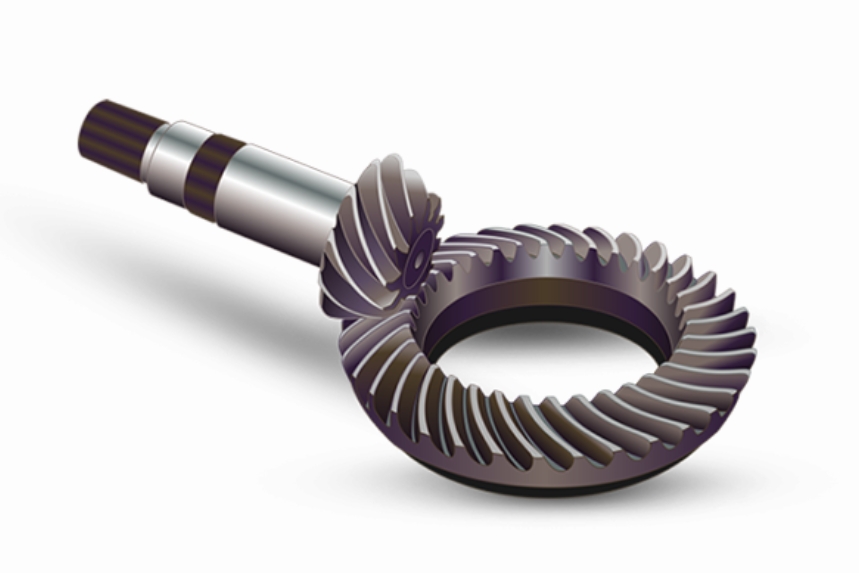
In the realm of gear manufacturing, spiral bevel gears play a crucial role in transmitting power between intersecting shafts, especially in automotive and industrial applications. Traditional methods for producing spiral bevel gears, such as metal cutting, have long been associated with significant drawbacks. These include low material utilization, high processing costs, complex procedures, and the destruction of metal fiber structures, which ultimately reduces fatigue strength and service life. As an alternative, precision plastic forming techniques offer a promising path toward near-net-shape manufacturing, but for large-diameter spiral bevel gears, conventional forging demands enormous equipment and energy, making it economically challenging. In this article, I introduce a novel process—twin symmetry roll axial rolling—for forming passive spiral bevel gears. This method leverages local, incremental deformation to achieve full tooth filling with reduced forming forces, presenting a sustainable and efficient solution for gear production.
The core of this new technology lies in the twin symmetry roll axial rolling mill. This setup consists of two conical rolls symmetrically positioned on either side of the machine spindle axis. During operation, the spindle rotates, causing the rolls to revolve around the central axis. The workpiece, typically a pre-formed blank, is mounted on a concave die. As the rolls approach and contact the workpiece, frictional forces induce self-rotation of the rolls, allowing them to roll over the workpiece surface. The continuous axial feed of the die facilitates progressive deformation, culminating in the complete formation of spiral bevel gears. This process is characterized by localized pressure accumulation, which minimizes overall force requirements and enhances energy efficiency.
To understand the deformation mechanics, I developed a comprehensive simulation model. The approach is based on rigid-viscoplastic finite element analysis (FEM), which neglects elastic deformations due to their minor contribution compared to plastic flow in bulk forming processes. The geometric models for the spiral bevel gears, rolls, and dies were constructed using 3D CAD software, adhering to mathematical formulations of spherical involutes and helical curves. For instance, the tooth profile of spiral bevel gears can be derived from the spherical involute equation, while the tooth line follows a cylindrical helix. The key parameters for simulation are summarized in Table 1.
| Parameter | Value | Description |
|---|---|---|
| Material | 20CrMnTi Alloy Steel | Common gear steel with good hardenability |
| Temperature | 850°C (Workpiece), 20°C (Tools) | Warm forming conditions to reduce flow stress |
| Friction Factor | 0.3 | Coulomb friction model for tool-workpiece interface |
| Roll Revolution Speed | 7.85 rad/s | Angular velocity around spindle axis |
| Roll Self-Rotation Speed | 11.1 rad/s | Induced by contact friction |
| Die Feed Rate | 4 mm/s | Axial displacement per unit time |
| Mesh Elements | 30,000 (initial) | Refined near deformation zones for accuracy |
The simulation reveals intricate details of the deformation process. As the rolls progressively engage the blank, metal flow initiates simultaneously at both the large and small ends of the spiral bevel gears, ensuring uniform filling along the tooth line. The velocity fields, depicted through contour plots, show distinct active and passive deformation zones. The active zones, directly under roll contact, undergo severe plastic strain, while passive regions experience minimal displacement. This localized, cumulative deformation is symmetric about the gear axis, leading to balanced stress distributions and reduced risk of defects. The evolution of tooth formation can be described by analyzing the strain rate tensor components, which relate to material flow directions. For instance, the effective strain rate $\dot{\epsilon}$ is given by:
$$ \dot{\epsilon} = \sqrt{\frac{2}{3} \dot{\epsilon}_{ij} \dot{\epsilon}_{ij}} $$
where $\dot{\epsilon}_{ij}$ represents the strain rate tensor. In the context of rolling spiral bevel gears, the dominant components align with the helical tooth geometry, promoting efficient filling of complex cavities.
One of the critical advantages of this technology is the significant reduction in forming force compared to conventional forging. The theoretical rolling force $P$ for twin symmetry roll axial rolling can be derived from the contact mechanics between the conical rolls and the workpiece. The formula is expressed as:
$$ P = k \cdot p \cdot A_C $$
where $k$ is a constraint factor (typically between 1.5 and 2.2, taken as 2 in this study), $p$ is the flow stress of the material (e.g., 168 MPa for 20CrMnTi at 850°C), and $A_C$ is the projected contact area between the roll and workpiece. The contact area $A_C$ depends on geometric parameters such as the roll angle, workpiece radius $R$, and feed per revolution $S$. For a spiral bevel gear with outer diameter 246 mm ($R = 123$ mm) and inner radius $r = 77$ mm, the contact area can be approximated by integrating over the polar coordinates. Let $Q = 2S/(2R)$, where $S$ is related to the die feed rate $v$ and roll revolution speed $n$:
$$ S = \frac{60v}{n} $$
With $v = 4$ mm/s and $n = 75$ rpm, $S$ calculates to 3.2 mm. The angle $\alpha$ at the contact boundary is $\alpha = \arccos(1 – 2Q)$. Then, $A_C$ can be computed as:
$$ A_C = 2 \left(0.822 \sqrt{\frac{S}{R}} + 0.282 \sqrt{\frac{S}{R}} \right) \left(1 – 0.31 \frac{r}{R} \right) \pi (R^2 – r^2) $$
Substituting the values yields $A_C \approx 5948$ mm². Thus, the rolling force $P$ is approximately:
$$ P = 2 \times 168 \times 5948 \approx 1.998 \times 10^6 \text{ N} \approx 2000 \text{ kN} $$
In contrast, precision forging of the same spiral bevel gears would require a force $P_1$ based on the full projected area $A = \pi (R^2 – r^2)$:
$$ P_1 = 2pA = 2 \times 168 \times \pi (123^2 – 77^2) \approx 9.706 \times 10^6 \text{ N} \approx 9700 \text{ kN} $$
This indicates that the twin symmetry roll axial rolling process reduces the forming force to about 21% of that needed for forging, highlighting its efficiency. The force progression during simulation, as shown in Figure 7 of the original text, confirms a gradual increase to a peak of around 2143 kN, aligning with theoretical predictions.
To further elucidate the material behavior, I analyzed the stress and strain distributions throughout the rolling process. The von Mises stress $\sigma_{vm}$, a scalar measure of distortional energy, is pivotal for assessing yield conditions. It is defined as:
$$ \sigma_{vm} = \sqrt{\frac{3}{2} s_{ij} s_{ij}} $$
where $s_{ij}$ is the deviatoric stress tensor. During rolling of spiral bevel gears, $\sigma_{vm}$ peaks in the active deformation zones, but symmetry ensures no net bending moments. This balance is crucial for dimensional accuracy and tooth integrity. Additionally, the strain hardening behavior of the gear steel can be modeled using the power-law equation:
$$ \sigma = K \epsilon^n $$
where $\sigma$ is the true stress, $\epsilon$ is the true strain, $K$ is the strength coefficient, and $n$ is the hardening exponent. For 20CrMnTi at elevated temperatures, $K$ and $n$ can be derived from hot compression tests, but for simplicity, the simulation used constant flow stress. The cumulative effect of incremental deformation on microstructure evolution, such as grain refinement, also merits discussion for spiral bevel gears, as it influences mechanical properties like fatigue resistance.
The numerical simulation was validated through experimental trials on a 4000 kN twin symmetry roll axial rolling mill. Using gear steel blanks and warm forming conditions, spiral bevel gears with an outer diameter of 246 mm were successfully produced. The measured forming force, monitored via hydraulic pressure gauges, consistently hovered around 2000 kN, corroborating both simulation and theoretical results. The formed gears exhibited complete tooth filling with sharp contours and no evident defects, as illustrated in the inserted image. This confirms the practicality of the new process for manufacturing high-quality spiral bevel gears.
Beyond force reduction, this technology offers multiple benefits for spiral bevel gears. The localized deformation minimizes material waste, enhances tool life due to lower pressures, and reduces energy consumption. Moreover, the continuous rolling action promotes favorable grain flow along tooth profiles, potentially improving strength and durability compared to cut gears. To quantify these advantages, Table 2 compares key metrics between traditional cutting, precision forging, and twin symmetry roll axial rolling for spiral bevel gears.
| Process | Forming Force (kN) | Material Utilization | Energy Efficiency | Typical Applications |
|---|---|---|---|---|
| Metal Cutting | N/A (Material Removal) | Low (~40-50%) | Low | Prototypes, Low Volume |
| Precision Forging | ~9700 (for 246 mm gear) | High (~80-90%) | Moderate | High-Volume Automotive |
| Twin Symmetry Roll Axial Rolling | ~2000 (for 246 mm gear) | High (~85-95%) | High | Medium to High Volume |
The deformation mechanics of spiral bevel gears during rolling can be further explored through analytical models. For instance, the slip-line field theory can approximate stress states in plane strain conditions, though the 3D nature of spiral bevel gears requires simplifications. The roll-workpiece contact pressure distribution $p(x)$ along the contact arc can be estimated using Hertzian contact theory modified for plastic deformation:
$$ p(x) = p_0 \sqrt{1 – \left( \frac{x}{a} \right)^2} $$
where $p_0$ is the maximum pressure and $a$ is the half-width of contact. However, due to the complex geometry of spiral bevel gears, finite element analysis remains indispensable for accurate predictions. The simulation also revealed that the strain rate sensitivity $m$, defined as $\sigma \propto \dot{\epsilon}^m$, plays a role in material flow at elevated temperatures, potentially affecting surface finish and dimensional precision of spiral bevel gears.
In terms of process optimization, several parameters influence the outcome for spiral bevel gears. The roll angle, feed rate, and initial blank temperature are critical. A higher feed rate may increase productivity but could lead to incomplete filling or excessive forces. Conversely, a lower feed rate might improve detail but prolong cycle times. The optimal roll angle ensures uniform contact along the tooth helix. Empirical relationships can be derived through design of experiments (DOE). For example, the filling ratio $F$, defined as the volume of formed tooth to total cavity volume, can be modeled as a function of key variables:
$$ F = c_0 + c_1 \cdot T + c_2 \cdot v + c_3 \cdot \theta $$
where $T$ is temperature, $v$ is feed rate, $\theta$ is roll angle, and $c_i$ are coefficients determined from regression analysis. Such models aid in tailoring the process for different sizes and specifications of spiral bevel gears.
The economic and environmental implications of this technology are substantial. By reducing force requirements, smaller and less costly machinery can be employed, lowering capital investment. The near-net-shape nature minimizes secondary machining, saving energy and reducing scrap. For spiral bevel gears used in automotive differentials, this translates to lower production costs and enhanced sustainability. Additionally, the improved mechanical properties from plastic deformation could extend gear life, reducing maintenance and replacement frequencies.
Looking ahead, the twin symmetry roll axial rolling process holds promise for further advancements. Integration with Industry 4.0 technologies, such as real-time monitoring and adaptive control, could enhance consistency and quality for spiral bevel gears. Research into new material grades, including lightweight alloys or composites, may expand applications. Moreover, hybrid processes combining rolling with heat treatment or surface coating in-line could streamline production chains. The fundamental principles discussed here also apply to other gear types, such as hypoid or bevel gears, suggesting broad industrial relevance.
In conclusion, the twin symmetry roll axial rolling technology represents a significant leap forward in the manufacturing of spiral bevel gears. Through detailed simulation, theoretical analysis, and experimental validation, I have demonstrated its ability to achieve full tooth filling with substantially reduced forming forces—approximately 2000 kN for a 246 mm diameter gear, compared to 9700 kN for forging. The process leverages localized, symmetric deformation to ensure geometric accuracy and material efficiency. As industries strive for greener and more economical production methods, this innovative approach offers a viable path for high-performance spiral bevel gears. Future work should focus on scaling the process for larger gears, optimizing parameters for diverse materials, and exploring digital twin integrations to maximize productivity and quality.