
As a key transmission component in compact reducers, spiral bevel gears with small modules find extensive applications in power tools, mechanical instruments, household appliances, and office equipment. The pursuit of higher efficiency and precision in their manufacturing is a constant focus within gear engineering. Traditional multi-step machining methods, while reliable, present significant challenges for these compact components, prompting the exploration of advanced, integrated numerical control (NC) strategies.
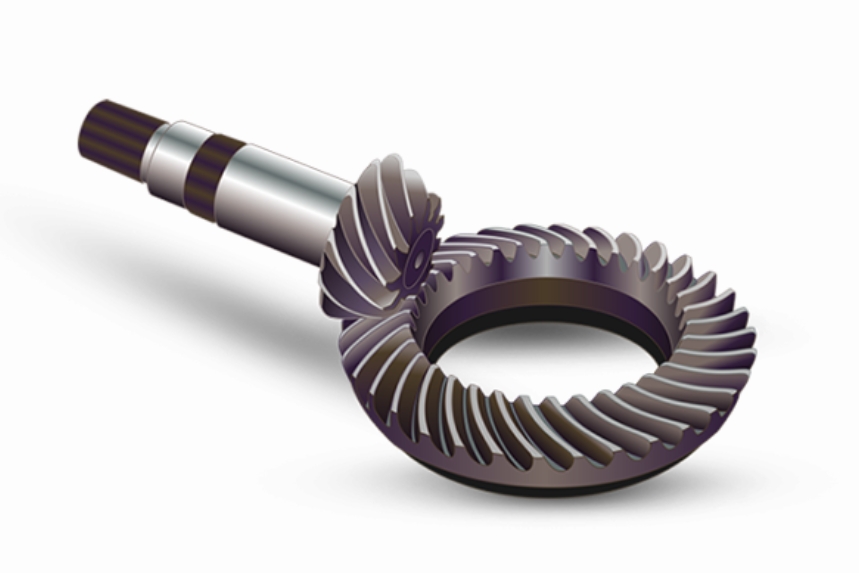
The predominant method for machining spiral bevel gears has been the “Five-Cut” or “Five-Step” method. This process is well-established, involving separate roughing and finishing passes for both the concave and convex sides of the tooth flank, often requiring a final topping cut. Research on this method is comprehensive, covering adjustment calculations and contact pattern control. While it allows for excellent control over the gear tooth contact, its sequential nature makes it time-consuming. For small module spiral bevel gears, the narrow tooth slots introduce a critical bottleneck: the manual tool alignment operation between finishing passes becomes exceedingly difficult and prone to error, drastically reducing throughput and consistency.
To circumvent the alignment issue and boost productivity, the “Two-Step” or duplex method is often employed for small gears. This method machines both sides of the tooth slot simultaneously in a single pass using a cutter head with combined inside and outside blades. Although efficient and eliminating alignment, it suffers from a fundamental limitation: both flanks (concave and convex) are generated under identical machine settings. This makes it notoriously difficult to independently control and optimize the contact patterns on the driving and coast sides of the spiral bevel gears, often compromising meshing quality and noise performance.
The advent of full CNC spiral bevel gear generators presents a new opportunity. These machines offer the flexibility to execute multiple machining sequences with different kinematic settings in a single setup without manual intervention. This capability forms the foundation for the Double Roll NC Machining method. This approach aims to synthesize the strengths of the prior methods: it seeks the contact pattern control afforded by separate finishing passes (like the Five-Cut method) and the efficiency and automatic operation of a consolidated process (like the Two-Step method). The core idea is to use the same cutter and machine to perform two distinct rolling motions within one cutting cycle—each with its own optimized set of machine settings—to finish the concave and convex flanks of the spiral bevel gears, respectively, without any manual tool alignment.
1. The Double Roll Machining Process
The Double Roll machining process for spiral bevel gears is a sequential NC routine performed in a single clamping. The process leverages the multi-axis capability of a modern CNC hypoid generator to execute two distinct generating roll motions with different machine-tool-workpiece geometries. A typical workflow is outlined in the table below:
| Step | Action | Description |
|---|---|---|
| 1 | Positioning | Move machine axes to the start position at the gear toe (or heel, depending on design). |
| 2 | First Roll (e.g., Convex) | Feed cutter from the start position to full depth and execute the first generating roll to finish one flank (e.g., the convex side). The opposite flank is simultaneously rough-cut. |
| 3 | Retract | Retract the cutter from the gear heel/toe after the first roll is complete. |
| 4 | Phase Compensation | Calculate and execute a rotational adjustment of the workpiece (C-axis) to account for the different theoretical tooth space produced by the second set of machine settings. |
| 5 | Second Roll (e.g., Concave) | Feed cutter from the opposite end into the pre-cut slot and execute the second generating roll with a different set of parameters to finish the opposite flank (e.g., the concave side). |
| 6 | Final Retract & Index | Retract the cutter and index the workpiece to the next tooth space. |
| 7 | Loop | Repeat steps 1-6 until all teeth of the spiral bevel gear are machined. |
This process is highly efficient because both the forward and reverse motions of the generating roll are used for productive cutting. The most critical technological element, enabling the avoidance of manual alignment, is the accurate calculation of the Phase Compensation in Step 4.
2. Mathematical Model for Tool Path Calculation
The foundation for controlling the CNC machine lies in a precise mathematical model that converts gear design and process parameters into real-time axis commands. We define a series of coordinate systems to describe the spatial relationship between the machine, the cutter, and the spiral bevel gear workpiece.
Let $ \Sigma_s (O_s; X_s, Y_s, Z_s) $ be the machine fixed frame. The key moving frames are:
- Cradle/Generating Frame $ \Sigma_m (O_m; X_m, Y_m, Z_m) $: $O_m$ is on the cradle axis. Plane $X_mO_mY_m$ is perpendicular to this axis. $X_m$ lies in the cradle’s horizontal mid-plane, pointing outwards.
- Cutter Frame $ \Sigma_t (O_t; X_t, Y_t, Z_t) $: $O_t$ is the cutter center. Plane $X_tO_tY_t$ coincides with $X_mO_mY_m$.
- Workpiece Frame $ \Sigma_w (O_w; X_w, Y_w, Z_w) $: $O_w$ is the gear crossing point. $Z_w$ is along the gear axis, and $Y_w$ is parallel to $Y_m$.
When the generating cradle rotates through an angle $q$, the vector from cradle center $O_m$ to cutter center $O_t$ in $ \Sigma_m $ is:
$$ \mathbf{r}^m_t = \left[ S \cos(q), \, -S \sin(q), \, 0 \right]^T $$
where $S = O_mO_t$ is the Radial Distance or Sliding Base.
The vector from gear crossing point $O_w$ to cradle center $O_m$ in $ \Sigma_m $ is:
$$ \mathbf{D}^m_l = \left[ -X_p \cos\gamma, \, E_m, \, -X_b – X_p \sin\gamma \right]^T $$
where $X_p$ is the Horizontal Alignment, $E_m$ is the Machine Offset (Vertical Alignment), $X_b$ is the Blank Offset, and $\gamma$ is the Machine Root Angle.
Therefore, the vector from $O_w$ to $O_t$ in the cradle frame is:
$$ \mathbf{V}_l = \mathbf{r}^m_t + \mathbf{D}^m_l $$
Transforming this to the machine fixed frame $ \Sigma_s $ involves accounting for the gear mounting. Let $X_a$ be the Workpiece Mounting Distance, $H_t$ the Tool Spindle Height, and $L_t$ the distance from the machine bed to the B-axis center. The unit vector along the gear axis direction in the machine frame is $\mathbf{V}_p = [-\cos\gamma, 0, -\sin\gamma]^T$. The tool center position in the machine frame is:
$$ \mathbf{V}_s = (X_a + H_t – L_t)\mathbf{V}_p + \mathbf{V}_l $$
Expanding and separating components yields the machine linear axis coordinates $(X, Y, Z)$ as functions of the cradle angle $q$:
$$
\begin{cases}
X(q) = S \cos q – (X_p + X_a + H_t – L_t)\cos\gamma \\
Y(q) = -S \sin q + E_m \\
Z(q) = -X_b – (X_p + X_a + H_t – L_t)\sin\gamma
\end{cases}
$$
The rotary axis commands are:
$$
\begin{cases}
A(q) = R_{aq} (q_t – q_s) \\
B = \gamma
\end{cases}
$$
where $A$ is the workpiece rotation (C-axis equivalent), $R_{aq}$ is the ratio of roll (gear ratio), $q_t$ is the instantaneous cradle angle, and $q_s$ is the starting cradle angle. This model provides the tool path for a single generating roll of the spiral bevel gear.
3. Automatic Phase Compensation Model
If the second roll is executed with a different set of parameters $\{S^{(2)}, E_m^{(2)}, X_p^{(2)}, R_{aq}^{(2)}, …\}$ but with the workpiece simply indexed from the first roll position, the finished tooth space will not have the correct width. The flanks would be mismatched. Traditionally, this is corrected by manual “toe-heel” alignment, which is impractical for small spiral bevel gears. Therefore, an automatic phase compensation model is essential.
The goal is to calculate the angular shift $\Delta A$ that must be applied to the workpiece ($A$-axis) before the second roll so that its finished flank is correctly positioned relative to the first finished flank, achieving the designed tooth thickness.
Let $P_1$ be the midpoint of the first finished flank (e.g., convex) and $P_2$ be the intended midpoint of the second finished flank (e.g., concave). The designed arc tooth thickness $S_1$ at the mean point radius $R$ relates to their angular separation $\phi_1$:
$$ \phi_1 = S_1 / R $$
If the second roll were started without compensation, its flank would be at point $P_3$. We need to find the compensation angle $\Delta A = \phi_0 – \phi_1$, where $\phi_0 = \angle P_1O_wP_3$.
To find $\phi_0$, we must locate the mean points $P_1$ and $P_3$ in gear coordinates. This requires solving the gear generation kinematics for the mean point. A point $M$ on the cutter surface is defined in $\Sigma_t$ by its axial section angle $\theta$ and distance $\mu$ along the blade from the tip:
$$ \mathbf{r}^c = [0, \, r_0 \pm \mu \sin\alpha, \, -\mu \cos\alpha]^T $$
$$ \mathbf{n}^c = [0, \, \pm \cos\alpha, \, \sin\alpha]^T $$
where $r_0$ is the point radius, $\alpha$ is the blade pressure angle ($+$ for outside blade, $-$ for inside). Transforming to $\Sigma_t$:
$$ \mathbf{r}^t = \mathbf{M}(\theta) \mathbf{r}^c, \quad \mathbf{n}^t = \mathbf{M}(\theta) \mathbf{n}^c $$
with $\mathbf{M}(\theta)$ being a rotation matrix about the cutter axis.
In the cradle frame $\Sigma_m$, the position and normal of the cutter point are:
$$ \mathbf{r}^m = \mathbf{V}_l + \mathbf{M}(q) \mathbf{r}^t $$
$$ \mathbf{n}^m = \mathbf{M}(q) \mathbf{n}^t $$
where $\mathbf{M}(q)$ is the cradle rotation matrix.
The generated point on the spiral bevel gear tooth surface must satisfy the equation of meshing:
$$ \mathbf{V}_{12} \cdot \mathbf{n}^m = 0 $$
where $\mathbf{V}_{12}$ is the relative velocity between the cutter and the workpiece at the contact point.
For the mean point $P$ with known coordinates $(L_P, R_P)$ in the gear axial plane (where $L_P$ is the distance from $O_w$ along the gear axis, and $R_P$ is the mean radius), we have two additional equations:
$$
\begin{cases}
-\mathbf{r}^m \cdot \mathbf{V}_p = L_P \\
|\mathbf{V}_p \times \mathbf{r}^m| = R_P
\end{cases}
$$
Solving the system formed by the equation of meshing and the two geometric equations above for the unknowns $(q, \theta, \mu)$ yields the specific cradle angle and cutter point that generate the mean point $P$. Its position vector $\mathbf{r}^m_p$ can then be transformed to the gear coordinate system $\Sigma_w$:
$$ \mathbf{r}^w_p = \mathbf{M}(\pi/2 + \gamma) \, \mathbf{M}(A) \, \mathbf{r}^m_p $$
where $A$ is the corresponding workpiece rotation angle during generation.
Applying this procedure for the first and second roll settings gives vectors $\mathbf{r}^w_{p1}$ and $\mathbf{r}^w_{p3}$ for points $P_1$ and $P_3$, respectively. Their projections onto the gear’s transverse plane are:
$$ \mathbf{ro}_{p1} = \mathbf{V}_p \times \mathbf{r}^w_{p1}, \quad \mathbf{ro}_{p3} = \mathbf{V}_p \times \mathbf{r}^w_{p3} $$
The angle $\phi_0$ between these projected vectors is:
$$ \phi_0 = \arccos\left( \frac{\mathbf{ro}_{p1} \cdot \mathbf{ro}_{p3}}{|\mathbf{ro}_{p1}| \, |\mathbf{ro}_{p3}|} \right) $$
The required phase compensation for the $A$-axis command during the second roll is therefore:
$$ \Delta A = \phi_0 – \phi_1 $$
The compensated $A$-axis command becomes:
$$ A^{(2)}(q) = R_{aq}^{(2)} (q_t – q_s^{(2)}) \pm \Delta A $$
where the sign depends on the direction of the generating roll. This calculation, performed offline during NC program generation, enables fully automatic Double Roll machining of spiral bevel gears.
4. Process Design, Experiment, and Verification
To validate the Double Roll NC method, a high-ratio spiral bevel gear pair was designed and manufactured. The primary goal was to achieve good, controlled contact patterns on both flanks with high efficiency. The basic gear design parameters are summarized below:
| Parameter | Pinion | Gear |
|---|---|---|
| Number of Teeth | 4 | 41 |
| Module | 2.1 mm | |
| Face Width | 18.03 mm | 14.00 mm |
| Offset | 17.00 mm | |
| Shaft Angle | 90° | |
| Spiral Angle | 57° (LH) | 29°17′ (RH) |
| Pressure Angle | 20° | |
The gear was finished in one roll using a spread-blade method. The pinion, the target for Double Roll machining, required separate optimization for its concave and convex flanks. Using specialized gear design software, machine settings were calculated to position the bearing contact centrally with a desired length and direction. The derived machine settings for the two rolls of the pinion are shown in this table:
| Machine Setting | Concave Flank Roll | Convex Flank Roll |
|---|---|---|
| Cutter Point Diameter | 76.99 mm | 75.40 mm |
| Blade Pressure Angle | 17°20′ | 22°40′ |
| Machine Root Angle ($\gamma$) | 5°25′ | |
| Horizontal Alignment ($X_p$) | -0.46 mm | 0.71 mm |
| Blank Offset ($X_b$) | 2.03 mm | 1.92 mm |
| Machine Offset ($E_m$) | 16.00 mm | 17.64 mm |
| Radial Distance ($S$) | 36.6646 mm | 37.8507 mm |
| Ratio of Roll ($R_{aq}$) | 9.9845 | 10.6625 |
| Phase Comp. ($\Delta A$) | 4.721° | |
Theoretical tooth contact analysis (TCA) for the gear pair using these settings predicted well-centered, oblong contact patterns on both driving and coast sides of the spiral bevel gears. The patterns showed minimal sensitivity to small assembly errors (V/H adjustments), indicating robust performance.
The machining was performed on a 6-axis CNC spiral bevel gear generator. The tool path coordinates $(X(q), Y(q), Z(q), A(q), B)$ for both rolls were computed using the models in Sections 2 and 3, incorporating the phase compensation $\Delta A$. The resulting NC program followed the Double Roll sequence: First Roll for the convex flank, automatic phase shift, Second Roll for the concave flank, followed by indexing. The machining process was stable, producing spiral bevel gears with excellent surface finish and smooth root fillet transitions, with no visible mismatch or interference between the two flanks.
Subsequent rolling contact tests of the manufactured pinion and gear assembly confirmed the predictions. The actual contact patterns on both flanks were located in the central region of the tooth surfaces, with shapes and sizes closely matching the theoretical TCA results. This validates the accuracy of the Double Roll kinematic model, the phase compensation algorithm, and the overall process for spiral bevel gears.
5. Analysis of Manufacturing Efficiency
The principal advantage of the Double Roll method is its significant reduction in cycle time compared to the traditional Five-Cut method, while retaining independent control over flank geometry. A direct comparison was conducted for the example spiral bevel pinion:
| Process Step | Five-Cut Method | Double Roll Method | Time Saved / Benefit |
|---|---|---|---|
| Roughing (Both sides) | Required | Integrated into 1st Roll* | Eliminates separate op. |
| Finish Concave Flank | Separate roll + alignment | 2nd Roll in cycle | No manual alignment |
| Finish Convex Flank | Separate roll + alignment | 1st Roll in cycle | No manual alignment |
| Topping/Planing | Often required | Not required** | Eliminates entire op. |
| Air-Cuts / Retracts | Multiple (for each op) | Minimized (2 per tooth) | ~68s saved in example |
| Workpiece Handling | Multiple setups/clampings | Single setup | ~28s saved, improves accuracy |
| Total Cycle Time (Example) | ~265 seconds | ~169 seconds | ~96s (36%) reduction |
| First-Part Setup | 30-60 min manual alignment | Automatic via calculation | Dramatic setup reduction |
*The opposite flank is roughed during the first finishing roll.
**Tooth depth and slot width are controlled by the two finishing rolls.
The efficiency gain stems from multiple factors: the productive use of both directions of the generating roll, the elimination of non-cutting alignment passes and separate topping operations, and the reduction in workpiece handling. For small module spiral bevel gears, where manual alignment is particularly problematic and time-consuming, the shift to an automatic Double Roll process is especially impactful, enhancing both throughput and quality consistency.
6. Conclusion
The Double Roll NC machining method presents a significant advancement in the manufacturing of small module spiral bevel gears. By integrating two distinct generating motions with optimized settings into a single, automated cutting cycle, it successfully bridges the gap between the high quality of multi-step methods and the high efficiency of simultaneous cutting methods.
The core of this methodology lies in two robust mathematical models: one for generating the precise tool path for each roll, and another for calculating the critical phase compensation that enables automatic flank alignment. This eliminates the need for error-prone manual toe-heel alignment, a major bottleneck for small gears.
Experimental results confirm that spiral bevel gears produced via the Double Roll method exhibit excellent, independently controllable contact patterns on both flanks, comparable to those achieved with traditional, less efficient methods. The substantial reduction in cycle time—approximately 36% in the documented case—along with the elimination of lengthy first-part setup, demonstrates a clear path to higher productivity. The implementation of this method is facilitated by modern, multi-axis CNC gear generators and dedicated software, marking a step towards more intelligent and efficient manufacturing systems for precision gear components.
Future work may explore the extension of this principle to other gear types, the integration of in-process measurement for closed-loop correction of the phase compensation, and the optimization of the roughing strategy embedded within the first roll to further improve metal removal rates for spiral bevel gears.