
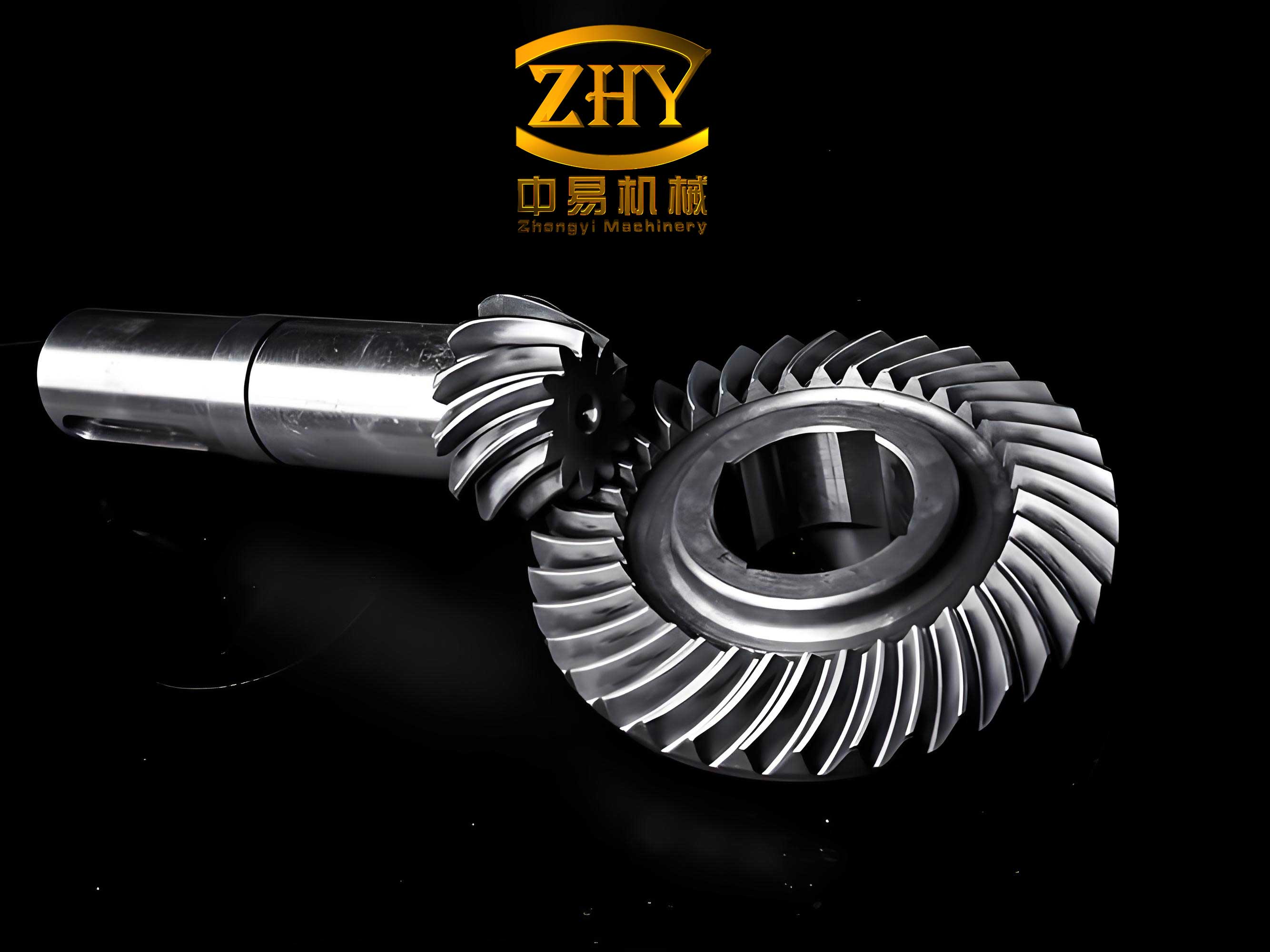
In the field of gear transmission, spiral bevel gears play a critical role in transmitting power between intersecting shafts, especially in automotive, aerospace, and industrial machinery. The design and analysis of spiral bevel gears are complex due to their intricate geometry and load distribution. Traditional methods often rely on simplified models, which may not capture the true mechanical behavior. Therefore, developing accurate parametric models for finite element analysis (FEA) is essential for optimizing performance and reliability. In this work, I focus on a novel type of spiral bevel gear—the loxodrome normal circular-arc spiral bevel gear—which offers advantages such as controlled contact patterns and ease of manufacturing on CNC machines. My goal is to present a comprehensive parametric modeling approach that enables efficient simulation and design optimization.
The loxodrome normal circular-arc spiral bevel gear is based on the principle of conjugate surfaces, where the tooth profile is generated from a normal circular arc swept along a loxodromic curve on the pitch cone. This design enhances load capacity and reduces stress concentrations compared to conventional spiral bevel gears. However, its complex geometry poses challenges for modeling and analysis. To address this, I derive precise mathematical equations for the tooth surfaces and implement them in CAD/CAE software using parametric techniques. This allows for rapid generation of gear models with variable parameters, facilitating studies on strength, vibration, and efficiency. Throughout this article, I will emphasize the importance of spiral bevel gears in modern engineering and how this new variant can advance the field.
To begin, I establish the coordinate systems for the gear geometry. The absolute coordinate system is fixed at the cone apex, with the z-axis aligned along the gear axis. The pitch cone is defined by the cone angle δ, and the loxodromic curve serves as the tooth trace. The tooth surface is composed of a circular arc in the normal section, which moves along this curve. Let me denote the position vector of a point on the loxodromic curve as \( \vec{R}_p(\lambda) \), where λ is the angular parameter. For a loxodrome on a cone, the curve can be expressed in terms of exponential functions due to its constant angle property relative to the meridians. The equation is:
$$ \vec{R}_p(\lambda) = v_0 \exp(b\lambda) [\sin\delta \, \vec{e}(\lambda) + \cos\delta \, \vec{k}] $$
Here, \( v_0 \) is a parameter related to the initial radial distance, \( b = \sin\delta / \tan\beta \), β is the spiral angle of the tooth trace, \( \vec{e}(\lambda) = \cos\lambda \, \vec{i} + \sin\lambda \, \vec{j} \) is a unit vector in the equatorial plane, and \( \vec{k} \) is the unit vector along the z-axis. This formulation ensures that the loxodromic curve wraps around the cone with a consistent spiral angle, which is key for the behavior of spiral bevel gears.
Next, I define the normal section frame at any point on the loxodromic curve. This frame consists of three orthonormal vectors: \( \vec{e}_1 \), \( \vec{e}_2 \), and \( \vec{e}_3 \), where \( \vec{e}_1 \) is tangent to the loxodromic curve, \( \vec{e}_2 \) is in the direction of the tooth profile normal, and \( \vec{e}_3 \) completes the right-handed system. These vectors are derived from the geometry of the cone and the spiral angle:
$$ \vec{e}_1 = \cos\beta [\sin\delta \, \vec{e}(\lambda) + \cos\delta \, \vec{k}] + \sin\beta \, \vec{e}_1(\lambda) $$
$$ \vec{e}_2 = \cos\beta [\sin\delta \, \vec{e}(\lambda) + \cos\delta \, \vec{k}] – \cos\beta \, \vec{e}_1(\lambda) $$
$$ \vec{e}_3 = \cos\beta \, \vec{e}(\lambda) – \sin\beta \, \vec{k} $$
with \( \vec{e}_1(\lambda) = -\sin\lambda \, \vec{i} + \cos\lambda \, \vec{j} \). This frame allows me to describe the circular arc profile in the normal plane. The tooth surface vector \( \vec{R}(\theta, \lambda) \) for a point on the convex side (left flank) can then be written as:
$$ \vec{R}(\theta, \lambda) = \vec{R}_p(\lambda) + \vec{r}(\theta) $$
where \( \vec{r}(\theta) \) is the vector from the point on the loxodromic curve to the tooth surface point in the normal plane. For a circular arc profile with radius \( R_c \), parameterized by angle θ, we have:
$$ \vec{r}(\theta) = R_c (\vec{e}_2 \cos\theta + \vec{e}_3 \sin\theta) $$
This equation fully defines the tooth flank surface for spiral bevel gears with normal circular arcs. However, the gear also includes fillet regions and root surfaces, which must be modeled accurately to avoid stress concentrations. The fillet is typically a circular arc tangent to both the tooth flank and the root cone. For loxodromic spiral bevel gears, the tooth thickness varies along the length due to the curved trace, making it challenging to maintain tangency. I solve this by simulating the manufacturing process: the fillet is generated by a milling cutter that moves along the pitch cone while rotating, creating a surface of revolution. The condition for tangency between the fillet arc and the root surface is that their common normal intersects the axis of revolution. By enforcing this condition, I derive the trajectory of the tangency point.
Let \( \vec{R}_g \) be the position vector of a point on the fillet arc, and \( \vec{R}_{pr} \) be a point on the right loxodromic trace (for the convex gear). The fillet arc center in the normal plane is at \( (x_{no}, y_{no}) \), and the fillet radius is \( R_g \). The equation for the fillet arc is:
$$ \vec{R}_g = \vec{R}_{pr} + \vec{r}_g, \quad \text{where } \vec{r}_g = x_n \vec{e}_2 + y_n \vec{e}_3 $$
with \( (x_n – x_{no})^2 + (y_n – y_{no})^2 = R_g^2 \). The tangency condition leads to solving for the parameter t along the z-axis where the common normal intersects, yielding \( t = v_0 \exp(b_r \lambda_r) / \cos\delta \). From this, the unit normal vector \( \vec{n}_0 \) and the tangency point trajectory \( \vec{R}_a \) are computed:
$$ \vec{R}_a = \vec{R}_{pr} + \vec{r}_{no} + R_g \vec{n}_0 $$
where \( \vec{r}_{no} = x_{no} \vec{e}_2 + y_{no} \vec{e}_3 \). This trajectory is then revolved around the z-axis to form the root surface, ensuring a smooth transition. Similar equations apply to the concave gear side, with adjustments for the opposite spiral direction. The complete set of equations enables parametric generation of the entire gear tooth, including flanks and fillets, which is crucial for accurate finite element analysis of spiral bevel gears.
To implement this mathematically, I summarize key parameters in tables. For instance, the initial design parameters for a pair of loxodrome normal circular-arc spiral bevel gears are listed below. These parameters include module, number of teeth, spiral angles, cone angles, and arc radii, which are typical for spiral bevel gears in transmission systems.
| Parameter | Pinion (Small Gear) | Gear (Large Gear) |
|---|---|---|
| Normal module \( m_n \) (mm) | 5 | 5 |
| Number of teeth \( Z \) | 12 | 24 |
| Nominal spiral angle \( \beta \) (°) | 30 | 30 |
| Pitch cone angle \( \delta \) (°) | 26.565 | 63.435 |
| Actual spiral angle (left) \( \beta_l \) (°) | -27.5 | 27.5 |
| Actual spiral angle (right) \( \beta_r \) (°) | -32.5 | 32.5 |
| Loxodrome rotation angle \( kk \) (°) | -1.89 | 5.5 |
| Small end cone distance (mm) | 77.460 | 77.460 |
| Large end cone distance (mm) | 181.203 | 181.203 |
| Tooth profile arc radius \( R_c \) (mm) | \( 1.5m_n \) | \( 1.65m_n \) |
| Fillet arc radius \( R_g \) (mm) | \( 0.6248m_n \) | \( 0.6227m_n \) |
With the mathematical model established, I proceed to parametric modeling in CAD/CAE software. I choose ANSYS for this task due to its integrated environment for pre-processing, solving, and post-processing, which is well-suited for spiral bevel gears analysis. The parametric design language (APDL) in ANSYS allows me to automate the modeling process by scripting the generation of keypoints, curves, and surfaces based on the derived equations. The workflow involves creating a macro that defines gear parameters as variables, computes coordinates using the tooth surface equations, and then builds the solid model through Boolean operations and surface fitting.
First, I write an APDL script to generate the keypoints for the tooth profile. For example, for the convex flank, I loop over parameters λ and θ to compute \( \vec{R}(\theta, \lambda) \) and create keypoints in ANSYS. The script also handles the fillet and root surfaces by incorporating the tangency conditions. This approach ensures that the model is fully parametric; changing a single variable, such as the spiral angle or module, automatically updates the entire geometry. This is particularly beneficial for spiral bevel gears, where design iterations are common to optimize performance.
Second, I use ANSYS’s solid modeling functions to connect the keypoints into curves, fit surfaces, and generate volumes. The process includes creating spline curves for the loxodromic traces and revolving surfaces for the root cone. Since the tooth geometry is complex, I divide it into segments that are amenable to mapped meshing later. The APDL macro records all steps, and I refine it to remove redundant commands, resulting in a concise parametric program. This program can be reused for different gear sets, saving time and ensuring consistency. Below, I outline the key steps in the parametric modeling algorithm for spiral bevel gears.
| Step | Description | Mathematical Basis |
|---|---|---|
| 1 | Define input parameters (e.g., \( m_n, Z, \beta, \delta \)) | Gear design specifications |
| 2 | Compute derived parameters (e.g., cone distances, arc radii) | Geometry relations |
| 3 | Generate keypoints for loxodromic curve using \( \vec{R}_p(\lambda) \) | Equation for loxodrome on cone |
| 4 | Create normal frame vectors \( \vec{e}_1, \vec{e}_2, \vec{e}_3 \) | Orthonormal frame equations |
| 5 | Compute tooth flank points via \( \vec{R}(\theta, \lambda) \) | Tooth surface equation with circular arc |
| 6 | Calculate fillet points using tangency condition | Common normal intersection method |
| 7 | Fit curves and surfaces through keypoints | Spline interpolation and Boolean operations |
| 8 | Build solid model by merging volumes | CAD operations in ANSYS |
| 9 | Export macro for reuse with different parameters | APDL scripting |
Once the solid model is created, I move to finite element modeling. The goal is to discretize the geometry into finite elements for stress analysis, contact simulation, or dynamic studies. For spiral bevel gears, mesh quality is critical due to the curved surfaces and potential stress concentrations. I opt for mapped meshing with hexahedral elements because they provide better accuracy and convergence compared to tetrahedral elements. However, the complex shape of spiral bevel gears requires partitioning the tooth into simpler volumes that can be mapped.
I start by selecting an appropriate element type. For structural analysis, I use SOLID186, a 20-node quadratic hexahedral element in ANSYS, which supports curved boundaries and is suitable for high-stress gradients. The material properties are defined as linear elastic, with Young’s modulus \( E = 2.068 \times 10^{11} \) Pa and Poisson’s ratio \( \nu = 0.29 \), typical for steel gears. To prepare for meshing, I divide a single tooth into four sections using auxiliary surfaces, ensuring each section is roughly cuboidal. This allows me to apply swept meshing with hexahedral elements.
The meshing process involves defining element sizes based on the curvature of the tooth flank and fillet. Smaller elements are used in the fillet region and contact areas to capture stress concentrations accurately. I control the mesh density through global and local sizing commands in APDL. After meshing, I apply boundary conditions and loads for simulation, but that is beyond the scope of this modeling discussion. The final finite element model for a single tooth of the spiral bevel gear consists of thousands of nodes and elements, ready for analysis. The quality of the mesh is checked by metrics such as aspect ratio and skewness, which are crucial for reliable results in spiral bevel gears simulations.
To illustrate the effectiveness of this parametric approach, I generated a pair of loxodrome normal circular-arc spiral bevel gears using the parameters from Table 1. The solid models show accurate geometry with smooth transitions between flanks and fillets. The finite element model of a single tooth demonstrates a structured hexahedral mesh that conforms to the complex surfaces. This model can be used for various analyses, including static stress, fatigue, and contact mechanics, providing insights into the performance of spiral bevel gears under different operating conditions.
In terms of applications, this parametric modeling method is not limited to ANSYS; it can be adapted to other CAD/CAE platforms like UG or CATIA by translating the equations into their respective scripting languages. The key advantage is the ability to rapidly explore design variations. For instance, by varying the spiral angle or arc radius, I can study their effects on stress distribution and contact patterns, leading to optimized designs for spiral bevel gears. This is particularly valuable in industries where weight reduction and efficiency are priorities, such as in electric vehicle transmissions or wind turbine gearboxes.
Furthermore, the mathematical framework can be extended to include manufacturing errors, misalignments, or lubrication effects, enhancing the realism of simulations. For spiral bevel gears, such factors significantly influence noise, vibration, and durability. By integrating these into the parametric model, I can perform robust design studies that account for uncertainties. The table below summarizes potential design variables and their impacts on spiral bevel gears performance, based on parametric studies.
| Variable | Typical Range | Impact on Gear Performance |
|---|---|---|
| Spiral angle \( \beta \) | 20° to 40° | Affects contact ratio, axial thrust, and smoothness of engagement |
| Normal module \( m_n \) | 1 to 10 mm | Influences tooth strength, size, and load capacity |
| Circular arc radius \( R_c \) | 1.2\( m_n \) to 2.0\( m_n \) | Controls contact stress and pressure distribution |
| Fillet radius \( R_g \) | 0.3\( m_n \) to 0.7\( m_n \) | Reduces stress concentrations at the tooth root |
| Loxodrome parameter \( b \) | Function of δ and β | Determines tooth trace curvature and thickness variation |
In conclusion, the parametric finite element modeling of loxodrome normal circular-arc spiral bevel gears provides a powerful tool for design and analysis. I have derived comprehensive tooth surface equations that account for the unique geometry of these spiral bevel gears, implemented them in ANSYS via APDL scripting, and created detailed solid and finite element models. This approach enables efficient exploration of design spaces and accurate simulation of mechanical behavior. Future work could involve coupling this with multi-body dynamics or thermal analysis to further advance the understanding of spiral bevel gears in real-world applications. By leveraging parametric methods, engineers can accelerate the development of high-performance spiral bevel gears for demanding industries, ensuring reliability and efficiency.
The methodology presented here underscores the importance of integrating mathematical modeling with modern CAE tools. As spiral bevel gears continue to evolve, such parametric techniques will become increasingly vital for innovation. I encourage researchers and practitioners to adopt similar approaches for other complex gear types, fostering advancements in transmission technology. Ultimately, the goal is to design spiral bevel gears that are not only strong and durable but also optimized for energy efficiency and minimal environmental impact, contributing to sustainable engineering solutions.