
The dynamic performance of mechanical transmission systems, particularly those involving high-speed and high-precision applications, is profoundly influenced by the interactions between their core components. Among these, the coupled dynamics of rolling element bearings and gear pairs present a significant engineering challenge. Traditional analysis methods often simplify the bearing supports as linear or nonlinear spring-damper elements, which fails to capture the intricate multi-body contact interactions within the bearing itself and its coupling with the gear mesh. This work introduces a comprehensive multibody contact dynamics framework to analyze the complete dynamic behavior of a system comprising angular contact ball bearings and spiral bevel gears. The proposed methodology explicitly models the discrete contact events between rolling elements and raceways, as well as the detailed tooth-to-tooth engagement of spiral bevel gears, within a unified computational dynamics environment.
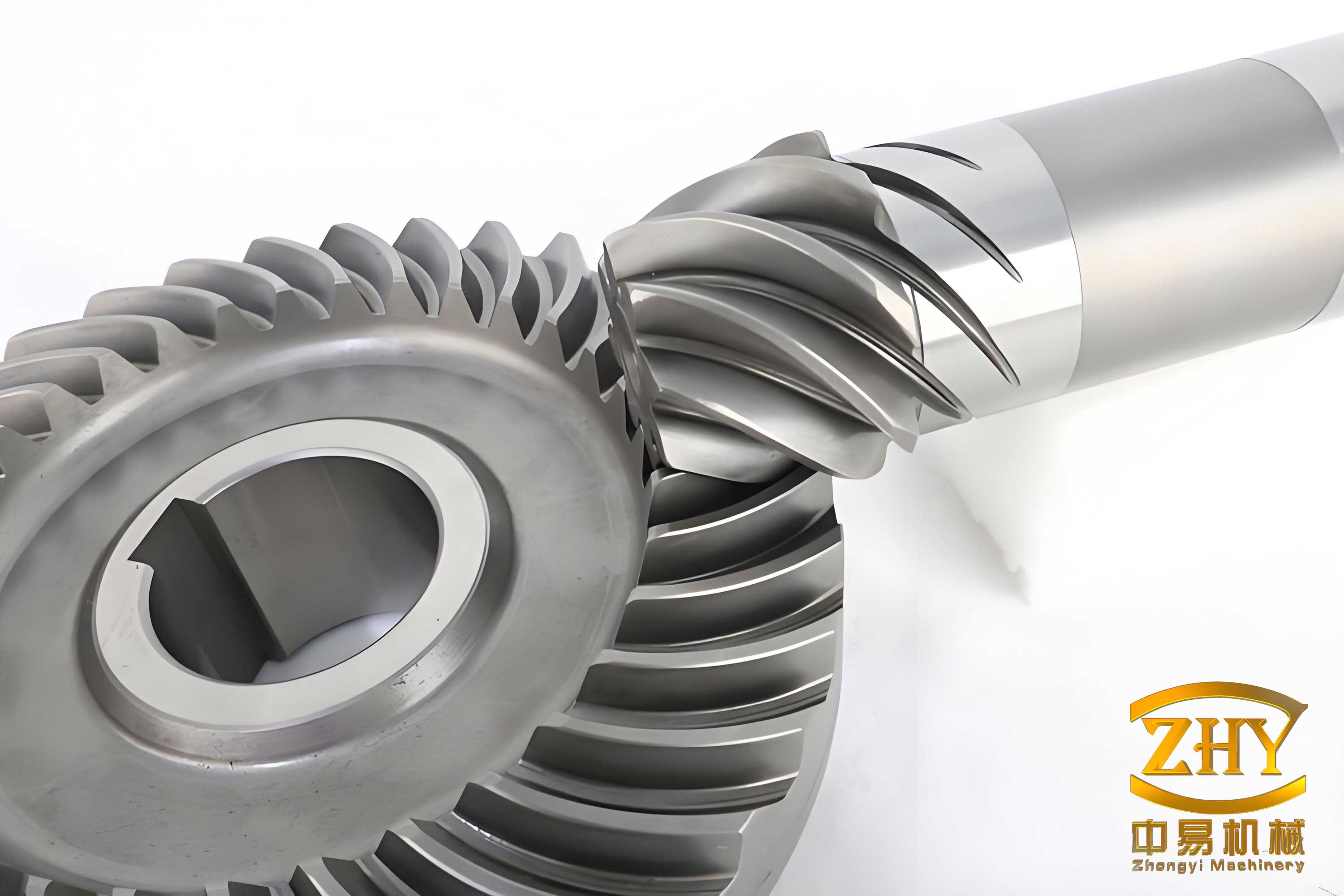
The geometrical complexity of spiral bevel gears, characterized by their curved teeth and localized contact patterns, necessitates a high-fidelity modeling approach for accurate dynamic simulation. Similarly, the operation of ball bearings involves time-varying contacts, cage interactions, and lubricant effects. Integrating these two sophisticated subsystems requires a robust formulation based on multibody system dynamics principles. This study builds upon prior work in gear contact dynamics to develop a novel integrated model that considers the Hertzian contact in bearings, cage dynamics, lubrication traction, and the full three-dimensional contact of spiral bevel gear teeth, neglecting only tooth friction and elastohydrodynamic lubrication effects for the gear mesh in this initial formulation. The objective is to reveal the system-level dynamic response, including vibration characteristics and force transmission, under the combined influence of preload, operational torque, and inherent clearances.
1. Theoretical Framework and System Modeling
The system consists of a pair of spiral bevel gears, each supported by a pair of angular contact ball bearings. A global inertial coordinate system \( OXYZ \) is defined at the intersection point of the pinion and gear axes in their theoretical assembly position. The pinion body frame \( o_{1g}x_{1g}y_{1g}z_{1g} \) aligns with \( OXYZ \), while the gear body frame \( o_{2g}x_{2g}y_{2g}z_{2g} \) is rotated accordingly. Each component—gears, bearing inner rings, outer rings, balls, and cages—is treated as a rigid body with six degrees of freedom (DOF): three translational coordinates \( \mathbf{s} = [x, y, z]^T \) for the center of mass and three rotational coordinates described by Cardan angles \( \boldsymbol{\Theta} = [\phi, \theta, \psi]^T \). The generalized coordinate vector for the entire system is assembled from these individual coordinates. The outer rings are considered fixed to the housing, thus their translational and rotational DOFs are constrained, and their dynamic influence is represented through the contact forces they exert.
1.1 Geometric Modeling for Contact Detection
A critical step in the multibody contact dynamics approach is the efficient and accurate detection of contact between bodies with complex geometry. For both bearing raceways and spiral bevel gear tooth surfaces, a triangulation method is employed.
Bearing Raceway Surface: The surface of a bearing raceway is a segment of a torus. The position of a point on the raceway in the ring’s body frame is given by:
$$
\mathbf{S’}_{*} = \begin{bmatrix}
(R’_{*} + R_{*}\cos\gamma_{*})\cos\varphi_{*} \\
(R’_{*} + R_{*}\cos\gamma_{*})\sin\varphi_{*} \\
R_{*}\sin\gamma_{*} + \xi_{*}
\end{bmatrix}
$$
where \( * \) denotes inner (\(i\)) or outer (\(o\)) ring. Here, \( R’_{i} = d_i/2 + R_i \), \( R’_{o} = D_o/2 – R_o \), with \( d_i \) and \( D_o \) being the raceway diameters, and \( R_i, R_o \) the raceway groove curvature radii. The parameters \( \varphi \) and \( \gamma \) are the circumferential and axial distribution angles, respectively. The offset \( \xi \) accounts for the initial contact angle \( \alpha_0 \) and ball radius \( r_b \). By discretizing \( \varphi \) and \( \gamma \), a cloud of points is generated and connected into a triangular mesh representing the raceway surface.
Spiral Bevel Gear Tooth Surface: The complex geometry of spiral bevel gears is obtained from manufacturing simulation or direct measurement. The tooth flank surface is similarly discretized into a set of points defined in a local “bounding box” coordinate system attached to each individual tooth. These points are then meshed into triangles. This discrete representation allows for the application of efficient contact search algorithms between mating gear teeth during simulation.
1.2 Multibody Contact Force Formulation
Contact forces are calculated using a penalty method based on the Hertzian contact theory for normal force and appropriate models for tangential forces (friction/traction).
Ball-Raceway Contact: The relative position vector between the center of ball \( j \) and a triangle \( s \) on a raceway, expressed in the ball’s body frame, is:
$$
\mathbf{s”}_{js*b} = (\mathbf{A}_{j*b})^T (\mathbf{s’}_{s*} – \mathbf{s’}_{j*b})
$$
where \( \mathbf{A}_{j*b} \) is the transformation matrix from the raceway body frame to the ball’s body frame, \( \mathbf{s’}_{s*} \) is the constant position of the triangle vertex in the ring’s body frame, and \( \mathbf{s’}_{j*b} \) is the position of the ball center relative to the ring’s body frame. The normal penetration \( \delta \) is calculated by projecting this relative vector onto the triangle’s unit normal vector \( \mathbf{n}_s \) and comparing it to the ball radius \( r_b \). The normal contact force is:
$$
\mathbf{F}_{c,j*b} = \sum_{s=1}^{k} \left( K_{*b} \, \delta_{js*b}^{3/2} \frac{\partial \delta_{js*b}}{\partial \mathbf{q}_{jb}} + c_{*b} \, \dot{\delta}_{js*b} \frac{\partial \dot{\delta}_{js*b}}{\partial \dot{\mathbf{q}}_{jb}} \right)
$$
where \( K_{*b} \) is the Hertzian contact stiffness derived from the material properties and principal curvatures, and \( c_{*b} \) is a damping coefficient, often defined as a step function of penetration. The tangential traction force due to lubricant shearing is modeled as:
$$
\mathbf{F}_{t, j*b} = \mu_t \, F_{c, j*b} \, \frac{\mathbf{v”}_{jsp}^{t}}{||\mathbf{v”}_{jsp}^{t}||}
$$
where \( \mu_t \) is a traction coefficient dependent on lubricant properties and sliding velocity, and \( \mathbf{v”}_{jsp}^{t} \) is the tangential component of the relative velocity at the contact point.
Ball-Cage Pocket Contact: The interaction between a ball and its corresponding cage pocket is modeled by calculating the relative displacement in a pocket-centered coordinate system. The radial clearance \( \Delta_{cb} \) and the relative eccentricity determine if contact occurs. The contact force combines a Hertzian-type term for metal-to-metal contact and a linear spring term representing oil film squeeze effects:
$$
F_{cb} =
\begin{cases}
K_{ch} \, h_{jcb}, & \text{if } h_{jcb} \ge \Delta_0 \\
F_{jc}^{Hertz} + K_{ch} \, \Delta_{cb}, & \text{if } h_{jcb} < \Delta_0
\end{cases}
$$
where \( h_{jcb} \) is the minimum gap, \( \Delta_0 \) is a critical oil film thickness, and \( K_{ch} \) is an empirically derived stiffness constant.
Cage-Guide Surface Interaction: The dynamics of the cage, guided by the outer ring’s land, is modeled as a combination of hydrodynamic action (short bearing approximation) and possible intermittent contact. The radial eccentricity of the cage center \( \Delta_g \) relative to the guide diameter determines the oil film thickness \( h_g \). The resulting force has two components: a hydrodynamic traction force \( \mathbf{F}_{g}^{hydro} \) and, if \( h_g < \Delta_0 \), a contact force \( \mathbf{F}_{gc}^{Hertz} \). The hydrodynamic force components are:
$$
F_{gx} = -\frac{\eta_0 V_g \epsilon_g L_g^3}{C_g^2 (1-\epsilon_g^2)^2}, \quad F_{gy} = \frac{\pi \eta_0 V_g \epsilon_g L_g^3}{4 C_g^2 (1-\epsilon_g^2)^{1.5}}, \quad M_{gz} = \frac{\pi \eta_0 V_g D_{gc} L_g}{C_g \sqrt{1-\epsilon_g^2}}
$$
where \( \eta_0 \) is lubricant viscosity, \( V_g \) is relative speed, \( L_g \) is guide width, \( C_g \) is radial clearance, and \( \epsilon_g = \Delta_g / C_g \) is eccentricity ratio.
Spiral Bevel Gear Mesh Contact: The contact between mating spiral bevel gear teeth is detected by calculating the relative distance between the triangular meshes of potential contact tooth pairs. For a triangle \( s_i \) on the pinion and \( s_j \) on the gear, the relative position vector \( \mathbf{d}^{s_j}_{s_i} \) is projected along the normal vector of the gear triangle to find the potential penetration \( \delta^{s_j}_{s_i} \). The resulting normal contact force on the tooth pair is:
$$
\mathbf{F}_{tc} = \sum_{contacts} \left( K_g \, \delta^{3/2} \frac{\partial \delta}{\partial \mathbf{q}_g} + c_g \, \dot{\delta} \frac{\partial \dot{\delta}}{\partial \dot{\mathbf{q}}_g} \right)
$$
where \( K_g \) is the gear contact stiffness, encapsulating the local Hertzian stiffness of the contacting teeth.
2. System Dynamics Equations and Solution Procedure
The equations of motion for the entire ball bearing-spiral bevel gear system are derived using Lagrange’s equations, incorporating the constraint forces via Lagrange multipliers. The assembled system dynamics can be expressed in the following general matrix form:
$$
\mathbf{M} \ddot{\mathbf{q}} = \mathbf{Q}_{ext} + \mathbf{Q}_{cen} + \mathbf{Q}_{gra} – \mathbf{Q}_{ct} – \mathbf{Q}_{gear} – \boldsymbol{\Phi}_{\mathbf{q}}^T \boldsymbol{\lambda}
$$
$$
\boldsymbol{\Phi}(\mathbf{q}, t) = \mathbf{0}
$$
where:
- \(\mathbf{M}\) is the system mass matrix.
- \(\mathbf{q}\) is the vector of generalized coordinates.
- \(\mathbf{Q}_{ext}\) represents external applied loads and torques.
- \(\mathbf{Q}_{cen}\) and \(\mathbf{Q}_{gra}\) are Coriolis/centrifugal and gravitational forces, respectively.
- \(\mathbf{Q}_{ct}\) is the vector of all bearing internal contact/traction forces (ball-race, ball-cage, cage-guide).
- \(\mathbf{Q}_{gear}\) is the vector of gear mesh contact forces.
- \(\boldsymbol{\Phi}\) is the constraint equation vector (e.g., fixed outer rings, prescribed pinion rotation).
- \(\boldsymbol{\Phi}_{\mathbf{q}}\) is the constraint Jacobian matrix.
- \(\boldsymbol{\lambda}\) is the vector of Lagrange multipliers.
The system is highly nonlinear and stiff due to the intermittent contact events with high stiffness. The generalized-\(\alpha\) time integration algorithm, known for its numerical damping properties suitable for high-frequency problems, is employed to solve this differential-algebraic equation (DAE) system. The solution process involves, at each time step: updating positions and velocities, performing geometric contact detection for all potential contact pairs (bearing and gear), calculating the resulting contact forces, and solving for the new accelerations and constraint forces.
3. Case Study: Dynamic Analysis of a Pinion-Gear-Bearing System
A representative model is analyzed, featuring a spiral bevel gear pair supported by four 7010C angular contact ball bearings. The system parameters are summarized below.
| Parameter | Pinion | Gear |
|---|---|---|
| Number of Teeth | 13 | 35 |
| Module (mm) | 5.5 | 5.5 |
| Face Width (mm) | 30 | 28 |
| Pressure Angle | 20° | 20° |
| Spiral Angle | 35° | 35° |
| Shaft Angle | 90° | 90° |
| Parameter | Value |
|---|---|
| Inner Raceway Diameter \(d_i\) (mm) | 55 |
| Outer Raceway Diameter \(D_o\) (mm) | 85 |
| Ball Diameter \(D_b\) (mm) | 9.525 |
| Number of Balls \(Z\) | 18 |
| Initial Contact Angle \(\alpha_0\) | 15° |
| Pitch Diameter (mm) | 70 |
| Cage Guide Clearance \(C_g\) (mm) | 1.4 |
| Cage Pocket Clearance \(\Delta_{cb}\) (mm) | 0.864 |
Operating Conditions: The pinion is driven with a ramp-up angular speed to 6000 rpm (628 rad/s). A constant axial preload of 500 N is applied to each bearing set. The gear is subjected to a resisting torque of 100 N·m. The lubricant is a typical aviation oil with a base dynamic viscosity \( \eta_0 \) of 0.033 Pa·s.
3.1 Dynamic Response Results and Analysis
The simulation results reveal the complex coupled dynamics of the integrated system.
Gear Vibration Responses: The spiral bevel gears exhibit multi-frequency vibration. The pinion shows transverse vibration displacements on the order of a few micrometers, while its axial vibration is smaller. The gear’s motion is more constrained. The trajectory of the pinion’s center exhibits a quasi-periodic pattern, whereas the gear’s motion is concentrated in a narrower band. Frequency spectrum analysis of the gear vibrations shows dominant low-frequency components related to rotational speeds and their modulations, alongside the gear mesh frequency (GMF). The GMF for this pair, at approximately 3100 Hz, is clearly identifiable in the acceleration spectra, indicating its significant role in dynamic excitation.
Bearing Internal Dynamics: The dynamic contact forces between balls and raceways follow a periodic pattern but are modulated by vibrations from the spiral bevel gear mesh. Bearing assemblies closer to the gear mesh experience higher and more fluctuating contact forces than those further away. The cage angular speed fluctuates, indicating the presence of slip and impact within the bearing. The trajectory of the cage center varies significantly between bearing locations: cages in bearings less directly influenced by gear torque fluctuations show more stable, circular whirl motions, while those in bearings subjected to stronger fluctuating loads exhibit more irregular trajectories.
Gear Mesh Behavior: The contact forces on the spiral bevel gear teeth confirm the multi-tooth engagement characteristic. At any instant, up to three tooth pairs share the load. The dynamic transmission error, reflected in the fluctuation of the gear’s angular speed around its theoretical value (540.8 rad/s), has an amplitude of about 3 rad/s. This fluctuation has a primary frequency component of 512.4 Hz, which is also found in the vibration spectra and even modulates the cage speed of the adjacent bearing, demonstrating the strong coupling between the spiral bevel gear dynamics and the bearing subsystem.
| Dynamic Feature | Frequency / Value | Source / Implication |
|---|---|---|
| Pinion Rotational Frequency | 100 Hz | Drive input speed (6000 rpm) |
| Gear Rotational Frequency | ~37 Hz | Output speed (reduced by ratio) |
| Gear Mesh Frequency (GMF) | ~3100 Hz | Primary excitation from spiral bevel gears |
| Cage Speed Frequency (varies) | 38-43 Hz | Fundamental bearing kinematic frequency |
| Gear Speed Fluctuation Dominant Frequency | 512.4 Hz | Modulation frequency, strongly coupled to system |
| Dynamic Contact Force Fluctuation | Harmonics of cage frequency & GMF | Result of bearing-gear dynamic coupling |
| Number of Simultaneous Gear Tooth Contacts | 2-3 pairs | Typical for spiral bevel gears under load |
4. Conclusions
This study successfully developed and demonstrated a three-dimensional multibody contact dynamics model for analyzing the complete dynamic behavior of a ball bearing-spiral bevel gear transmission system. The model explicitly accounts for the discrete contact interactions within the angular contact ball bearings, including cage dynamics and lubricant traction, and couples them with a detailed model of the spiral bevel gear tooth contact. The key findings and contributions are:
- Integrated Modeling Framework: A novel methodology was established that moves beyond simplified bearing support models, enabling the study of system-level dynamics arising from the direct coupling of bearing internal mechanics and spiral bevel gear mesh mechanics.
- Coupled Dynamic Phenomena: The results clearly show that the dynamic performance of the spiral bevel gears and the supporting ball bearings are interdependent. Vibrations from the gear mesh, particularly frequency components like the 512.4 Hz fluctuation and the GMF, significantly influence bearing contact forces and cage stability. Conversely, bearing-induced vibrations and clearances affect gear motion and load sharing.
- Non-Uniform Bearing Behavior: Bearings at different locations in the system experience distinct dynamic environments. Those closer to the source of torque fluctuation (the gear mesh) exhibit higher force variations and less stable cage motion compared to those further away, which has direct implications for bearing life prediction and system reliability.
- Practical Utility: The proposed model provides a high-fidelity tool for the dynamic design and analysis of power transmission systems utilizing spiral bevel gears. It allows for the investigation of the effects of preload, operational torque, clearance, and lubrication parameters on the overall system response, including vibrations that are critical for noise and reliability assessment.
The methodology lays a foundation for further research, such as incorporating detailed tribological models for the gear contact, studying the effects of manufacturing errors on spiral bevel gear dynamics, and extending the analysis to more complex gear-rotor-bearing systems. The insights gained are crucial for advancing the design of high-performance, low-vibration, and high-reliability mechanical transmission systems.