
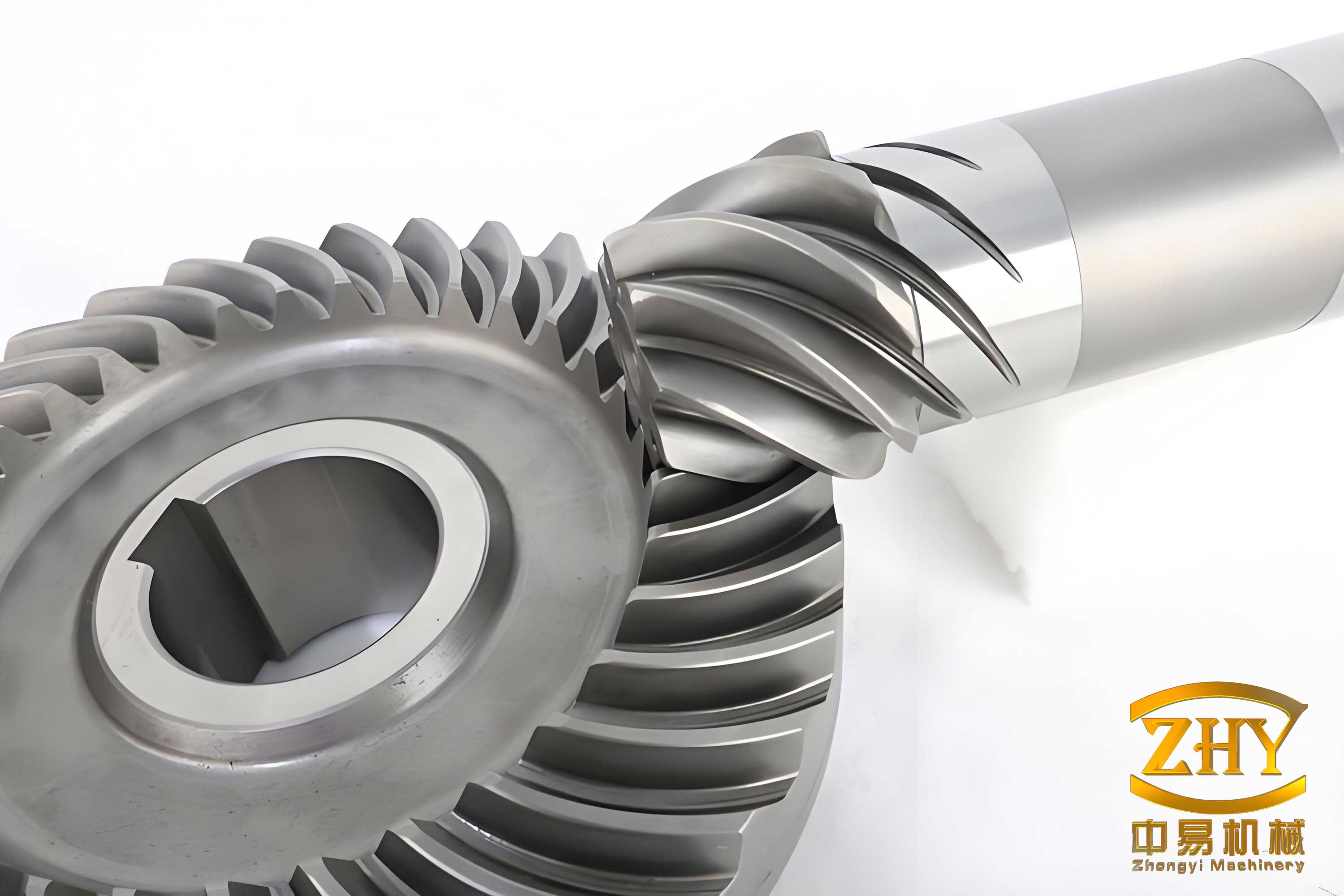
The machining of spiral bevel gears represents a critical and complex manufacturing process within the power transmission industry. These components are essential for transmitting motion and power between intersecting or non-parallel shafts, offering superior performance characterized by high load capacity, smooth operation, and reduced noise compared to straight or helical bevel gears. Their applications span across demanding sectors such as automotive, aerospace, marine, and heavy machinery. The advancement towards full CNC (Computer Numerical Control) milling, particularly using the duplex spread blade method for generating tapered tooth profiles, has significantly enhanced production efficiency and consistency. However, this process introduces significant challenges related to cutting forces and thermal loads. Excessive forces can lead to tool deflection, reduced machining accuracy, and accelerated tool wear, while high cutting temperatures can induce thermal damage to the workpiece surface, alter material properties, and drastically shorten tool life. Therefore, a comprehensive understanding of the influence of cutting parameters on these thermo-mechanical phenomena is paramount for process optimization. This work employs a coupled thermal-stress finite element analysis to investigate the milling process of spiral bevel gears, with the primary objective of identifying optimal machining parameters to minimize cutting forces and temperatures, thereby enhancing tool longevity and final gear quality.
The core of the analysis is a high-fidelity 3D finite element model developed using a commercial explicit dynamics solver capable of handling coupled temperature-displacement analyses. The model geometry accurately reflects the critical features of a duplex spread blade cutter and a spiral bevel gear blank. The workpiece material is modeled using a Johnson-Cook constitutive model, which effectively captures the material’s behavior under the high strain rates and temperatures typical of metal cutting. The model’s equation is fundamental for accurate simulation:
$$
\sigma = \left( A + B \varepsilon_p^n \right) \left( 1 + C \ln \frac{\dot{\varepsilon}_p}{\dot{\varepsilon}_0} \right) \left[ 1 – \left( \frac{T – T_0}{T_{melt} – T_0} \right)^m \right]
$$
Where $\sigma$ is the flow stress, $A$ is the initial yield strength, $B$ is the hardening modulus, $\varepsilon_p$ is the equivalent plastic strain, $n$ is the work-hardening exponent, $C$ is the strain-rate sensitivity coefficient, $\dot{\varepsilon}_p$ is the plastic strain rate, $\dot{\varepsilon}_0$ is the reference strain rate, $T$ is the workpiece temperature, $T_0$ is the room temperature, $T_{melt}$ is the melting temperature, and $m$ is the thermal softening coefficient. Material separation is governed by a Johnson-Cook damage initiation and evolution criterion, ensuring realistic chip formation. The kinematics of the full CNC milling process are implemented through prescribed boundary conditions that replicate the tool rotation, feed motion, and workpiece indexing.
To systematically evaluate the impact of key process variables on the milling of spiral bevel gears, a Design of Experiments (DOE) approach was adopted. A three-factor, three-level orthogonal array L9(3^3) was selected. The chosen factors and their levels are critical for the finishing operation of spiral bevel gears and are defined as follows:
- Factor A (Cutting Speed, Vc): 13.13 rad/s, 26.25 rad/s, 52.50 rad/s.
- Factor B (Depth of Cut, ap): 0.2 mm, 0.3 mm, 0.5 mm.
- Factor C (Tool Rake Angle, γ): 10°, 15°, 20°.
The nine distinct machining trials, defined by the orthogonal array, were simulated. For each simulation, the maximum and mean values of the resultant cutting force and the maximum cutting temperature at the tool-workpiece interface were extracted. The detailed experimental layout and corresponding results are presented in Table 1.
| Expt. No. | Cutting Speed, Vc (rad/s) | Depth of Cut, ap (mm) | Rake Angle, γ (°) | Max. Cutting Force (N) | Mean Cutting Force (N) | Max. Cutting Temp. (°C) | Mean Cutting Temp. (°C) |
|---|---|---|---|---|---|---|---|
| 1 | 13.13 | 0.2 | 15 | 415.85 | 108.80 | 55.5 | 35.2 |
| 2 | 13.13 | 0.3 | 20 | 1782.98 | 501.41 | 132.4 | 75.6 |
| 3 | 13.13 | 0.5 | 10 | 2029.41 | 748.42 | 118.8 | 54.7 |
| 4 | 26.25 | 0.2 | 20 | 1973.53 | 320.30 | 126.5 | 69.9 |
| 5 | 26.25 | 0.3 | 10 | 1255.50 | 450.19 | 106.0 | 52.1 |
| 6 | 26.25 | 0.5 | 15 | 3316.74 | 608.89 | 120.2 | 55.4 |
| 7 | 52.50 | 0.2 | 10 | 1335.15 | 326.89 | 108.5 | 54.9 |
| 8 | 52.50 | 0.3 | 15 | 1677.03 | 464.74 | 150.0 | 78.5 |
| 9 | 52.50 | 0.5 | 20 | 3583.91 | 818.47 | 184.2 | 89.8 |
The data from the orthogonal experiments were analyzed using the range analysis method. This method calculates the average response (K) for each factor at each level and the range (R) between the maximum and minimum K values. The range R indicates the factor’s influence magnitude; a larger R signifies a greater effect on the response variable. The results of the range analysis for maximum cutting force, mean cutting force, maximum temperature, and mean temperature are consolidated in Table 2.
| Response Variable | Factor | Average Response by Level (K) | Range (R) | Rank of Influence |
|---|---|---|---|---|
| Max. Cutting Force | Vc | K1=1409.41, K2=2181.92, K3=2198.70 | 789.29 | 3 |
| ap | K1=1241.51, K2=1571.84, K3=2976.69 | 1735.18 | 1 | |
| γ | K1=1540.02, K2=1803.21, K3=2446.81 | 906.79 | 2 | |
| Mean Cutting Force | Vc | K1=452.64, K2=459.79, K3=536.70 | 84.06 | 3 |
| ap | K1=251.76, K2=472.11, K3=725.26 | 473.50 | 1 | |
| γ | K1=508.50, K2=393.90, K3=546.73 | 152.83 | 2 | |
| Max. Cutting Temp. | Vc | K1=102.23, K2=117.57, K3=147.57 | 45.34 | 1 |
| ap | K1=96.83, K2=129.47, K3=141.07 | 44.24 | 2 | |
| γ | K1=111.10, K2=108.57, K3=147.70 | 39.13 | 3 | |
| Mean Cutting Temp. | Vc | K1=55.17, K2=59.03, K3=74.40 | 19.23 | 2 |
| ap | K1=53.23, K2=68.73, K3=66.63 | 15.50 | 3 | |
| γ | K1=53.90, K2=56.37, K3=78.33 | 24.43 | 1 |
The analysis of the orthogonal experiments for machining spiral bevel gears yields clear insights. For both maximum and mean cutting force, the depth of cut (ap) exhibits the largest range (R), establishing it as the predominant influencing factor. The rake angle (γ) is the secondary factor, while cutting speed (Vc) has the least significant effect on force generation. The optimal level combination for minimizing cutting forces is determined by selecting the level with the lowest average response (K) for each factor: Vc at Level 1 (13.13 rad/s), ap at Level 1 (0.2 mm), and γ at Level 2 (15°).
The influence pattern on cutting temperature is distinct. For the maximum interface temperature, cutting speed is the primary driver, followed by depth of cut and then rake angle. Interestingly, for the mean temperature, the rake angle becomes the most influential factor. The optimal combination for controlling temperature, derived from the level with the lowest K values for each factor in the respective analyses, converges to the same set: Vc at 13.13 rad/s, ap at 0.2 mm, and γ at 15°. This convergence is highly advantageous, suggesting a single parameter set can simultaneously optimize for both low force and low temperature in the milling of spiral bevel gears.
To further elucidate the underlying physical mechanisms and validate trends observed in the orthogonal study, a series of controlled single-factor simulations were conducted. The baseline was set at the identified optimal combination (Vc=13.13 rad/s, ap=0.2 mm, γ=15°), and one factor was varied at a time while holding the others constant. The results are summarized in Table 3.
| Varied Factor | Levels | Fixed Parameters | Max. Force (N) | Max. Temp. (°C) |
|---|---|---|---|---|
| Cutting Speed (Vc) | 13.13 rad/s | ap=0.2 mm, γ=15° | 829.59 | 159.9 |
| 26.25 rad/s | 985.13 | 173.3 | ||
| 52.50 rad/s | 856.74 | 185.7 | ||
| Depth of Cut (ap) | 0.2 mm | Vc=13.13 rad/s, γ=15° | 829.59 | 159.9 |
| 0.3 mm | 1501.80 | 191.0 | ||
| 0.5 mm | 1788.13 | 163.1 | ||
| Rake Angle (γ) | 10° | Vc=13.13 rad/s, ap=0.2 mm | 1449.85 | 153.7 |
| 15° | 829.59 | 159.9 | ||
| 20° | 1252.15 | 196.9 |
The single-factor studies provide a deeper mechanistic understanding of the milling process for spiral bevel gears. The effect of cutting speed on force is non-linear: force increases from low to medium speed due to increased strain rate and reduced shear angle, but decreases at high speed as thermal softening of the workpiece material at the shear zone reduces deformation resistance. Temperature, however, shows a consistent positive correlation with speed, governed by the fundamental energy equation where the heat generation rate is proportional to the cutting power. This relationship can be conceptually expressed as:
$$
\dot{Q} \propto F_t \cdot V_c
$$
Where $\dot{Q}$ is the heat generation rate and $F_t$ is the tangential cutting force. Even if force slightly decreases at high speed, the product $F_t \cdot V_c$ generally increases, leading to higher temperatures.
The depth of cut has the most dramatic and direct impact on cutting force. Increasing the depth of cut linearly increases the uncut chip area (approximately $a_p \cdot f_z$), directly increasing the volume of material undergoing plastic deformation and consequently the total cutting force. The relationship is strongly positive and near-linear within the studied range. The effect on temperature is more complex; increasing ap initially raises temperature due to greater friction and deformation work, but beyond a point, the larger chip cross-section acts as a more efficient heat sink, carrying away a greater proportion of the generated heat and causing the temperature to stabilize or even slightly decrease.
The tool rake angle significantly influences both force and temperature through changes in chip formation mechanics. An increase in positive rake angle reduces the shear angle, decreases plastic deformation, and lowers cutting forces—up to an optimum point (15° in this study). Beyond this point, further increases can reduce tool tip strength and potentially alter chip flow, sometimes leading to increased forces. The effect on temperature is pronounced: a larger positive rake angle reduces the tool-chip contact length, concentrating frictional heat into a smaller area on the rake face and reducing the tool’s mass available for heat conduction. This leads to a significant increase in interface temperature with increasing rake angle, as clearly shown in the single-factor data for spiral bevel gear milling.
In conclusion, this integrated finite element and experimental design study provides a comprehensive framework for optimizing the full CNC milling process of spiral bevel gears. The orthogonal experiment and subsequent range analysis effectively identified the hierarchy of influence among key machining parameters. The depth of cut is the dominant factor governing cutting forces, while cutting speed is the primary driver for maximum cutting temperature. A convergent optimal parameter combination was identified: a cutting speed of 13.13 rad/s, a depth of cut of 0.2 mm, and a tool rake angle of 15°. This combination is predicted to simultaneously minimize both mechanical load and thermal load on the cutting tool during the finishing of spiral bevel gears. The single-factor analyses provided essential validation and revealed the underlying thermo-mechanical mechanisms, including the non-linear relationship between speed and force, the strong linear influence of depth of cut on force, and the critical trade-off between reduced force and increased temperature associated with larger rake angles. The methodologies and findings presented establish a solid foundation for process planning and tool design aimed at improving the efficiency, quality, and tool life in the precision manufacturing of spiral bevel gears.