
In modern mechanical transmission systems, spiral bevel gears play a critical role due to their high load-bearing capacity, efficient power transmission, stability, and low noise generation. These components are extensively used in automotive, aerospace, and heavy machinery applications, particularly in differential systems. Traditionally, spiral bevel gears are manufactured through machining processes, which involve complex operations, high material waste, and energy consumption. Moreover, machining disrupts the metal fiber continuity, reducing the gear’s durability and wear resistance. To address these limitations, forging methods have been explored, but conventional forging requires substantial forces—5 to 10 times higher than rotary forging—leading to high demands on equipment and costs. Double-roller rotary forging, a precision forming technique, offers a promising alternative with benefits such as reduced forming forces, improved accuracy, and enhanced material properties. This study focuses on optimizing the process parameters for double-roller rotary forging of spiral bevel gears to achieve better forming quality, lower loads, and finer microstructures.
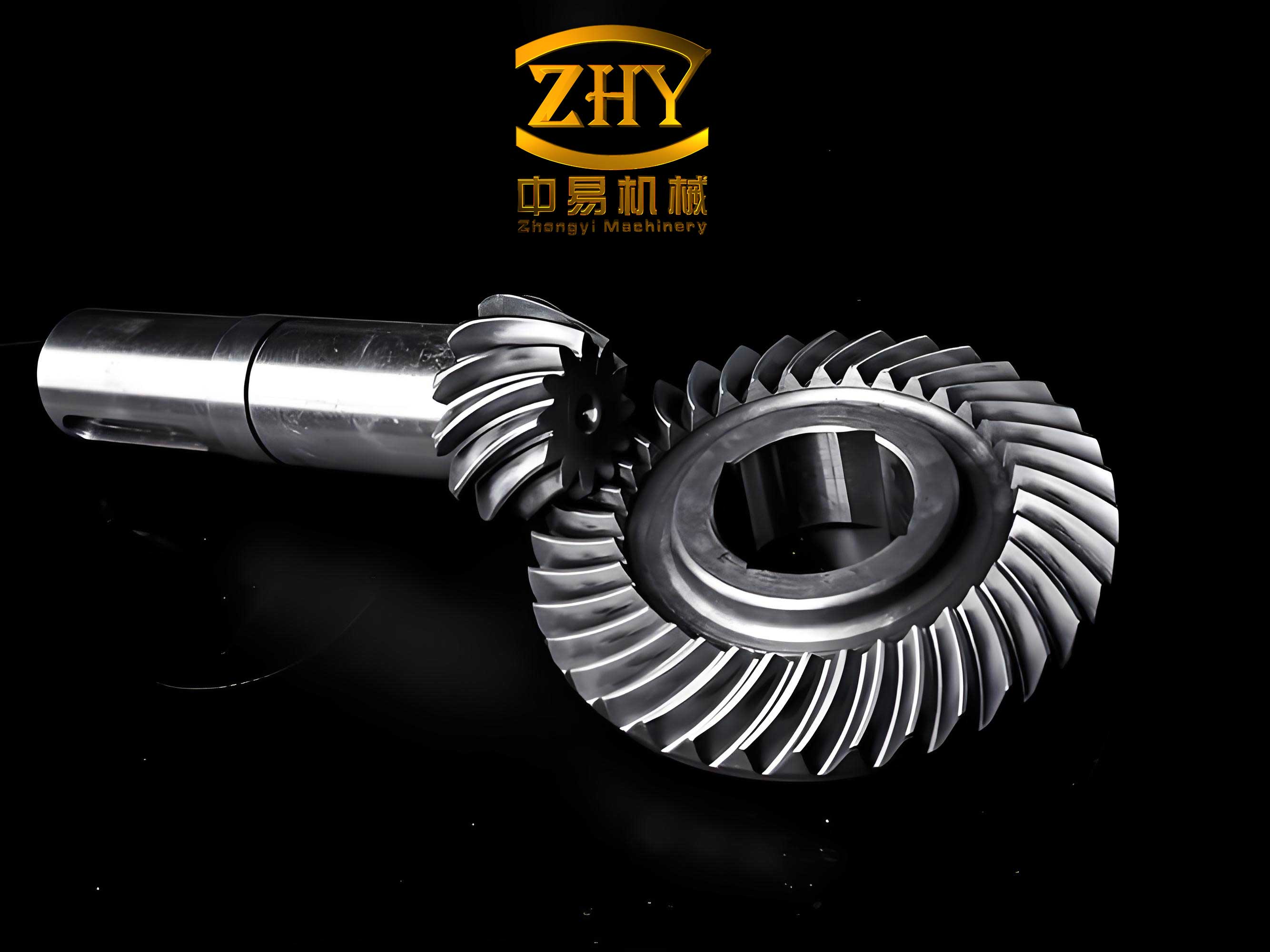
The double-roller rotary forging process involves localized incremental deformation, where two rotating rollers apply pressure to a workpiece positioned between a die and a mandrel. This method is particularly suitable for complex geometries like spiral bevel gears, as it minimizes defects and preserves metal flow lines. However, the forming outcome is highly sensitive to various process parameters. In this investigation, we identify three key experimental indicators to evaluate the process performance: the contact area between the forged workpiece and the die (denoted as S), which reflects the filling degree of the gear teeth; the maximum axial forming load (F), which correlates with equipment tonnage requirements; and the average grain size (L) of the workpiece, which influences mechanical properties through dynamic recrystallization during hot forging. Optimizing these indicators is essential for producing high-quality spiral bevel gears efficiently.
To systematically analyze the effects of process parameters, we employ an orthogonal experimental design coupled with finite element simulation. The parameters considered include the initial workpiece temperature (Factor A), the feed speed of the lower die (Factor B), the friction coefficient (Factor C), the revolution speed of the double rollers (Factor D), and the blank thickness (Factor E). Each factor is set at four levels, as detailed in Table 1. The orthogonal array L16 (4^5) is used to arrange 16 simulation runs, ensuring a comprehensive exploration of the parameter space while minimizing computational effort. The material selected for the spiral bevel gears is 20CrMnTi steel, a common gear steel known for its hardenability and toughness.
| Level | Factor A: Initial Temperature (°C) | Factor B: Feed Speed (mm/s) | Factor C: Friction Coefficient | Factor D: Revolution Speed (rpm) | Factor E: Blank Thickness (mm) |
|---|---|---|---|---|---|
| 1 | 850 | 1 | 0.2 | 50 | 29.22 |
| 2 | 900 | 2 | 0.3 | 75 | 30.22 |
| 3 | 950 | 3 | 0.4 | 100 | 31.22 |
| 4 | 1000 | 4 | 0.5 | 125 | 32.22 |
Finite element simulations are conducted using DEFORM-3D software to model the double-roller rotary forging process. The three-dimensional geometry of the spiral bevel gear is created based on specifications typical for automotive applications, with parameters such as module, pressure angle, and spiral angle defining the tooth profile. The finite element model includes the double rollers, the die cavity, and the workpiece. The workpiece is meshed with approximately 150,000 tetrahedral elements, with local refinement in the tooth region to capture detailed deformation. The material behavior is modeled using a thermo-mechanical approach, incorporating flow stress data for 20CrMnTi steel at elevated temperatures. The constitutive relationship for plastic deformation can be expressed using the Arrhenius-type equation:
$$ \dot{\varepsilon} = A \sigma^n \exp\left(-\frac{Q}{RT}\right) $$
where $\dot{\varepsilon}$ is the strain rate, $\sigma$ is the flow stress, $n$ is the stress exponent, $Q$ is the activation energy for deformation, $R$ is the universal gas constant, and $T$ is the absolute temperature. This equation helps in simulating the material response under hot forging conditions. Additionally, dynamic recrystallization kinetics are considered to predict grain size evolution, which is crucial for assessing the microstructure of the forged spiral bevel gears. The recrystallized grain size $d_{rec}$ can be estimated using the model:
$$ d_{rec} = k Z^{-m} $$
where $Z = \dot{\varepsilon} \exp(Q/RT)$ is the Zener-Hollomon parameter, and $k$ and $m$ are material constants. These formulations are integrated into the simulation to provide accurate predictions of mechanical and metallurgical outcomes.
The simulation setup assumes an initial workpiece temperature range of 850–1000°C, a die temperature of 200°C, and environmental heat transfer coefficients. Friction at the die-workpiece interface is modeled using the shear friction law, with coefficients varying from 0.2 to 0.5. The double rollers rotate at speeds from 50 to 125 rpm, while the lower die feeds upward at speeds from 1 to 4 mm/s. Each simulation runs until the complete filling of the gear teeth, with data extracted for the three indicators. The orthogonal experimental scheme and corresponding simulation results are summarized in Table 2.
| Experiment No. | Factor A | Factor B | Factor C | Factor D | Factor E | Contact Area S (mm²) | Max Axial Load F (kN) | Avg Grain Size L (μm) |
|---|---|---|---|---|---|---|---|---|
| 1 | 1 | 1 | 1 | 1 | 1 | 16850 | 3500 | 55.2 |
| 2 | 1 | 2 | 2 | 2 | 2 | 17520 | 3200 | 52.8 |
| 3 | 1 | 3 | 3 | 3 | 3 | 18030 | 3100 | 50.5 |
| 4 | 1 | 4 | 4 | 4 | 4 | 18540 | 2950 | 48.3 |
| 5 | 2 | 1 | 2 | 3 | 4 | 19010 | 2800 | 46.7 |
| 6 | 2 | 2 | 1 | 4 | 3 | 19500 | 2650 | 44.9 |
| 7 | 2 | 3 | 4 | 1 | 2 | 18800 | 2750 | 47.5 |
| 8 | 2 | 4 | 3 | 2 | 1 | 18250 | 2900 | 49.8 |
| 9 | 3 | 1 | 3 | 4 | 2 | 20020 | 2400 | 40.2 |
| 10 | 3 | 2 | 4 | 3 | 1 | 20500 | 2300 | 38.5 |
| 11 | 3 | 3 | 1 | 2 | 4 | 21030 | 2200 | 36.8 |
| 12 | 3 | 4 | 2 | 1 | 3 | 19800 | 2500 | 42.1 |
| 13 | 4 | 1 | 4 | 2 | 3 | 19550 | 2600 | 43.9 |
| 14 | 4 | 2 | 3 | 1 | 4 | 19200 | 2700 | 45.6 |
| 15 | 4 | 3 | 2 | 4 | 1 | 18750 | 2850 | 48.0 |
| 16 | 4 | 4 | 1 | 3 | 2 | 20210 | 2350 | 39.4 |
From the simulation results, we observe significant variations in the indicators across different parameter combinations. To quantify the influence of each factor, range analysis is performed. For each indicator, the average value for each factor level is calculated, and the range (difference between maximum and minimum averages) is determined. The results for contact area S are shown in Table 3. The larger the contact area, the better the filling of the spiral bevel gear teeth.
| Factor | Level 1 Average | Level 2 Average | Level 3 Average | Level 4 Average | Range |
|---|---|---|---|---|---|
| A | 17735 | 18890 | 20338 | 19428 | 2603 |
| B | 18858 | 19155 | 19153 | 19200 | 342 |
| C | 19448 | 18865 | 19038 | 18973 | 583 |
| D | 18663 | 19050 | 19435 | 19438 | 775 |
| E | 18588 | 19163 | 19420 | 19418 | 832 |
The range values indicate that Factor A (initial temperature) has the strongest effect on contact area, followed by Factor E (blank thickness), Factor D (revolution speed), Factor C (friction coefficient), and Factor B (feed speed). This suggests that for achieving optimal filling in spiral bevel gears, temperature control is paramount. Similarly, range analyses for maximum axial load F and average grain size L are conducted, as summarized in Tables 4 and 5. For maximum axial load, lower values are desirable to reduce equipment demands.
| Factor | Level 1 Average | Level 2 Average | Level 3 Average | Level 4 Average | Range |
|---|---|---|---|---|---|
| A | 3188 | 2775 | 2350 | 2625 | 838 |
| B | 2825 | 2713 | 2725 | 2700 | 125 |
| C | 2675 | 2838 | 2763 | 2650 | 188 |
| D | 2888 | 2725 | 2638 | 2688 | 250 |
| E | 2888 | 2675 | 2663 | 2713 | 225 |
For average grain size L, smaller values indicate finer microstructures, which enhance the mechanical properties of spiral bevel gears.
| Factor | Level 1 Average | Level 2 Average | Level 3 Average | Level 4 Average | Range |
|---|---|---|---|---|---|
| A | 51.7 | 47.2 | 39.4 | 44.2 | 12.3 |
| B | 46.5 | 45.0 | 45.7 | 44.9 | 1.6 |
| C | 44.1 | 47.4 | 46.5 | 44.9 | 3.3 |
| D | 48.3 | 45.9 | 44.3 | 44.0 | 4.3 |
| E | 47.9 | 45.0 | 45.3 | 44.3 | 3.6 |
Based on the range analyses, we derive optimal parameter combinations for each indicator. For contact area S, the best levels are A3, B2, C1, D3, and E3. For maximum axial load F, the optimal levels are A3, B2, C4, D3, and E2. For average grain size L, the optimal levels are A3, B4, C1, D4, and E3. To achieve a balanced optimization considering all three indicators for spiral bevel gears, we perform a comprehensive evaluation. Factor A (initial temperature) is the most influential across all indicators, with level A3 (950°C) consistently providing high contact area, low load, and fine grain size. Factor B (feed speed) shows moderate effects; level B2 (2 mm/s) is selected as it offers a good compromise. Factor C (friction coefficient) should be minimized to reduce loads and improve contact, so level C1 (0.2) is chosen. Factor D (revolution speed) at level D2 (75 rpm) balances deformation kinetics. Factor E (blank thickness) at level E3 (31.22 mm) enhances filling without excessively increasing loads. Thus, the overall optimal parameter combination is A3B2C1D2E3.
To validate this optimization, we conduct a simulation under the optimal conditions: initial workpiece temperature of 950°C, lower die feed speed of 2 mm/s, friction coefficient of 0.2, double-roller revolution speed of 75 rpm, and blank thickness of 31.22 mm. The results show a contact area of 24,310 mm², a maximum axial load of 1,358 kN, and an average grain size of 33.3 μm. Compared to a baseline simulation with typical parameters (e.g., 900°C, 2 mm/s, 0.3 friction, 75 rpm, 30.22 mm), which yielded a contact area of 16,885 mm², a load of 1,827 kN, and a grain size of 58.2 μm, the optimized parameters improve contact area by approximately 43.9%, reduce maximum load by 25.7%, and decrease grain size by 42.8%. These enhancements demonstrate the effectiveness of the orthogonal experimental approach in refining the double-roller rotary forging process for spiral bevel gears.
Furthermore, the physical significance of these parameters can be explained through metallurgical and mechanical principles. The initial temperature affects material flow stress and recrystallization behavior. Higher temperatures reduce flow stress, facilitating deformation and improving tooth filling, but excessive temperatures may lead to grain growth or oxidation. The relationship between flow stress and temperature can be modeled as:
$$ \sigma = K \varepsilon^n \exp\left(\frac{Q}{RT}\right) $$
where $K$ is a material constant, $\varepsilon$ is the strain, and $n$ is the strain-hardening exponent. For spiral bevel gears, optimal temperature ensures sufficient plasticity without compromising microstructure. The feed speed influences strain rate; lower speeds allow more time for material flow, enhancing filling but potentially increasing process time. The friction coefficient affects interfacial shear stresses; lower friction reduces forming loads and improves surface quality. The revolution speed of the rollers relates to the deformation rate and heat generation; moderate speeds balance productivity and forming quality. Blank thickness directly impacts the volume of material available for filling the gear teeth; adequate thickness prevents underfilling but may increase loads.
In addition to the orthogonal analysis, we explore the interaction effects between parameters, although the orthogonal design primarily focuses on main effects. For instance, the combination of high temperature and low friction may synergistically reduce loads further. Future studies could include full factorial designs or response surface methodology to capture these interactions. Moreover, the microstructural evolution during forging of spiral bevel gears can be described using dynamic recrystallization models. The volume fraction of recrystallized grains $X_{rec}$ as a function of strain $\varepsilon$ is given by:
$$ X_{rec} = 1 – \exp\left[-k \left(\frac{\varepsilon – \varepsilon_c}{\varepsilon_p}\right)^m\right] $$
where $\varepsilon_c$ is the critical strain for recrystallization, $\varepsilon_p$ is the peak strain, and $k$ and $m$ are constants. This model helps in predicting the grain refinement achievable under optimized parameters.
The practical implementation of these optimized parameters was tested on a 400-ton double-roller rotary forging machine. Using 20CrMnTi steel blanks, the forged spiral bevel gears exhibited complete tooth filling, reduced forging loads, and a uniform fine-grained microstructure, confirming the simulation predictions. The successful production of high-quality spiral bevel gears through this optimized process highlights its industrial applicability, offering a cost-effective alternative to traditional machining and conventional forging.
In conclusion, this study systematically optimizes the process parameters for double-roller rotary forging of spiral bevel gears using orthogonal experiments and finite element simulation. The optimal combination—initial temperature of 950°C, feed speed of 2 mm/s, friction coefficient of 0.2, revolution speed of 75 rpm, and blank thickness of 31.22 mm—significantly improves contact area, reduces forming loads, and refines grain size. These findings provide a scientific basis for enhancing the manufacturing efficiency and performance of spiral bevel gears, contributing to advancements in precision forging technology. Future work could focus on real-time monitoring and control of these parameters, as well as extending the methodology to other complex gear geometries.