
The pursuit of compact, high-ratio, and high-power transmission systems has consistently driven innovation in gear design. Among various solutions, nutation drives offer a compelling advantage due to their inherent capability for high reduction ratios within a confined space. The core of an efficient nutation transmission lies in its gear pair, which typically consists of internal and external spiral bevel gears meshing in a unique spatial arrangement. Conventional designs often employ involute or straight-bevel profiles, which may fall short under extreme demands for contact strength and load capacity. This is where the double circular-arc profile presents a superior alternative. Characterized by conjugated convex-concave tooth flanks, this geometry significantly enhances contact stress distribution and load-bearing capability, making it exceptionally suitable for the rigorous conditions of high-speed, heavy-load applications such as advanced nutation drives.
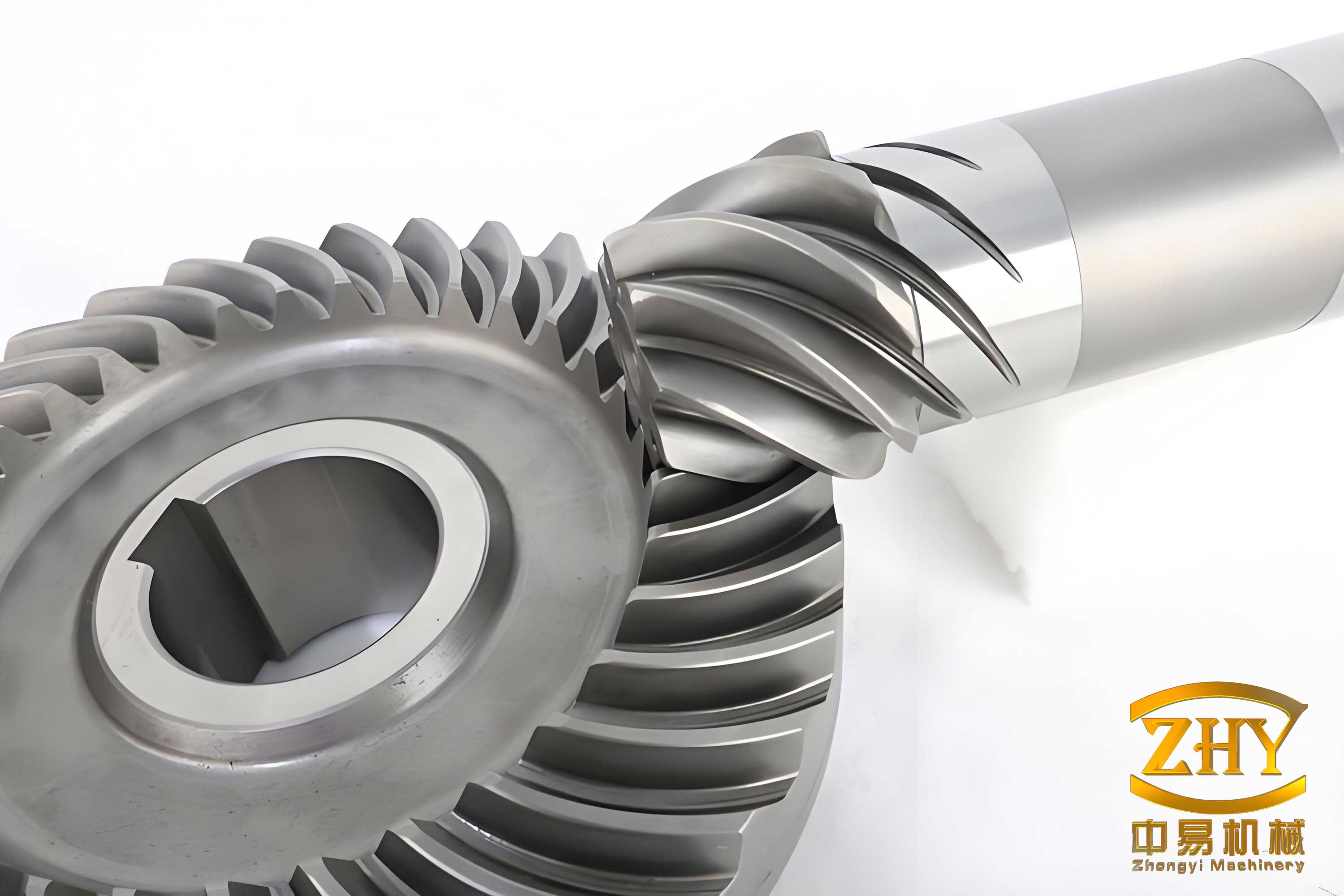
The transition from a promising design concept to a functional, high-performance gear necessitates a robust and precise digital model. Traditional modeling techniques for such complex spiral bevel gears often rely on sweep operations of a basic profile along a path. While straightforward, this method fails to accurately represent the true conjugate meshing action dictated by the kinematics of the nutation drive. Consequently, models generated this way are geometrically approximate and may not yield optimal contact patterns or stress profiles under load. To overcome this limitation, a modeling methodology grounded in the fundamental principles of gear meshing and coordinate transformation is essential. This approach involves deriving the precise mathematical equations of the tooth surfaces as envelopes of a generating tool motion, leading to a “controlled-accuracy” model where the fidelity of the gear geometry is directly governed by computational parameters.
This article details the comprehensive process for the precision modeling of internal and external meshing double circular-arc spiral bevel gears. The methodology begins with the mathematical definition of a virtual generating gear, known as a crown gear. The complete tooth surface of the target spiral bevel gears is then derived through systematic coordinate transformations between the crown gear and the work gear coordinate systems. The resulting complex surface, defined by parametric equations, is constructed programmatically. A critical step involves the precise trimming of this raw surface against the gear blank boundaries to form the final, manufacturable tooth volume. The entire workflow, from equation derivation to model realization and physical manufacturing, will be explored, emphasizing the principle of controlled-accuracy design.
Mathematical Foundation: The Crown Gear and Tooth Surface Derivation
The generation of double circular-arc spiral bevel gears can be conceptually understood as the envelope of surfaces created by the relative motion between the gear blank and a fictitious generating gear, or crown gear. The crown gear possesses a basic rack-like form with a double circular-arc profile that is swept along a defined path to create its own tooth surface. The accurate mathematical model of the final gear teeth is therefore built in two stages: first, by defining the crown gear’s tooth surface, and second, by mapping this surface onto the coordinate system of the internal and external spiral bevel gears through their specific kinematic relationships.
Tooth Profile Geometry: The Double Circular-Arc Standard
The transverse cross-section of the tooth, or the tooth profile, follows the standard double circular-arc specification. This profile is composed of eight distinct circular arc segments on one side, mirrored for the opposite flank. The primary functional segments are the convex and concave arcs which form the active meshing surfaces. Transition arcs and root fillet arcs complete the profile, ensuring smooth stress flow and manufacturability.
In a local profile coordinate system \( S_n (O_n-X_nY_nZ_n) \), where the \( Z_n \)-axis is perpendicular to the profile plane, any point on the i-th arc segment can be expressed as:
$$
\mathbf{r_{ni}} = \begin{bmatrix}
x_{ni} \\
y_{ni} \\
z_{ni}
\end{bmatrix} = \begin{bmatrix}
r_i \cos\alpha_i + x_{nOi} \\
r_i \sin\alpha_i + y_{nOi} \\
0
\end{bmatrix}
$$
where \( i = 1, 2, …, 8 \) denotes the arc segment, \( r_i \) is the radius of the i-th arc, \( \alpha_i \) is the angular parameter along the arc, and \( (x_{nOi}, y_{nOi}) \) are the coordinates of the arc’s center point \( O_i \).
| Segment (i) | Description | Radius \( r_i \) | Center \( (x_{nOi}, y_{nOi}) \) |
|---|---|---|---|
| 1 | Left Convex Arc | \( r_{n1} \) | Calculated from standard layout |
| 2 | Left Concave Arc | \( r_{n2} \) | Calculated from standard layout |
| 3 | Left Transition Arc | \( r_{n3} \) | Calculated from standard layout |
| 4 | Left Root Fillet Arc | \( r_{n4} \) | Calculated from standard layout |
| 5 | Right Convex Arc | \( r_{n5} \) | Symmetric to segment 1 |
| 6 | Right Concave Arc | \( r_{n6} \) | Symmetric to segment 2 |
| 7 | Right Transition Arc | \( r_{n7} \) | Symmetric to segment 3 |
| 8 | Right Root Fillet Arc | \( r_{n8} \) | Symmetric to segment 4 |
Crown Gear Tooth Surface Generation
The three-dimensional tooth surface of the crown gear is generated by moving the 2D profile along a prescribed tooth trace (longitudinal direction) on the crown gear’s pitch cone. This trace is typically a logarithmic or circular arc spiral to ensure conjugate action. In the crown gear coordinate system \( S_c (O_c-X_cY_cZ_c) \), the equation of the tooth trace can be described by:
$$
\begin{aligned}
x_c &= e^{\theta \cot\beta} \cos\gamma \pm \varepsilon \sin(-\gamma – \beta) \\
y_c &= e^{\theta \cot\beta} \sin\gamma \pm \varepsilon \cos(\gamma + \beta) \\
z_c &= 0
\end{aligned}
$$
where \( \theta \) is the generating parameter related to the cone distance, \( \beta \) is the spiral angle, \( \gamma = \theta – \Delta\theta_j \), and \( \varepsilon \) is a parameter related to the curvature of the tooth trace. The sign convention (±) differentiates between left-hand and right-hand flanks.
The local profile coordinate system \( S_n \) is attached to and moves along this tooth trace. The transformation from \( S_n \) to the crown gear system \( S_c \) is given by the matrix \( \mathbf{M}_{\{c\}\{n\}} \). Consequently, the parametric equation for any point on the crown gear tooth surface is obtained by applying this transformation to the profile point \( \mathbf{r_{ni}} \):
$$
\mathbf{R_{ch}} = \begin{bmatrix} x_{ch} \\ y_{ch} \\ z_{ch} \\ 1 \end{bmatrix} = \mathbf{M}_{\{c\}\{n\}} \begin{bmatrix} \mathbf{r_{ni}} \\ 1 \end{bmatrix}
$$
This equation, when expanded, provides the explicit coordinates \( (x_{ch}, y_{ch}, z_{ch}) \) of the h-th point on the crown gear surface as functions of the profile parameter \( \alpha_i \) and the trace parameter \( \theta \).
Coordinate Transformation: Mapping to Internal and External Spiral Bevel Gears
The crown gear serves as the generating tool. The tooth surfaces of the actual internal and external spiral bevel gears are the envelopes of the crown gear surface as it undergoes a specific rolling motion relative to each gear blank. This kinematic relationship is captured through a series of coordinate transformations.
Kinematic Relationship and Transformation Matrices
The process involves several coordinate systems: a fixed global system \( S_0 \), the crown gear system \( S_c \) rotating with angular velocity \( \omega_c \), and coordinate systems \( S_I \) and \( S_{II} \) firmly attached to the external and internal spiral bevel gears, rotating with angular velocities \( \omega_I \) and \( \omega_{II} \) respectively. The relative motion is defined by the nutation kinematics, relating the rotation angles \( \phi_c \), \( \phi_I \), and \( \phi_{II} \), and the pitch cone angles \( \delta_I \) and \( \delta_{II} \).
The transformation from the crown gear system \( S_c \) to the external gear system \( S_I \) is governed by the matrix \( \mathbf{M}_{\{I\}\{c\}} \), which incorporates the rotation angles and the pitch cone angle:
$$
\mathbf{M}_{\{I\}\{c\}} = \begin{bmatrix}
a_{11} & a_{12} & a_{13} & 0 \\
a_{21} & a_{22} & a_{23} & 0 \\
a_{31} & a_{32} & a_{33} & 0 \\
0 & 0 & 0 & 1
\end{bmatrix}
$$
where the elements \( a_{mn} \) are functions of \( \phi_I \), \( \phi_c \), and \( \delta_I \). For instance, \( a_{11} = -\cos\phi_I \cos\phi_c – \sin\phi_I \sin\delta_I \sin\phi_c \).
Similarly, the transformation to the internal gear system \( S_{II} \) is given by matrix \( \mathbf{M}_{\{II\}\{c\}} \):
$$
\mathbf{M}_{\{II\}\{c\}} = \begin{bmatrix}
b_{11} & b_{12} & b_{13} & 0 \\
b_{21} & b_{22} & b_{23} & 0 \\
b_{31} & b_{32} & b_{33} & 0 \\
0 & 0 & 0 & 1
\end{bmatrix}
$$
where the elements \( b_{mn} \) are functions of \( \phi_{II} \), \( \phi_c \), and \( \delta_{II} \), e.g., \( b_{31} = \cos\delta_{II} \sin\phi_c \).
| Symbol | Description | Applies to |
|---|---|---|
| \( \phi_c \) | Rotation angle of the crown gear | Crown Gear |
| \( \phi_I, \phi_{II} \) | Rotation angle of external/internal gear | External/Internal Gear |
| \( \delta_I, \delta_{II} \) | Pitch cone angle | External/Internal Gear |
| \( \omega_c, \omega_I, \omega_{II} \) | Angular velocity | Respective Component |
| \( \mathbf{M}_{\{I\}\{c\}} \) | Transformation matrix: Crown → External Gear | External Gear |
| \( \mathbf{M}_{\{II\}\{c\}} \) | Transformation matrix: Crown → Internal Gear | Internal Gear |
Final Tooth Surface Equations
By applying the appropriate transformation matrix to the crown gear surface point \( \mathbf{R_{ch}} \), the universal parametric equation for a point on either the external (k=I) or internal (k=II) spiral bevel gear tooth surface is derived. The general form can be expressed as:
$$
\mathbf{R_k} = \begin{bmatrix} x_k \\ y_k \\ z_k \\ 1 \end{bmatrix} = \mathbf{M}_{\{k\}\{c\}} \mathbf{R_{ch}} = \mathbf{F}_k(\alpha_i, \theta, \phi_c)
$$
Expanding this for the external gear yields a complex vector function \( \mathbf{F}_I \), and for the internal gear, a different function \( \mathbf{F}_{II} \). These equations \( \mathbf{F}_I \) and \( \mathbf{F}_{II} \) are the precise mathematical definitions of the double circular-arc tooth surfaces for the nutation drive pair. They are functions of the profile parameter \( \alpha_i \), the longitudinal parameter \( \theta \), and the generation motion parameter \( \phi_c \).
Controlled-Accuracy Modeling and Surface Trimming in MATLAB
With the mathematical surface equations established, the next step is their numerical realization into a three-dimensional, watertight solid model suitable for manufacturing. This is achieved through a procedural, controlled-accuracy approach implemented in a computational environment like MATLAB.
Generating the Raw Tooth Surface Point Cloud
The first computational step involves evaluating the surface equations \( \mathbf{F}_k(\alpha_i, \theta, \phi_c) \) over defined ranges of the parameters. For a given tooth flank (e.g., the left convex arc, i=1), discrete values are assigned to \( \alpha_1 \) and \( \theta \). By holding the generation parameter \( \phi_c \) constant for a specific relative position, a discrete mesh of points in 3D space is calculated. This mesh represents the raw, unbounded tooth surface for that specific arc segment. Repeating this process for all eight arc segments (i=1 to 8) yields the complete, yet untrimmed, tooth surface雏形. The density of this point mesh—the number of points sampled along \( \alpha_i \) and \( \theta \)—is the primary control parameter for model accuracy. A finer mesh results in a more precise representation of the true continuous surface at the cost of higher computational load, enabling true “controlled-accuracy” design.
Defining the Gear Blank Boundaries
The raw surface extends infinitely along the directions of its parameters. To create a realistic gear tooth, this surface must be trimmed by the boundaries of the gear blank. These boundaries are defined by standard gear geometry surfaces:
- Inner (Toe) Cone Surface: The conical surface at the small end of the gear.
- Outer (Heel) Cone Surface: The conical surface at the large end of the gear.
- Tip Cone Surface: The conical surface connecting the tips of all teeth.
- Root Cone Surface: The conical surface connecting the roots of all teeth.
Each of these boundary surfaces can be described by simple parametric equations in the gear’s own coordinate system (\( S_I \) or \( S_{II} \)). For example, the outer cone surface for the external gear can be parameterized by a length parameter \( l_b \) and an angle parameter \( \Theta_b \):
$$
\begin{aligned}
x_{Ib} &= l_b \cos\delta_I \cos\Theta_b \\
y_{Ib} &= l_b \cos\delta_I \sin\Theta_b \\
z_{Ib} &= R / \cos\delta_I – l_b \sin\delta_I
\end{aligned}
$$
where \( R \) is the outer cone distance.
Algorithmic Surface Trimming
The core of the modeling process is the algorithmic trimming of the raw tooth surface mesh against these boundary surfaces. This is not a simple Boolean operation in CAD, but a numerical procedure executed in MATLAB. The fundamental logic for trimming against, say, the outer cone is as follows:
- Intersection Solving: For each discrete value of the profile parameter \( \alpha_i \) along a given arc, find the specific value(s) of the longitudinal parameter \( \theta \) where the tooth surface equation intersects the boundary surface equation. This involves solving a system of non-linear equations derived from equating the coordinates.
- Valid Range Determination: This calculation yields the minimum (\( \theta_{min} \)) and maximum (\( \theta_{max} \)) allowable values of \( \theta \) for that particular \( \alpha_i \) such that the tooth surface point lies inside the gear blank.
- Point Cloud Filtering: The original dense mesh of points \( [\theta, \alpha_i] \) is then filtered. Any point whose \( \theta \) coordinate falls outside the computed valid range \( [\theta_{min}(\alpha_i), \theta_{max}(\alpha_i)] \) for its corresponding \( \alpha_i \) is discarded or marked as invalid (e.g., set to NaN in MATLAB).
This process is executed sequentially for all relevant boundary surfaces: first the inner and outer cones to trim the length of the tooth, then the tip and root cones to trim the height, and finally between adjacent arc segments (e.g., between the convex arc and the transition arc) to ensure sharp, clean edges. The result is a refined, trimmed point cloud that accurately defines the complete, bounded tooth surface.
| Step | Target Boundary | Purpose | Methodological Action |
|---|---|---|---|
| 1 | Inner & Outer Cone | Define tooth length (toe to heel) | Solve for intersection curves \( \theta = f(\alpha_i) \), filter points outside \( \theta \) range. |
| 2 | Tip & Root Cone | Define tooth height (root to tip) | Solve for intersection curves, filter points based on radial/height criteria. |
| 3 | Adjacent Arc Segments | Define clean boundaries between arcs | Calculate intersection of adjacent surface patches, filter points based on \( \alpha_i \) limits. |
| 4 | Meshing & Export | Create manufacturable CAD data | Triangulate the final filtered point cloud, export as STL or point data for CAD import. |
From Digital Model to Physical Manufacturing
The final output of the MATLAB process is a highly accurate set of discrete data points representing the trimmed tooth surfaces for one tooth space. This data is exported and imported into a commercial 3D CAD software (e.g., SolidWorks, CATIA, or NX). Within the CAD environment, the points are used to generate smooth, precise NURBS surfaces. These surfaces are then stitched together to form a closed, solid body representing a single tooth. This solid tooth is then patterned circumferentially around the gear axis to create the full gear model, incorporating the hub and other necessary features. The resulting 3D solid model is the direct embodiment of the controlled-accuracy design.
This digital model serves as the master for all downstream manufacturing activities. It can be used to:
- Generate NC (Numerical Control) code for 5-axis CNC milling machines to directly cut the gear teeth from a forged or rough-machined blank.
- Create electrodes for Electrical Discharge Machining (EDM) processes, suitable for very hard materials.
- Perform advanced finite element analysis (FEA) for stress, strain, and thermal simulations under operational loads.
- Conduct virtual mating and assembly checks, and kinematic simulations of the full nutation drive assembly.
The physical realization—the actual manufactured pair of internal and external double circular-arc spiral bevel gears—validates the modeling approach. Successful assembly and functional testing in a nutation drive prototype confirm that the conjugate surfaces derived from the mathematical model produce the intended smooth, controlled meshing action with high contact ratio and strength.
Conclusion and Future Perspectives
The precision modeling of internal and external double circular-arc spiral bevel gears for nutation drives represents a significant advancement over traditional approximate methods. By grounding the model in the fundamental principles of gear meshing—deriving the tooth surface as an envelope via coordinate transformations from a virtual crown gear—a geometrically accurate representation is achieved. The implementation of this methodology in a computational environment like MATLAB, coupled with a rigorous algorithmic surface trimming routine, enables a true controlled-accuracy design paradigm. The model’s fidelity is explicitly governed by the discretization parameters of the surface mesh, allowing for a balance between precision and computational efficiency tailored to the application’s needs.
The practical outcome is a direct path from mathematical definition to a manufacturable 3D CAD model and, ultimately, to high-performance physical gears. This workflow ensures that the superior load-bearing characteristics of the double circular-arc profile are fully realized in the final product. However, the current model represents an ideal, error-free state. The logical and essential progression of this work involves extending the mathematical framework to account for real-world imperfections and manufacturing variances.
Future research should focus on developing a comprehensive error-incorporation model. This would involve introducing parameters for common manufacturing and assembly errors—such as misalignments (axial, radial, angular), pitch errors, profile form deviations, and mounting deflections—directly into the coordinate transformation matrices or surface equations. Analyzing the sensitivity of the meshing performance (e.g., transmission error, contact pattern shift, stress concentration) to these multi-error parameters would provide invaluable insights. Such a coupled error model would not only enhance the predictive capability of the design software but also inform tolerance allocation and guide compensatory manufacturing or assembly strategies, pushing the performance and reliability of double circular-arc spiral bevel gear-based nutation drives to even greater heights.