
In the field of mechanical transmission, spiral bevel gears are critical components due to their ability to transmit power between intersecting shafts with high efficiency and load capacity. However, accurately predicting the stress field in meshing teeth of spiral bevel gears has long been a challenge. Traditional methods, such as the cantilever beam theory for bending stress and Hertz theory for contact stress, rely on numerous correction factors and often fail to capture the complex three-dimensional stress state. In this article, I present a novel approach that integrates loaded tooth contact analysis with a three-dimensional elastic contact finite element mixed method. This method establishes a direct link between tooth geometry, applied loads, and the resulting stress field, offering a more precise tool for strength characterization of spiral bevel gears and other complex spatial meshing gear pairs.
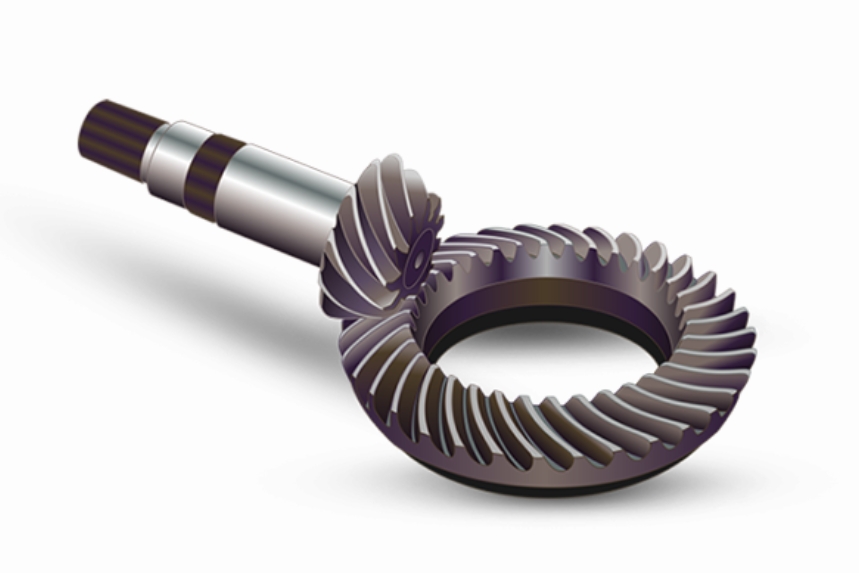
The analysis begins with a discretized mechanical model of the tooth contact, which is automatically generated based on loaded tooth contact analysis. This model, as illustrated in the figure, includes all potential contact point pairs on the tooth surfaces of both the pinion and gear, along with their coordinates, initial relative gaps accounting for tooth surface mismatch, and local coordinate system basis vectors at each contact point. The boundary conditions are carefully defined to simulate real operating conditions. For the driving gear (pinion), radial displacements are constrained by the shaft, axial displacements are typically fixed, and rotational rigid body motion is allowed around its axis. To handle these oblique constraints, a local coordinate system is established at the boundary points. For the driven gear, boundary conditions are often set as fixed constraints. The external load, typically a torque applied to the pinion, is converted into equivalent tangential surface loads on the boundary face using static equivalence principles. A more refined distribution can be obtained through an inverse method, where contact forces from an initial analysis are used to compute reaction forces that satisfy the torque equilibrium.
The core of the methodology lies in the finite element mixed method for solving the elastic contact problem. For a pair of meshing spiral bevel gears, the compatibility equation for the gaps between potential contact point pairs can be expressed as:
$$\{ \Delta \} = [F] \{ P \} + [G] \{ U \} + \{ \Delta_0 \}$$
Here, $\{ \Delta \}$ is the vector of relative displacements between contact point pairs, $[F]$ is the flexibility matrix relating contact forces $\{ P \}$ to displacements, $[G]$ is the rigid body displacement influence matrix, $\{ U \}$ is the vector of rigid body displacements, and $\{ \Delta_0 \}$ is the vector of initial gaps determined by tooth geometry. This equation is derived from variational principles and ensures compatibility of deformations at the contact interface.
In the context of spiral bevel gears, where only rotational rigid body motion is considered, a key relationship simplifies the computation. The rigid body displacement influence matrix $[G]$ and the overall equilibrium matrix $[H]$ are transposes of each other:
$$[G] = [H]^T$$
This relationship significantly reduces computational memory and effort. To derive $[G]$, consider the pinion’s rotational rigid body displacement $\theta$ around its axis. The displacement at a potential contact point due to this rotation, projected into the local coordinate system, gives the entries of $[G]$. For the equilibrium matrix $[H]$, the moments generated by contact forces about the pinion axis are computed, leading to its formulation. The transposition property emerges naturally from vector algebra, as shown in the derivations.
The flexibility matrix $[F]$ is obtained by applying unit forces at potential contact points and computing the resulting displacements using the finite element method. For a single pair of meshing spiral bevel gears, this involves solving the finite element model with appropriate boundary conditions. However, in practical operation, multiple teeth may be in contact simultaneously, such as double or triple tooth contact. Analyzing such multi-region contact problems with full finite element models would lead to prohibitively large computational costs. To address this, I propose a simplified yet effective approach.
For instance, in triple tooth contact, each contact zone (e.g., zones A, B, C representing exiting, main, and entering contact) is treated separately. The overall flexibility matrix is partitioned into submatrices:
$$[F] = \begin{bmatrix}
[F_{AA}] & [F_{AB}] & [F_{AC}] \\
[F_{BA}] & [F_{BB}] & [F_{BC}] \\
[F_{CA}] & [F_{CB}] & [F_{CC}]
\end{bmatrix}$$
Here, $[F_{ij}]$ represents the flexibility of zone $i$ with respect to contact forces in zone $j$. Due to the high stiffness of the gear body compared to the teeth, the off-diagonal submatrices ($i \neq j$) are approximately zero. This means the interaction between contact zones through the gear body is negligible. Therefore, each contact zone can be analyzed using a single-tooth contact model, drastically reducing the degrees of freedom and computation time. The compatibility equation is then solved for all zones simultaneously, yielding the contact force distribution, load sharing among teeth, and the complete stress field.
To validate this methodology, I applied it to analyze a hypoid gear pair used in an automotive rear axle. The results were compared with experimental data, including photoelastic measurements and contact pattern tests. One key aspect is the distribution of normal contact force along the major axis of the instantaneous contact ellipse. As the load increases, the peak contact force shifts from the center towards the toe (larger end) of the tooth, as summarized in the table below:
| Load Condition | Peak Contact Force Location | Remarks |
|---|---|---|
| Light Load | Near Center | Approximately elliptical |
| Medium Load | Towards Toe | Distribution becomes asymmetric |
| Heavy Load | At Toe Region | High concentration |
This behavior aligns with experimental observations from loaded contact pattern tests on spiral bevel gears and hypoid gears. The calculated peak contact stress for a specific case was $$ \sigma_{c,max} = 1250 \, \text{MPa} $$, while the Hertzian theory gave $$ \sigma_{H} = 1300 \, \text{MPa} $$, resulting in a relative error of only 3.85%. This close agreement underscores the accuracy of the present method.
Regarding root bending stress, the calculated peak tensile stress along the root line was compared with photoelastic data. The distribution patterns matched well, with maximum stresses occurring at similar locations. For the hypoid gear pair, the pinion (smaller gear) exhibited significantly higher root stresses than the gear. Specifically, the peak tensile stress on the pinion concave side was about 1.8 times that on the gear convex side. This stress concentration typically occurs near the mid-region towards the toe, which correlates with common failure modes in spiral bevel gears, such as tooth breakage.
The stress distribution within cross-sections of the gear tooth was also examined. Below are key equations and a summary table for stress components:
The von Mises equivalent stress, based on the fourth strength theory, is given by:
$$\sigma_{vm} = \sqrt{ \frac{1}{2} \left[ (\sigma_x – \sigma_y)^2 + (\sigma_y – \sigma_z)^2 + (\sigma_z – \sigma_x)^2 + 6(\tau_{xy}^2 + \tau_{yz}^2 + \tau_{zx}^2) \right] }$$
where $\sigma_x, \sigma_y, \sigma_z$ are normal stresses and $\tau_{xy}, \tau_{yz}, \tau_{zx}$ are shear stresses in the local coordinate system. In the finite element analysis, these stresses are computed at each node. A comparison between calculated and photoelastic results for two cross-sections—one through the peak contact stress and one away from the contact zone—showed consistent isostress patterns, validating the model.
| Stress Parameter | Pinion (Concave Side) | Gear (Convex Side) | Units |
|---|---|---|---|
| Peak Bending Stress | 450 | 250 | MPa |
| Von Mises Stress (Max) | 520 | 300 | MPa |
| Location Along Tooth | Mid to Toe | Near Heel | – |
The table highlights that the pinion experiences higher stresses, which is critical for design optimization. The direct linkage between tooth geometry—such as spiral angle, pressure angle, and tooth profile—and stress fields allows for parametric studies. For example, adjusting the bias of contact patterns can mitigate peak stresses. The method also facilitates fatigue life prediction when combined with cyclic load analysis and material S-N curves.
In conclusion, the integrated approach of loaded tooth contact analysis and three-dimensional elastic contact finite element mixed method provides a robust framework for analyzing the stress field in meshing spiral bevel gears. The key achievements include: (1) a discretized contact model that incorporates tooth geometry and misalignment, (2) a simplified treatment for multi-tooth contact that reduces computational cost, (3) proof of the transposition relationship between rigid body displacement and equilibrium matrices, and (4) validation through experimental comparisons. This methodology not only enhances the accuracy of stress predictions but also serves as a valuable tool for the design and optimization of spiral bevel gears, potentially extending to other complex gear types like hypoid and face gears. Future work could involve incorporating friction effects, dynamic loading conditions, and advanced material models to further refine the analysis.
The analysis of spiral bevel gears is essential for ensuring reliability in applications such as automotive differentials, aerospace transmissions, and industrial machinery. By bridging gear geometry with mechanical behavior, this method supports the development of lighter, stronger, and more efficient gear systems. The use of finite element techniques, as demonstrated here, offers a path toward virtual prototyping, reducing the need for physical testing and accelerating innovation in gear technology.