
The pursuit of high-precision, adaptable, and cost-effective manufacturing methods for complex power transmission components remains a central challenge in advanced mechanical engineering. Among these components, spiral bevel gears hold a critical position due to their ability to transmit power and motion smoothly and efficiently between intersecting, typically perpendicular, shafts. The curved tooth geometry of spiral bevel gears provides gradual engagement, resulting in higher load capacity, reduced noise, and superior performance compared to straight bevel gears, making them indispensable in aerospace, automotive, marine, and heavy machinery applications. However, their complex, spatially curved tooth surfaces have traditionally necessitated specialized, expensive gear-generating machines like Gleason or Klingelnberg systems, which are often dedicated to a single manufacturing process. This paper explores and details a transformative methodology: the adaptation of a standard, multi-axis CNC milling machine into a capable platform for machining spiral bevel gears using a continuous generation (or展成, zhǎn chéng) principle. This approach democratizes high-quality gear manufacturing, offering flexibility and reducing capital investment while maintaining a strong emphasis on precision.
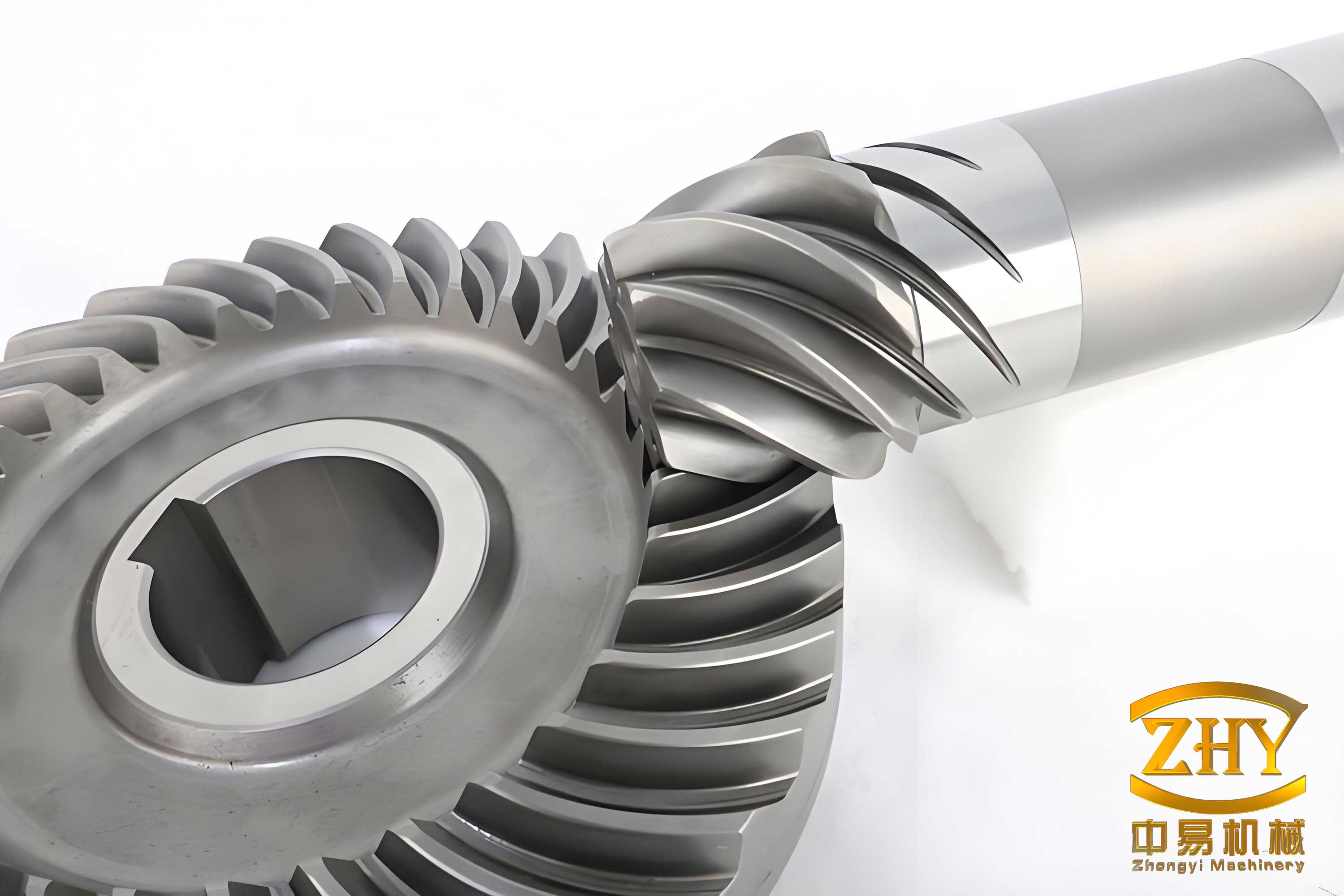
The core philosophy of this methodology is to replicate the fundamental kinematics of dedicated gear generators using the programmable axes of a standard CNC machine, enhanced with a custom-designed milling attachment and precision indexing unit. In this setup, the gear blank is not cut with a form tool that mimics the tooth space, but rather is generated through a precise, synchronized relative motion between a simple rotating cutter (acting as one tooth of a theoretical generating gear, or “crown gear”) and the workpiece itself. This generating motion creates the complex involute or octoidal tooth profile of the spiral bevel gears as an envelope of the cutter path. The technical implementation involves mounting the workpiece on a high-precision rotary table (or dividing head) integrated as an additional CNC axis (e.g., the A-axis). A specially designed milling cutter head, simulating the generating gear tooth, is mounted on the machine spindle. The CNC system then orchestrates a continuous, interpolated motion between the spindle rotation (C-axis), the linear axes (X, Y, Z), and the workpiece rotation (A-axis).
Kinematic Model and Generation Principle
The mathematical foundation for machining spiral bevel gears on a CNC mill is the kinematic model of the gear generation process. The relationship between the angular velocity of the imaginary generating gear (ω_g) and the workpiece gear (ω_w) is defined by their tooth numbers (N_g and N_w), following the basic law of gearing for a constant velocity ratio:
$$ \frac{\omega_g}{\omega_w} = \frac{N_w}{N_g} $$
In practical CNC terms, the generating gear is virtual. Its role is played by the rotating cutter. Therefore, the spindle rotation (C-axis position, θ_c) must be synchronized with the workpiece rotation (A-axis position, θ_w). For continuous generation of a tooth flank, the relationship is:
$$ \theta_w(t) = \frac{N_w}{N_g} \cdot \theta_c(t) + \theta_{offset} $$
Where θ_offset is the initial phase angle. Simultaneously, the linear axes must move to maintain the correct relative position between the cutter and the workpiece, accounting for the machine’s tool center point (TCP) and the desired depth of cut. This requires a coordinated 5-axis motion. The cutter location (CL) path for generating a single tooth flank can be derived from the equation of meshing. For a simplified model using a conical or tapered milling cutter, the surface of the generating gear tooth can be represented parametrically. The generated surface on the workpiece is the family of these surfaces subject to the meshing condition.
Let the surface of the cutter (generating tooth) be Σ_c with parameters (u, v):
$$ \vec{r_c} = \vec{r_c}(u, v) $$
During generation, this surface undergoes a screw motion relative to the workpiece. The family of surfaces is:
$$ \vec{r_w}(u, v, \phi) = M_{wg}(\phi) \cdot \vec{r_c}(u, v) $$
where M_{wg}(φ) is a homogeneous transformation matrix representing the relative motion, and φ is the motion parameter (e.g., related to θ_c). The equation of meshing is given by:
$$ f(u, v, \phi) = \vec{n_c} \cdot \vec{v_c}^{(wg)} = 0 $$
Here, \(\vec{n_c}\) is the normal to surface Σ_c, and \(\vec{v_c}^{(wg)}\) is the relative velocity vector of the cutter with respect to the workpiece at the contact point. The generated tooth surface Σ_w is the set of points satisfying both the family of surfaces and the equation of meshing.
| Feature | Traditional Dedicated Gear Generator | CNC Milling with Generation Principle |
|---|---|---|
| Machine Cost | Very High | Moderate (utilizes existing CNC) |
| Flexibility | Low (often process-specific) | Very High (programmable for different gear designs) |
| Setup Time | Can be lengthy for changeovers | Relatively fast (change CNC program) |
| Tooling Cost | High (specialized cutters & heads) | Lower (standard or slightly modified milling cutters) |
| Primary Process | Continuous indexing generation or forming | Simulated continuous generation via multi-axis interpolation |
| Ideal For | High-volume production | Prototyping, low-to-medium volume, repair, research |
System Architecture and Implementation on a Standard CNC Mill
Implementing this for spiral bevel gears requires augmenting a standard 3 or 4-axis vertical or horizontal CNC milling machine. The critical hardware additions are a high-resolution rotary axis and a rigid milling attachment. The rotary table must be accurately aligned with the machine’s coordinate system. Its angular position is controlled as a full CNC axis, synchronized with the main program. The milling attachment, mounted on the spindle, holds a cutter designed to approximate the shape of the generating gear’s tooth. For roughing, a simple end mill or a tapered ball-nose mill can be used. For finishing, a cutter with a profile closer to the ideal generating tooth form is preferred to enhance surface quality and accuracy.
The machining process is strategically divided into two phases: roughing and finishing. This division optimizes both efficiency and final quality when producing spiral bevel gears.
Roughing Strategy
The goal of roughing is to remove the bulk of material from the gear blank quickly, leaving a small, uniform stock allowance for the finishing pass. Instead of a fully synchronized continuous motion, a discrete, point-by-point strategy is often more efficient here. The tooth slot is subdivided into a series of layers or sections. For each section, the CNC program calculates a corresponding angular position for both the cutter (spindle) and the workpiece. The cutter rotates at a constant speed for cutting, but its angular position at the moment of engaging a new section is precisely defined. The process can be described algorithmically:
- Position the cutter at the start of a tooth slot at a specific depth.
- Command the spindle to rotate to a specific angular orientation (θ_c_i).
- Simultaneously, command the workpiece rotary axis to move to its corresponding angle (θ_w_i), calculated from the generation ratio.
- Execute a linear or simple contouring move to machine a segment of the slot.
- Repeat steps 2-4 for the next segment, iterating through the planned sequence until the entire slot volume is roughed out.
- Index the workpiece to the next tooth slot and repeat.
This method significantly reduces cutting forces and heat generation during heavy material removal.
Finishing Strategy
Finishing is where true continuous generation kinematics are employed to achieve the final, precise geometry of the spiral bevel gears. The cutter and workpiece enter into a state of perfectly synchronized motion, mimicking the rolling contact of the crown gear and the finished gear. The relationship defined by the equation of meshing governs the toolpath. A typical finishing pass for one flank involves:
- Engaging the cutter with the workpiece at the toe (small end) of the gear.
- Executing a synchronized 5-axis interpolated move where the linear axes (X,Y,Z) and the rotary axes (A, C) move continuously and simultaneously according to a pre-calculated, time-parameterized path derived from the kinematic model.
- This motion guides the cutter from the toe to the heel (large end) of the tooth, generating the precise curved flank surface.
- After completing one flank, the machine retracts, repositions, and generates the opposite flank of the same tooth slot, or indexes to the next tooth.
The quality of the finished spiral bevel gears is directly dependent on the accuracy of this synchronized motion, the rigidity of the setup, and the quality of the cutter.
| Parameter Category | Specific Parameters | Influence on Gear Quality & Process |
|---|---|---|
| Kinematic Parameters | Gear Ratio (N_w/N_g), Machine Root Angle, Cutter Tilt Angle | Defines fundamental tooth geometry, spiral angle, and contact pattern. |
| Tool Parameters | Cutter Diameter, Profile Angle, Corner Radius, Number of Flutes | Affects tooth form, surface finish, cutting forces, and chip evacuation. |
| Cutting Parameters | Spindle Speed (ω_c), Feed per Tooth (f_z), Synchronization Ratio (dθ_w/dθ_c), Depth of Cut | Determines material removal rate, surface integrity, tool life, and dimensional accuracy. |
| CNC Control Parameters | Interpolation Period, Servo Gain, Look-Ahead Points | Affects motion smoothness, synchronization accuracy, and contouring fidelity. |
Mathematical Formulation for Toolpath Generation
The practical task is converting the gear design specifications into machine-specific G-code. This requires a detailed mathematical model. Consider a right-hand spiral bevel gear. The fundamental coordinate systems are established: a machine coordinate system {M}, a workpiece coordinate system {W} attached to the gear blank, and a cutter coordinate system {C}. The transformation from {C} to {W} involves a series of rotations and translations based on the machine setup angles (like machine center to back, sliding base setting) and the instantaneous motion of generation.
Let the position of a point on the cutter axis in {C} be \( \vec{P_c} \). Its position in {W} is:
$$ \vec{P_w} = R_{wc}(\phi) \cdot \vec{P_c} + \vec{T}_{wc}(\phi) $$
where \( R_{wc}(\phi) \) is the rotation matrix and \( \vec{T}_{wc}(\phi) \) is the translation vector, both functions of the generation roll angle φ. For a standard CNC mill configured as a virtual gear generator, the relationship between φ and the machine axes positions (X, Z, A, C) must be established. A common configuration is:
- X-axis: Controls the horizontal offset (related to the radial setting).
- Z-axis: Controls the vertical position (related to the blank offset).
- A-axis: The workpiece rotation (θ_w).
- C-axis: The spindle rotation (θ_c).
Given the generation ratio, we have \( \theta_w = \frac{N_w}{N_g} \phi + \theta_{w0} \). The spindle rotation is directly tied to the virtual generating gear rotation, so \( \theta_c = \phi + \theta_{c0} \) (considering direction). The linear axes X and Z are functions of φ to maintain the correct center distance and vertical alignment during the roll:
$$ X(\phi) = X_0 + \Delta X(\phi) $$
$$ Z(\phi) = Z_0 + \Delta Z(\phi) $$
The functions ΔX(φ) and ΔZ(φ) are derived from the kinematic chain of the specific generator model being simulated (e.g., a planar or hypoid generator). A simplified model for a face-mill type generation might yield:
$$ \Delta X(\phi) = R_{cg} \cdot \sin(\phi) $$
$$ \Delta Z(\phi) = R_{cg} \cdot (1 – \cos(\phi)) $$
where \( R_{cg} \) is a characteristic radius related to the cutter head and generation geometry.
The final toolpath is a time-parameterized sequence of machine coordinates [X(φ(t)), Z(φ(t)), A(φ(t)), C(φ(t))]. The parameter t is often linearly related to φ for constant roll velocity during finishing.
Error Analysis and Compensation Strategies
Machining high-precision spiral bevel gears on a reconfigured platform introduces several potential error sources that must be understood and mitigated. The total error E_total on the tooth surface can be modeled as a composite of various factors:
$$ E_{total} = \sqrt{E_{kinematic}^2 + E_{thermal}^2 + E_{deflection}^2 + E_{setup}^2 + E_{tool}^2} $$
Kinematic Error (E_kinematic): Arises from inaccuracies in the mathematical model, approximations in the toolpath calculation, and interpolation errors in the CNC controller. Using higher-order terms in the generation model and tighter CNC interpolation tolerances can reduce this.
Thermal Error (E_thermal): Heat from the machining process and ambient variations cause expansion/contraction of the machine structure, workpiece, and tool. Implementing thermal stability protocols and in-process compensation is crucial.
Deflection Error (E_deflection): Cutting forces cause elastic deformation of the tool, workpiece, and machine structure, leading to deviations from the programmed path. This is particularly important for spiral bevel gears due to the varying engagement. Strategies include:
- Optimizing cutting parameters to reduce forces.
- Using a stiffness model to predict and compensate for deflection. The static deflection δ at the tool tip can be approximated by:
$$ \delta \approx \frac{F}{k_{system}} $$
where F is the cutting force component and k_system is the effective stiffness of the machine-tool-workpiece system. - Employing iterative “cut-measure-compensate” cycles.
Setup Error (E_setup): Misalignment of the rotary axis, incorrect workpiece offset, or errors in the tool length/radius compensation. Rigorous metrology and calibration procedures are essential.
Tool Geometry Error (E_tool): Wear or imperfect geometry of the milling cutter directly imprints on the gear tooth. Regular tool inspection and wear compensation are necessary.
| Error Source | Primary Effect on Spiral Bevel Gears | Potential Mitigation Techniques |
|---|---|---|
| Rotary Axis Misalignment | Asymmetric tooth profile, incorrect spiral angle, bad bearing contact. | Laser calibration, master artifact measurement, software error mapping. |
| Cutting Force Deflection | Profile error, lead crowning deviation, surface waviness. | Reduced feed per tooth, increased tool rigidity, adaptive feed control, software compensation based on force model. |
| Thermal Drift | Progressive tooth thickness error, altered pressure angle across a batch. | Machine warm-up cycles, coolant temperature control, in-process probing for thermal drift compensation. |
| Tool Wear & Runout | Deteriorating surface finish, profile inaccuracies, chatter marks. | High-quality tool holders (HSK), dynamic balancing, regular tool condition monitoring, adaptive wear offset. |
| CNC Interpolation/Following Error | Non-smooth tooth surfaces, deviations at high-curvature regions. | Optimizing servo tuning, using look-ahead functionality, employing NURBS interpolation if supported. |
Advanced Topics: Closed-Loop Control and Adaptive Machining
To push the boundaries of accuracy for spiral bevel gears manufactured on standard CNC platforms, closed-loop control strategies can be integrated. One powerful concept involves using a rotary encoder or high-resolution angle sensor (like a grating ruler or resolver) directly on the cutter spindle or an independent master axis. This sensor provides real-time feedback on the actual angular position of the generating element (θ_c_actual). This signal is fed into the CNC’s programmable logic controller (PLC) or an external real-time controller.
The core algorithm for this closed-loop generation during finishing is as follows:
- The system is initialized with the theoretical generation ratio \( R = N_w / N_g \).
- As the spindle begins its programmed rotation, the angle sensor outputs a pulse train proportional to θ_c_actual.
- For every incremental change Δθ_c measured, the controller calculates the required incremental motion for the workpiece axis:
$$ \Delta \theta_w^{command} = R \cdot \Delta \theta_c^{measured} $$ - This Δθ_w_command is sent as a motion command to the A-axis servo drive, ensuring the workpiece follows the cutter motion with the exact theoretical ratio, regardless of minor speed fluctuations in the spindle.
This method effectively makes the workpiece rotation slaved to the actual spindle rotation, creating a hardware-synchronized electronic gearbox. This dramatically improves the fidelity of the generation motion compared to open-loop programmed synchronization, especially on machines where spindle speed regulation is not perfect. The relationship can be expressed in the Laplace domain for control analysis:
$$ \Theta_w(s) = R \cdot H(s) \cdot \Theta_c(s) $$
Where H(s) represents the transfer function of the servo loop for the A-axis, designed to have near-unity gain and minimal phase lag in the frequency range of interest to accurately track the command derived from θ_c.
Furthermore, this real-time data acquisition enables adaptive machining. By monitoring cutting forces (through a spindle-integrated force sensor or motor current) and correlating it with the angular position, one can detect anomalies, adjust feeds dynamically to maintain constant chip load, or even implement on-the-fly compensation for detected errors. This represents a significant step towards intelligent, self-correcting manufacturing of complex components like spiral bevel gears.
Conclusion and Future Outlook
The methodology of adapting standard CNC milling machines for the generation of spiral bevel gears presents a compelling paradigm shift. It breaks the dependency on highly specialized, single-purpose machinery, offering remarkable flexibility, reduced capital cost, and accessibility to high-precision gear manufacturing for research institutions, job shops, and industries with low-to-medium volume needs. The key lies in the precise emulation of dedicated generator kinematics through sophisticated multi-axis interpolation and, potentially, closed-loop synchronized control. While challenges remain in matching the ultimate speed and long-term stability of dedicated gear grinders for ultra-high-volume production, the achievable quality is sufficient for a vast array of demanding applications.
The future development of this technology is closely tied to advancements in several areas: more powerful and open-architecture CNC systems that allow deeper integration of real-time sensor feedback and custom algorithms; improved physical machine components like direct-drive rotary tables and high-stiffness spindle attachments; and smarter, cloud-connected CAM software that can seamlessly translate gear design parameters into optimized, compensated toolpaths while factoring in predicted machine and process dynamics. As these elements converge, the vision of a standard, multi-purpose CNC machining center serving as a versatile and precise “gear generator on demand” becomes increasingly tangible, further solidifying the role of advanced digital manufacturing in producing critical components like spiral bevel gears.