
In the automotive industry, the performance and durability of rear axle drives heavily depend on the precision of spiral bevel gears, which transmit power between intersecting shafts. As a manufacturing engineer, I have been involved in extensive research to understand how heat treatment processes affect the contact patterns of these critical components. Through systematic experimentation, we aimed to uncover the underlying laws governing contact pattern shifts in spiral bevel gears before and after heat treatment, thereby enhancing product quality and production control. This study focuses on spiral bevel gears used in heavy-duty vehicles, where consistent contact patterns are essential for minimizing noise, wear, and failure. The investigation delves into the types of contact patterns, their transformations during thermal processing, and key influencing factors, with the ultimate goal of stabilizing contact patterns for improved reliability. Our work emphasizes the importance of spiral bevel gears in automotive applications, and we will repeatedly reference spiral bevel gears to highlight their centrality in this analysis.
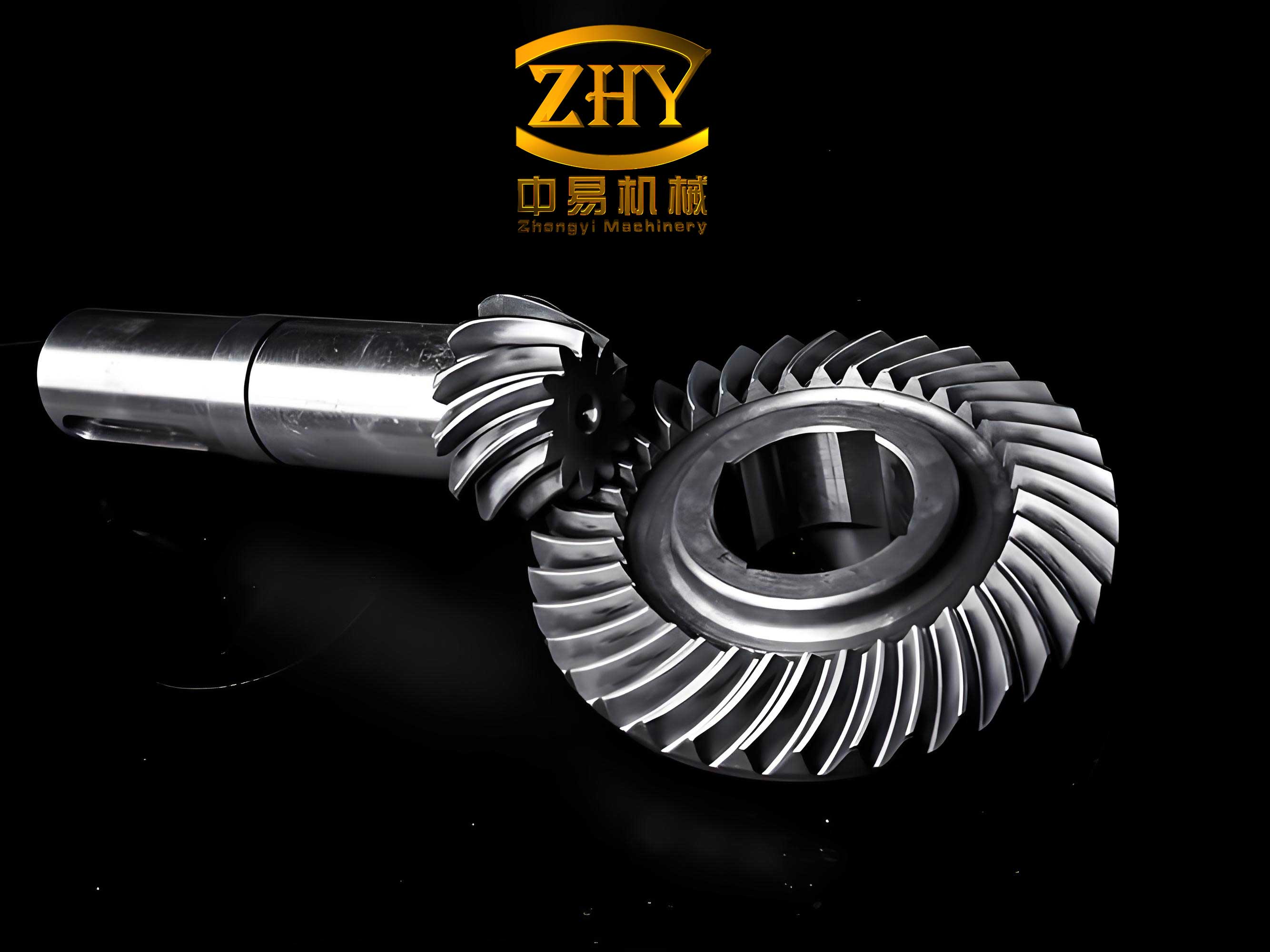
The contact pattern on the tooth surface of spiral bevel gears is a critical indicator of proper meshing and load distribution. It refers to the area where the driving and driven gears make contact under load, and its position and size directly influence gear performance. In our factory, we observed that spiral bevel gears often exhibit variations in contact patterns after heat treatment, leading to inconsistencies in product quality. To address this, we initiated a large-scale experimental program involving numerous spiral bevel gear sets. We classified the contact patterns based on their locations on the tooth surfaces, which helped us identify common trends and anomalies. The stability of these patterns is paramount, as deviations can result in increased stress concentrations and reduced service life. Therefore, understanding the changes in contact patterns for spiral bevel gears is essential for optimizing manufacturing processes.
We began by categorizing the contact patterns of spiral bevel gears before heat treatment. Based on observations from multiple gear sets, the contact patterns on the convex and concave tooth surfaces can be divided into four primary types. These types are defined by the position of the contact area relative to the gear tooth, such as near the toe (small end) or heel (large end). The distribution of these types provides insight into the initial machining accuracy and potential thermal deformation. Below is a summary table of these contact pattern types for spiral bevel gears, derived from our pre-heat treatment inspections.
| Type | Convex Tooth Surface | Concave Tooth Surface | Description | Percentage of Total |
|---|---|---|---|---|
| 1 | Mid-tooth, slightly toward small end | Mid-tooth, slightly toward small end | Contact area centered but shifted toward the toe on both surfaces. | Approximately 40% |
| 2 | Toward large end | Near small end | Convex surface contact is biased toward the heel, while concave surface is near the toe. | Approximately 30% |
| 3 | Near small end | Mid-tooth | Convex surface contact is close to the toe, and concave surface is centered. | Approximately 20% |
| 4 | Inconsistent across gear circumference | Inconsistent across gear circumference | Contact pattern varies around the gear, indicating machining or material inconsistencies. | Approximately 10% |
This classification reveals that a significant portion of spiral bevel gears exhibit non-ideal contact patterns even before heat treatment. To improve product quality, we must enhance the stability of these patterns, which requires a deep dive into how they evolve during thermal processing. The spiral bevel gears we studied are manufactured using Gleason machines, and our experiments involved both drive (pinion) and driven (gear) spiral bevel gears. We designed a four-step inspection protocol to systematically track contact pattern changes at different stages, ensuring comprehensive data collection for spiral bevel gears.
The experimental procedures were as follows: First, we inspected the contact patterns after gear cutting but before heat treatment. This involved checking the convex and concave surfaces of both pinion and gear spiral bevel gears, along with geometric parameters like flatness of the gear back face, ovality of the bore, and radial runout of pinion shafts. Second, after heat treatment of the driven gear, we examined its contact pattern changes by pairing it with an unheated pinion. This isolated the driven gear’s deformation effects. Third, we assessed the heat-treated pinion’s contact pattern using an unheated driven gear, eliminating influence from the mating gear’s deformation. Fourth, we conducted a final pair-check with both heat-treated spiral bevel gears to observe the combined contact pattern. All inspections were performed on a Gleason testing machine, ensuring consistent measurement conditions for spiral bevel gears.
From this data, we analyzed the contact pattern transformations. Before heat treatment, typical spiral bevel gears showed the driven gear’s convex surface contact at mid-tooth and concave surface contact near the small end. After heat treatment, when paired with an unheated pinion, the driven gear’s contact patterns shifted into three main categories, as summarized in the table below. These changes indicate predictable deformations in spiral bevel gears due to thermal cycles.
| Category | Convex Tooth Surface | Concave Tooth Surface | Description | Percentage of Cases |
|---|---|---|---|---|
| A | Contact length increases by 10-20% | Contact length slightly increases | Position remains similar to pre-heat treatment, with minimal movement. | Approximately 50% |
| B | Shifts toward large end by 1-2 mm | Position largely unchanged | Convex surface moves toward heel, while concave surface stays stable. | Approximately 40% |
| C | Inconsistent around gear circumference | Inconsistent around gear circumference | Irregular deformations lead to non-uniform contact patterns. | Approximately 10% |
These results suggest that most spiral bevel gears undergo systematic deformations, which can be anticipated and compensated for during pre-heat treatment machining adjustments. For instance, if we know that a spiral bevel gear’s convex surface tends to shift toward the large end after heat treatment, we can pre-adjust the cutting parameters to position the contact area slightly toward the small end initially. This proactive approach is crucial for achieving ideal contact patterns in finished spiral bevel gears.
Similarly, we examined the pinion spiral bevel gears after heat treatment. When paired with unheated driven gears, the pinions showed consistent deformation patterns based on normalizing temperature. For example, pinions normalized at 900°C exhibited convex surface contact moving 0.5-1.0 mm toward the small end and concave surface contact moving 0.5-1.0 mm toward the large end. Those normalized at 950°C showed similar but slightly larger shifts. This consistency allows us to model the deformation using mathematical formulas. The contact pattern shift can be related to thermal expansion and phase transformations during heat treatment. We propose a simplified model for the displacement $\Delta P$ of the contact center on a spiral bevel gear tooth surface:
$$ \Delta P = \alpha \cdot \Delta T \cdot L + \beta \cdot \sigma_y $$
where $\alpha$ is the coefficient of thermal expansion for the gear material, $\Delta T$ is the temperature change during heat treatment, $L$ is a characteristic length of the tooth, and $\beta$ is a deformation coefficient related to yield stress $\sigma_y$. This equation highlights how temperature gradients and material properties affect spiral bevel gears. For more precise analysis, we can incorporate gear geometry parameters. The contact pattern location on a spiral bevel gear tooth can be parameterized by the distance from the toe $d_t$ and the distance from the heel $d_h$, with the total tooth length $L_t = d_t + d_h$. After heat treatment, the new position $d_t’$ can be expressed as:
$$ d_t’ = d_t + \gamma \cdot \Delta T \cdot \left( \frac{E}{E_0} \right) $$
where $\gamma$ is a gear-specific constant, $E$ is the Young’s modulus after heat treatment, and $E_0$ is the initial Young’s modulus. Such formulas help quantify the changes observed in spiral bevel gears and guide process adjustments.
When both heat-treated spiral bevel gears are paired, the combined contact pattern results from the superposition of individual deformations. Our final pair-check revealed four outcome categories, as shown in the table below. These outcomes demonstrate how interactions between pinion and gear spiral bevel gears can lead to ideal or non-ideal contact patterns.
| Category | Convex Tooth Surface | Concave Tooth Surface | Description |
|---|---|---|---|
| I | Moves toward small end | Moves toward large end | Achieves ideal contact pattern position after compensation. |
| II | Mid-tooth position | Biased toward small end | Convex surface is centered, but concave surface is off-center. |
| III | At small end | Mid-tooth position | Convex surface is at toe, while concave surface is centered. |
| IV | Inconsistent around gear circumference | Inconsistent around gear circumference | Non-uniform deformations cause erratic contact patterns. |
To further understand these variations, we investigated key factors influencing contact pattern consistency in spiral bevel gears after heat treatment. The two primary factors identified were normalizing temperature and bore ovality. Normalizing temperature plays a critical role in determining the microstructure and residual stresses of spiral bevel gears. We conducted experiments with gears made from the same material batch but normalized at different temperatures: 900°C and 950°C. Both sets were then carburized and quenched under identical conditions. The results indicated that spiral bevel gears normalized at the same temperature exhibited consistent contact pattern shifts, while those normalized at different temperatures showed discrepancies. This can be explained by the differential phase transformation kinetics, which affect dimensional stability. The relationship between normalizing temperature $T_n$ and contact pattern shift $\Delta C$ can be approximated by:
$$ \Delta C = k_1 \cdot (T_n – T_0) + k_2 \cdot \exp\left(-\frac{Q}{RT_n}\right) $$
where $k_1$ and $k_2$ are constants, $T_0$ is a reference temperature, $Q$ is activation energy for diffusion, and $R$ is the gas constant. This nonlinear behavior underscores the importance of tightly controlling normalizing processes for spiral bevel gears.
The second major factor is bore ovality in driven spiral bevel gears. Bore ovality refers to the deviation from a perfect circular shape in the gear’s inner diameter, which can exacerbate during heat treatment due to uneven cooling or residual stresses. We measured ovality before and after carburization, as well as after quenching, using standard metrology tools. Increased ovality was found to correlate with skewed contact patterns, as it alters the gear’s mounting alignment and meshing geometry. The effect of ovality $\delta_o$ on contact pattern deviation $\Delta D$ can be modeled as:
$$ \Delta D = \mu \cdot \delta_o \cdot \frac{D_p}{B} $$
where $\mu$ is a proportionality constant, $D_p$ is the pitch diameter of the spiral bevel gear, and $B$ is the face width. This relationship suggests that even minor ovality can significantly impact contact patterns, reducing product yield. Therefore, controlling bore distortion through optimized quenching techniques or pre-stress relief is vital for spiral bevel gears.
In addition to these factors, other variables such as carburizing time, quenching medium, and gear geometry also contribute to contact pattern changes in spiral bevel gears. However, our experiments focused on the most prominent ones to establish actionable guidelines. Based on our findings, we implemented process adjustments in the gear cutting phase for spiral bevel gears. For example, if a batch of spiral bevel gears is normalized at 950°C, we offset the machine settings to pre-position the contact area 0.5 mm toward the opposite direction of expected shift. This compensation has improved the consistency of post-heat treatment contact patterns for spiral bevel gears, enhancing overall product quality.
To generalize our results, we developed a comprehensive framework for predicting contact pattern changes in spiral bevel gears. This framework integrates thermal, mechanical, and geometric models. The total deformation $\Delta T_{total}$ of a spiral bevel gear tooth surface after heat treatment can be expressed as a sum of contributions from thermal expansion, phase transformation, and residual stresses:
$$ \Delta T_{total} = \int_{V} \left( \alpha(T) \Delta T + \epsilon_{pt}(T) + \frac{\sigma_r(T)}{E(T)} \right) dV $$
where $V$ is the gear volume, $\alpha(T)$ is temperature-dependent thermal expansion coefficient, $\epsilon_{pt}(T)$ is phase transformation strain, and $\sigma_r(T)$ is residual stress as a function of temperature. This integral approach allows us to simulate the behavior of spiral bevel gears under various heat treatment conditions, aiding in process optimization. Furthermore, we can relate contact pattern quality to gear performance metrics like contact stress $\sigma_c$, calculated using Hertzian contact theory for spiral bevel gears:
$$ \sigma_c = \sqrt{ \frac{F_n}{\pi} \cdot \frac{1-\nu^2}{E} \cdot \frac{1}{R_e} } $$
where $F_n$ is the normal load, $\nu$ is Poisson’s ratio, and $R_e$ is the equivalent radius of curvature at the contact point. By ensuring optimal contact patterns, we minimize $\sigma_c$ and extend the service life of spiral bevel gears.
Our research has practical implications for the manufacturing of spiral bevel gears. By understanding and controlling contact pattern changes, we can reduce scrap rates, improve gear efficiency, and lower warranty claims. The insights gained from this study are now being applied to our production lines for spiral bevel gears, resulting in more predictable outcomes and higher customer satisfaction. Future work could explore advanced materials or hybrid heat treatment processes for spiral bevel gears to further enhance stability.
In conclusion, through extensive experimentation and analysis, we have elucidated the laws governing contact pattern changes in spiral bevel gears after heat treatment. The classification of contact patterns, systematic inspection procedures, and identification of key factors like normalizing temperature and bore ovality provide a solid foundation for quality control. By leveraging mathematical models and empirical data, we can now proactively adjust manufacturing parameters to achieve ideal contact patterns in spiral bevel gears. This advancement not only solves production challenges but also elevates the overall quality of spiral bevel gears, ensuring their reliable performance in demanding automotive applications. The continuous focus on spiral bevel gears in this study underscores their critical role, and we remain committed to refining our processes for these essential components.