
In modern mechanical transmission systems, spiral bevel gears are widely employed due to their smooth operation and high load-carrying capacity. However, traditional design approaches often involve tedious iterative adjustments and repeated verification calculations, consuming significant time and effort. This article introduces an analytical design method that enables efficient and accurate design of spiral bevel gears in a single pass, addressing the limitations of conventional techniques.
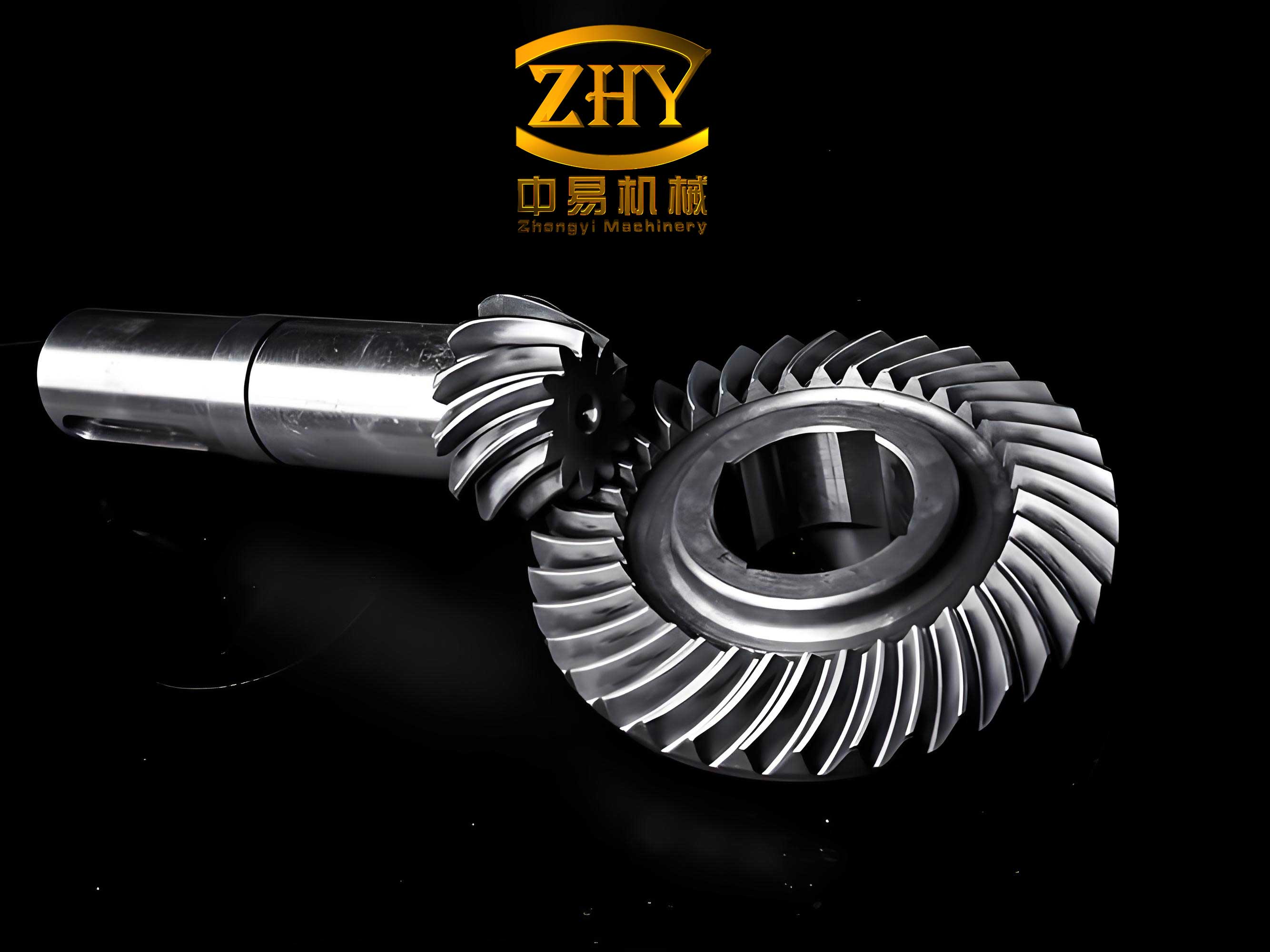
The design of spiral bevel gears is critical for applications in industries such as mining, automotive, and aerospace, where reliability and performance are paramount. The Gleason system is a standard for manufacturing these gears, but its design complexity has long been a challenge. Commonly used methods include graphical selection with verification, analogy-based design, and optimization techniques. While these approaches have their merits, they often rely on rough initial parameter estimates or simplified constraints, leading to suboptimal results. For instance, graphical methods may not adequately account for factors like reliability, operating conditions, installation specifics, material properties, or manufacturing precision. Optimization methods, though advanced, can suffer from oversimplifications to improve computational speed, potentially compromising design accuracy. Thus, there is a pressing need for a more robust and streamlined design methodology for spiral bevel gears.
This analytical design method leverages established strength verification formulas to derive mathematical models for both bending and contact strength. By incorporating iterative calculations for key coefficients, it ensures precise parameter selection without multiple trials. The method has been successfully implemented in computer software for mining reducer design, demonstrating its practicality and efficiency. Below, I will detail the derivation and application of this method, emphasizing the use of formulas and tables to summarize key aspects.
Overview of Existing Design Methods
Current design practices for spiral bevel gears can be categorized into three main approaches:
| Method | Description | Limitations |
|---|---|---|
| Graphical Selection with Verification | Initial parameters are chosen from charts, followed by strength checks and iterations. | Time-consuming; may not consider all operational factors. |
| Analogy-Based Design | Parameters are selected based on similar existing gear designs. | Requires extensive experience; may not optimize for specific conditions. |
| Optimization Design | Mathematical optimization techniques are used to minimize or maximize objective functions. | Often simplifies constraints for speed, potentially reducing accuracy. |
These methods typically involve initial guesses that do not fully incorporate reliability targets, such as minimum safety factors, or detailed operating environments. Consequently, designers must repeatedly adjust parameters and perform verification calculations, which can be inefficient. The analytical method presented here overcomes these drawbacks by directly embedding strength criteria into the design equations.
Analytical Design Method for Spiral Bevel Gears
The analytical design method is founded on strength-based formulas, allowing for a one-pass design process. It separately addresses bending strength and contact strength, deriving explicit expressions for the pinion pitch diameter. Key to this method is the iterative refinement of dynamic and size factors, which are typically approximated in traditional approaches. I will first discuss the bending strength design, followed by the contact strength design, and then outline the steps to determine the final gear parameters.
Design Based on Bending Strength
The bending stress calculation for spiral bevel gears follows the Gleason system. The formula for bending stress is given by:
$$ \sigma_F = \frac{4 \times 10^3 T_1 K_A K_{FU} \sin \Gamma_1}{d_1^3 h_R z_1 J} K_v Y_x $$
Where:
– \( T_1 \) is the input torque of the pinion (in N·m).
– \( K_A \) is the application factor.
– \( K_{FU} \) is the load distribution factor for bending.
– \( \Gamma_1 \) is the pinion pitch angle (calculated from the actual gear ratio).
– \( z_1 \) is the number of teeth on the pinion.
– \( K_v \) is the dynamic factor.
– \( Y_x \) is the size factor for bending.
– \( d_1 \) is the pitch diameter of the pinion at the large end (in mm).
– \( h_R \) is the face width coefficient.
– \( J \) is the geometry factor for bending, which is a function of \( z_1 \) and \( z_2 \) (the gear teeth numbers).
The bending fatigue limit stress is:
$$ \sigma’_{F \text{lim}} = \sigma_{F \text{lim}} \frac{Y_N}{Y_\theta} $$
Where:
– \( \sigma_{F \text{lim}} \) is the bending fatigue limit stress from test data.
– \( Y_N \) is the life factor for bending.
– \( Y_\theta \) is the temperature factor.
The safety factor for bending is:
$$ S_F = \frac{\sigma’_{F \text{lim}}}{\sigma_F} $$
To meet the strength condition, \( S_F \geq S_{F \text{min}} \), where \( S_{F \text{min}} \) is the minimum allowable safety factor. Setting \( S_F = S_{F \text{min}} \), we can combine the equations to derive the design formula for the pinion pitch diameter based on bending strength:
$$ d_F = \sqrt[3]{\frac{4 \times 10^3 T_1 K_A K_{FU} Y_\theta S_{F \text{min}} \sin \Gamma_1 z_1}{h_R \sigma_{F \text{lim}} Y_N J}} \cdot \sqrt[3]{K_v Y_x} $$
Define a constant term for bending:
$$ C_{1F} = \sqrt[3]{\frac{4 \times 10^3 T_1 K_A K_{FU} Y_\theta S_{F \text{min}} \sin \Gamma_1 z_1}{h_R \sigma_{F \text{lim}} Y_N J}} $$
Thus, the equation simplifies to:
$$ d_F = C_{1F} \sqrt[3]{K_v Y_x} $$
In this expression, only the dynamic factor \( K_v \) and the size factor \( Y_x \) are variable and require determination. For spiral bevel gears, typical manufacturing precision ranges from grade 7 to 9, and the dynamic factor can be approximated from standard curves. By fitting the curve for lower-precision spiral bevel gears, an approximate function is derived:
$$ K_v = 1 + \frac{v}{5.56} $$
Where \( v \) is the pitch line velocity in m/s, calculated as \( v = \frac{d_1 \pi n}{6 \times 10^4} \), with \( n \) being the pinion speed in rpm. The value of \( K_v \) typically lies between 1 and 1.42 for velocities up to 40 m/s.
The size factor \( Y_x \) depends on the module and can be approximated from another standard curve. Fitting this curve yields:
$$ Y_x = \left( \frac{m_t}{25.4} \right)^{0.25106} $$
Where \( m_t \) is the transverse module at the large end in mm. \( Y_x \) generally ranges from 0.5 to 1 for common module sizes.
To accurately determine \( K_v \) and \( Y_x \), an iterative process is employed. Initial values are chosen, such as \( K_{v0} = 1.26 \) and \( Y_{x0} = 0.8 \), based on typical design ranges. Then, iterative equations are established:
For the dynamic factor:
$$ K_{vN} = 1 + C_{2F} \sqrt[6]{K_{v(N-1)} Y_{x(N-1)}} $$
Where \( C_{2F} = \frac{C_{1F} \pi n / (6 \times 10^4)}{5.56} \).
For the size factor:
$$ Y_{xN} = C_{3F} \left( \sqrt[3]{K_{v(N-1)} Y_{x(N-1)}} \right)^{0.25106} $$
Where \( C_{3F} = \frac{C_{1F}}{25.4 z_1} \).
These functions converge quickly. The iteration continues until the relative changes in \( K_v \) and \( Y_x \) are below a threshold, such as 0.001. After convergence, the final values \( K_v = K_{vN} \) and \( Y_x = Y_{xN} \) are substituted back to compute \( d_F \).
| Parameter | Symbol | Typical Range or Value |
|---|---|---|
| Pinion Pitch Diameter (Bending) | \( d_F \) | Determined iteratively |
| Dynamic Factor | \( K_v \) | 1 to 1.42 |
| Size Factor (Bending) | \( Y_x \) | 0.5 to 1 |
| Bending Constant | \( C_{1F} \) | Calculated from input parameters |
This iterative approach ensures that the dynamic and size factors are precisely accounted for, leading to an accurate bending strength design for spiral bevel gears.
Design Based on Contact Strength
For contact strength, the Hertzian stress formula is used. The contact stress is given by:
$$ \sigma_H = Z_E \sqrt{ \frac{6 \times 10^3 T_1 K_A K_{HU} K_v Z_x Z_R \sin \Gamma_1}{d_1^3 h_R I} } $$
Where:
– \( Z_E \) is the elasticity coefficient.
– \( K_{HU} \) is the load distribution factor for contact.
– \( Z_x \) is the size factor for contact.
– \( Z_R \) is the surface finish factor.
– \( I \) is the geometry factor for contact.
The contact fatigue limit stress is:
$$ \sigma’_{H \text{lim}} = \sigma_{H \text{lim}} \frac{Z_N Z_W}{Z_\theta} $$
Where:
– \( \sigma_{H \text{lim}} \) is the contact fatigue limit stress from test data.
– \( Z_N \) is the life factor for contact.
– \( Z_W \) is the work hardening factor.
– \( Z_\theta \) is the temperature factor.
The safety factor for contact is:
$$ S_H = \frac{\sigma’_{H \text{lim}}}{\sigma_H} $$
Setting \( S_H = S_{H \text{min}} \), the minimum allowable safety factor, we derive the design formula for the pinion pitch diameter based on contact strength:
$$ d_H = \sqrt[3]{ \frac{6 \times 10^3 T_1 K_A K_{HU} Z_x Z_R \sin \Gamma_1}{h_R I} \left( \frac{Z_\theta Z_E S_{H \text{min}}}{\sigma_{H \text{lim}} Z_N Z_W} \right)^2 } \cdot \sqrt[3]{K_v} $$
Define a constant term for contact:
$$ C_{1H} = \sqrt[3]{ \frac{6 \times 10^3 T_1 K_A K_{HU} Z_x Z_R \sin \Gamma_1}{h_R I} \left( \frac{Z_\theta Z_E S_{H \text{min}}}{\sigma_{H \text{lim}} Z_N Z_W} \right)^2 } $$
Thus, the equation simplifies to:
$$ d_H = C_{1H} \sqrt[3]{K_v} $$
Here, only the dynamic factor \( K_v \) is variable. Using the same approximation for \( K_v \) as in bending strength, an iterative process is applied. Starting with an initial value \( K_{v0} = 1.26 \), the iterative formula is:
$$ K_{vN} = 1 + C_{2H} \sqrt[6]{K_{v(N-1)}} $$
Where \( C_{2H} = \frac{C_{1H} \pi n / (6 \times 10^4)}{5.56} \). This function converges rapidly. Iteration continues until the relative change in \( K_v \) is below 0.001. The final \( K_v = K_{vN} \) is then used to compute \( d_H \).
| Parameter | Symbol | Typical Range or Value |
|---|---|---|
| Pinion Pitch Diameter (Contact) | \( d_H \) | Determined iteratively |
| Dynamic Factor | \( K_v \) | 1 to 1.42 |
| Contact Constant | \( C_{1H} \) | Calculated from input parameters |
This process ensures that the contact strength design for spiral bevel gears is accurate and efficient.
Determination of Final Pinion Pitch Diameter
After computing both \( d_F \) and \( d_H \), the larger value is selected as the final pinion pitch diameter \( d_1 \). This ensures that the gear design satisfies both bending and contact strength criteria. To complete the design, a final strength verification can be performed using the selected parameters to compute the actual safety factors for both pinion and gear, providing a reliability assessment. Additionally, geometric dimensions and measurement parameters should be calculated for manufacturing purposes.
The table below summarizes the key steps in the analytical design method for spiral bevel gears:
| Step | Action | Formula or Method |
|---|---|---|
| 1 | Input design parameters (torque, speed, material, etc.) | Specify \( T_1, n, \sigma_{F \text{lim}}, \sigma_{H \text{lim}}, S_{F \text{min}}, S_{H \text{min}}, etc. \) |
| 2 | Calculate constants \( C_{1F} \) and \( C_{1H} \) | Use derived equations for bending and contact. |
| 3 | Perform iterative calculation for \( K_v \) and \( Y_x \) in bending design | Use iterative equations until convergence. |
| 4 | Compute \( d_F \) from bending strength | \( d_F = C_{1F} \sqrt[3]{K_v Y_x} \) |
| 5 | Perform iterative calculation for \( K_v \) in contact design | Use iterative equation until convergence. |
| 6 | Compute \( d_H \) from contact strength | \( d_H = C_{1H} \sqrt[3]{K_v} \) |
| 7 | Select final \( d_1 \) as max(\( d_F, d_H \)) | Ensures both strength conditions are met. |
| 8 | Verify strength and compute geometric parameters | Perform final checks and detailed calculations. |
Advantages of the Analytical Design Method
This analytical design method offers several benefits over traditional approaches for spiral bevel gears. First, it eliminates the need for repeated trials by directly incorporating strength criteria into the design equations. Second, the iterative refinement of dynamic and size factors enhances accuracy, as these coefficients are often approximated in other methods. Third, the method is computationally efficient and can be easily implemented in software, reducing design time significantly. Moreover, it is applicable to all Gleason system spiral bevel gears, making it versatile for various industrial applications. By using this method, designers can achieve optimal gear parameters in a single pass, ensuring high reliability and performance for spiral bevel gears in demanding environments.
Conclusion
The analytical design method for Gleason spiral bevel gears presented here provides a systematic and efficient approach to gear design. By deriving explicit formulas for bending and contact strength and employing iterative calculations for key factors, it addresses the shortcomings of conventional methods. This method not only saves time but also improves design accuracy, making it a valuable tool for engineers working with spiral bevel gears. Future work could involve extending this approach to incorporate additional factors like lubrication effects or advanced material properties, further enhancing the design of spiral bevel gears for modern mechanical systems.