
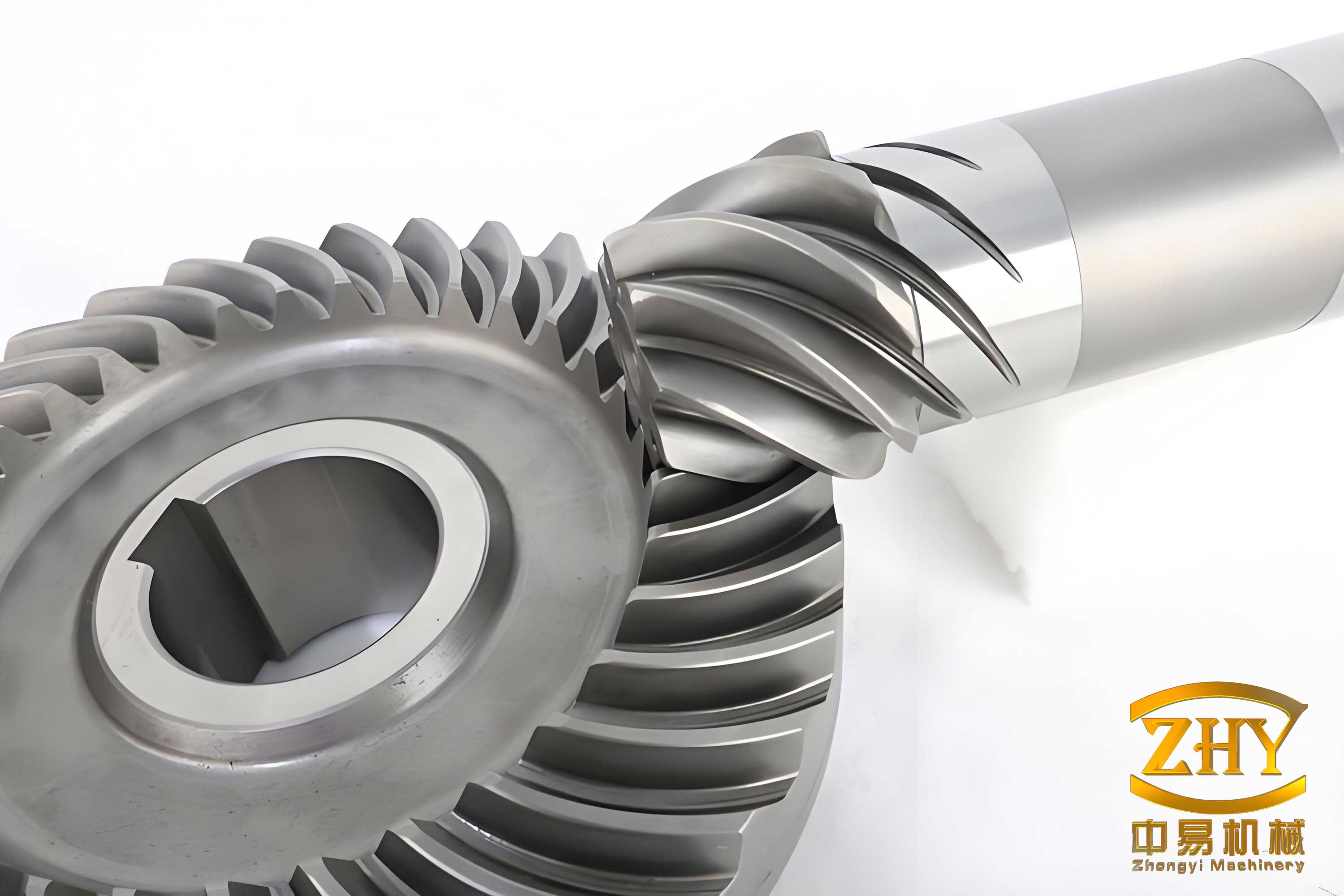
The manufacturing of high-precision spiral bevel gears is a cornerstone of modern power transmission systems, particularly in demanding sectors such as aerospace, automotive, and heavy machinery. These gears enable efficient power transfer between non-parallel, intersecting shafts with superior load capacity and smoother operation compared to their straight-bevel counterparts. The complexity of their geometry—featuring curved teeth and a progressive contact pattern—poses significant challenges in production.
For decades, the dominant manufacturing technology relied on complex mechanical gear generators, often referred to as cradle-style machines. These machines use a sophisticated arrangement of gears, cams, and linkages to generate the relative motion between the cutting tool (cutter head) and the workpiece (gear blank). While capable of producing excellent gears, these mechanical systems suffer from inherent limitations: intricate setup procedures requiring highly skilled operators, long changeover times between different gear designs, physical constraints on possible machine kinematics, and the inability to easily implement advanced corrections or new gear geometries.
The advent of Computer Numerical Control (CNC) has revolutionized this field. Modern CNC gear generators, such as those in the conceptual model shown below, replace the intricate mechanical train with independently controlled servo axes. A typical architecture involves three linear axes (X, Y, Z) and three rotational axes (A, B, C). This configuration provides unparalleled flexibility, allowing the machine to emulate not only traditional Gleason methods but also Oerlikon systems, face-hobbing processes, and even free-form machining strategies through direct programming of the toolpath. Theoretically, this grants nearly infinite degrees of freedom for designing and manufacturing optimized tooth surfaces.
However, this transition introduces a significant practical hurdle: the vast repository of established knowledge, proven machine settings, and practical experience is encoded in the language of mechanical machine settings (e.g., machine center to back, sliding base, cradle angle, ratio of roll). CNC machines require inputs as time-dependent polynomial functions for each axis. To leverage existing expertise and ensure continuity in gear quality, a robust, accurate, and computationally efficient method for transforming traditional mechanical settings into CNC axis polynomials is essential. This article delves into the kinematic transformation principle and presents a superior method—the Velocity-Differentiating Method—for calculating the coefficients of these polynomials, enabling the precise and efficient CNC machining of spiral bevel gears.
Kinematic Fundamentals and Mathematical Modeling
The core principle governing the parameter transformation is invariance: the relative position and motion between the cutting tool and the gear blank must remain identical in both the mechanical and the CNC machine at every instant during the generation process. This ensures that the manufactured tooth surface geometry is preserved. We begin by establishing mathematical models for both machine types.
Mathematical Model of a Mechanical Cradle-Style Generator (Tilt-Type)
Consider a simplified model of a tilt-style mechanical generator for spiral bevel gears. The key components and their associated parameters are defined within a global machine coordinate system (O-XYZ). The Z-axis is aligned with the cradle axis, the Y-axis is vertical, and the X-axis completes the right-handed system.
The critical vectors defining the spatial relationship are:
1. Tool Axis Vector (T): Defines the orientation of the cutter head. It is influenced by the machine tilt ($I_n$) and swivel ($\eta$) angles, and rotates with the cradle angle.
2. Workpiece Axis Vector (W): Defines the orientation of the gear blank, set by the machine’s root angle ($\gamma$).
3. Position Vector (L): Connects the gear blank’s root cone apex ($O_1$) to the center of the cutter head (C). Its components are determined by settings like the radial distance ($S_p$), horizontal ($H$) and vertical ($E$) offsets, and the machine center to back ($M$).
Let $t=0$ be the reference instant at the start of the roll cycle, with an initial cradle angle $\theta_0$. The cradle rotates with an angular velocity $\omega_c$. At any time $t$, the cradle angle is $\theta = \theta_0 + \omega_c t$. The vectors can be expressed as functions of $t$, the machine settings, and constants $(\mathbf{i}, \mathbf{j}, \mathbf{k})$ representing the unit vectors of the X, Y, Z axes.
$$
\mathbf{T}(t) = \sin I_n \sin(\theta_0 – \eta + \omega_c t)\,\mathbf{i} + \sin I_n \cos(\theta_0 – \eta + \omega_c t)\,\mathbf{j} + \cos I_n\,\mathbf{k}
$$
$$
\mathbf{L}(t) = \left[S_p \cos(\theta_0 + \omega_c t) + H \cos\gamma\right]\mathbf{i} + \left[E – S_p \sin(\theta_0 + \omega_c t)\right]\mathbf{j} + \left(H \sin\gamma – M\right)\mathbf{k}
$$
$$
\mathbf{W} = \cos\gamma\,\mathbf{i} + \sin\gamma\,\mathbf{k} \quad \text{(constant orientation)}
$$
These three vectors $\mathbf{T}(t)$, $\mathbf{W}$, and $\mathbf{L}(t)$ completely define the instantaneous kinematic state of the mechanical system for machining spiral bevel gears.
Mathematical Model of a 6-Axis CNC Gear Generator
The CNC machine has a different structural layout. Typically, the cutter spindle axis is aligned parallel to the machine’s Z-axis, and the workpiece spindle axis lies in the XZ-plane. The goal is to find time-dependent functions for its six axes $X(t), Y(t), Z(t), A(t), B(t), C(t)$ such that the tool-workpiece relationship defined by $\mathbf{T}(t)$, $\mathbf{W}$, and $\mathbf{L}(t)$ is exactly replicated.
The transformation is achieved through a sequence of virtual rotations applied to the mechanical machine’s vectors:
1. Rotation $\Delta\alpha$ about the Workpiece Axis (W): This rotation is applied to the tool axis vector $\mathbf{T}$ to bring it into the XZ-plane of the CNC machine, resulting in an intermediate vector $\mathbf{T}^I$. The angle $\Delta\alpha$ is time-dependent and derived from the condition that the Y-component of the rotated tool axis (relative to a coordinate system aligned with $\mathbf{W}$) becomes zero.
2. Rotation $\Delta\beta$ about the Y-axis: Both the transformed tool axis $\mathbf{T}^I$ and the workpiece axis $\mathbf{W}$ are then rotated together about the global Y-axis by an angle $\Delta\beta$. This final rotation aligns $\mathbf{T}^{II}$ with the CNC machine’s Z-axis, while the workpiece axis $\mathbf{W}^{II}$ takes its final orientation in the XZ-plane.
3. Transformation of the Position Vector: The position vector $\mathbf{L}$ undergoes the same sequence of rotations to become $\mathbf{L}^{II}(t)$ in the CNC coordinate system.
The required CNC axis commands are then extracted from these transformed vectors and the required workpiece rotation:
– The linear axes $X(t), Y(t), Z(t)$ are the components of $\mathbf{L}^{II}(t)$.
– The rotational axis $A(t)$ is the sum of the workpiece’s own generation rotation (e.g., $\alpha_g(t)$ from the ratio of roll) and the virtual rotation $\Delta\alpha(t)$.
– The rotational axis $B(t)$ is the sum of the basic root angle $\gamma$ and the virtual rotation $\Delta\beta(t)$.
– The rotational axis $C(t)$ is the cutter spindle rotation, which is independent and typically a constant high speed.
The formal expressions are:
$$
\begin{aligned}
X(t) &= \mathbf{L}^{II}(t) \cdot \mathbf{i} \\
Y(t) &= \mathbf{L}^{II}(t) \cdot \mathbf{j} \\
Z(t) &= \mathbf{L}^{II}(t) \cdot \mathbf{k} \\
A(t) &= \alpha_g(t) + \Delta\alpha(t) \\
B(t) &= \gamma + \Delta\beta(t)
\end{aligned}
$$
Where $\Delta\alpha(t)$ and $\Delta\beta(t)$ are non-linear functions of $t$, $I_n$, $\eta$, $\theta_0$, $\gamma$, and $\omega_c$. The explicit forms are complex but derivable from the rotation constraints. For modern production of spiral bevel gears, each axis function $X(t), Y(t), …$ is approximated by a 4th-order polynomial in time to ensure high-order conformity of the generated tooth surface.
$$
X(t) = x_0 + x_1 t + x_2 t^2 + x_3 t^3 + x_4 t^4
$$
And similarly for $Y(t), Z(t), A(t), B(t)$. The central computational problem is determining the coefficients $(x_0, x_1, …, x_4)$ efficiently and accurately from the known mechanical settings.
The Velocity-Differentiating Method for Coefficient Determination
A straightforward approach to find the polynomial coefficients is the Direct Differentiation Method. It involves evaluating the closed-form expression for, say, $X(t)$ and its first four time derivatives at the reference point $t=0$:
$$
\begin{aligned}
x_0 &= X(0) \\
x_1 &= \left.\frac{dX}{dt}\right|_{t=0} \\
x_2 &= \frac{1}{2!}\left.\frac{d^2X}{dt^2}\right|_{t=0} \\
x_3 &= \frac{1}{3!}\left.\frac{d^3X}{dt^3}\right|_{t=0} \\
x_4 &= \frac{1}{4!}\left.\frac{d^4X}{dt^4}\right|_{t=0}
\end{aligned}
$$
However, since $X(t)$ is derived from $\mathbf{L}^{II}(t)$, which itself is the result of applying two time-dependent rotations to the already complex function $\mathbf{L}(t)$, its direct differentiation is extremely cumbersome and computationally expensive. This is a significant drawback for applications requiring real-time calculation or iterative design optimization for spiral bevel gears.
The Velocity-Differentiating Method offers a more elegant and efficient solution. It is based on a kinematic interpretation of the transformation: The motion of point C (cutter center) in the CNC machine ($\mathbf{L}^{II}(t)$) can be viewed as the combination of two simpler motions:
1. Relative Motion: The motion of C as seen in the moving (mechanical machine) coordinate system. This is simply $\mathbf{L}(t)$ and its derivatives, which are easy to compute.
2. Transport Motion: The motion of the moving coordinate system itself relative to the fixed (CNC machine) frame. This is the rotation defined by the time-varying angles $\Delta\alpha(t)$ and $\Delta\beta(t)$.
Therefore, instead of differentiating the complex absolute position $\mathbf{L}^{II}$, we differentiate the simpler relative motion and then add the contributions from the transport motion using fundamental kinematics of rotating frames. We define:
– $\mathbf{\Omega}(t)$: The instantaneous angular velocity vector of the moving (mechanical) frame as seen from the fixed (CNC) frame. This combines the effects of $\dot{\Delta\alpha}$ and $\dot{\Delta\beta}$.
– $\mathbf{\varepsilon}(t) = \dot{\mathbf{\Omega}}(t)$: The corresponding angular acceleration vector.
Let $\mathbf{v}_r = \dot{\mathbf{L}}$ and $\mathbf{a}_r = \ddot{\mathbf{L}}$ be the relative velocity and acceleration of point C in the moving frame (readily available from derivatives of Eq. for $\mathbf{L}(t)$). The absolute velocity $\mathbf{v}$ and acceleration $\mathbf{a}$ of point C in the fixed CNC frame are given by:
$$
\mathbf{v} = \mathbf{v}_r + \mathbf{\Omega} \times \mathbf{L}^{II}
$$
$$
\mathbf{a} = \mathbf{a}_r + \mathbf{\Omega} \times \mathbf{v}_r + \mathbf{\Omega} \times (\mathbf{\Omega} \times \mathbf{L}^{II}) + \mathbf{\varepsilon} \times \mathbf{L}^{II}
$$
For higher-order coefficients, we need the third and fourth time derivatives of position (jerk and jounce). The general formulas for the derivatives of a vector $\mathbf{r}$ in a rotating frame are applied recursively. The first derivative is the standard velocity formula. The subsequent derivatives become:
$$
\begin{aligned}
\dot{\mathbf{a}} &= \dot{\mathbf{a}}_r + \mathbf{\varepsilon} \times \mathbf{v}_r + \mathbf{\Omega} \times (\mathbf{a}_r + \mathbf{a}) + \mathbf{\Omega} \times (\mathbf{\Omega} \times \mathbf{v}_r) + \dot{\mathbf{\varepsilon}} \times \mathbf{L}^{II} \\
\ddot{\mathbf{a}} &= \ddot{\mathbf{a}}_r + \ddot{\mathbf{\varepsilon}} \times \mathbf{L}^{II} + \dot{\mathbf{\varepsilon}} \times (3\mathbf{v} + \mathbf{v}_r) + \mathbf{\varepsilon} \times (3\mathbf{a}_r + 3\mathbf{a} + 2\mathbf{\Omega} \times \mathbf{v}_r) \\
&+ \mathbf{\Omega} \times \left[3\dot{\mathbf{a}}_r + 3\mathbf{\Omega} \times \mathbf{a}_r + \dot{\mathbf{a}} + \mathbf{\varepsilon} \times \mathbf{v}_r + \mathbf{\Omega} \times (\mathbf{\Omega} \times \mathbf{v}_r) \right]
\end{aligned}
$$
Where $\dot{\mathbf{a}}_r$ and $\ddot{\mathbf{a}}_r$ are the third and fourth relative derivatives of $\mathbf{L}(t)$, which are very simple harmonic functions. The key advantage is that all terms on the right-hand side involve:
– Simple derivatives of $\mathbf{L}(t)$ (sine/cosine functions).
– The angular velocity $\mathbf{\Omega}$ and its derivatives $\mathbf{\varepsilon}, \dot{\mathbf{\varepsilon}}, \ddot{\mathbf{\varepsilon}}$, which are derived from the relatively simpler functions $\Delta\alpha(t)$ and $\Delta\beta(t)$.
– Vector cross products.
The coefficients for the CNC axis polynomials are then obtained by evaluating the dot products of these derivative vectors with the fixed unit vectors at $t=0$:
$$
\begin{aligned}
x_1 &= \mathbf{v}(0) \cdot \mathbf{i}, \quad &x_2 &= \frac{1}{2} \mathbf{a}(0) \cdot \mathbf{i} \\
x_3 &= \frac{1}{6} \dot{\mathbf{a}}(0) \cdot \mathbf{i}, \quad &x_4 &= \frac{1}{24} \ddot{\mathbf{a}}(0) \cdot \mathbf{i}
\end{aligned}
$$
And similarly for the Y and Z axes using $\mathbf{j}$ and $\mathbf{k}$. The coefficients for the A and B rotational axes are found by directly applying the polynomial coefficient formulas to the expressions for $A(t)=\alpha_g(t)+\Delta\alpha(t)$ and $B(t)=\gamma+\Delta\beta(t)$, which are simpler than the positional functions.
This Velocity-Differentiating Method decomposes a complex differentiation problem into the management of simpler relative motions and rotational kinematics. It is inherently more systematic, reduces algebraic complexity, minimizes computational operations, and improves numerical stability compared to the brute-force Direct Differentiation Method, making it ideal for the computerized calculation of settings for spiral bevel gears.
Application Example and Computational Implementation
To demonstrate the practical application of the Velocity-Differentiating Method, consider the machining of the concave side of a hypoid pinion. Hypoid gears are a specialized and challenging type of spiral bevel gear with offset axes. The basic gear pair data and the corresponding mechanical machine settings for a tilt-style generator are given below.
| Parameter | Value | Parameter | Value |
|---|---|---|---|
| Pinion Teeth | 9 | Gear Pitch Diameter | 223 mm |
| Gear Teeth | 41 | Pinion Face Width | 60.89 mm |
| Offset Distance | 44.1567 mm | ||
| Machine Setting | Value | Machine Setting | Value |
|---|---|---|---|
| Root Angle ($\gamma$) | 35.0° | Machine Tilt ($I_n$) | 26.11° |
| Cutter Swivel ($\eta$) | 323.11° | Cutter Phase Angle | 84.42° |
| Machine Center to Back ($M$) | 26.7988 mm | Vertical Offset ($E$) | 44.1567 mm |
| Ratio of Roll | -1 : 4.24 | Radial Distance ($S_p$) | 100.9618 mm |
| Horizontal Offset ($H$) | 19.6454 mm | ||
While the Velocity-Differentiating Method simplifies the theory, manual calculation remains impractical. Implementation in a computational environment is essential. MATLAB is an excellent platform for this task due to its powerful matrix operations, symbolic math toolbox (for deriving the angular velocity expressions), and efficient numerical computation. A program can be written where:
1. The mechanical settings are assigned as input variables.
2. The functions for $\Delta\alpha(t)$, $\Delta\beta(t)$, $\mathbf{\Omega}(t)$, $\mathbf{\varepsilon}(t)$, $\mathbf{L}(t)$, $\mathbf{v}_r(t)$, $\mathbf{a}_r(t)$ are defined symbolically or via function handles.
3. The formulas for $\mathbf{v}(t)$, $\mathbf{a}(t)$, $\dot{\mathbf{a}}(t)$, $\ddot{\mathbf{a}}(t)$ are constructed using the kinematic equations.
4. These functions are evaluated at $t=0$.
5. The dot products are computed to yield the polynomial coefficients for X, Y, Z, A, and B axes.
Executing such a program with the above data produces the following 4th-order polynomial for the CNC axes motion needed to machine the identical hypoid pinion tooth surface:
$$
\begin{aligned}
X(t) &= 35.4945 + 99.2499t – 6.1937t^2 – 16.1344t^3 – 3.2472t^4 \\
Y(t) &= -60.5413 + 17.7786t + 48.8323t^2 + 1.9524t^3 – 6.0414t^4 \\
Z(t) &= -3.2793 + 21.0279t + 1.4120t^2 – 3.5046t^3 – 0.1177t^4 \\
A(t) &= -0.2363 + 4.6308t + 0.1254t^2 – 0.0535t^3 – 0.0248t^4 \\
B(t) &= 0.2161 + 0.2306t – 0.1837t^2 – 0.0457t^3 + 0.0123t^4
\end{aligned}
$$
These polynomials command the 5-axis CNC machine (excluding the C-axis spindle rotation). The accuracy of the transformation can be verified through sophisticated gear geometry software or CNC simulation. By comparing the tooth surface geometry, contact pattern, and transmission errors generated from the original mechanical settings and the derived CNC polynomials, one can confirm they are identical to a very high order of approximation. This validates both the correctness of the underlying kinematic transformation principle and the computational precision of the Velocity-Differentiating Method for spiral bevel gears.
Conclusion and Outlook
The transition from mechanical to CNC-based manufacturing of spiral bevel gears represents a paradigm shift, offering unprecedented flexibility and control over the gear generation process. The critical enabler for this transition is a robust mathematical and computational bridge that transforms decades of accumulated process knowledge into a language understood by CNC systems.
This article has detailed the fundamental kinematic principles required for this transformation, demonstrating that the complex relative motion of a cradle-style machine can be equivalently reproduced by the coordinated movement of five independent CNC axes (X, Y, Z, A, B). The core challenge lies in efficiently calculating the time-polynomial coefficients for these axes from a set of traditional machine settings.
The introduced Velocity-Differentiating Method provides a superior solution to this challenge. By intelligently decomposing the absolute motion into relative and transport components, it avoids the algebraic intractability of direct differentiation. The method translates the problem into the domain of classical kinematics involving relative velocities, Coriolis and centrifugal accelerations, and angular motion of reference frames. This results in a solution that is:
- Simpler in its conceptual breakdown.
- More Computationally Efficient, requiring fewer and simpler operations.
- Numerically Stable and well-suited for implementation in software like MATLAB.
The successful application to a hypoid pinion case study, verified through simulation, confirms the method’s accuracy and practicality. It ensures that the high-performance tooth surfaces developed for mechanical machines can be faithfully and precisely reproduced on modern CNC gear generators.
Looking forward, this transformation methodology is not merely a backward-compatibility tool. It serves as the foundation for the next generation of spiral bevel gear technology. With the CNC machine’s parameters directly linked to a mathematical model, it becomes possible to:
– Perform advanced Loaded Tooth Contact Analysis (LTCA) and directly optimize the CNC axis polynomials for minimal transmission error under load, rather than just replicating an existing motion.
– Implement compensation strategies for machine tool deflection or thermal drift by modifying the polynomial coefficients in real-time.
– Explore novel tooth geometries that were impossible to generate on mechanical machines, moving beyond replication to true innovation in spiral bevel gear design.
Thus, the Velocity-Differentiating Method for parameter transformation is more than a conversion technique; it is the key that unlocks the full potential of CNC technology for the advanced, high-precision manufacturing of spiral bevel gears.