
In recent years, our factory has produced four types of oil drilling rigs primarily driven by gear transmission systems, namely the 3200-meter, ZJ-45, ZJ-60, and ZJ-75 models. The main transmission gearboxes in these rigs all employ spiral bevel gears. These gears transmit power up to 1000 horsepower, operate at speeds of 1000 revolutions per minute, and frequently endure pulsed loads. Such high-power, large-module, high-speed spiral bevel gears previously faced numerous quality issues due to lack of experience. Initially, we used medium-carbon steel subjected to quenching and tempering, followed by high-frequency surface hardening tooth by tooth without subsequent fine machining of the tooth profile. After short-term use in oilfields, gears manufactured with this process suffered severe damage, disrupting normal drilling operations. To address gear quality problems, our factory formed a worker-led tripartite task force, collaborating with partner factories, research institutions, and universities. We conducted extensive trials on various processes including gas nitriding, medium-frequency hardening along the tooth groove, carburizing quenching with grinding, and carburizing quenching with lapping. Gears produced by these processes have been deployed in oilfields. To determine the main direction for future gear quality improvement, enhance quality, and stabilize processes, our factory organized an investigation team. From September 4 to October 4, 1975, we visited drilling crews under the Liaobe Petroleum Exploration Bureau, Tianjin Dagang No. 2 Department, and Shengli Oilfield Linpan Command to investigate the usage of spiral bevel gears in drilling rigs, sampling 20 gears. These included 5 pairs of high-frequency hardened gears, 5 pairs of nitrided gears, 1 pair of medium-frequency hardened gears along the tooth groove, 1 pair of carburized quenched lapped gears, and 1 pair of carburized quenched ground gears. The findings are as follows.
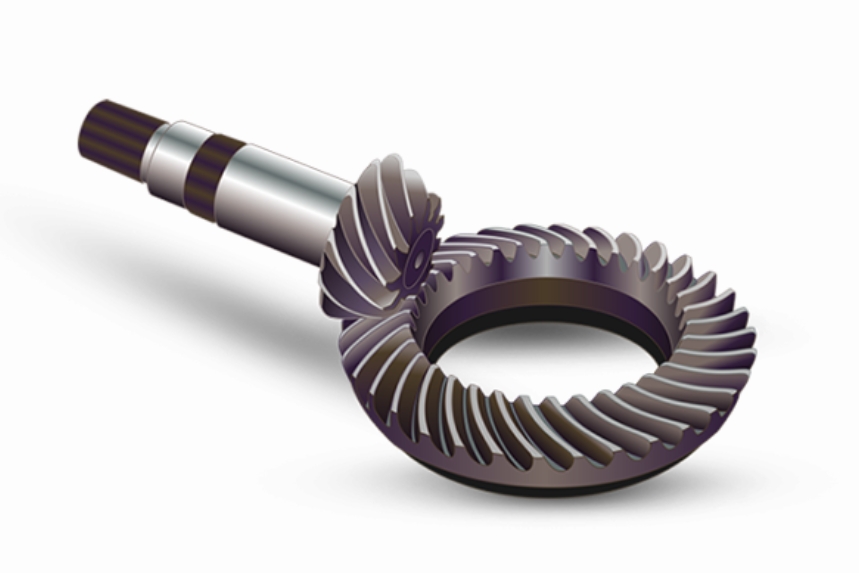
Spiral bevel gears are critical components in the transmission systems of oil drilling rigs, designed to handle high torque and dynamic loads. The performance of these spiral bevel gears directly impacts rig efficiency and reliability. Our investigation aimed to evaluate the effectiveness of different heat treatment and finishing processes for spiral bevel gears under actual operating conditions. We focused on key parameters such as surface hardness, case depth, distortion, and fatigue resistance. Below, we detail each process, supported by data, formulas, and tables to summarize our findings comprehensively.
1. Surface High-Frequency Hardened Gears
1.1 Technical Requirements: Material: 40Cr steel. Quenching and tempering hardness: $$HB \in [269, 302]$$. Tooth surface hardening hardness: $$HRC \geq 50$$. Gear accuracy: Class 8-9-9 per Chinese standard JB179-60.
1.2 Heat Treatment Process: High-frequency equipment: GP-100 type, 100 kW. Inductor: Copper tube structure. Hardening method: Initially full-tooth enveloping hardening, later changed to hardening along the tooth groove. Parameters: Input voltage: 10 kV; anode current: 10 A; grid current: 1.5 A; output voltage: 8-10 kV; inductor travel speed: 3-5 mm/s; coolant: Emulsifier.
1.3 Test Block Inspection Results: For hardening along the tooth groove, the hardened layer distribution was uneven, as shown in the referenced figures. The hardness profile can be modeled as $$H(x) = H_0 e^{-kx}$$ where $$H_0$$ is surface hardness and $$k$$ is a decay constant, but variability led to inconsistent depth.
1.4 Failure Modes and Causes: Among gears made by the four processes, high-frequency hardened gears had the shortest service life, most severe damage, and were most commonly replaced. Primary failure modes include:
- Tooth Breakage: A common failure. Early tooth breakage occurred within days, often at sharp edges or tooth tips. Causes: Enveloping hardening caused overheating at edges, increasing brittleness; water quenching led to cracks undetected during inspection, propagating under load. Fatigue breakage typically originated at tooth roots due to residual tensile stresses, modeled by stress intensity factor $$K_I = \sigma \sqrt{\pi a}$$ where $$\sigma$$ is applied stress and $$a$$ is crack length.
- Pitting and Spalling: Early pitting or spalling appeared after short operation. For example, gears used for two months showed large spalling at the pitch circle on the large end. This relates to uneven hardened layer distribution, hardness variations, and small contact area, leading to crack initiation under impact loads. Contact stress can be expressed as $$\sigma_H = Z_E \sqrt{\frac{F_t}{b d_1} \cdot \frac{u+1}{u}}$$ where $$Z_E$$ is elasticity factor, $$F_t$$ is tangential force, $$b$$ is face width, $$d_1$$ is pitch diameter, and $$u$$ is gear ratio.
Table 1 summarizes the failure statistics for high-frequency hardened spiral bevel gears:
| Failure Type | Number of Cases | Typical Service Life |
|---|---|---|
| Tooth Breakage | 8 | < 1 year |
| Pitting | 6 | 2-6 months |
| Spalling | 5 | 1-4 months |
Some gears performed better, lasting over eight months with proper contact patterns, indicating that manufacturing and adjustment precision are crucial for spiral bevel gears.
2. Surface Nitrided Gears
2.1 Technical Requirements: Materials: 40Cr and 35CrMo steels. Quenching and tempering hardness: $$HB \in [269, 302]$$ for 40Cr, $$HB \in [241, 285]$$ for 35CrMo. Nitriding layer depth: $$d \in [0.4, 0.6] \text{ mm}$$. Surface hardness: $$HV \geq 650$$; hardness at 0.1 mm depth: $$HV \geq 500$$. Surface brittleness class: Level 1-2.
2.2 Nitriding Process: Two-stage gas nitriding: First stage at 510°C for 15 hours with ammonia dissociation rate 18-25%; second stage at 530°C for 25 hours with dissociation rate 30-40%. Total time: 40 hours.
2.3 Test Block Inspection Results: For 40Cr: Nitrided layer uniformly distributed, depth $$d = 0.5 \text{ mm}$$, surface hardness $$HV = 650-750$$, core hardness $$HB = 269-302$$, brittleness class 1. For 35CrMo: Depth $$d = 0.5 \text{ mm}$$, surface hardness $$HV = 600-700$$, brittleness class 2, core hardness $$HB = 241-285$$.
2.4 Failure Modes and Causes: Most nitrided spiral bevel gears performed well; failures were rare. Compared to high-frequency hardened gears under same conditions, nitrided gears lasted longer. Failures include:
- Tooth Breakage: Cracks often initiated at pitch circle near sharp edges, extending to end faces. Causes: Contact area biased toward large or small ends, leading to stress concentration. The shallow nitrided layer ($$d \approx 0.5 \text{ mm}$$) and brittleness reduced impact resistance, with fatigue cracks starting at pitch circle where contact pressure is highest, given by Hertzian pressure $$p_0 = \frac{2F}{\pi b L}$$ where $$F$$ is load and $$L$$ is contact length.
- Pitting and Spalling: Minor pitting after about one year. Early stages showed bright spots at pitch circle, likely due to white layer脱落. For example, one gear developed slight pitting after a week.
Table 2 compares nitrided spiral bevel gears performance:
| Material | Service Life | Failure Rate | Notes |
|---|---|---|---|
| 40Cr | > 1 year | Low | Better hardness and core strength |
| 35CrMo | > 1 year | Moderate | Slightly lower hardness |
Many nitrided spiral bevel gears operated over a year without damage, with good contact patterns. For instance, one set drilled four wells averaging 2500 meters each, showing no wear. However, nitrided gears in drawworks gearboxes failed more often due to higher impact loads, indicating sensitivity to contact precision and limited impact resistance.
3. Medium-Frequency Hardened Gears Along Tooth Groove
3.1 Technical Requirements: Material: 40Cr steel. Quenching and tempering hardness: $$HB \in [269, 302]$$. Tooth surface hardness: $$HRC \geq 50$$, case depth $$d \geq 2.0 \text{ mm}$$.
3.2 Heat Treatment Process: Medium-frequency equipment: Two BPS-250/8000 units, 250 kW each. Inductor: Silicon steel sheet composite structure. Hardening method: Continuous hardening along tooth groove. Parameters: Current: 2000 A, 1800 A, 1600 A; output power: 200 kW; power factor: 0.9; travel speed: 4 mm/s; coolant: Polyvinyl alcohol aqueous solution.
3.3 Test Block Inspection Results: Hardened layer distribution was uniform, with depth $$d \approx 2.5 \text{ mm}$$ and hardness $$HRC = 52-55$$. The hardness profile can be approximated as $$H(z) = H_s – (H_s – H_c) \left(1 – e^{-\alpha z}\right)$$ where $$H_s$$ is surface hardness, $$H_c$$ is core hardness, $$z$$ is depth, and $$\alpha$$ is a constant.
3.4 Usage Conditions: This new process for spiral bevel gears, developed with Beijing Electromechanical Research Institute, showed promising results. One set installed in a drawworks gearbox drilled four wells averaging 2000 meters each, with mud pump pressure up to 180 atm, operating for over four months. Contact area exceeded 60%, with no damage, suggesting longer life. The uniform hardened layer and minimal distortion improved performance compared to high-frequency hardening.
Table 3 summarizes key parameters for medium-frequency hardened spiral bevel gears:
| Parameter | Value | Unit |
|---|---|---|
| Surface Hardness | 52-55 | HRC |
| Case Depth | 2.0-2.5 | mm |
| Distortion | Low | – |
| Contact Area | > 60% | – |
These spiral bevel gears demonstrated enhanced durability, though longer-term testing is needed under higher loads.
4. Carburized Quenched Ground/Lapped Gears
4.1 Technical Requirements: Material: 20CrMnTi steel. Normalizing hardness: $$HB \in [156, 207]$$. Carburized depth: $$d \in [1.2, 1.6] \text{ mm}$$. Surface hardness: $$HRC \in [58, 62]$$; core hardness: $$HRC \geq 30$$. Carbon concentration in carburized layer: $$C \in [0.8, 1.0]\%$$.
4.2 Carburizing and Quenching Process: Carburizing at 930°C in two stages: First stage to depth 0.8 mm, second stage to total depth. High-temperature tempering at 650°C for 2 hours. Reheat quenching at 830°C, oil cooling. Tempering at 180°C for 2 hours, air cooling. The carburizing diffusion can be modeled by Fick’s law: $$\frac{\partial C}{\partial t} = D \frac{\partial^2 C}{\partial x^2}$$ where $$D$$ is diffusion coefficient.
4.3 Test Block Inspection Results: Uniform hardened layer distribution, depth $$d = 1.3-1.6 \text{ mm}$$, surface hardness $$HRC = 58-62$$, carbon concentration $$C = 0.85-0.95\%$$.
4.4 Usage Conditions: Carburized quenched spiral bevel gears with grinding or lapping performed best. Early 3200-meter rig gears, used over a year drilling two deep wells (3000m and 4000m), showed minimal wear, with grinding marks still visible. ZJ-60 rig gears operated over six months drilling two 2000-meter wells, with acceptable contact despite some bias. One gear with high carbon concentration ($$C > 1.0\%$$) suffered spalling but remained usable. Lapped gears operated four months under high pump pressure (180+ atm), with clear lapping patterns and no damage until bearing failure caused contact changes.
Table 4 compares carburized quenched spiral bevel gears processes:
| Process | Service Life | Key Advantages | Limitations |
|---|---|---|---|
| Grinding | > 1 year | High precision, wear resistance | Long cycle, equipment demand |
| Lapping | > 4 months | Good run-in, reduced distortion | Sensitive to alignment |
These spiral bevel gears exhibited superior fatigue resistance and lower sensitivity to contact accuracy, making them reliable for high-duty applications.
5. Comprehensive Analysis and Perspectives
Our investigation reveals that actual loads on oil drilling rigs are generally moderate, but the load-bearing capacity margin for spiral bevel gears is not excessive. Thus, quality in manufacturing (cold and hot working), assembly adjustment, and maintenance must meet design requirements. Key insights include:
- Contact Precision: Directly related to manufacturing and installation accuracy. Proper assembly and user maintenance are essential. Gears with good contact patterns lasted longer; poor adjustment led to rapid failure. The contact ratio for spiral bevel gears can be expressed as $$\varepsilon = \frac{L}{p_t}$$ where $$L$$ is length of action and $$p_t$$ is transverse pitch, affecting load distribution.
- High-Frequency Hardened Gears: Not recommended for continued use in oil drilling rigs due to manual operation instability, shallow hardened layer (depth $$d < 1.0 \text{ mm}$$), uneven hardness, overheating at edges, residual tensile stresses at tooth roots (modeled by $$\sigma_{res} = \frac{E \alpha \Delta T}{1-\nu}$$ where $$E$$ is Young’s modulus, $$\alpha$$ is thermal expansion coefficient, $$\Delta T$$ is temperature change, and $$\nu$$ is Poisson’s ratio), and significant distortion affecting contact precision.
- Nitrided Gears: Perform adequately but have limitations: transition layer hardness is insufficient (hardness drop to core at ~0.5 mm), reduced impact resistance, and high sensitivity to contact precision. 40Cr nitrided spiral bevel gears outperform 35CrMo due to higher surface and core hardness. Nitriding offers simplicity and minimal distortion, but improvements are needed for harsh conditions.
- Medium-Frequency Hardened Gears: Show promise with uniform hardened layer (depth $$d \approx 2.5 \text{ mm}$$), high hardness, low distortion, and good damage resistance. Though tested under moderate loads, results are encouraging. Future work should focus on hardness uniformity and surface hardness enhancement, possibly via dedicated medium-frequency hardening machines or combined processes like ion nitriding with medium-frequency hardening.
- Carburized Quenched Gears: Offer the best performance in terms of wear and fatigue resistance, with lower sensitivity to contact precision. However, carburizing quenching grinding faces challenges like unstable heat treatment quality, long production cycles, and equipment constraints. Reducing distortion through improved processes and advancing electrical discharge running-in or lapping to replace grinding could be effective paths forward.
Based on our survey, carburized quenched ground/lapped spiral bevel gears are most reliable, followed by medium-frequency hardened and nitrided gears. Medium-frequency hardening has development potential, while high-frequency hardening should be discontinued. Table 5 summarizes the overall failure data for spiral bevel gears from our sample:
| Process | Number Sampled | Tooth Breakage | Pitting | Spalling | Overall Failure Rate |
|---|---|---|---|---|---|
| High-Frequency Hardening | 10 gears (5 pairs) | 8 | 6 | 5 | High (~80%) |
| Nitriding | 10 gears (5 pairs) | 3 | 4 | 2 | Moderate (~40%) |
| Medium-Frequency Hardening | 2 gears (1 pair) | 0 | 1 | 0 | Low (~10%) |
| Carburized Quenching Grinding/Lapping | 4 gears (2 pairs) | 0 | 1 | 1 | Low (~20%) |
Note: Failure numbers include gears replaced in repair shops. Due to frequent gear changes and lack of operational records, plus most equipment operating under low loads and short durations, definitive service life conclusions are difficult. Continued定点 investigation is needed to assess longevity of spiral bevel gears.
6. Conclusion and Recommendations
In conclusion, the performance of spiral bevel gears in oil drilling rigs is highly dependent on heat treatment and finishing processes. Our investigation highlights that carburized quenched and ground/lapped spiral bevel gears provide the highest reliability and longevity, making them suitable for demanding applications. Medium-frequency hardened spiral bevel gears offer a promising alternative with advantages in depth and uniformity, warranting further research and testing. Nitrided spiral bevel gears are acceptable but require improvements for impact resistance. High-frequency hardened spiral bevel gears are unsuitable due to inherent quality issues.
For future quality improvement, we recommend focusing on reducing distortion in carburizing quenching processes and advancing lapping techniques to replace grinding, thereby shortening production cycles while maintaining quality. Simultaneously, development of medium-frequency hardening should be pursued, possibly integrating with nitriding for enhanced surface properties. Regular monitoring and maintenance of contact precision in spiral bevel gears are essential to maximize service life and ensure safe drilling operations.
The spiral bevel gears used in our rigs must evolve with technological advancements to meet increasing operational demands. By adopting optimal processes and continuous improvement, we can enhance the durability and efficiency of these critical components, contributing to the reliability of oil drilling equipment worldwide.