
In modern manufacturing, the production of high-precision spiral bevel gears is critical for applications in automotive, aerospace, and industrial machinery. As a researcher in metal forming, I have extensively studied various precision forming methods, including rolling, extrusion, closed-die forging, swing rolling, and closed extrusion. Among these, cold extrusion stands out as a near-net-shape process that enhances mechanical properties, particularly fatigue resistance, by producing dense microstructures and continuous material flow lines. This article delves into the cold extrusion forming of spiral bevel gears, addressing challenges such as metal flow difficulties, die filling, and mold design. Through finite element analysis and practical insights, I aim to elucidate optimal preform designs and process parameters for efficient production of spiral bevel gears.
The significance of spiral bevel gears lies in their ability to transmit motion between intersecting shafts with high efficiency and smooth operation. However, their complex geometry, characterized by spiral angles and tapered teeth, poses manufacturing hurdles. Traditional machining methods often fall short for small-diameter, high-spiral-angle gears produced in large batches. Thus, precision forming techniques like cold extrusion offer a viable alternative. In my work, I focus on the cold extrusion of spiral bevel gears, leveraging numerical simulations to analyze metal flow, stress distribution, and forming loads. The keyword ‘spiral bevel gears’ will be frequently emphasized to underscore their importance in this context.
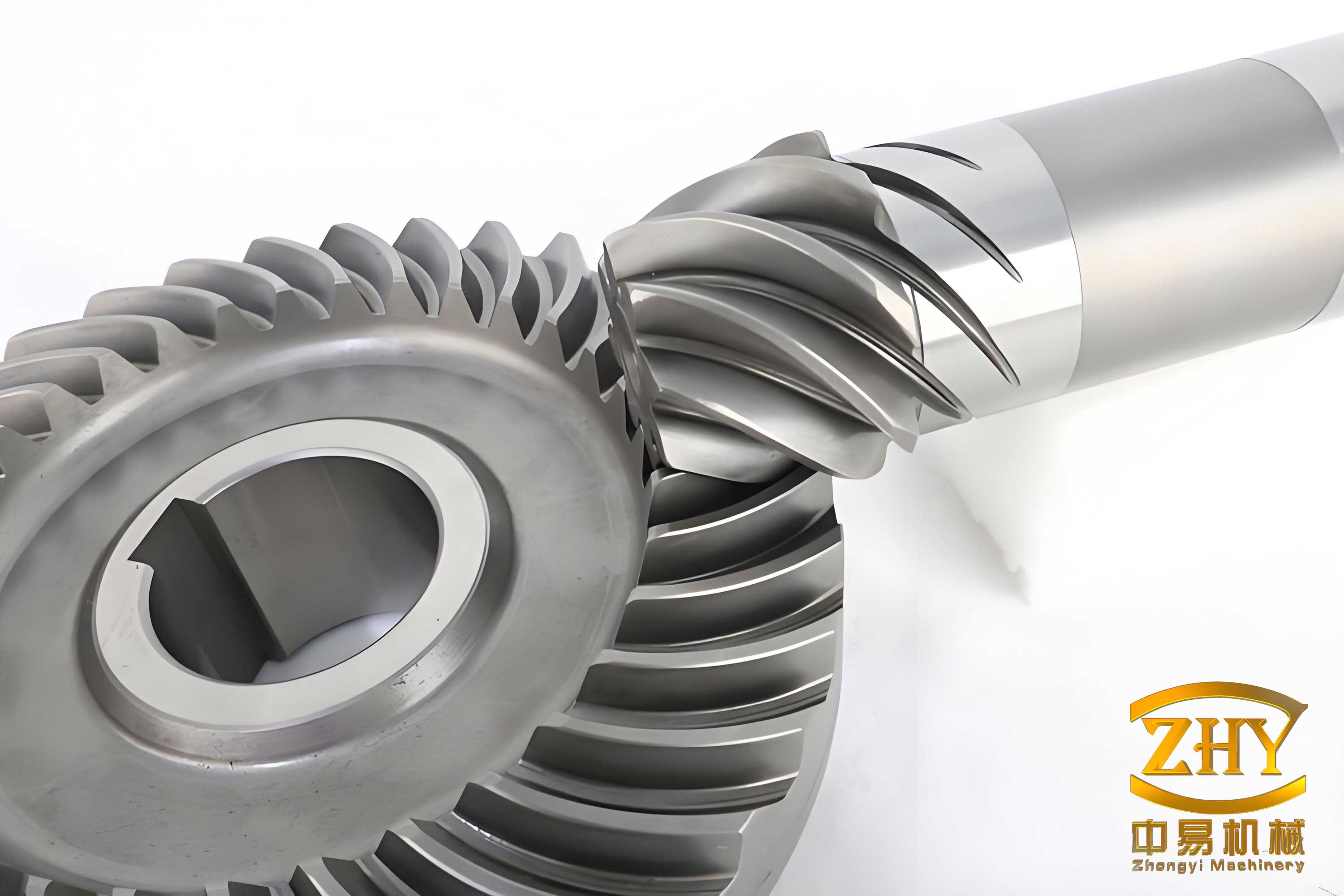
Cold extrusion is a near-net-shape process where material is forced through a die at room temperature, resulting in minimal waste and enhanced properties. For spiral bevel gears, this method improves fatigue performance due to grain refinement and aligned flow lines. The process involves designing preforms that facilitate metal flow into intricate tooth cavities. In my research, I explored three preform designs for a spiral bevel gear made of 20CrMo steel, with key geometric parameters summarized in Table 1. The spiral bevel gears in this study feature a spiral angle of 35°, a pressure angle of 20°, and 11 teeth, making them suitable for high-stress applications.
| Parameter | Value |
|---|---|
| Number of Teeth | 11 |
| Module | 1.35 mm |
| Spiral Direction | Left-hand |
| Pressure Angle | 20° |
| Tooth Root Height | 0.884 mm |
| Total Tooth Height | 2.788 mm |
| Spiral Angle | 35° |
| Face Width | 7.10 mm |
| Pitch Diameter | 14.85 mm |
| Outer Cone Distance | 27.35 mm |
The forming of spiral bevel gears via cold extrusion presents unique challenges. Metal must flow along curved paths from the tooth ends into the cavity, leading to high resistance and potential filling defects. Additionally, demolding requires relative motion between the workpiece and die. To address this, I investigated closed extrusion, where a sealed die cavity ensures controlled metal flow. The preform design is crucial; improper shapes can cause folds, cracks, or incomplete filling. I proposed three preform schemes, as illustrated in Table 2, each with distinct geometries to influence metal deformation. These spiral bevel gears require precise preforms to achieve full tooth filling and minimal defects.
| Scheme | Description | Key Dimensions |
|---|---|---|
| Scheme 1 | Axial flow-driven radial filling | Diameter: 9 mm, Height: 15.2 mm |
| Scheme 2 | Upsetting-like deformation from large end | Diameter: 14 mm, Height: 13.6 mm |
| Scheme 3 | Bidirectional extrusion from both ends | Diameter: 11.6 mm, Height: 9.5 mm |
Finite element analysis (FEA) using Deform-3D software was employed to simulate the cold extrusion process. The material was modeled as 45 steel, with dies treated as rigid bodies at 20°C and a friction coefficient of 0.2. The simulations focused on equivalent stress, strain, filling patterns, and load-stroke curves. The equivalent stress, which indicates deformation resistance, is calculated using the von Mises criterion:
$$\sigma_{eq} = \sqrt{\frac{1}{2}[(\sigma_1 – \sigma_2)^2 + (\sigma_2 – \sigma_3)^2 + (\sigma_3 – \sigma_1)^2]}$$
where $\sigma_1$, $\sigma_2$, and $\sigma_3$ are principal stresses. For spiral bevel gears, this stress distribution reveals areas of high resistance. In Scheme 1, stress concentrated at the tooth center due to radial flow, leading to incomplete filling. Scheme 2 showed high stress at the small end, mimicking upsetting deformation. Scheme 3 exhibited lower stress levels, with uniform distribution from bidirectional extrusion, enhancing formability of spiral bevel gears.
The filling process analysis provided insights into metal flow. In Scheme 1, metal moved rapidly from the small to large end, but cavities formed at corners. Scheme 2 involved initial bulging, with teeth forming first but the small end remaining unfilled. Scheme 3 demonstrated progressive filling from both ends, resulting in complete tooth profiles. The equivalent strain, representing deformation intensity, is given by:
$$\epsilon_{eq} = \sqrt{\frac{2}{3} \epsilon_{ij} \epsilon_{ij}}$$
where $\epsilon_{ij}$ are strain tensor components. For spiral bevel gears, Scheme 3 showed uniform strain, avoiding defects like folds. The load-stroke curves, plotted in Figure 1, indicated that Scheme 3 required lower forces, peaking at 150 kN, compared to 200 kN for Scheme 1 and 250 kN for Scheme 2. This reduction in load prolongs die life and reduces equipment requirements for producing spiral bevel gears.
| Scheme | Max Equivalent Stress (MPa) | Max Equivalent Strain | Filling Quality | Defects |
|---|---|---|---|---|
| Scheme 1 | 945 | 6.00 | Partial | Unfilled corners |
| Scheme 2 | 902 | 6.00 | Partial | Unfilled small end |
| Scheme 3 | 600 | 4.50 | Full | None |
Die design for closed extrusion is paramount. The mold assembly includes upper and lower punches, a tooth die, and buffer mechanisms to control movement. During forming, the dies close to form a sealed cavity, and punches apply pressure from both sides. Springs provide buffering to balance forces, as shown in the assembly. Demolding involves rotating the tooth die via bearings to release the spiral bevel gear. This design ensures smooth ejection without damaging the teeth, critical for maintaining the accuracy of spiral bevel gears.
The mathematical modeling of extrusion forces can be approximated by:
$$F = A \cdot k \cdot \ln\left(\frac{h_0}{h_f}\right)$$
where $F$ is the extrusion force, $A$ is the cross-sectional area, $k$ is the material’s flow stress, $h_0$ is initial height, and $h_f$ is final height. For spiral bevel gears, this formula helps estimate loads for different preforms. In Scheme 3, the bidirectional approach reduces $h_0/h_f$, lowering $F$ and facilitating成形. Additionally, the spiral angle influences flow; a higher angle increases resistance, requiring optimized preforms for spiral bevel gears.
Further analysis of metal flow in spiral bevel gears involves the continuity equation and plasticity theory. The volume constancy during deformation is expressed as:
$$\nabla \cdot \mathbf{v} = 0$$
where $\mathbf{v}$ is the velocity field. In extrusion, metal velocity varies along the tooth profile, affecting filling. Numerical simulations solve this using the finite element method, discretizing the gear into elements. For spiral bevel gears, element size must be fine enough to capture tooth细节. The deformation energy $W$ is calculated as:
$$W = \int_V \sigma_{eq} \epsilon_{eq} \, dV$$
where $V$ is volume. Scheme 3 minimized $W$, indicating efficient forming for spiral bevel gears.
Material selection also impacts spiral bevel gear production. 20CrMo steel offers good hardenability and strength, but its flow stress $k$ depends on strain rate $\dot{\epsilon}$ and temperature $T$, modeled by:
$$k = k_0 \cdot (1 + \beta \dot{\epsilon})^m \cdot e^{-\alpha T}$$
where $k_0$, $\beta$, $m$, and $\alpha$ are constants. Cold extrusion keeps $T$ low, increasing $k$ and requiring higher forces. Thus, preform design must account for material properties to successfully form spiral bevel gears.
In practice, process parameters like punch speed and die geometry are optimized. For spiral bevel gears, a punch speed of 1-5 mm/s ensures gradual filling. Die angles and fillet radii reduce stress concentrations. Table 4 summarizes key parameters for cold extruding spiral bevel gears, derived from simulations and experiments. These parameters ensure high-quality spiral bevel gears with full tooth profiles and minimal defects.
| Parameter | Value |
|---|---|
| Punch Speed | 2 mm/s |
| Die Filler Radius | 0.5 mm |
| Initial Billet Temperature | 20°C |
| Friction Coefficient | 0.2 |
| Extrusion Force (Scheme 3) | 150 kN |
| Spiral Angle Tolerance | ±0.5° |
The benefits of cold extrusion for spiral bevel gears extend beyond dimensional accuracy. The process enhances fatigue life by aligning grain flow with tooth contours, resisting crack propagation. Fatigue strength $\sigma_f$ can be estimated using:
$$\sigma_f = \sigma_0′ \cdot (N_f)^{-b}$$
where $\sigma_0’$ is fatigue strength coefficient, $N_f$ is cycles to failure, and $b$ is exponent. For spiral bevel gears, cold extrusion increases $\sigma_0’$, improving durability in cyclic loading applications. This makes spiral bevel gears ideal for high-performance systems.
Comparative studies with other forming methods highlight the advantages of cold extrusion for spiral bevel gears. Hot forging might reduce forces but causes scale and decarburization, while machining wastes material. Cold extrusion offers net-shape forming with superior surface finish. For spiral bevel gears with complex geometries, this method reduces post-processing and cost. The table below contrasts methods for producing spiral bevel gears, emphasizing cold extrusion’s efficiency.
| Method | Advantages | Disadvantages | Suitability for Spiral Bevel Gears |
|---|---|---|---|
| Cold Extrusion | High accuracy, improved properties | High tooling costs | Excellent for batch production |
| Hot Forging | Lower forces | Oxidation, poor surface | Moderate, requires finishing |
| Machining | Flexibility | Material waste, time-consuming | Low for large batches |
| Closed-Die Forging | Good strength | Flash formation | Good, but less precise |
Future trends in spiral bevel gear manufacturing include additive manufacturing for dies and adaptive control systems. However, cold extrusion remains dominant for mass production. Research on hybrid processes, such as warm extrusion, could further optimize spiral bevel gear forming by balancing forces and microstructure. Numerical simulations will continue to play a key role in designing spiral bevel gears with enhanced performance.
In conclusion, the cold extrusion of spiral bevel gears via bidirectional closed extrusion proves optimal, offering low stress, full tooth filling, and clear contours. This method addresses challenges like metal flow and demolding, ensuring high-quality production. Through finite element analysis, preform Scheme 3 was validated, reducing loads and defects. Die design with buffer mechanisms facilitates smooth operation. As demand for precision spiral bevel gears grows, cold extrusion will remain a vital technology, driven by advancements in simulation and material science. The repeated focus on spiral bevel gears throughout this article underscores their importance in modern engineering, and ongoing research will further refine their manufacturing processes.
The mathematical models and tables provided here serve as a foundation for optimizing spiral bevel gear production. By integrating theory with practice, manufacturers can achieve efficient, cost-effective forming of spiral bevel gears for various applications. The continuous improvement in forming techniques will ensure that spiral bevel gears meet evolving industrial standards, contributing to advancements in machinery and transportation systems worldwide.