
In the field of mechanical lifting devices, the screw jack has long been a staple due to its simplicity and reliability. However, traditional designs often suffer from limitations such as poor stability during operation, significant operator movement, and restricted working行程. As an engineer focused on innovative mechanical systems, I have explored an alternative approach: a screw jack where the nut rotates and the screw translates vertically, driven by a spiral bevel gears mechanism. This design not only mitigates the drawbacks of conventional jacks but also offers a higher force amplification ratio. In this article, I will delve into the design principles, force analysis, and calculations behind this spiral bevel gears-based screw jack, providing detailed insights through formulas, tables, and practical considerations. The core idea is to leverage the efficiency and compactness of spiral bevel gears to create a more stable and user-friendly lifting device.
The primary requirements for any jack include reliable operation, smooth motion, self-locking capability, intermittent workload handling, good force amplification, stability under maximum load and stroke, portability, and lightweight construction. Traditional screw jacks, as shown in early designs, involve a rotating screw that moves vertically along with the handle or handwheel, causing the entire传动 system to shift with the load. This leads to a changing center of gravity, reduced stability, and increased operator effort, especially over long行程. In contrast, the proposed design fixes the screw’s rotation while allowing the nut to rotate horizontally via spiral bevel gears, thereby keeping the handle stationary and improving overall performance. This article will systematically compare the two schemes, analyze the螺旋机构, detail the spiral bevel gears传动, discuss balance moments, and compute the force ratio, all while incorporating multiple formulas and tables for clarity.
To begin, let’s compare the传动 schemes. In a traditional screw jack, the screw rotates and moves vertically, carrying the handle and传动 components with it. This results in a variable force distribution along the screw, as illustrated in early diagrams. The axial load Q and friction torque T act over lengths that change simultaneously during lifting, potentially leading to stress concentrations and reduced stability. Conversely, in the spiral bevel gears screw jack, the传动 sequence is: handle (or handwheel) → input spiral bevel gears → output spiral bevel gears attached to the nut → nut rotating horizontally → screw moving vertically. Here, the handle remains fixed in position, requiring only rotational effort from the operator, and the screw’s motion is constrained to translation without rotation. This scheme ensures a more uniform force application and eliminates limitations on working行程. Table 1 summarizes the key differences between the two designs.
| Aspect | Traditional Screw Jack | Spiral Bevel Gear Screw Jack |
|---|---|---|
| 传动 Type | Screw rotates and translates | Nut rotates, screw translates |
| Handle Movement | Moves vertically with screw | Stationary, only rotates |
| Stability | Lower due to shifting重心 | Higher as重心 remains fixed |
| Operator Effort | Higher due to movement | Lower,原地 operation |
| 行程 Limitation | Limited by handle movement | Unlimited, independent of handle |
| Force Amplification | Depends on screw lead alone | Enhanced by gear ratio i |
| Key Components | Screw, nut, handle | Screw, nut, spiral bevel gears, handle |
Moving to the螺旋机构设计, the screw and nut are critical elements. In the新设计, the screw is subjected to axial pressure Q (the lifting load) and a normal force N from the nut threads, which平衡 Q. The friction torque in the螺旋副, denoted T₃, acts as the driving torque, while a balancing torque T₅ counteracts it to prevent screw rotation. The screw’s受力 length varies during operation: Q acts from the screw’s supporting shoulder to the nut engagement zone, and T₃ acts from the nut engagement to the tail end where a limiter block engages with a slide guide in the base. This arrangement, as shown in force diagrams, allows for a more uniform stress distribution compared to traditional designs where both Q and T₃ vary simultaneously over the entire screw length. For design purposes, the screw dimensions are determined based on maximum load Q and maximum stroke, often allowing for a smaller diameter under the same load conditions due to improved force distribution.
The nut, on the other hand, experiences forces包括 N’ (reaction from screw threads), support force R from the base, friction torque T₃’ from the螺旋副, bearing friction torque Tᵦ, and input torque T₂ from the spiral bevel gears. The equilibrium condition is T₂ = -(T₃’ + Tᵦ). The nut’s engagement length H is typically limited to 10-12 times the pitch t (i.e., H ≤ (10~12)t) to ensure strength and wear resistance. Wear calculation is crucial, often based on the pressure between threads. The contact pressure p can be expressed as:
$$ p = \frac{Q}{\pi d_m H z} $$
where d_m is the mean thread diameter, H is the nut height, and z is the number of engaged threads. For自锁, the螺旋 angle α must satisfy:
$$ \alpha \leq \arctan(\mu) $$
with μ being the friction coefficient. In practice, for trapezoidal threads commonly used in jacks, α is kept below 4.5° to ensure self-locking. Table 2 lists typical design parameters for the螺旋机构.
| Parameter | Symbol | Typical Range | Remarks |
|---|---|---|---|
| Axial Load | Q | 10-100 kN | Maximum lifting capacity |
| Screw Diameter | d | 20-50 mm | Based on strength计算 |
| Pitch | t | 5-10 mm | Affects lead and speed |
| Lead | P | 5-20 mm | P = n t for multi-start threads |
| Nut Height | H | (10-12)t | For wear resistance |
| Friction Coefficient | μ | 0.1-0.15 | Depends on material and lubrication |
| Self-locking Angle | α | < 4.5° | Ensures safety |
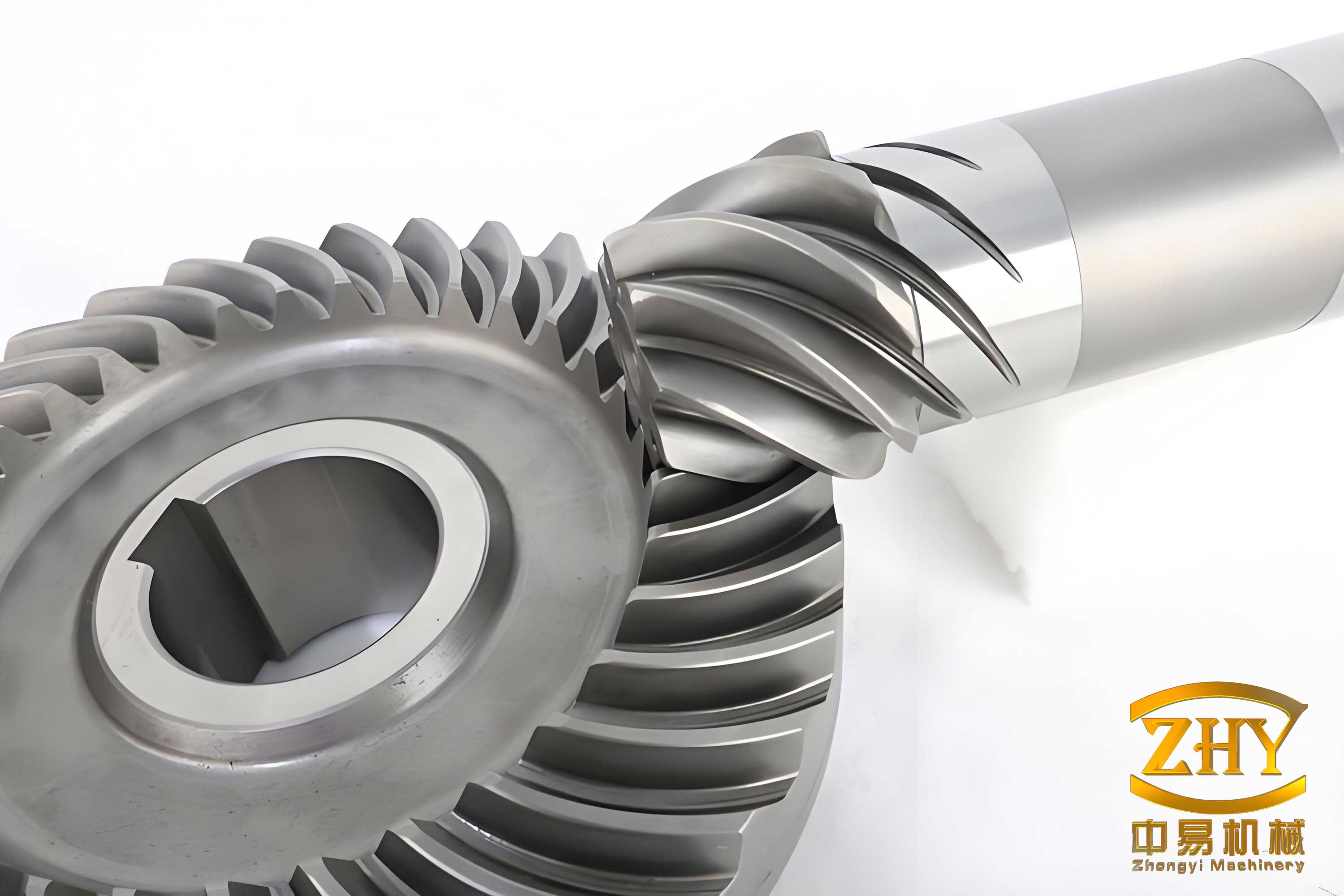
Now, let’s focus on the spiral bevel gears机构设计. The use of spiral bevel gears is pivotal in this design, as they enable efficient torque transmission between perpendicular shafts while maintaining compactness. The传动比 i, defined as the ratio of input gear teeth to output gear teeth (i = z₁/z₂ > 1 for reduction), directly influences the force amplification and lifting speed. A higher i reduces operator effort but slows down the lifting process, so a balance must be struck. The input torque T₀ from the handle is given by T₀ = F R, where F is the operator’s force on the handle (typically 50-150 N for intermittent work) and R is the handle length or handwheel radius (up to 1000 mm for handles). When the handle rotates one revolution, the nut rotates 1/i revolutions, causing the screw to move P/i millimeters (P is the screw lead). The output work is Q P/i, and the input work is F × 2πR. Considering the overall efficiency η (which includes spiral bevel gears efficiency, bearing losses, and螺旋副 efficiency), we have:
$$ F \times 2\pi R \eta \geq \frac{Q P}{i} $$
Rearranging for传动比 i:
$$ i \geq \frac{Q P}{F \times 2\pi R \eta} $$
For example, with Q = 50 kN, F = 150 N, R = 1000 mm, η = 25% (0.25), and P = 5 mm, we compute:
$$ i \geq \frac{50000 \times 5}{150 \times 2\pi \times 1000 \times 0.25} = \frac{250000}{235619} \approx 1.06 $$
But in practice, to ensure sufficient force amplification and account for losses, i is often chosen between 2.5 and 3.5. The efficiency η for spiral bevel gears can be estimated using公式, such as η_gear = 1 – μ (tan(γ) + tan(δ)) for approximate calculations, where γ and δ are pitch cone angles. However, for design purposes, a total η of 0.2-0.3 is common for screw jacks. The spiral bevel gears must be designed for bending strength and surface durability. The bending stress σ_b can be calculated using Lewis formula modified for bevel gears:
$$ \sigma_b = \frac{F_t}{b m_n Y} K_v K_o $$
where F_t is the tangential force, b is the face width, m_n is the normal module, Y is the Lewis form factor, K_v is the velocity factor, and K_o is the overload factor. For spiral bevel gears, the spiral angle β (typically 35°) enhances smoothness and load capacity. Table 3 provides key design aspects for the spiral bevel gears in this jack.
| Parameter | Symbol | Typical Values | Notes |
|---|---|---|---|
| 传动比 | i | 2.5-3.5 | Based on force and speed requirements |
| Module | m | 2-5 mm | Depends on torque and size constraints |
| Spiral Angle | β | 35° | Improves engagement and reduces noise |
| Pressure Angle | φ | 20° | Standard for bevel gears |
| Efficiency | η_gear | 0.95-0.98 per pair | High due to spiral design |
| Material | – | Steel (e.g., 4140) | Heat-treated for strength |
| Safety Factor | SF | 1.5-2 | For bending and pitting |
The balancing moment T₅ is another critical aspect. In the base, a vertical guide rail is installed, and a limiter block attached to the screw’s tail end engages with this rail via sliding surfaces. This creates a reaction torque T₅ that balances the friction torque T₃, preventing screw rotation. As shown in a horizontal cross-section, the forces F_a acting on the limiter block from the rail generate T₅ = F_a × l, where l is the moment arm. This mechanism ensures that the screw only translates, enhancing stability. The design of this sliding pair involves wear calculations, often using the pressure velocity (PV) limit for the material pair, such as steel on bronze or polymer composites.
Next, the force amplification ratio K is a key performance metric, defined as K = Q / F. From the earlier energy balance equation, we can derive:
$$ K = \frac{2\pi R \eta i}{P} $$
This shows that the force ratio is enhanced by the gear ratio i compared to a simple screw jack where K = 2πR η / P. For instance, with R = 1000 mm, η = 0.25, i = 3, and P = 5 mm, we get:
$$ K = \frac{2\pi \times 1000 \times 0.25 \times 3}{5} = \frac{4712.39}{5} \approx 942.5 $$
This means an operator applying 150 N can lift approximately 141.4 kN (since Q = K × F), demonstrating the significant amplification achieved by incorporating spiral bevel gears. Table 4 compares force ratios for different configurations.
| Design Type | 传动 Ratio i | Lead P (mm) | Handle Radius R (mm) | Efficiency η | Force Ratio K |
|---|---|---|---|---|---|
| Traditional Screw Jack | 1 (direct) | 5 | 1000 | 0.25 | 314.16 |
| Spiral Bevel Gear Jack (i=2.5) | 2.5 | 5 | 1000 | 0.25 | 785.4 |
| Spiral Bevel Gear Jack (i=3.5) | 3.5 | 5 | 1000 | 0.25 | 1099.56 |
| High-Efficiency Version | 3 | 10 | 800 | 0.3 | 452.39 |
Beyond the core design, stability analysis is crucial. For a vertical screw under axial load, Euler’s buckling formula applies for long columns. The critical load Q_cr for a screw fixed at one end and free at the other (approximation for the jack screw) is:
$$ Q_{cr} = \frac{\pi^2 E I}{(L_e)^2} $$
where E is Young’s modulus, I is the area moment of inertia, and L_e is the effective length. For a screw with diameter d, I = πd⁴/64. In the新设计, since the screw does not rotate, the effective length can be taken as the unsupported length between the nut and the base support, which varies during lifting. Thus, designing for the maximum stroke ensures safety against buckling. Additionally, the use of spiral bevel gears contributes to a lower overall重心, as the heavy gears and handle remain fixed, improving tip-over stability. A stability factor can be defined as the ratio of restoring moment to overturning moment, often targeting values above 1.5.
Self-locking is another essential feature, ensuring the load does not descend uncontrollably when the handle is released. As mentioned, the螺旋副 must have a lead angle α less than the arctan of the friction coefficient. For the spiral bevel gears, back-driving should also be prevented; this is inherently achieved if the螺旋副 is self-locking, as the gears will not reverse due to the high friction in the screw thread. However, in some cases, a brake or detent mechanism might be added to the gear train for extra safety.
Material selection plays a vital role. The screw and nut are typically made of hardened steel (e.g., 1045 for the screw and bronze for the nut) to reduce wear. The spiral bevel gears are often forged or machined from alloy steel like 4140, heat-treated to HRC 45-50 for durability. The base and housing can be cast iron or aluminum for lightweight portability. Lubrication is critical for the螺旋副 and spiral bevel gears to maintain efficiency and lifespan; grease or heavy oil is commonly used.
From a manufacturing perspective, the spiral bevel gears require precise machining, often using gear generators or CNC methods, to ensure proper meshing and minimize noise. The螺旋 threads can be cut or rolled, with rolling providing better strength. Assembly must ensure alignment of the gear shafts and the screw-nut pair to avoid binding. Cost analysis might show that the addition of spiral bevel gears increases initial cost but offers long-term benefits in performance and reliability.
In terms of applications, this spiral bevel gears screw jack is suitable for automotive repair, construction, and industrial maintenance where stability and ease of operation are paramount. Its modular design allows for scalability—by adjusting the gear ratio, screw dimensions, and materials, it can be tailored for loads from a few kilonewtons to hundreds of kilonewtons. Comparative testing with traditional jacks would demonstrate advantages in operator fatigue reduction and safety.
To illustrate the design process, let’s consider a step-by-step calculation example. Assume we need a jack with Q_max = 50 kN, stroke S = 200 mm, and operator force F = 100 N. Choose a screw with pitch t = 6 mm and single-start, so lead P = 6 mm. Select a handle radius R = 800 mm. Estimate overall efficiency η = 0.25. Compute required传动比 i:
$$ i \geq \frac{Q P}{F \times 2\pi R \eta} = \frac{50000 \times 6}{100 \times 2\pi \times 800 \times 0.25} = \frac{300000}{125663.7} \approx 2.39 $$
So, choose i = 3 for safety. Design the spiral bevel gears with module m = 3 mm, input gear teeth z₁ = 20, output gear teeth z₂ = 60 (thus i = 3). Check gear strength based on torque T₀ = F R = 100 × 0.8 = 80 Nm. Then, compute screw diameter d based on compressive stress and buckling. Use steel with yield strength σ_y = 250 MPa. For compression, area A = πd²/4, so d ≥ √(4Q/πσ_y) = √(4×50000/(π×250×10⁶)) ≈ 0.01596 m or 16 mm. Considering buckling, with unsupported length L = S + nut height = 200 + 72 mm (assuming H=12t=72 mm) = 272 mm, and end conditions, a d = 30 mm might be needed. This iterative process highlights the interplay between components.
In conclusion, the spiral bevel gears screw jack design offers significant improvements over traditional approaches by fixing the handle and rotating the nut via a spiral bevel gears传动. This enhances stability, reduces operator effort, and allows unlimited行程. Through detailed force analysis,传动比 optimization, and careful component design, one can achieve high force amplification ratios while ensuring reliability and self-locking. The use of spiral bevel gears is central to this design, providing efficient torque transmission in a compact form. Future developments could involve integrating motor drives or smart sensors for automated control, but the mechanical principles outlined here remain foundational. By leveraging formulas, tables, and systematic calculations, engineers can adapt this concept for various增力机构, underscoring the versatility of spiral bevel gears in mechanical design.