
In the field of gear engineering, the accurate modeling of spiral bevel gears is crucial for both manufacturing and inspection processes. Spiral bevel gears are widely used in automotive, aerospace, and industrial machinery due to their ability to transmit power between non-parallel shafts with high efficiency and smooth operation. However, the complex geometry of spiral bevel gears poses significant challenges in design and verification. In this article, I will present a detailed methodology for discrete modeling of spiral bevel gears, leveraging numerical computation and 3D modeling software. This approach is essential for validating tooth surface parameters and facilitating precision measurement in gear inspection systems.
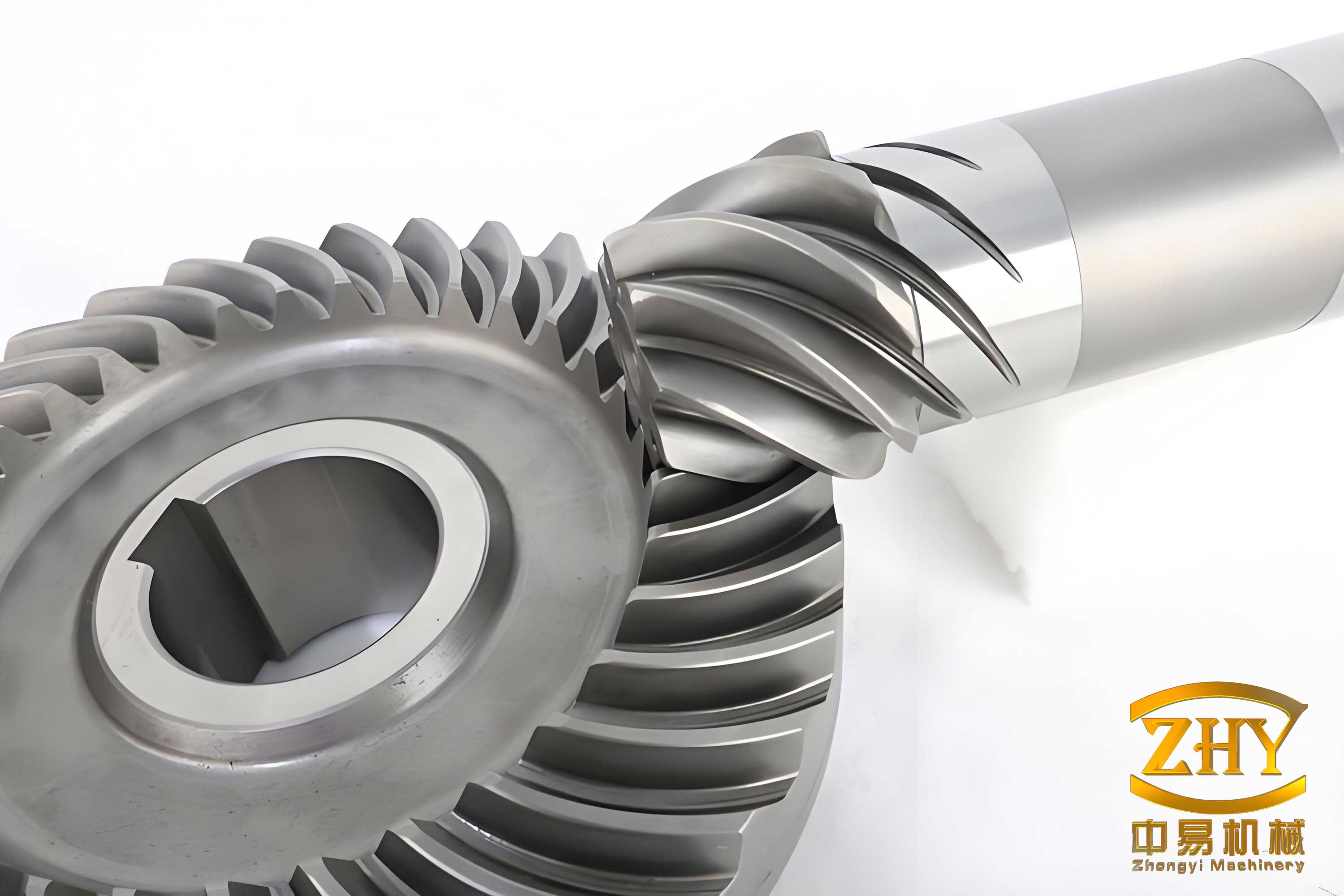
The core of this research revolves around developing a discrete representation of the tooth surface for spiral bevel gears. This discrete model consists of a set of points whose coordinates are derived from the mathematical equations describing the gear tooth geometry. By comparing these theoretical coordinates with actual measurements from coordinate measuring machines (CMMs), engineers can assess manufacturing errors and make adjustments to improve gear quality. The process involves several steps: establishing the tooth surface equation, discretizing the surface into a grid of points, solving for the coordinates numerically, and constructing a 3D model. Throughout this article, I will emphasize the importance of spiral bevel gears in modern machinery and how discrete modeling enhances their production accuracy.
To begin, let’s delve into the mathematical foundation of spiral bevel gears. The tooth surface of a spiral bevel gear is generated through a machining process, typically using a face-milling or face-hobbing method. For the purpose of this study, I focus on the gear wheel (larger gear) as it represents a general case. The machining simulation involves treating the cutting tool and the gear as a pair of meshing entities. By applying gear theory and coordinate transformations, we can derive the surface equation. This equation is parameterized by variables related to the tool geometry and machine settings. The derivation starts with defining coordinate systems based on the Gleason spiral bevel gear milling machine principle.
Consider the generating gear coordinate system $\sigma = \{o; x, y, z\}$, where $o$ is the machine center, the $x$-$y$ plane is the machine plane, and the $z$-axis points outward from the cradle. The cutter head position is defined by parameters such as radial distance, angular orientation, and blade geometry. For a point $M$ on the cutting surface, the position vector $\vec{r}_{02}$ can be expressed in terms of tool parameters. Let $r_0$ be the nominal cutter radius, $W_2$ the blade edge width, and $\alpha_{02}$ the blade pressure angle. The cutter tip point $M_0$ has coordinates given by:
$$ \vec{r}_{02} = \begin{bmatrix} S_2 \cos q_2 + r_{02} \sin(q_2 – \theta_2) \\ S_2 \sin q_2 – r_{02} \cos(q_2 – \theta_2) \\ 0 \end{bmatrix} $$
where $r_{02} = r_0 \pm \frac{1}{2} W_2$, with the “$+$” sign for the outer blade tip radius and the “$-$” sign for the inner blade tip radius. Here, $S_2$ is the radial distance, $q_2$ is the angular tool position, and $\theta_2$ is the phase angle of point $M$. The distance from $M_0$ to $M$ along the cutting surface is denoted as $s_{02}$. Thus, the vector for point $M$ is $\vec{R}_{02} = \vec{r}_{02} – s_{02} \vec{t}_2$, where $\vec{t}_2$ is the unit vector along the cutting surface generatrix:
$$ \vec{t}_2 = \begin{bmatrix} \sin \alpha_{02} \sin(q_2 – \theta_2) \\ -\sin \alpha_{02} \cos(q_2 – \theta_2) \\ \cos \alpha_{02} \end{bmatrix} $$
The normal vector at point $M$ is critical for meshing conditions and is given by:
$$ \vec{n}_2 = \begin{bmatrix} \cos \alpha_{02} \sin(q_2 – \theta_2) \\ -\cos \alpha_{02} \cos(q_2 – \theta_2) \\ -\sin \alpha_{02} \end{bmatrix} $$
Note that for spiral bevel gears, the pressure angle $\alpha_{02}$ is negative for outer blades and positive for inner blades, with inner blades typically having a smaller absolute value. The gear wheel axis direction is represented by $\vec{p}_2 = [\cos(\delta_{m2}) \ 0 \ \sin(\delta_{m2})]^T$, where $\delta_{m2}$ is the mean spiral angle. The vector from the machine center to the gear design crossing point $O_2$ is $\vec{m}_2 = [-X_{2p2} \ -E_{02} \ X_{B2}]^T$, where $X_{2p2}$ is the axial work offset, $E_{02}$ is the vertical offset, and $X_{B2}$ is the machine center distance.
In the generating process, the cutter surface (first surface) and the gear tooth surface (second surface) are in continuous tangency. According to gear meshing theory, the relative velocity between the surfaces must satisfy the equation of meshing. Let $\vec{\omega}_1 = [0 \ 0 \ 1]^T$ be the angular velocity of the generating gear, and $\vec{\omega}_2 = i_{02} \vec{p}_2$ be the angular velocity of the gear wheel, where $i_{02}$ is the ratio of roll. The relative angular velocity is $\vec{\omega}_{12} = \vec{\omega}_1 – \vec{\omega}_2$. The meshing equation is:
$$ \vec{n}_2 \cdot \vec{v}_{12} = \vec{n}_2 \cdot (\vec{\omega}_{12} \times \vec{R}_{02} – i_{02} \vec{p}_2 \times \vec{m}_2) = 0 $$
Substituting the expressions for $\vec{R}_{02}$ and simplifying, we can solve for $s_{02}$:
$$ s_{02} = \frac{(\vec{\omega}_{12}, \vec{r}_{02}, \vec{n}_2) – i_{02} (\vec{p}_2, \vec{m}_2, \vec{n}_2)}{(\vec{\omega}_{12}, \vec{t}_2, \vec{n}_2)} $$
Here, the notation $( \vec{a}, \vec{b}, \vec{c} )$ denotes the scalar triple product. This equation links the tool parameters to the gear geometry. To compute the machine settings efficiently, I developed a parameter file in MATLAB that encapsulates the adjustment formulas for spiral bevel gears. By inputting basic gear design parameters, such as number of teeth, module, and spiral angle, the program outputs all necessary adjustment values. This automation streamlines the modeling process for spiral bevel gears.
The tooth surface equation in the generating coordinate system is then $\vec{r}_2 = \vec{r}_{02} – s_{02} \vec{t}_2 + \vec{m}_2$. To transform this into the gear workpiece coordinate system $\sigma_1 = \{O_2; x_1, y_1, z_1\}$, we apply a transformation matrix $M_{10}$:
$$ M_{10} = \begin{bmatrix} \sin \delta_{m2} & 0 & -\cos \delta_{m2} & \cos \delta_{m2} \cdot X_{B2} \\ 0 & 1 & 0 & -E_{02} \\ \cos \delta_{m2} & 0 & \sin \delta_{m2} & -X_2 – \sin \delta_{m2} \cdot X_{B2} \\ 0 & 0 & 0 & 1 \end{bmatrix} $$
Thus, the tooth surface equation in the workpiece system is $\vec{R}_2 = M_{10} \vec{r}_2$. This equation is parameterized by $q_2$ and $\theta_2$, and it describes the exact geometry of the spiral bevel gear tooth. However, for practical applications like inspection, we need a discrete set of points on this surface. This leads to the next step: discretization.
Discretizing the tooth surface of spiral bevel gears involves projecting the surface onto a plane and creating a grid of points. Assuming no secondary enveloping (which is generally avoided in gear manufacturing), there is a one-to-one correspondence between points on the tooth surface and their projections in the axial cross-section. I define a plane coordinate system $\sigma_2 = \{O_2; l, r\}$, where $l$ is the axial direction and $r$ is the radial direction from the gear axis. In this system, the tooth surface is divided into an $n \times m$ grid, typically $5$ rows and $9$ columns for balance between accuracy and computational cost. The grid intersections represent the discrete points for which we will compute coordinates.
To generate this grid uniformly, I first determine the coordinates of four corner points (A, B, C, D) on the tooth surface boundary in the $l$-$r$ plane. These points correspond to the extremities of the active tooth surface. Using gear geometry relations, their coordinates are calculated as follows:
- Point A: $(l_{mx}, r_{2mx})$
- Point B: $(l_{ax}, r_{2ax})$
- Point C: $(l_{ad}, r_{2ad})$
- Point D: $(l_{md}, r_{2md})$
The edges AB, BC, CD, and DA are linear segments in this projection. Their slopes are computed as:
$$ k_1 = \frac{r_{2md} – r_{2mx}}{l_{md} – l_{mx}}, \quad k_2 = \frac{r_{2ax} – r_{2mx}}{l_{ax} – l_{mx}}, \quad k_3 = \frac{r_{2ad} – r_{2ax}}{l_{ad} – l_{ax}}, \quad k_4 = \frac{r_{2md} – r_{2ad}}{l_{md} – l_{ad}} $$
From these, linear equations for each edge are derived. For example, edge AD has equation $r = k_1 (l – l_{mx}) + r_{2mx}$. By dividing each edge into equal segments based on the desired grid size, we obtain points along the boundaries. Connecting corresponding points on opposite edges gives the grid lines. The intersection of a grid line from AD to BC (constant $l$) and a grid line from AB to CD (constant $r$) yields a grid point $(l_i, r_j)$.
In MATLAB, I implemented this algorithm in a script called “total4.m”. Using nested loops, all grid points are computed and stored in arrays. The following table summarizes the parameters involved in the discretization process for spiral bevel gears:
| Parameter | Symbol | Description |
|---|---|---|
| Number of rows | $m$ | Typically 5, for axial divisions |
| Number of columns | $n$ | Typically 9, for radial divisions |
| Axial coordinate | $l$ | Distance along gear axis from reference point |
| Radial coordinate | $r$ | Distance from gear axis |
| Corner points | A, B, C, D | Vertices of tooth surface in projection |
With the $l$ and $r$ values known for each grid point, the next task is to find the corresponding 3D coordinates $(x, y, z)$ on the actual tooth surface of the spiral bevel gear. From geometry, we have $r = \sqrt{x^2 + y^2}$ and $z = l$. Combining these with the tooth surface equation $\vec{R}_2 = [x(q_2, \theta_2), y(q_2, \theta_2), z(q_2, \theta_2)]^T$, we obtain a system of nonlinear equations for each grid point:
$$ \begin{cases} x(q_2, \theta_2)^2 + y(q_2, \theta_2)^2 = r^2 \\ z(q_2, \theta_2) = l \\ \text{Tooth surface equation constraints} \end{cases} $$
This system involves the parameters $q_2$, $\theta_2$, and $s_{02}$. To solve it, I use Newton’s method in MATLAB. The initial guesses for $q_2$ and $\theta_2$ are chosen based on the tool geometry and mesh generation ranges. The iterative process converges quickly to the precise values. Once solved, the coordinates $(x, y, z)$ are stored. By varying the signs of $\alpha_{02}$ and $r_{02}$, we can generate both concave and convex sides of the spiral bevel gear tooth. For instance, the concave side corresponds to the driven side in many applications.
To illustrate, the MATLAB code outputs surface plots for both sides. The discrete points are then exported to a text file with high precision (6 decimal places) and units in millimeters. This ensures compatibility with 3D modeling software. Before importing, settings in SolidWorks are adjusted: under Tools > Options > Document Properties > Units, set to millimeters with 6 decimal digits; under Image Quality, set error tolerance below 0.20325203 mm for accurate curve fitting.
The imported points in SolidWorks are used to create curves through spline interpolation. These curves form a network that approximates the tooth surface. Using the “Boundary Surface” feature, a surface is generated from the curves. Subsequently, the root cone and other gear features, such as the bore and keyway, are modeled based on design parameters. The complete spiral bevel gear model is assembled, as shown in the figure above. This discrete modeling approach provides a digital twin of the physical gear, essential for simulation and inspection.
To further elucidate the mathematical process, let’s consider key formulas in the tooth surface generation for spiral bevel gears. The relationship between tool and gear parameters can be summarized in the following equations, which are solved iteratively:
$$ \vec{R}_2 = M_{10} \left( \vec{r}_{02} – s_{02} \vec{t}_2 + \vec{m}_2 \right) $$
$$ \text{where } s_{02} = \frac{(\vec{\omega}_{12} \times \vec{r}_{02}) \cdot \vec{n}_2 – i_{02} (\vec{p}_2 \times \vec{m}_2) \cdot \vec{n}_2}{(\vec{\omega}_{12} \times \vec{t}_2) \cdot \vec{n}_2} $$
These equations encapsulate the kinematics of the gear generation process. For practical implementation, I have compiled the adjustment parameters into a table that can be referenced during design:
| Adjustment Parameter | Symbol | Typical Range | Role in Spiral Bevel Gears |
|---|---|---|---|
| Radial distance | $S_2$ | 50-200 mm | Positions cutter radially |
| Angular tool position | $q_2$ | 0-360° | Sets cutter orientation |
| Phase angle | $\theta_2$ | 0-360° | Defines point on cutter blade |
| Blade pressure angle | $\alpha_{02}$ | 14-22° | Controls tooth profile angle |
| Roll ratio | $i_{02}$ | 1.2-3.5 | Determines speed ratio in generation |
| Axial work offset | $X_{2p2}$ | -10 to 10 mm | Adjusts gear position axially |
| Vertical offset | $E_{02}$ | -5 to 5 mm | Aligns gear vertically |
| Machine center distance | $X_{B2}$ | 100-300 mm | Sets distance between centers |
The discretization algorithm ensures that the points are evenly distributed across the tooth surface of spiral bevel gears. This is vital for accurate measurement path planning in gear inspection machines. The density of points can be increased for higher precision, but at the cost of computational time. In my implementation, I use adaptive meshing in regions of high curvature, such as the tooth flank and fillet, to balance efficiency and accuracy. The MATLAB script calculates the coordinates for hundreds of points within seconds, making it suitable for iterative design processes.
Moreover, the discrete model enables advanced analyses such as contact pattern simulation, load distribution, and thermal effects. By importing the point cloud into finite element analysis (FEA) software, engineers can perform stress simulations to optimize gear design. This holistic approach underscores the versatility of discrete modeling for spiral bevel gears.
In conclusion, the discrete modeling of spiral bevel gears is a powerful technique that bridges theoretical design and practical manufacturing. By deriving the tooth surface equation, discretizing it into a grid, and solving for point coordinates numerically, we create a digital representation that can be used for validation and inspection. The integration of MATLAB for computation and SolidWorks for 3D modeling provides a seamless workflow. This methodology not only enhances the accuracy of spiral bevel gears but also reduces development time and cost. Future work may involve extending this approach to hypoid gears or incorporating real-time measurement feedback for adaptive manufacturing. As technology advances, discrete modeling will continue to play a pivotal role in the production of high-precision spiral bevel gears for demanding applications.
Throughout this article, I have emphasized the importance of spiral bevel gears in transmission systems. Their complex geometry requires sophisticated modeling techniques, and the discrete approach offers a practical solution. By leveraging numerical methods and CAD software, engineers can ensure that spiral bevel gears meet stringent quality standards. I hope this detailed exposition provides valuable insights for researchers and practitioners working with spiral bevel gears.