
In modern manufacturing, the production of spiral bevel gears has traditionally relied on cutting methods, which often lead to inefficiencies such as low material utilization, high costs, and complex processes. Moreover, cutting disrupts the metal’s fibrous structure, reducing the gear’s bending fatigue strength, contact fatigue strength, and wear resistance, ultimately shortening its service life. To address these issues, precision forging has emerged as a superior alternative, offering enhanced mechanical properties and longer lifespan for spiral bevel gears. However, forging large spiral bevel gears, especially driven gears with significant diameters, requires heavy-duty equipment, which is economically and technically challenging. In this article, I propose a novel twin-cone roller rolling process for forming spiral bevel gears, which reduces equipment tonnage, saves energy and materials, and enables precise, quiet deformation. I will delve into the process design, preform calculation, die structure, and experimental validation, emphasizing the advantages of this method for spiral bevel gears.
The twin-cone roller rolling process is a local pressure accumulation forming technique suitable for axisymmetric disk-shaped components like spiral bevel gears. It involves symmetric rolling with two conical rollers, where the deformation occurs progressively, reducing the required force to about 1/20 to 1/5 of conventional forging. This makes it ideal for large spiral bevel gears that would otherwise necessitate massive presses. For instance, consider a driven spiral bevel gear used in automotive rear axles, with an outer diameter of 246 mm. The traditional cutting approach is resource-intensive, whereas rolling can achieve near-net shape with minimal waste. Below, I outline the rolling process and preform design, supported by tables and formulas to clarify key parameters.
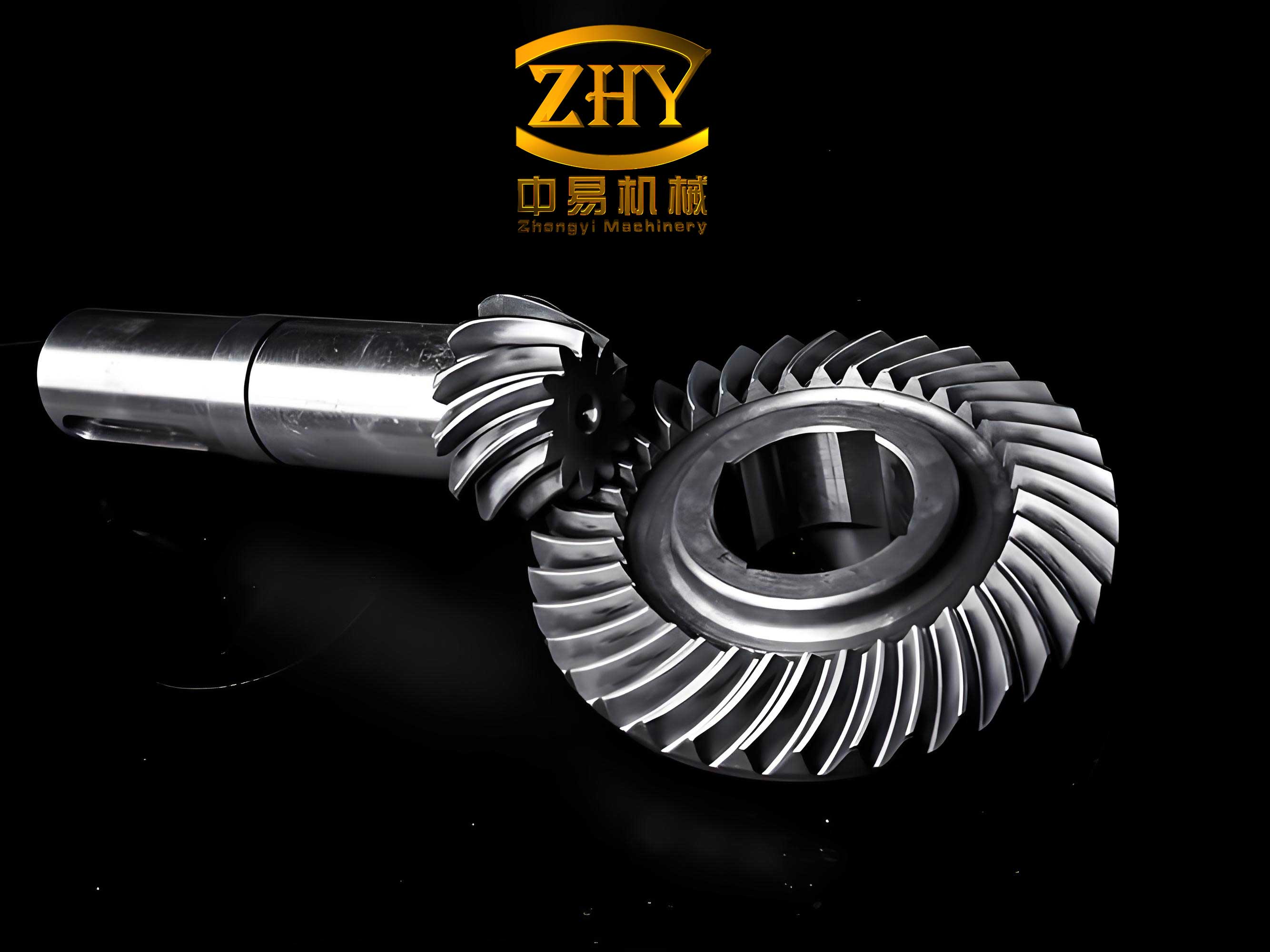
The rolling process combines hot and cold forming to balance large deformation and dimensional accuracy. Spiral bevel gears typically have large modules, requiring substantial plastic deformation. Cold working has limited deformation capacity and needs multiple annealing steps, increasing costs, while hot working introduces oxidation and thermal shrinkage, affecting surface finish and precision. Therefore, a hybrid hot-cold process is adopted: heating to 900°C, rolling, trimming, shot blasting, annealing, phosphating, cold rolling for precision, and final machining. This sequence ensures full tooth profile filling and high-quality spiral bevel gears. Based on the gear part drawing, the forged component is designed with additional height for cold finishing allowance. The volume of the hot-rolled part is calculated using the principle of constant volume, considering burn loss during heating. The preform dimensions are derived from this, as summarized in Table 1.
| Parameter | Value | Description |
|---|---|---|
| Gear Outer Diameter | 246 mm | Final part dimension |
| Forged Height | 54 mm | Includes cold rolling allowance |
| Preform Outer Diameter | 245.2–245.7 mm | 0.3–0.8 mm smaller than die cavity |
| Preform Inner Diameter | Based on gear bore + 0.3–0.8 mm | Larger than die core for positioning |
| Material | Gear Steel | Common alloy for spiral bevel gears |
The volume calculation for the preform follows the formula: $$ V_{\text{preform}} = V_{\text{forged}} \times (1 + \beta) $$ where \( V_{\text{forged}} \) is the volume of the forged spiral bevel gear, and \( \beta \) is the burn loss rate (typically 2–5%). For cylindrical preforms, the height \( H \) is determined by: $$ H = \frac{V_{\text{preform}}}{\pi (R_o^2 – R_i^2)} $$ with \( R_o \) and \( R_i \) as outer and inner radii. This ensures proper filling during rolling for spiral bevel gears. The preform is usually produced via ring rolling, offering good dimensional control. The design focuses on facilitating positioning in the die, with clearances of 0.3–0.8 mm to prevent jamming while ensuring precise alignment.
Moving to die structure, the rolling die is critical for forming accurate spiral bevel gears. It consists of a concave die (female die) that interacts directly with the workpiece. To simplify manufacturing and enhance durability, I designed a combined concave die with three components: core, cavity, and outer ring. This allows for easier electrical discharge machining (EDM) of the tooth profile and enables replacement of worn parts. The cavity features the spiral bevel gear tooth form, machined using a copper electrode. The outer ring is a hollow truncated cone that fits into a pressure ring flange for fixation, with keyways to prevent rotation. The core has a square lower section to engage with a base plate, providing anti-rotation and ejection guidance. The overall die assembly, shown in Figure 5 of the original, incorporates a prestressed combined die to counteract tangential tensile stresses during rolling, extending die life. The rolling force for spiral bevel gears is significantly lower than in forging; for the 246 mm gear, it’s approximately 2000 kN, as calculated from empirical data. The force estimation can be expressed as: $$ F_{\text{rolling}} = k \cdot \sigma_y \cdot A \cdot \mu $$ where \( k \) is a factor (0.2–0.5 for rolling), \( \sigma_y \) is the material’s yield stress at temperature, \( A \) is the contact area, and \( \mu \) is the friction coefficient. This reduction in force highlights the efficiency of rolling for spiral bevel gears.
The die’s operational features include a near-closed forming cavity between the conical rollers and the concave die, minimizing flash and ensuring complete tooth filling—similar to closed-die forging. After rolling, the upper rollers retract, and the forged spiral bevel gear is ejected via a bottom push rod. The base plate and pressure ring are secured with screws and keys to prevent torsion. Table 2 summarizes the die components and their functions, emphasizing the design’s robustness for spiral bevel gears.
| Component | Material | Function |
|---|---|---|
| Core | Tool Steel | Forms inner diameter of spiral bevel gears |
| Cavity | Hardened Steel | Contains tooth profile for spiral bevel gears |
| Outer Ring | Alloy Steel | Provides prestress and fixation |
| Conical Rollers | High-Speed Steel | Apply symmetric rolling force on spiral bevel gears |
| Base Plate | Structural Steel | Supports and aligns die assembly |
To validate the process, I conducted experiments on a 4000 kN twin-cone roller rolling machine. The material was gear steel, heated to 900°C, and rolled into spiral bevel gear preforms. The rolling force was monitored via a pressure gauge, reading around 2000 kN during stable deformation—consistent with theoretical predictions. The forged spiral bevel gears exhibited full tooth profiles with minimal defects, as shown in Figure 6b of the original. The dimensional accuracy met requirements, confirming the viability of the rolling process for spiral bevel gears. Further analysis of strain distribution can be modeled using finite element methods (FEM), with the effective strain \( \bar{\epsilon} \) given by: $$ \bar{\epsilon} = \sqrt{\frac{2}{3} \epsilon_{ij} \epsilon_{ij}} $$ where \( \epsilon_{ij} \) are the strain tensor components. This helps optimize preform design for spiral bevel gears.
The advantages of twin-cone roller rolling for spiral bevel gears are manifold. It reduces equipment size and investment, as evidenced by the 2000 kN force versus higher forging loads. The die design simplifies EDM加工 and replacement, lowering maintenance costs. Moreover, the process enhances material properties due to grain flow alignment, improving fatigue resistance in spiral bevel gears. Compared to cutting, rolling increases production efficiency by 30–50% and material utilization by 20–30%, based on industry data. Future work could explore cold rolling parameters for finish accuracy, with the relationship between reduction ratio \( r \) and springback \( \delta \) expressed as: $$ \delta = \alpha \cdot r^2 $$ where \( \alpha \) is a material constant. This ensures precise final dimensions for spiral bevel gears.
In conclusion, the twin-cone roller rolling process and die design presented here offer a practical solution for manufacturing spiral bevel gears. The combination of hot rolling and cold finishing achieves high precision and strength, while the symmetric rolling mechanism minimizes force and noise. Experimental results confirm the production of qualified spiral bevel gear forgings, validating the工艺’s feasibility. This approach is particularly beneficial for large-diameter spiral bevel gears in automotive and aerospace applications, where performance and cost are critical. By adopting this method, manufacturers can overcome the limitations of traditional cutting and forging, paving the way for more efficient production of spiral bevel gears. Further refinements in die life and process control will continue to enhance the technology for spiral bevel gears.
To summarize key formulas and data, I provide Table 3, which encapsulates the rolling parameters for spiral bevel gears. This aids in practical implementation and highlights the process’s efficiency.
| Aspect | Equation/Value | Notes for Spiral Bevel Gears |
|---|---|---|
| Volume Consistency | $$ V_{\text{preform}} = V_{\text{final}} / (1 – \beta) $$ | Ensures material adequacy |
| Rolling Force | $$ F \approx 0.3 \cdot \sigma_y \cdot \pi D t $$ | D: diameter, t: thickness |
| Deformation Energy | $$ W = \int F \, dx $$ | Integral over rolling stroke |
| Tooth Fill Factor | $$ \eta = A_{\text{tooth}} / A_{\text{cavity}} $$ | Aim for >95% for spiral bevel gears |
| Temperature Loss | $$ \Delta T = h \cdot t_{\text{process}} $$ | h: heat transfer coefficient |
Throughout this discussion, the term spiral bevel gears has been emphasized to underscore the focus on this specific component. The rolling process not only addresses production challenges but also aligns with sustainable manufacturing goals by reducing waste and energy consumption. As industries demand higher-performance spiral bevel gears, innovations like twin-cone roller rolling will play a pivotal role in meeting these needs. I encourage further research into advanced materials and real-time monitoring to optimize the process for diverse applications of spiral bevel gears.