
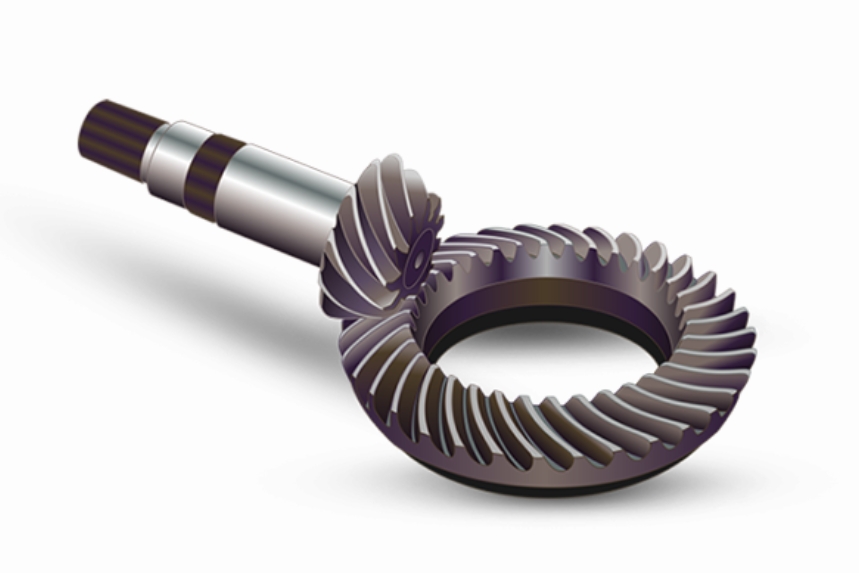
In my extensive work with power transmission systems, I have consistently observed that spiral bevel gears are critical components in many automotive and industrial applications, such as differentials and heavy machinery. These spiral bevel gears are prized for their ability to transmit power between intersecting shafts smoothly and efficiently. However, a persistent failure mode that plagues spiral bevel gears is tooth surface gluing, also known as scuffing or adhesive wear. This phenomenon severely limits the load-carrying capacity and reliability of spiral bevel gear drives. Through both experimental evidence and theoretical analysis, I have identified that the relative axial misalignment between the pinion and gear under load is a primary contributor to this gluing failure. Essentially, as the load increases, the supporting rolling element bearings undergo elastic axial deformation, causing the spiral bevel gears to displace axially relative to each other. This misalignment alters the contact pattern and increases the flash temperature at the tooth interface, dramatically raising the risk of gluing. Therefore, in my research, I have focused on developing a methodology to minimize this relative axial displacement by optimizing the match of axial forces acting on the spiral bevel gear pair. This approach directly enhances the anti-gluing capability of spiral bevel gears.
The core of the problem lies in the elastic behavior of the tapered roller bearings typically used to support spiral bevel gears. When subjected to axial loads, these bearings exhibit an axial displacement, which in turn causes the connected spiral bevel gear to shift axially. The magnitude of this displacement for a single tapered roller bearing can be calculated using an empirical formula derived from bearing mechanics. For spiral bevel gear applications, this formula is crucial:
$$l_a = 0.000077 \frac{F_a^{0.9}}{Z^{0.9} l_e^{0.8} \sin^{1.9}\alpha_A} \text{ mm}$$
where \( l_a \) is the axial displacement in millimeters, \( F_a \) is the axial force on the bearing in Newtons, \( Z \) is the number of rolling elements, \( l_e \) is the effective length of the roller in millimeters, and \( \alpha_A \) is the actual contact angle of the bearing in degrees. This equation shows that the displacement is highly sensitive to the axial force \( F_a \). Consequently, for a pair of spiral bevel gears, the relative axial misalignment \( \Delta l_a \) that critically affects gluing is the difference between the axial displacements of the pinion and the gear:
$$ \Delta l_a = | l_{a1} \pm l_{a2} | $$
The sign depends on whether the axial displacements of the pinion and gear are in opposite directions (plus) or the same direction (minus). My goal is to minimize \( \Delta l_a \) through design optimization, thereby improving the performance of spiral bevel gears.
To achieve this, a detailed analysis of the forces acting on the spiral bevel gear system is essential. The axial force \( K_a \) and radial force \( F_r \) on the spiral bevel gears arise from the transmitted torque and depend on gear geometry. For a spiral bevel gear pair, these forces are computed at the mean point of the tooth face width. The mean tangential force \( F_{tm} \) is foundational:
$$ F_{tm} = \frac{2 T_2}{d_{m2}} $$
Here, \( T_2 \) is the torque on the driven gear (often taken as the maximum engine torque or average service torque in Newton-millimeters), and \( d_{m2} \) is the mean pitch diameter of the driven gear. The geometry of spiral bevel gears involves several parameters: the number of teeth on the pinion \( z_1 \) and gear \( z_2 \), the mean spiral angle \( \beta_m \), the normal pressure angle \( \alpha \), the pitch angles \( \delta_1 \) and \( \delta_2 \), and the face width \( b \). Relations such as \( \delta_1 = \arctan(z_1 / z_2) \) and \( \delta_2 = 90^\circ – \delta_1 \) are used. The axial and radial forces for the pinion and gear vary based on the hand of spiral and direction of rotation. I have compiled these calculations into tables for clarity, which are vital for understanding the loading on spiral bevel gears.
| Gear | Hand of Spiral | Rotation Direction | Axial Force \( K_a \) Formula |
|---|---|---|---|
| Pinion | Right | Clockwise | $$ K_{a1} = \frac{F_{tm}}{\cos\beta_m} (\tan\alpha \sin\delta_1 – \sin\beta_m \cos\delta_1) $$ |
| Gear | Left | Counter-Clockwise | $$ K_{a2} = \frac{F_{tm}}{\cos\beta_m} (\tan\alpha \sin\delta_2 + \sin\beta_m \cos\delta_2) $$ |
| Pinion* | Right | Counter-Clockwise | $$ K_{a1} = \frac{F_{tm}}{\cos\beta_m} (\tan\alpha \sin\delta_1 + \sin\beta_m \cos\delta_1) $$ |
| Gear* | Left | Clockwise | $$ K_{a2} = \frac{F_{tm}}{\cos\beta_m} (\tan\alpha \sin\delta_2 – \sin\beta_m \cos\delta_2) $$ |
*For reverse rotation conditions. A positive \( K_a \) value indicates force direction away from the cone apex; negative indicates toward the apex.
| Gear | Hand of Spiral | Rotation Direction | Radial Force \( F_r \) Formula |
|---|---|---|---|
| Pinion | Right | Clockwise | $$ F_{r1} = \frac{F_{tm}}{\cos\beta_m} (\tan\alpha \cos\delta_1 + \sin\beta_m \sin\delta_1) $$ |
| Gear | Left | Counter-Clockwise | $$ F_{r2} = \frac{F_{tm}}{\cos\beta_m} (\tan\alpha \cos\delta_2 – \sin\beta_m \sin\delta_2) $$ |
| Pinion* | Right | Counter-Clockwise | $$ F_{r1} = \frac{F_{tm}}{\cos\beta_m} (\tan\alpha \cos\delta_1 – \sin\beta_m \sin\delta_1) $$ |
| Gear* | Left | Clockwise | $$ F_{r2} = \frac{F_{tm}}{\cos\beta_m} (\tan\alpha \cos\delta_2 + \sin\beta_m \sin\delta_2) $$ |
*For reverse rotation. Positive \( F_r \) tends to separate the gears; negative tends to draw them together.
These forces, along with the tangential force, induce reaction forces on the supporting bearings. The common mounting configurations for spiral bevel gears in applications like vehicle axles are the overhung (straddle) and straddle-mounted (riding) arrangements. The bearing reactions are calculated considering static equilibrium. For each bearing location (labeled A, B for the pinion shaft and C, D for the gear shaft), the radial force components due to \( F_{tm} \), \( F_r \), and \( K_a \) are summed vectorially to find the total radial load \( R \) on each bearing. The axial load \( F_a \) on the critical bearing—the one that governs the axial displacement of the spiral bevel gear—is determined by considering the gear axial force \( K_a \) and the induced internal axial forces (S-forces) in the tapered roller bearings. The S-force for a tapered roller bearing is approximated as:
$$ S \approx 1.3 \tan\alpha_A \cdot R $$
The net axial force \( F_a \) on the bearing that dictates gear movement depends on the relative magnitudes of \( K_a \) and the S-forces, and the bearing arrangement (face-to-face or back-to-back). Detailed logic, as explored in my analysis, is required to determine \( F_a \) correctly for each configuration. This step is critical because it directly feeds into the axial displacement formula for spiral bevel gears.
With the forces established, I formulated an optimization problem to find the best combination of design parameters that minimizes the relative axial displacement \( \Delta l_a \) of the spiral bevel gear pair. This is the essence of optimal axial force matching. The optimization model is a nonlinear programming problem with multiple design variables and constraints.
The objective function is straightforward: minimize the relative axial displacement. For spiral bevel gears, this is:
$$ \min F(\mathbf{x}) = | l_{a1} \pm l_{a2} | $$
where \( l_{a1} \) and \( l_{a2} \) are calculated using the bearing displacement formula for the pinion and gear supports, respectively, which in turn depend on the design variables.
The design variables \( \mathbf{x} \) are key parameters that influence the force system and stiffness of the spiral bevel gear assembly. I selected eight primary variables:
$$ \mathbf{x} = [\beta_m, b, m_{et}, z_1, l_1, l_2, l_3, l_4]^T = [x_1, x_2, x_3, x_4, x_5, x_6, x_7, x_8]^T $$
where \( \beta_m \) is the mean spiral angle, \( b \) is the face width, \( m_{et} \) is the transverse module (often treated as the gear module), \( z_1 \) is the pinion tooth number, and \( l_1, l_2, l_3, l_4 \) are the bearing span distances for the pinion and gear shafts, defining the overhung distances and support widths. These variables directly affect gear geometry, load distribution, and bearing reactions, hence impacting the axial forces and displacements in spiral bevel gears.
The optimization is subject to a set of constraints to ensure practical, manufacturable, and strong spiral bevel gears. These constraints fall into two categories: geometric design limits and gear strength requirements.
Geometric Design Constraints:
- Tooth Number: For proper meshing and avoidance of undercutting in spiral bevel gears: \( 6 \leq z_1 \leq 16 \) and \( z_1 + z_2 \geq 35 \).
- Module: To ensure sufficient bending strength: \( m_{et} \geq 6 \) mm.
- Face Width: A reasonable face width for spiral bevel gears: \( 4m_{et} \leq b \leq 10m_{et} \) and also \( b \leq \frac{1}{3} R_e \), where \( R_e = \frac{d_1}{2\sin\delta_1} \) is the outer cone distance.
- Spiral Angle: Optimal range for smooth operation and force components: \( 30^\circ \leq \beta_m \leq 40^\circ \).
- Bearing Spans: Practical limits based on housing design: \( [l_i]_{L} \leq l_i \leq [l_i]_{U} \) for \( i=1,2,3,4 \).
Gear Strength Constraints: Spiral bevel gears must satisfy bending and contact (pitting) strength criteria to prevent tooth breakage and surface fatigue. The bending stress \( \sigma_F \) and contact stress \( \sigma_H \) must not exceed their respective permissible limits \( \sigma_{FP} \) and \( \sigma_{HP} \). The formulas, based on AGMA or similar standards, are:
Bending stress for pinion and gear:
$$ \sigma_{F1} = \frac{2 T_1 K_0 K_s K_m}{K_v z_1 b m_{et}^2 J_1} \leq \sigma_{FP} $$
$$ \sigma_{F2} = \frac{2 T_2 K_0 K_s K_m}{K_v z_2 b m_{et}^2 J_2} \leq \sigma_{FP} $$
Contact stress:
$$ \sigma_H = C_p \frac{1}{d_1} \sqrt{\frac{2 T_1 K_0 K_s K_m K_f}{K_v b I}} \leq \sigma_{HP} $$
Here, \( T_1 \) is the pinion torque, \( K_0 \) is the overload factor, \( K_s \) is the size factor, \( K_m \) is the load distribution factor, \( K_v \) is the dynamic factor, \( K_f \) is the surface condition factor, \( J_1, J_2 \) are the geometry factors for bending strength, \( I \) is the geometry factor for contact stress, and \( C_p \) is the elastic coefficient. These factors are determined from gear design standards and depend on the specific geometry and operating conditions of the spiral bevel gears.
The complete optimization model for spiral bevel gears is therefore:
$$
\begin{aligned}
& \min_{\mathbf{x}} F(\mathbf{x}) = | l_{a1} \pm l_{a2} | \\
& \text{subject to:} \\
& g_u(\mathbf{x}) \geq 0, \quad u = 1,2,\ldots,20 \\
& a_j \leq x_j \leq b_j, \quad j = 1,2,\ldots,8
\end{aligned}
$$
The constraints \( g_u(\mathbf{x}) \) encapsulate all the inequality constraints from geometry and strength, totaling around 20 constraints as outlined. This is a constrained nonlinear optimization problem suitable for numerical methods.
To demonstrate the effectiveness of this approach for spiral bevel gears, I applied it to a practical case: a two-stage automotive rear axle differential where the first stage is a spiral bevel gear set. The known data includes an average transmitted torque \( T_2 = 1260 \times 10^3 \) Nmm, a gear ratio \( i = 25/11 \), and specific tapered roller bearings (7610E for the pinion shaft, and 7611E and 7610E for the gear shaft). The mounting is overhung for the pinion (back-to-back bearing arrangement) and straddle for the gear (face-to-face arrangement). The initial design parameters were within typical ranges for such spiral bevel gears.
I employed the complex search method (a direct search optimization algorithm) to solve this problem. The design variables were allowed to vary within their bounds, and the objective function \( \Delta l_a \) was evaluated repeatedly, considering all force calculations and constraints. After obtaining a continuous optimal solution, practical discretization was applied: the tooth number \( z_1 \) and face width \( b \) were rounded to integer and standard values, and a final optimization run was performed with these fixed. The results are summarized in the table below.
| Design Variable / Objective | Original Design | Continuous Optimal Solution | Optimized Design (Rounded) |
|---|---|---|---|
| Mean Spiral Angle \( \beta_m \) (°) | 35 | 30.03156 | 30.29320 |
| Face Width \( b \) (mm) | 41 | 42.48032 | 42.5 |
| Transverse Module \( m_{et} \) (mm) | 9 | 10.22040 | 10.57756 |
| Pinion Teeth \( z_1 \) | 11 | 10.53557 | 11 |
| Pinion Span \( l_1 \) (mm) | 110 | 109.24230 | 106.71670 |
| Pinion Overhang \( l_2 \) (mm) | 50 | 46.42487 | 45.73646 |
| Gear Span \( l_3 \) (mm) | 60 | 56.26423 | 56.03885 |
| Gear Overhang \( l_4 \) (mm) | 150 | 143.57770 | 145.71470 |
| Relative Axial Displacement \( \Delta l_a \) (μm) | 18.5 | 7.14 | 6.81 |
The results are striking. The optimized design for the spiral bevel gear pair achieves a relative axial displacement \( \Delta l_a \) of only about 6.8 micrometers, compared to 18.5 micrometers in the original design. This represents a reduction of over 60%. Such a significant decrease in axial misalignment directly translates to lower contact temperatures and a substantially reduced risk of gluing for the spiral bevel gears. The optimization process adjusted key parameters: it reduced the spiral angle, increased the module and face width slightly, and fine-tuned the bearing spans. These changes collectively alter the axial force balance on the bearings, leading to a better match where the axial displacements of the pinion and gear nearly cancel each other or are individually minimized.
The implications of this work for the design of spiral bevel gears are profound. By systematically optimizing for axial force matching, engineers can proactively address one of the most detrimental failure modes in spiral bevel gear drives. This methodology moves beyond traditional design practices that often focus solely on static strength ratings. It integrates system-level considerations—bearing compliance, housing stiffness, and gear geometry—into the design process for spiral bevel gears. The approach is particularly valuable for high-power, high-torque applications where spiral bevel gears are pushed to their limits, such in heavy-duty trucks, construction equipment, and industrial gearboxes. Implementing this optimization early in the design phase can lead to spiral bevel gear sets that are more compact, more efficient, and far more reliable over their service life.
In conclusion, my investigation confirms that controlling relative axial misalignment through optimal axial force matching is a highly effective strategy to enhance the anti-gluing capability of spiral bevel gears. The developed optimization model, incorporating detailed force analysis and practical constraints, provides a robust framework for designing spiral bevel gear transmissions with minimized risk of adhesive wear. Future work could extend this model to include dynamic effects, thermal expansion, and more advanced bearing models to further refine the performance predictions for spiral bevel gears. Nonetheless, the core principle stands: a holistic approach to force management is key to unlocking the full potential of spiral bevel gears in demanding mechanical systems.